
This was a short week because of the National Day long weekend giving us an extra day away from the usual routine. Somehow, though, nobody seems to have informed the rest of the week that it was supposed to be shorter. If anything, it felt as though five days of activity had been determinedly squeezed into four. Work was particularly hectic, with deadlines, meetings, revisions, decisions, and the inevitable last-minute changes competing for attention. There were moments when something that appeared finished suddenly needed another round of thought, and plans continued to evolve as new information came in. Yet beneath all that activity, there was progress. Things that had existed as ideas and conversations are becoming increasingly tangible, and the months ahead are beginning to take clearer shape.
Outside work, life continued with its familiar collection of small decisions and everyday preoccupations. There was planning for the future, thinking about finances and upcoming travels, making practical choices for home and life, and finding time for creative interests amidst everything else. Family life, too, continues to shift as everyone settles into their own routines and new chapters. Perhaps what struck me most this week was how many different versions of life can exist simultaneously. We can be busy and grateful, tired and excited, uncertain about some things while feeling completely sure about others. Not every week needs a single defining emotion. So, despite being a short week, this one somehow managed to feel very full. And as I head into the weekend, I’m quite happy to exchange momentum for a little stillness. Sometimes the best way to prepare for everything waiting ahead is simply to stop for a while.
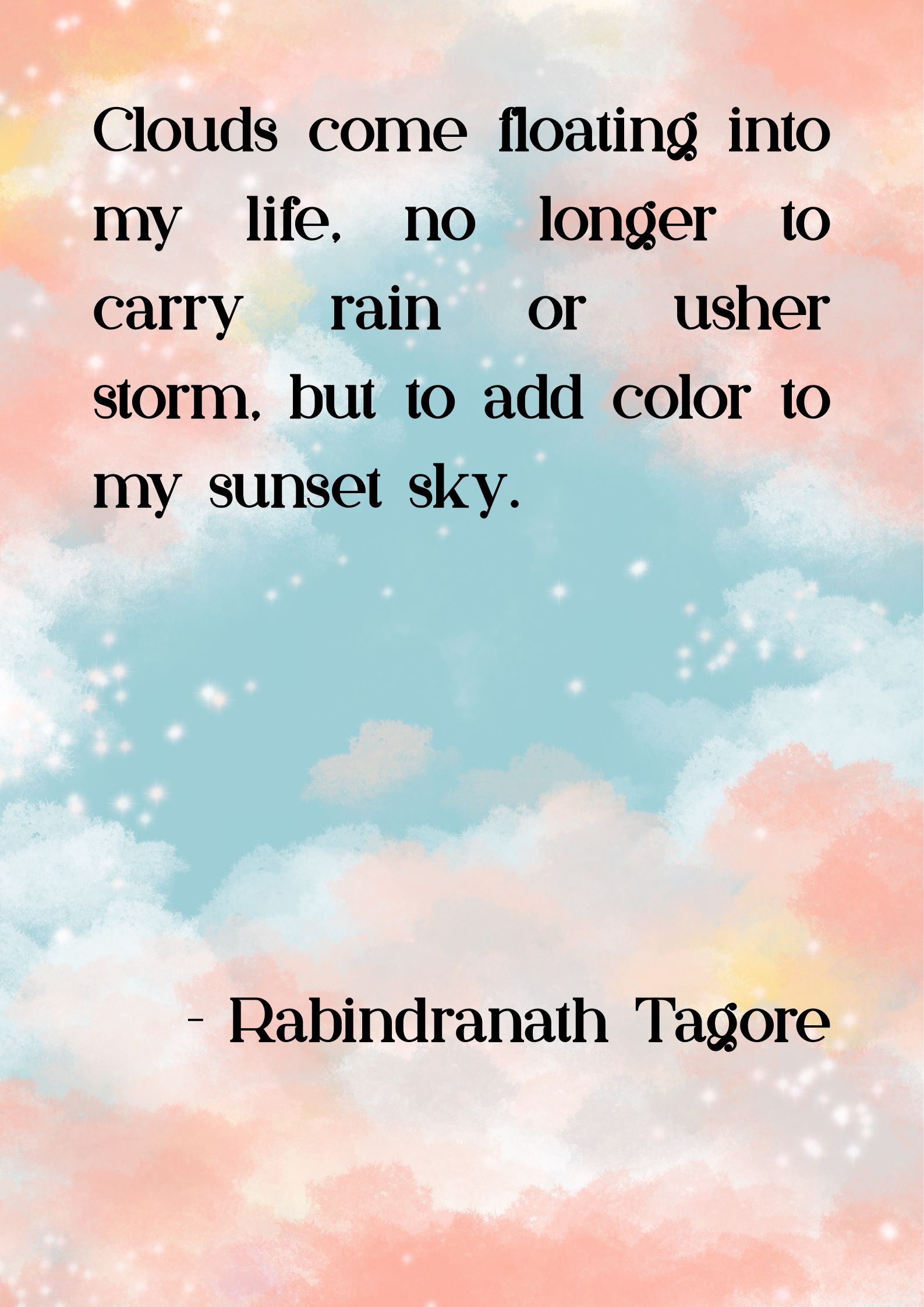
This week’s quote is from Rabindranath Tagore, a Bengali poet, writer, composer, philosopher, and artist whose work profoundly influenced Indian literature and culture. In 1913, he became the first non-European to receive the Nobel Prize in Literature, largely for his poetry collection Gitanjali. He also wrote the words that became the national anthems of both India and Bangladesh. Clouds are usually associated with approaching storms, darkness, and uncertainty. In Tagore’s imagery, however, they no longer represent something to fear. Instead, the same clouds become part of a beautiful sunset. Nothing about the clouds themselves has necessarily changed; what has changed is the way they are perceived.
Life often works this way. Experiences that once seemed painful, disappointing, or disruptive can acquire a different meaning when viewed from a distance. A failure may eventually redirect us towards something better. A difficult period may reveal strengths we didn’t know we possessed. Even loss, while never becoming something we would have chosen, can deepen our appreciation for what remains. The reference to the “sunset sky” also carries a sense of maturity. As we accumulate experiences, perhaps we become less frightened by every approaching cloud. We learn that storms pass, circumstances change, and difficult moments are only one part of a much larger landscape. Some of the experiences that complicated our lives may even add depth, wisdom, and richness to the people we eventually become.Tagore’s words therefore aren’t about pretending hardship is beautiful. They are about perspective. We may not be able to choose every cloud that enters our lives, but with time, healing, and understanding, we may discover that even some of our darker experiences have added unexpected colours to our story.

This week, in verse 18.58, the Bhagavad Gita tells us that every life contains obstacles. Some are external: difficult circumstances, losses, disappointments, and unexpected changes. Others are internal: fear, anxiety, pride, and self-doubt. Krishna’s message is not that obstacles will disappear. Rather, it is that we need not face them alone. Whether we understand this verse in a spiritual sense or as a reminder to trust something larger than ourselves, the lesson remains powerful. Strength often comes from recognising that we do not carry every burden by ourselves. When we stop trying to control everything, we create space for wisdom, support, and grace to enter. Inner courage is not the absence of vulnerability. It is the willingness to move forward despite it.

This week I learned that authenticity is the key to living a life of freedom. When you let yourself be guided by your own inner truth instead of trying to fit expectations, life feels more fulfilling. You no longer feel pressured to maintain a curated version of your life or chase external narratives. The energy you once spent seeking approval can be redirected toward designing a life that makes you feel fully alive. The right opportunities and connections flow naturally to you when you choose yourself and stay grounded in who you are.
That’s all from me this week. Take care and remain positive because life is authentic!

