Today is Aadi Perukku or Aadi 18, a little-known festival celebrated in the state of Tamil Nadu. Also known as Aadi 18, Aadi Perukku is the monsoon festival celebrated in the month Aadi monsoon festival and celebrated on the 18th day of the Tamil month of Adi, which should be sometime between mid-July to mid-August. The festival pays tribute to water’s life-sustaining properties. Nature worship in the form of Amman deities is organised to shower Nature’s bountiful grace on human beings and to bless mankind with peace, prosperity and happiness.
Aadi is a month of fervour and observances dedicated to the Goddesses related to water and other natural forces where prayers and pujas are offered to propitiate the powerful goddess to seek their protection from the inauspicious aspects that are often associated with the month. No weddings or other similar functions are celebrated during this month. It is during this time that the monsoon peaks on the west coast and the rivers of Tamil Nadu, shrunken in the summer heat, get replenished, often to near full levels. The month of Aadi is the fourth month of the year with the first day of the month, usually falling on 16 July, celebrated as Aadi Pandigai or Aadi Perukku, and an important festival to most Tamils, especially newly-weds.
In India the rivers Ganga and Yamuna, Cauvery, Narmada and Godavari are considered sacred. Just like the earth gives us food, water is considered a sacred necessity to meet the needs of individuals. People began to worship water in the form of wells, tanks and rivers. It is common among people to throw fruits, flowers and saffron cloths when the rivers and lakes are in spate purely based on the belief that these rivers are the species of female deities. Similarly, every temple has sacred wells and tanks, and the water in these resources is considered pure.
Aadi Perukku is a unique South Indian and especially a Tamil festival celebrated on the 18th day of the Tamil month of Adi. The festival coincides with the annual freshness of rivers and pays tribute to water’s life-sustaining properties. It is celebrated near river basins, water tanks, lakes and wells of Tamil Nadu when the water level rises significantly heralding the onset of the monsoon.
Aadi Perukku, also called Padinettam Perukku where Padinettu signifies eighteen, and Perukku denotes rising is a unique occasion dedicated to all the perennial river basins of Tamil Nadu and major lakes water source areas and is intended to celebrate the water rising levels due to the onset of monsoon, which is expected to occur invariably on the 18th day of the solar month, Aadi which corresponds to the 2 or 3 August every year. This festival is observed predominately by women in Tamil Nadu as a water ritual, to honour nature.
The association of this ritual with fertility, sex and reproduction is both natural and human. This water ritual practice is performed on the banks of Rivers, which is described as a rice-cultivation tract. The history of this ritual practice dates back to the ancient period and was patronised by the Kings and royal households. Aadi is the month for sowing, rooting and planting of seeds and vegetation since it is peak monsoon time when rain is showered in abundance.
Apart from people flocking to waterfalls for pre-monsoon and monsoon festivals, people living on the banks of rivers and other water sources offer pujas to the water goddess and river gods so that when nurseries are raised in the fields subsequently and sustained by the northeast monsoon, the crops will be ready for harvest during the Thai Pongal celebration in 5 months in mid-January.
The most visible manifestations of the month of Aadi are the huge kolams or rangolis that are painstakingly patterned early each morning in front of houses. They are usually bordered with red and across the front doorway at the top are strung mango leaves. The first of the month is marked with a special puja, followed by a feast with payasam prepared with coconut milk, boli and vadai.
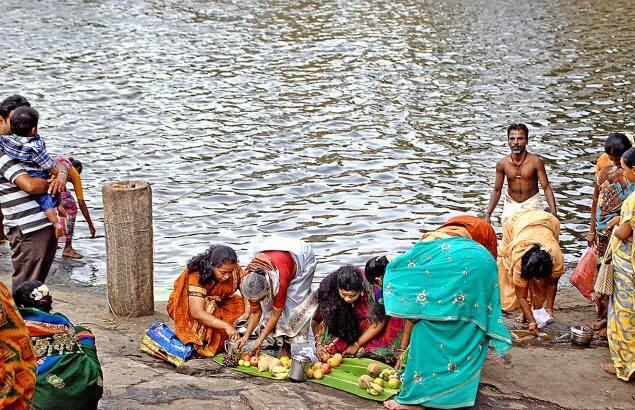
Aadi Perukku is a day of offerings and prayers to these rivers, which mean so much to the lives and prosperity of the people. The day is an occasion for rejoicing particularly for those living on the banks of all the main rivers, their branches and tributaries. The festival of Aadi Perukku is mainly observed by families living on the banks of the Cauvery River. On this auspicious day, relatives and friends collectively pray for the intermittent supply of water that would ultimately result in a good harvest. The devotees take a dip in the holy water. After the bath, they wear new clothes and perform some rituals at the bathing ghats along the Cauvery River. This is followed by abhishekham or the bathing of the Goddess Kaveri or Kaveri Amman.
A special lamp is prepared using jaggery and rice flour. The lamp is placed on the mango leaves, to which a yellow thread, turmeric and flowers are also added. The lamp is lit by the women and together with its accompaniments is floated in the river. Different forms of rice dishes are prepared and offered to the Goddess. Some of the commonly prepared rice dishes that vary in ingredients, colours or flavours include coconut rice, sweet Pongal, curd rice, lemon rice and tamarind rice. The devotees also worship the sacred river Mother Cauvery with rice offerings, Akshata and flowers. After completing the puja, the devotees eat the feast along the banks of the river with their families. The entire event turns out to be like a picnic on the banks of the Cauvery River.
Young girls observe this auspicious puja together with married women. It is a popular belief that maiden girls who make the offerings of Kaapparisi, a sweet dish made from jaggery and hand-crushed rice, Karugamani which are black coloured beads and Kaadholai which are earrings carved out of palm leaves shall be rewarded with good husbands. Young women play and dance to the tunes of folk songs on the occasion of Aadi Perukku. In some Tamil communities, the sons-in-law are invited on the day of Aadi Perukku and gifted new clothes. There is also a ritual in some districts of Tamil Nadu, wherein the newlyweds spend a month before Aadi Perukku at their parents’ home. Then on the day of Aadi Perukku, a gold coin is added to their Thali or Mangalsutra and they return with their husbands.
Mulaipari or the sprouting or germination of nine grains or navadhanyam in baskets or clay mud pots is a very important ritual which takes place at almost every village Goddess celebration. In its most original form, it is an exclusively women’s ritual and is of great importance to the whole village. The participants of the processions carry earthen pots with grown grains from nine different types of grains inside on their heads and walk towards a river where the contents are dissolved. Before the procession starts, special songs and dances like Kummi Pattu and Kummi are performed. The original meaning of the ritual performance is a request to the village Goddess for rain and the fertility of the land, to secure a rich harvest. The women are involved in large groups significantly implying the fertility of women also ensures the continuity of the human race with peace and harmony through empowered women.
All the year’s major festivals are packed into the six months that follow, culminating with Thai Pongal in mid- January, giving meaning to the Tamil saying, Aadi Azhaikkum, Thai Thudaikkum which means




 Memories and Such