Mata Vaishno Devi Temple, Katra, Jammu & Kashmir
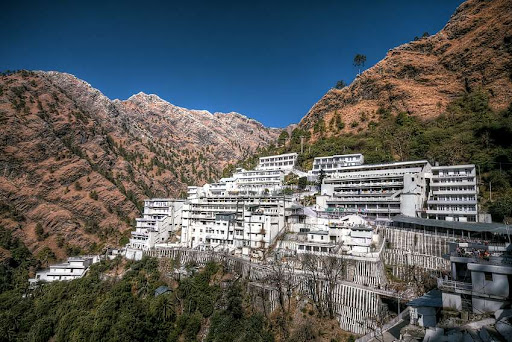
Also known as the Shri Mata Vaishno Devi Temple and Vaishno Devi Bhavan, the Vaishno Devi Temple is located in Katra, in Jammu and Kashmir. The temple is dedicated to Vaishno Devi, a manifestation of Mahakali, Mahalakshmi, and Mahasarasvati on the Trikuta mountain at 5,000 feet above sea level.
Mata Vaishno Devi Temple’s origins predate recorded history. While the exact date of its establishment remains uncertain, legends trace its roots to ancient times. A geological study of the Holy Cave has indicated its age to be nearly a million years. There is also a mention of the Trikuta hill in Rigveda. Some accounts suggest that the Pandavas were among the first to visit the Holy Cave and pay homage to Mata Vaishno Devi during their exile, linking the shrine to the epic Mahabharata. The discovery of the shrine in its current form is attributed to Pandit Shridhar, about 700 years ago. According to legend, Mata Vaishnavi appeared in Shridhar’s vision, guiding him to the Holy Cave amidst the Trikuta Mountains. Upon entering the cave, he found a rock formation with three heads atop it, which Mata Vaishno Devi revealed as her manifestation.
While there are differing beliefs about its exact status as a Shakti Peetha, some traditions consider it one of the holiest Shaktipeeths. One belief suggests that the goddess’s skull fell at this location, while another states that her right arm fell in this region. The bhairava associated with the Mata Vaishno Devi Temple is Bhairo Baba.
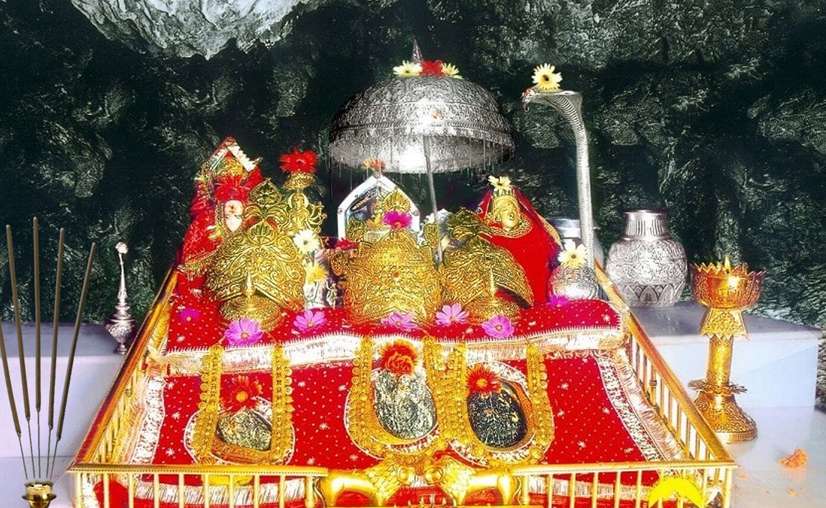
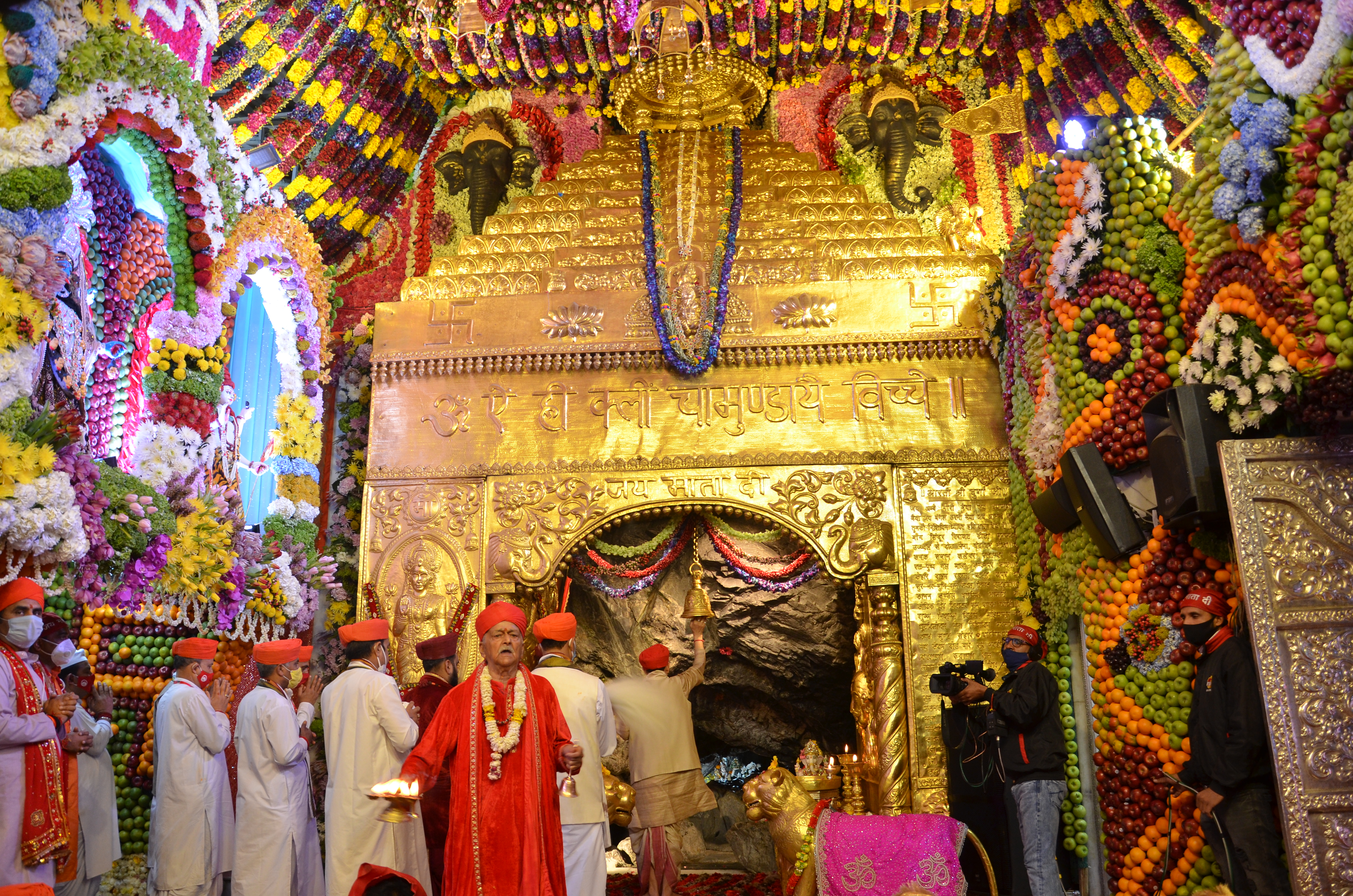
The temple is created in a cave believed to have been the abode of Mata Rani, adding to its mystical allure. In the garbha griha, the sanctum sanctorum of the temple, the image of Mata Vaishno Devi is installed in the form of three significant stone structures called Pindies. These symbolise the goddess in her three divine forms – Maha Kali, Maha Lakshmi, and Maha Saraswati. The three pindis are naturally formed from a single rock, yet they have different colors and textures, adding to the shrine’s mystique. The feet of the icons are washed by the water brought from the perennial flowing river Banganga. Remains of a stone hand called Varad Hast can be seen inside the holy cave, believed to be connected to the Shakti Peetha status. A shrine dedicated to Bhairavnath, who was defeated by Vaishno Devi and turned into a devotee, is also part of the complex. Located about halfway between Katra town and the main shrine, the Ardha Kunwari Cave is where Vaishno Devi is said to have meditated for nine months. Festivals celebrated at the temple include the nine-night Navaratri festival, Makar Sankranti and Chaitra Navratras that are observed during the spring season.
According to Hindu mythology, a goddess was born in southern India as a young girl named Vaishnavi. She was a sincere devotee of Lord Vishnu from a young age. During the events of the Ramayana, she vowed to marry Lord Rama, who, being Ekpatnivrata or devoted to one wife, could not marry her. Impressed by her devotion, he promised to marry her in his last incarnation as Kalki and asked her to meditate in the cave of the Trikuta Mountains. When Bhairon Nath, a powerful demon, ran after Vaishno Devi to catch her, she reached the cave in the hill. She called upon Hanuman and instructed him to guard the cave entrance while she meditated inside for nine months.
Mata had helped organise a Bhandara, a community feast, at Pandit Shridhar’s place. When she left amidst the Bhandara to escape Bhairon Nath, Shridhar felt immense grief. His fervent prayers led to the goddess appearing in his vision and guiding him to the holy cave. After being defeated by Vaishno Devi, Bhairon Nath turned into a devotee. It is believed that his spirit still lingers around the temple. According to some stories, Mata Rani observed the Navratra to pray for Lord Rama’s victory against Ravana. In return, Rama blessed her with immortality and ensured that the world would sing her praises.
Surrounded by the majestic Trikuta Mountain, as one stands in the temple complex,one can’t help but feel a connection to the spiritual heritage that has shaped this land for millennia. The Mata Vaishno Devi Temple, with its blend of myth, history, and living faith, continues to be a powerful force in the religious landscape of India, inviting all who visit to partake in its timeless spiritual journey.
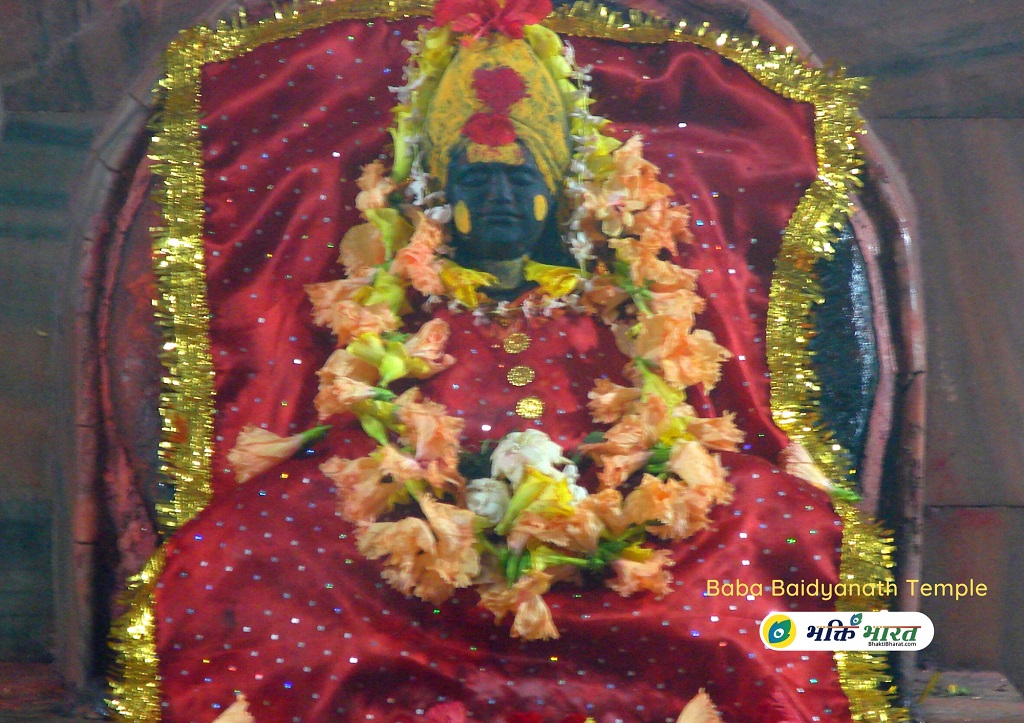
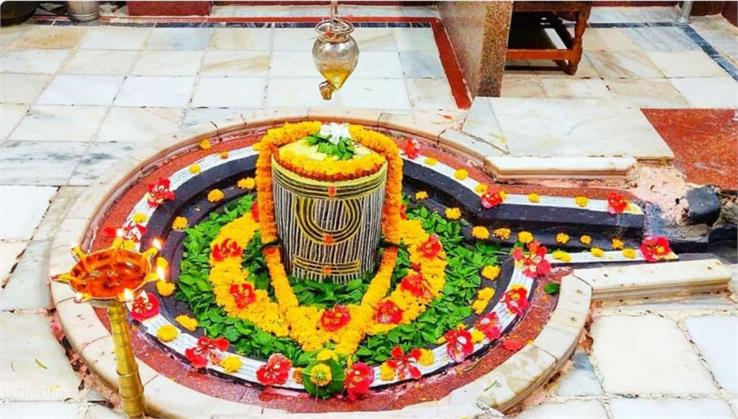
Baidyanath Dham, Deoghar, Jharkhand
Dedicated to Lord Shiva, Baidyanath Dham in Deoghar is an ancient site of devotion and spiritual significance. According to historical records, the temple was originally built by Puran Mal, an ancestor of the Nagavanshi dynasty, in the 8th century. However, the temple has undergone several renovations and expansions over the centuries, with the present structure believed to have been built by Raja Man Singh in the 16th century.
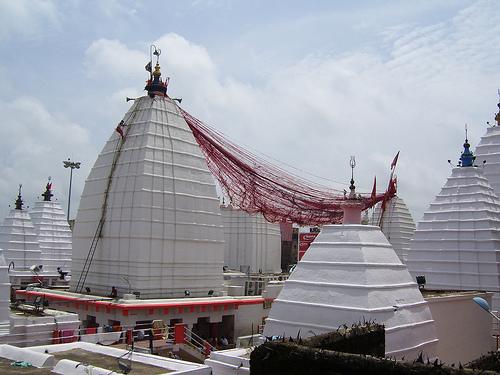
The temple complex is spread over a vast area and is characterised by its towering spire, intricate carvings, and a sacred tank known as Shrawani Mela Kund. The temple’s architecture reflects a blend of various styles, including Nagara and Dravidian, showcasing the diverse cultural influences that have shaped its design.
Baidyanath Dham holds a unique position as it is both one of the 12 Jyotirlingas and one of the 51 Shakti Peethas. As a Shakti Peetha, it is believed that Sati’s heart fell at this location, making it the Hriday Peeth, or the Heart Shrine. The Shakti Peetha here is dedicated to Jaya Durga, a manifestation of Goddess Parvati, while the bhairava associated with the temple is Baidyanath.
The sanctum houses the sacred Jyotirlinga, believed to be Swayambhu or self-manifested. The Jyotirlinga is said to have healing powers, earning Lord Shiva the epithet Baidyanath, meaning the Lord of Physicians. The temple stands 72 feet tall and resembles a blooming lotus, symbolising purity and enlightenment. Three ascending gold vessels, donated by the Maharaja of Gidhaur, crown the temple. A trident-shaped emblem representing Shiva’s power adorns the temple while the Chandrakanta Mani, an eight-petaled lotus jewel adds to the temple’s mystical beauty.
The Shravani Mela is the the most significant festival at Baidyanath Dham, held during the Hindu month of Shravan. Hundreds and thousands of pilgrims converge at the temple, creating a vibrant and spiritual atmosphere. Devotees embark on a sacred journey known as the Kanwar Yatra, walking barefoot from the nearby town of Jasidih, carrying a kanwar, a decorated pot filled with holy water from the Ganges. Maha Shivaratri, the festival dedicated to Lord Shiva is celebrated at the temple with enthusiasm.
One of the most prominent myths associated with the temple is linked to the demon king Ravana from the epic Ramayana. According to the legend, Ravana, an ardent devotee of Lord Shiva, sought to bring the powerful Jyotirlinga from Mount Kailash to Lanka. As Ravana was carrying the Linga, Lord Vishnu intervened, and during the struggle, a piece of the Linga broke off and fell in Deoghar, where the Baba Baidyanath Temple now stands. The name Baidyanath, meaning the Lord of Physicians or The King of Remedies, originates from a legend where Lord Shiva assumed the role of a healer to cure Ravana, who was injured during his devotion. Impressed by Shiva’s healing powers, Ravana requested him to reside in the form of the Linga at Deoghar. Another popular legend speaks of Chandrakant Mani, the jewel on Lord Shiva’s forehead, which is said to have fallen in Deoghar. Devotees believe that this jewel is still present in the sanctum, radiating divine energy.
Baidyanath Dham, with its blend of myth, history, and living faith, converges the worship of Shiva and Shakti and thus is a unique Shakti Peetha. The temple’s significance extends beyond its religious importance and celebrations at the temple reflects the deep spiritual connection that people share with Baba Baidyanath.
Jnanakshi Rajarajeshwari Temple, Bengaluru, Karnataka
Located in India’s Silicon Valley, the Jnanakshi Rajarajeshwari Temple is dedicated to Goddess Rajarajeshwari. The origins of the temple are rooted in a divine vision experienced by Sri Sivaratnapuri Swamiji, popularly known as Sri Tiruchi Swamigal. On January 14, 1960, while traveling to Mysore, Sri Tiruchi Swamiji witnessed a remarkable sight – three sacred eagles circling in the sky. These eagles reminded him of the divine forms of Durga, Lakshmi, and Saraswathi that had appeared to him during a profound meditation on Mount Kailas.
Guided by this celestial sign, Swamiji followed a footpath leading to a small village called Kenchenahalli. There, amidst a grove of guava trees, he discovered a tiny cottage – the spot where the eagles continued to circle. Recognising the spiritual significance of this location, Swamiji decided to establish his Ashrama there. The foundation stone for the temple was laid on April 3, 1960, by Sri Tiruchi Mahaswamigal himself. Over the years, the once remote village of Kenchenahalli transformed into what is now known as Sri Rajarajeshwarinagar, a testament to the temple’s influence on the surrounding area.
According to the Tantra Chudamani, this site forms the karnabhaga or ear of the numerous Shaktipeethas in Bharat. It was once known as Kanchanagiri situated between the Cauvery and Vrishabhavati rivers. The ruling Bhairava, Abiru Bhairava, is known as Jaya Peetha. The temple is believed to have been the home of the pious wife Anusuya and the sage Atri, who attained siddhi by appeasing the holy mother Sri Rajarajeshwari. The temple grounds are believed to be a sacred place for various devas, rishis, munis, and siddhas.
The temple is a magnificent edifice built in pure granite, showcasing the Dravidian style of architecture. It stands as an excellent specimen of religious architecture, strictly adhering to agama prescriptions. The temple boasts five impressive Rajagopuras and the main attraction is the six-feet tall, inspiring stone image of Divine Mother Sri Raja Rajeshwari, also worshipped as Mother Sri Jnanakshi. The garbha griha houses the splendid stone image of the Divine Mother Sri Jnanakshi Rajarajeshwari, seated on a throne with a unique posture – her right leg folded and placed across the seat, while her left leg is bent at the knee and stretched below to rest on a lotus in full bloom.
The complex includes an elevated sanctum, or a garbha griha, a porch or a antarala, an open pillared hall or a Mukha Mantapa, a wide circumambulatory path or a Pradikshina patha, and an inner courtyard. The temple complex houses shrines for various deities including Vinayaka, Subramanya, Srichakra, and Navagrahas.
The temple is renowned for its grand Navarathri festivities. The temple Brahmotsavam is another significant celebration at the temple, featuring daily Chandi Homa performances as priests recite the Vedas and Saptashati. A unique phenomenon occurs on March 27 each year when the sun directly illuminates the Devi’s forehead and travels down to her feet, attracting numerous devotees.
The story of Sri Tiruchi Swamiji’s vision of the three sacred eagles, which led to the temple’s establishment, is a cornerstone of the temple’s lore. It is said that in the remote past, many devas, rishis, munis, and siddhas, including deva rishi Narada, have propitiated the divine mother Sri Rajarajeshwari at this very place and obtained siddhi. Sage Athreya and his devout wife Anusuya are believed to have lived at this site, adding to its spiritual significance.
The Jnanakshi Rajarajeshwari Temple, with its blend of divine vision, meticulous architecture, and living faith, continues to be a powerful force in Bengaluru, inviting all who visit to partake in its timeless spiritual journey. Under the guidance of the current Peethadhipathi, H.H. Sri Jayendra Puri Mahaswamiji, the temple continues to thrive, maintaining its spiritual essence while adapting to the needs of modern devotees.
Sri Chamundeshwari Temple, Mysuru, Karnataka
Perched atop the Chamundi Hills, overlooking the regal city of Mysuru, the Sri Chamundeshwari Temple can be reached after climbing 1,000 steps. The temple’s origins, dedicated to Goddess Chamundeshwari, the fierce avatar of Shakti, are intertwined with the legend of the demon Mahishasura, whose defeat at the hands of the goddess gave the city its name – Mahishooru, later anglicised to Mysore and now known as Mysuru.
As one approaches the temple, the imposing seven-tiered gopuram or tower looms, its intricate carvings telling stories of divine battles and celestial triumphs. This architectural marvel, added in the 17th century by the Vijayanagara rulers, stands atop the original shrine built by the Hoysala dynasty in the 12th century. It is believed that the hair of Goddess Sati fell at this spot.
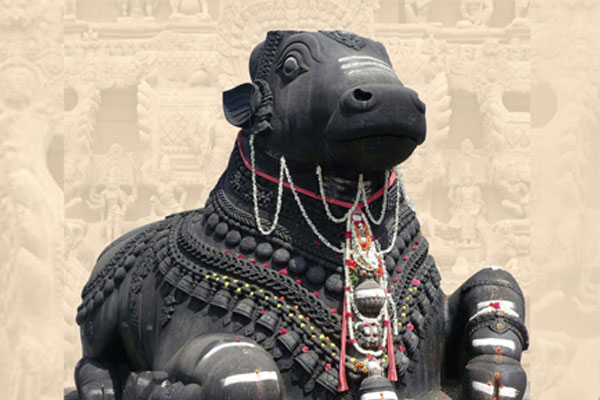
As one enters the sanctum sanctorum, the air thick with the scent of incense and vibrating with the chants of devotees, the gaze is drawn to the mesmerising idol of Goddess Chamundeshwari. The deity, resplendent in her Ashtabhuja or eight-armed form, embodies the multifaceted nature of divine feminine power. One of the most striking features of the temple complex is the colossal statue of Nandi, Lord Shiva’s bull mount. Situated on the 700th step of the ascent, this 5-meter-high granite monolith, installed in 1664 by Mysore Maharaja Dodda Devaraja Wodeyar, serves as a silent guardian of the sacred hill.
In 1399, when the Wodeyar dynasty rose to power in Mysuru, they embraced Goddess Chamundeshwari as their tutelary deity. This royal patronage elevated the temple’s status and led to significant expansions and embellishments over the centuries.
The Ashada Shukravara, observed on Fridays during the month of Ashada, sees throngs of devotees seeking the goddess’s blessings. However, it is during Navaratri that the temple truly comes alive. This nine-night festival, celebrated as Mysuru Dasara, transforms the entire city into a spectacle of lights, music, and devotion. The goddess is adorned differently each day, representing the nine forms of Shakti. On the seventh day, dedicated to Kalaratri, the idol is bedecked with priceless jewels from the royal treasury, a tradition that continues to this day.
One of the most intriguing aspects of the temple’s history is its association with animal sacrifices. In ancient times, it was not uncommon for devotees to offer animal and even human sacrifices to appease the fierce goddess. However, this practice was discontinued in the 18th century, reflecting the evolving nature of worship and societal values.
As one stands in the temple courtyard, gazing out at the panoramic view of Mysuru spread out below, it’s easy to understand why this site has captivated the hearts and minds of devotees for centuries. The Chamundeshwari Temple is more than just a place of worship; it’s a living, breathing entity that continues to shape the spiritual and cultural landscape of the region. At the foot of Chamundi Hills lies the Jwalamalini Sri Tripura Sundari Temple, dedicated to the sister of Chamundeshwari. According to local lore, this goddess aided Chamundeshwari in her battle against the demon Raktabija, adding another layer to the rich tapestry of myths surrounding this sacred site.








 Memories and Such