The Tiara Syndrome: Something that will never happen unless you ask for it

A term coined by Carol Frohlinger and Deborah Kolb, the founders of Negotiating Women, Inc, the Tiara Syndrome or the Tiara Effect is used to describe how many women approach salary and raise negotiations.

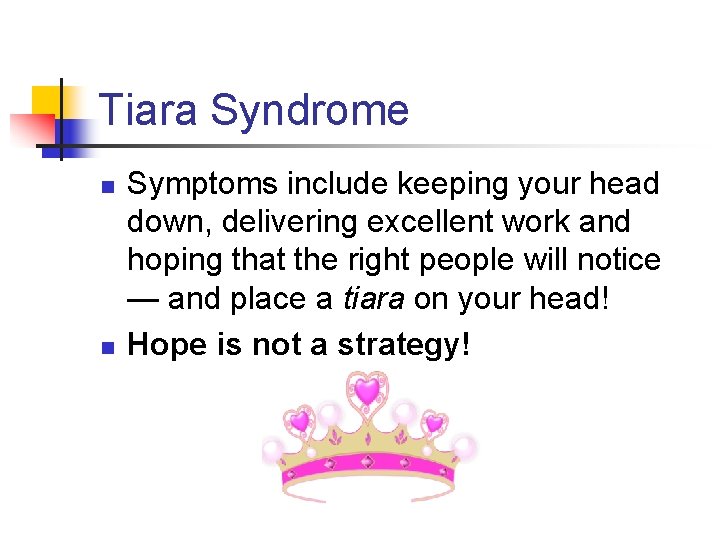
As Carol Frohlinger says, “Women expect that if they keep doing their job well someone will notice them and place a tiara on their head. That never happens.”

The fact is, most women don’t negotiate. That tiara is the recognition in the form of increased salary or pay. Women believe that they will be recognised for their value and automatically be paid what they are worth but the reality is, you have to ask for what you want. And if you don’t ask, the answer is always no.

In her bestselling book, Lean-In, Sheryl Sandberg says, “Women are also more reluctant to apply for promotions even when deserved, often believing that good job performance will naturally lead to rewards.”
Many women feel that working hard and doing a good job will be enough and the reality is that women are often extremely conscientious at delivering against their objectives. Just as at school where girls’ conscientiousness often leads to higher academic results than achieved by boys, many women believe that this same strategy will lead to success at work. However, sometimes this very diligence gets in the way of fast-tracking their careers. Many women are so so focused on doing the operational aspects of their job well that they don’t have time to step back and focus on strategic priorities and they often feel they do not have space in their busy working weeks to fit in networking which is seen as an unnecessary, and often uncomfortable, use of their precious time. In the same vein, they do not seek mentors to guide them or get the support of sponsors to give them the invaluable exposure and opportunities needed to step up to senior leadership positions.

Academic psychologist Cordelia Fine says such behaviour stems from socialisation, not innate differences between the sexes. And, of course, some men are sufferers, just as many women aren’t. But how do those who have been schooled not to boast learn to champion their cause and get over tiara syndrome?

A 2003 study of thirty-eight business students conducted University of California at Irvine discovered that 85% of the men believed that it was up to them to make sure their company paid them what they were worth. Only 17% of the women in the study believed this to be the case. The remaining 15% of the men and 83% of women assumed their worth would be determined by what their company paid them. The Tiara Syndrome only adds to the pay disparity between men and women. If we don’t ask for more pay based on our contributions, the answer is always no.

As women, we don’t negotiate. Most of us don’t negotiate our first job offer, which has been calculated to equal $500,000 over the length of her career. And all because we don’t speak up for ourselves and our worth.

So why do we women avoid negotiating? This is to a large extent because of the social conditioning females are brought up in where we are always told to be polite and quiet. Asking for money seems, greedy and rude and it is also uncomfortable. Frohlinger advises women to keep a work journal by month detailing the projects and accomplishments achieved, client kudos, amounts in new business created, or savings generated. This compelling evidence of their value to the company can be persuasively presented during a salary negotiation. Even if one gets an automatic raise annually, this substantiation of the corporate value could pay off in a larger increase. If you are stepping into a new role or moving to a new organization, don’t settle for the first offer.

Tory Johnson, the CEO of Women for Hire and Good Morning America’s career expert recommends the following for negotiating that initial offer. Start positive and get the whole compensation package in writing if it has been verbal so far. Be firm. If you have been offered a package lower than your expectations, then let them know politely with an emphasis on the skills and experience you bring to the role and ask them how much wriggle room is available. Every organisation will have a wriggle room, especially for someone they deem the best fit. Follow up especially if the hiring manager is firm on their offer. Work towards reaching an agreement, on paper, for a salary negotiation or review within a pre-determined period. Also try and negotiate on non-money aspects like vacation time, flexible working arrangements, medical benefits, etc.

What are the blocks that don’t allow extremely able women from progressing? These include insufficient impact and presence and lack of a strong personal brand, a lowered productivity and overwhelm through being pulled in too many directions at once as well as poor work-life balance, a belief that doing a good job will be enough and not seeking sponsors, discomfort with networking both internally and externally, being insufficiently strategic and too stuck in the detail, a lack of strategic career planning and reduced confidence and lack of self-belief as a leader.

If you suffer from this syndrome, here’s what you can do to overcome it:

Own your career, acknowledge that you suffer from the syndrome and come up with an action plan. If you don’t like talking about it, use technology instead. Copy your boss into relevant emails and share them on your professional social media accounts. Keep a career journal to keep a record of your accomplishments. This is great for building evidence required for negotiations, it can be confidence boosting and be useful for CVs, appraisals, and other career development opportunities. Stop comparing yourself to others and plan for and maximise the formal opportunities for negotiation, whether for a pay rise or a promotion. Build your brand and internal network. Your brand also includes managing your energetic presence, personal image and communication, including body language. Harness Your Potential which includes identifying and capitalising on strengths as well as being clear about which weaker areas are mission-critical and maximising time and energy. Creating a balance between work and other aspects of life is also vital for sustainable career success. Cultivate supportive relationships within your current work setting as well as the wider professional network, including sponsors and mentors. It is important to be able to initiate these relationships, enhance your influence and also handle difficult relationships. Focus on strategy and volunteer for strategic or extra credit projects so that you can develop an idea of the big picture. Thinking like a leader is necessary to develop a leadership mindset and this includes handling the little voice of doubt that we all have in our heads and also learning to let go of some of what we have excelled at to take on even higher level leadership tasks.

It’s naive to think that delivering excellent results is all that it takes to succeed in the workplace. The playing field is not yet equal for women; the fact is that women have to negotiate for things their male colleagues can often take for granted. In addition to the obvious issue regarding compensation, women should negotiate for high visibility assignments, the resources they need to get the job done, support from those senior in the organization and buy-in from colleagues. They should also negotiate in their personal lives for the things that will enable them to be successful in the workplace. Effective negotiation is a prerequisite to “leaning in”. As Sheryl Sandberg says, “Do not wait for power to be offered. Like that tiara, it might never materialise.” So to all the women reading this post, if you have the Tiara Syndrome, shrug it off and know that you too are worth it!

The Good and the Bad: Boss Edition

It is often said people don’t leave bad organisations, but leave bad bosses. And this is so true. When coworkers get together, stories are bandied about bosses and rarely are good managers discussed, but the spotlight is mostly on bad bosses. Many bosses fall into the bad boss category because they fail to provide clear direction, regular feedback, recognition for contributions, and a strategic framework of goals that enable their employees to see their progress. These kinds of bad bosses are what are called generic bad bosses because all employees need these types of support and feedback, and they suffer when they don’t receive it.

I’ve had my fair share of bosses, both good and bad. In my first job, we were a very young team, all of us fresh out of school and in our first jobs. The company was also a fairly young one, but the management were not very young, they had about a decade plus experience and you could probably call them middle management. While we didn’t really really report to them, they oversaw our work. My expectations with managers and bosses are most likely influenced by how they interacted with us. They were friendly and fair and had an open office policy. But one thing really stands out for me and is something that has been a sort of guiding principle for me all these years.

The office was a split office, with us in the ground floor and the managers and finance people in level 2. Officially the office would end at 5:30 pm and at 6 pm, one of the bosses, lets call him D would come down to go back home and if he saw us around, we would have to have a good reason why we were still around. 90% of the time, we were around, because we were hanging out with each other. Except for one, none of us were married and had no responsibilities, so there was no pressure to get out of the office and go home.

When D saw us hanging around, not leaving the office, he would ask us why were still there and used to say something like this. I am paraphrasing this, but he would say that if you are staying late because you have too much work, then there could be two reasons for this. One because you have too much on your plate or two because you have not finished your work in the scheduled hours of work. In both cases, we should have a talk, because if you have too much work, then we need to figure out how to reduce your workload and if it’s the second reason, then we also need to talk about why you are not able to finish your work on time. This is something that has always resonated with me and I have always tried to be as productive as possible while at work and leave on time as much as possible.

Another manager who made an impact in my life was someone who was my manager for the longest period of time. I was also in this organisation the longest, for almost a decade and of the multiple managers whom I reported to, this one was the one I reported to the longest. He was fair, but had his faults, the biggest of which was playing favourites. While I was not a favourite, I was also on his dislike list and so I escaped some of the worst things he said to others. From him I learnt how not to play favourites, especially when hiring people for the organisation and to not enable them so much they they believed to be above all others. He used to catch up with us every time he passed through Singapore but died a few years back.  

The third manager was someone whom I reported to for less than a couple of years, but he was a peer in terms of age. A very supportive manager, he gave me more responsibilities when he saw I could handle them and also credit where it is due. I learnt a lot from him, especially on how to manage people as he was someone who was friendly with everyone and even learnt some of the finer points of office politics from him. Unfortunately after about two years of reporting to him, he was transferred to a different country, but we are still in touch.

The last manager I was to talk about was the most toxic one. I have written about this person previously and even today, years after I left the organisation, I still have nightmares about how they used to literally torture me there. I can now think about them without my heart palpitating and getting stressed out, but it took me many years to get there.

Bosses are just like people, there are good ones and bad ones. A good boss or manager will set clear expectations from their subordinates, coach and give feedback, is inclusive and recognises efforts made by those reporting to him, knows his reportees, especially their talents and what they are good at and most importantly is there for them and takes a stand when it is needed.

A bad boss on the other hand, is everthing but what a good boss is. A boss is the umbilical cord that connects employees to an organisation, and if that cord is damaged, the employees will eventually leave. So if you are one of the lucky employees who has a great boss, don’t take that relationship for granted and show your boss how much you appreciate them.

2019 Secondary 4 Week 21 Update

We are at the last week of school now, though both BB & GG have to go back to in the June holidays for extra lessons.

Both schools are also doing intensive lessons for those who take the mother tongue languages of Chinese, Malay and Tamil. They will have their first attempt at the O level exams in the first week of June. Since both BB & GG’s mother tongue language of Hindi is not in this scheme, they, along with other classmates sit in the library and self study during this period.

We are also gearing up towards the Early Admission Exercise for Polytechnics. Both have specific courses they are interested in and will apply for them when the portal opens in end June. If they get selected in the course of their choice, it means even if their O level results do not meet the cut off points of that course, they still get in as long as they meet the polytechnic entry criteria and course base criteria.

That’s all from us for this week! We have the parent teacher session at the end of the week and I wonder what both sets of teachers will have to say for the children.

Job Search Woes: An Interview Episode

While I am actively looking for a new position, I thought I’d do a series on job search woes. This will document the random and sometimes funny and weird people I meet while looking for a new position. Here’s the latest one….

Earlier this week I went for an interview, which should rate as one of the weirdest ones I’ve ever gone for!

Early in the week, I chanced upon a position in one of the job boards I frequent which really appealed to me. This was very similar to a previous position I was doing and I could do the job easily. Plus the position would also stretch me professionally (or so it seemed) and so very excitedly I applied for the position. This was around 10 am in the morning. Sometime around 1:30 pm in the afternoon, I get a call from someone asking me if I was interested in coming down for an interview. I don’t think they mentioned the name of the company (or perhaps I didn’t hear it?), but I agreed and we discussed dates and times and agreed to meet the next morning. Soon an email arrived from the person I spoke to earlier confirming the interview, but again no company name, just the time and address.

I reversed searched the number from where the phone call came and got the name of the company. When I logged into the job board, I was very excited to see it was for the job I had applied that morning. I did notice that the same company had multiple positions open at that point, but didn’t really check them out. I was very excited thinking that they had seen my resume and since I checked all the items they needed for the position, decided to call me for an interview so soon. Boy, was I to be proven wrong! I spent the rest of the day preparing for the interview.

During my research of the company, I came across some points which made me a bit nervous. Like this place, I had worked briefly at another place which had a similar structure and was essentially a one-man show. The owner/founder called all the shots and if they were unhappy with someone, out they went, justified or not. I hated working there from my second week and could not wait to get out. I am sure I do not want to be in a similar environment.

The next day I reached on time for the interview. When I arrive at the venue, while searching for the stairs to get up to the office, I saw two women seated at some chairs downstairs in the open. From the body language, it seemed that one lady was interviewing the other. My feeling was that this was my interviewer and the person they were interviewing was the person before me. I did wonder why they could not do the interview in the office but walked to the office to find out.

At the office, which was a small open-plan office, I was met with 4 youngsters (early to mid-twenties, all of whom from the accents and the way they spoke English seemed to come from the same Asian country). I was asked to fill up an employment form, which had no space to write anything (even the space for telephone numbers was woefully inadequate). So I wait there for the lady to come up to interview me. She comes up after a bit and then starts my interview. She asked me to go downstairs with her which I did. Now comes the fun part.

While walking down to the chairs arrangement, she starts by asking me if I have sales before. I found the question a bit funny because the position I had applied for was not a sales position. I thought she was pulling it from my resume and started talking about all the times I did sales and what I did in the different roles.

She keeps talking more about sales, asking me about big achievements and targets when she realises that I’ve applied for another position. She turns to me saying, “Oh, I see you’ve come for this position and not the other one”. I say yes and start talking about why I am a good fit for that position. So then she starts reading my resume and can’t find the information I am talking about. That’s when I ask her if she has a copy of my resume and she says, “Yes, I have this”, showing me a print-out. The print out was a screen shot from someone’s phone with just the top quarter of the first page of my resume (I have a three -page resume). The paper she had just had the accomplishments and core competencies, with nothing of what I had done previously. So I laughed and told her this is just a fraction of my resume and asked her if I could send her a copy. I didn’t have a soft copy with me but emailed her a forward from another application. All this while talking to her about myself.

Later, on reading my resume, she asked if I was interested in this other sales position. When she explained the position, I did say it was interesting, but I am clearly not very interested in it. She also spoke about working late on a regular basis, but I was quite pissed off by then, so I told her that while working late was not an issue with me, I am a big proponent of work-life balance. I also brought up my India trip in November (even though I wan’t going to at this stage), but I wanted to put all my cards on the table so if they do want to proceed further, they have all the information. As with all companies, salary also seems to be an issue here, with her asking if I will reduce my asking salary.

We quickly wrapped up the interview in less than 30 minutes (including the time I took to send her my resume) and she said she will speak to the CEO and see if she can try to arrange for a second interview with the CEO based on my resume for the position I applied for.

What was so strange to me was that it looked like they’ve just called all candidates who applied for an interview, without even going through their resumes. Second, they can’t even print out a legit, full copy of the resume which the job board would have sent to them. Third, they don’t even know the position the candidate has applied for!

I’ve pretty much written off this company and am not expecting anyone to call back. But the position (as it sounds on paper) was fascinating and if it is as it looks like, it’ll be something I’d love to do. So let’s see what happens. So far, they’ve not gotten back to me, though I suspect they won’t.

Ah well, c’est la vie….