Mondays: Dread or Look forward to?

Source

Every Monday morning, across the world, scores of people wake up with a sense of dread. The Monday morning blues refer to a kind of mild depression people feel when it’s time to go back to work or school. They wake up with no enthusiasm for the day and in fact, dread the day.

The term Monday Blues describe a set of negative emotions that many people get at the beginning of the workweek if they’re not happy at work. It contains elements of depression, tiredness, hopelessness and a sense that work is unpleasant but unavoidable. Monday morning blues need not only happen on a Monday, but can happen any time of the week

A 2018 LinkedIn survey found that 80% of professionals experience what they called the Sunday Scaries, a prelude to the Monday morning blues. The Monday Blues are so prevalent that they have become a cultural phenomenon, but they can be much more than just passing tiredness; they are often a serious warning sign that something is not right at work. If you were happy, you’d be excited and energised on Mondays, not tired and depressed. If one is feeling under-appreciated or unsatisfied with their job, it can be especially difficult to start another seemingly endless workweek. And the case of the Monday Blues can have a negative impact on performance and productivity, as well as the people around us.

Countless studies in psychology and neurology have shown that a person’s current emotional state has a huge effect on the quality of their work and when they’re feeling blue they are less productive, less motivated, more pessimistic, less creative, less engaged and learn more slowly. The Monday Blues are contagious and one’s stress or bad mood can drastically change the overall work environment. When one is unhappy at work, it makes it very difficult for those around them to be happy, and oftentimes just one worker with a case of the Mondays can spread the doldrums to the whole team.

So what can one do to help overcome the Monday blues? Read on.

Identify the problem. If you have the Monday Blues most weeks, then this is not something you should laugh off or just live with. It’s a significant sign that you are unhappy at work and you need to fix it or move on and find another job. You need to ask yourself what is wrong and start with making a list of the things that are causing this stress and clarifying what is bothering you can help in trying to be active in finding solutions. It’s a way of empowering one to take charge and try to improve the situation.

Continue with your normal routine over the weekend. One of the reasons why Mondays are so hard is because we often leave all of our normal eating, sleeping, and exercise habits over the weekend. When we eat more, richer food and eat late drink and sleep and wake up late over the weekend, then when Monday morning comes, this catches up and we feel out of sorts. Not to say that this should not be done, but a balance should be found which lets us unwind while still keeping up with major routines.

Disconnect over the weekend. If you are constantly thinking of work and checking work emails when you should be using the weekend to relax, it’s a sign we are setting ourselves up for burnout sooner or later. When we feel stressed just thinking of work on Sunday, it’s a clear indication that we need to have stricter boundaries between work and play. One way to break the habit is to try turning off email notifications on Friday evening and unplugging from any work-related problems to focus on personal time over the weekend. Drawing clearly defined boundaries between work and personal time can help keep things in check.

As a piece of contrary advice to the above one, sometimes, when you know you have a big week ahead of you, you can get a head start on important tasks, but only if it is absolutely necessary. Maybe an hour or so on Sunday to plan the week and get some work done to take some of the pressure off come Monday. If this is something you would do once a while, make sure you spend one day relaxing and then work a bit the other day. You can also prepare for the next week on Friday evenings, by taking five or 10 minutes to prepare for the next week by straightening up the workspace, tying up loose ends and making a to-do list. Investing this time will help ease the mind for the next 48 hours.

If Monday mornings or Sunday evenings are usually scary and full of anxiety, then take some time to really think about what’s causing this anxiety. When you are able to figure that out, it’s easier to focus on what’s within your control, not on what’s beyond it and certainly not on that which might be based merely on fiction. Although it might seem counter-intuitive, waking up an extra 15 to 30 minutes early on Monday morning can actually make going back to the office easier. Having a little more ‘me time’ instead of feeling like you’re trapped in a time crunch can make that transition a little easier.

Another way to help combat that Monday morning anxiety is to be sure to leave as few dreadful tasks as possible on Friday afternoon so by taking care of the things you least want to handle at the end of one workweek, you’re making the start of the next that much better.

Don’t mess with your sleep cycle. An obvious thing, but not feeling well-rested can have a huge impact on how you feel come Monday morning. Experts advise keeping the sleep and wake schedule close to what it is during the week to avoid messing up your internal clock. Also, it is recommended that you wake up at the same time each day, even over weekends, so your body internal clock is still in sync. Even if you are unable to stick to the exact same routine, avoid going to bed more than an hour or two later than you would during the week.

Avoid overscheduling on Monday. It’s normal to feel overwhelmed when you’re flooded with meetings after coming back from a relaxing weekend, so whenever possible, try to avoid scheduling meetings or big tasks on Monday. It is also a good idea to make sure all the tasks scheduled for the week are completed before you start enjoying your weekend. If this is an issue, then using time management tools may help track activities and schedule events easily. This will help you to come into Monday with more ease from the weekend. Instead of tackling the biggest and most complicated tasks early on Monday, take some time for easier, more routine stuf. This might get you up and running and give you the energy for the more difficult or unpleasant tasks. But if you do have any unpleasant tasks awaiting your attention Monday morning, get them done as early as possible so that you don’t spend the rest of the day procrastinating or feeling as if there’s a black cloud hanging over your head. You’ll feel a lot better once it’s over.

Have fun at work. Take it upon yourself to do things that you enjoy in the office on Monday. Create an event that you will look forward to on Mondays as a way to break up the day with some known positivity. At the very least, it gives you a chance to take a deep breath, talk with a friend, and regroup for the rest of the day.

Write down your feelings. When our minds are overactive and we start overthinking, we can’t relax and destress, especially over the weekend. In such cases, jotting down your worries, can calm the mind and even make you more productive. I generally use Google Docs for this, but you can use the good old pen and paper or any other way to write down your thoughts and once you do that, the concerns and anxieties will feel much smaller and more manageable and the mind is clearer and calmer. According to the University of Rochester Medical Center, the simple act of journaling can help to manage anxiety, reduce stress and cope with depression.

Another way to beat the Monday Blues is to make a list of the things you’re excited about. We often look at the week ahead of us and think of all the tough stuff we have to do and the difficult tasks ahead of us, so we can just turn that around. On Sunday evening, make a list of three things you look forward to at work that week and this might put you in a more positive mood. If you can’t think of three things you look forward to, that might be an indication that you need to make some changes.
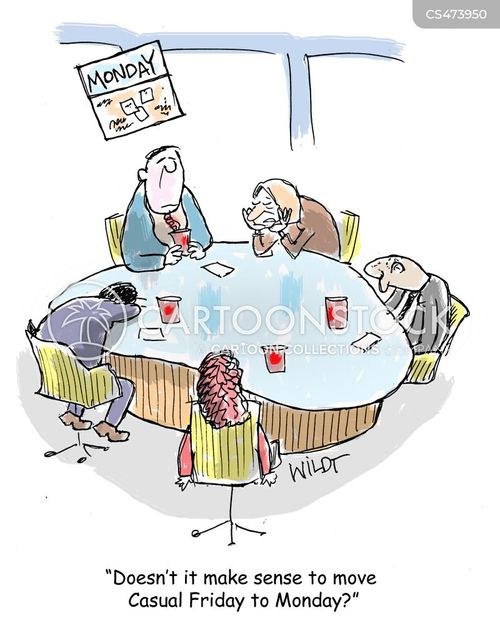
Dress for success. Mondays are when you should wear your favourite or a new outfit. It will perks you up and lets you be positive and also help others be positive. This can also help build your confidence because when you look good, you feel good and feeling good about yourself is half of the battle on Monday mornings, because rather than being deflated by work you want to face it with confidence.

Start the week out with an attitude of gratitude and take time to recognise and appreciate the things that you enjoy about work. Be positive and start even before you get into work. Try listening to favourite songs, with some upbeat, high-energy music into your morning preparation or commute to pump yourself up. And when you get into office, don’t listen to other people’s Monday gripes because creating or contributing to a culture of complaining is no way to improve your attitude. Make someone else happy and do something nice for someone else as soon as you get to work on Monday. This will definitely can lift the spirits and could actually help shift the overall mood. Research shows that according to positive psychology one of the best ways to cheer yourself up is to make someone else happy.

Have a post-work plan. Your day shouldn’t just be about trudging through Monday to get it over with, but about looking forward to something. By making Monday a special day where you get to go out with friends, make your favourite dinner, or eat a bowl of popcorn and catch up on a TV show you recorded, the day doesn’t have to be all about getting up to go into the office.

So here are some things you can do to get out the funk of the Monday Blues and have a great week.

Fibonacci Day

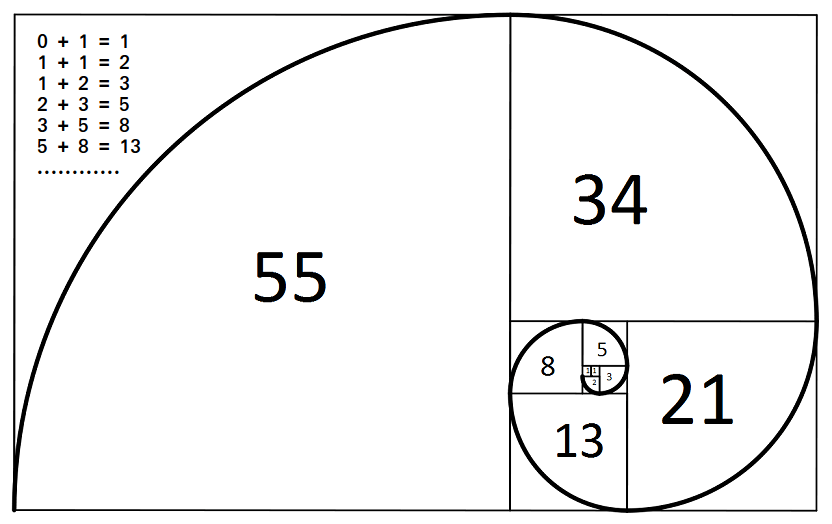
Every year, November 23 is celebrated as Fibonacci Day. And it is because when the date is written in the mm/dd format (11/23), the digits in the date form a Fibonacci Sequence – 0, 1, 1, 2, 3, 5, 8, 13, 21, 34, 55, 89, 144, … A Fibonacci Sequence is a series of numbers where a number is the sum of the two numbers before it. For example: 1, 1, 2, 3…is a Fibonacci sequence. Here, 2 is the sum of the two numbers before it (1+1). Similarly, 3 is the sum of the two numbers before it (1+2) and 5 is the sum of 2 and 3 and so on.

Fibonacci numbers are named after the Italian mathematician Leonardo of Pisa, later known as Fibonacci. In his 1202 book Liber Abaci, Fibonacci introduced the sequence to Western European mathematics, although the sequence had been described earlier in Indian mathematics, as early as 200 BC in work by Pingala on enumerating possible patterns of Sanskrit poetry formed from syllables of two lengths. The numbers are strongly related to the golden ratio: Binet’s formula expresses the nth Fibonacci number in terms of n and the golden ratio, and implies that the ratio of two consecutive Fibonacci numbers tends to the golden ratio as n increases.

Fibonacci numbers appear unexpectedly often in mathematics, so much so that there is an entire journal dedicated to their study, the Fibonacci Quarterly. Applications of Fibonacci numbers include computer algorithms such as the Fibonacci search technique and the Fibonacci heap data structure, and graphs called Fibonacci cubes used for interconnecting parallel and distributed systems. They also appear in biological settings, such as branching in trees, the arrangement of leaves on a stem, the fruit sprouts of a pineapple, the flowering of an artichoke, an uncurling fern, and the arrangement of a pine cone’s bracts. Computer data storage and processing uses this number sequence today and the sequence is also useful in the trading of stocks and architecture. DNA patterns and hurricanes contain patterns showing this sequence. Math and science classes refer to the Fibonacci sequence as nature’s secret code or nature’s universal rule.

In his book Liber Abaci or The Book of Calculation, written in 1202, Fibonacci used the growth of rabbit population as the basis of the sequence. Fibonacci considers the growth of an idealised, but biologically unrealistic, rabbit population, assuming that a newly born breeding pair of rabbits are put in a field; each breeding pair mates at the age of one month, and at the end of their second month they always produce another pair of rabbits; and rabbits never die, but continue breeding forever. Fibonacci posed the puzzle: how many pairs will there be in one year?

At the end of the first month, they mate, but there is still only 1 pair. At the end of the second month they produce a new pair, so there are 2 pairs in the field. At the end of the third month, the original pair produce a second pair, but the second pair only mate without breeding, so there are 3 pairs in all. At the end of the fourth month, the original pair has produced yet another new pair, and the pair born two months ago also produces their first pair, making 5 pairs. At the end of the nth month, the number of pairs of rabbits is equal to the number of mature pairs, that is, the number of pairs in month n – 2 plus the number of pairs alive last month (month n – 1). The number in the nth month is the nth Fibonacci number. The name Fibonacci Sequence” was first used by the 19th century number theorist Édouard Lucas.

Fibonacci’s book Liber Abaci also introduced the western world to the Hindu-Arabic numeral system we use today which writes numbers as 1,2,3, etc. instead of the Roman numerals I, II, III, etc.

So how can we observe Fibonacci Day? There are many way to do that.

We could watch a video showing the Fibonacci sequence in nature or a video discussing the magic of Fibonacci numbers and the Fibonacci Sequence and its theoretical and practical uses. Or look for items in our home or in nature containing the Fibonacci Sequence. A number of fruits and vegetables, like pineapples, romanesco which is a cross between broccoli and cauliflower display the Fibonacci series.

The Fibonacci Sequence is there everywhere in our lives. If an orange is cut in half, the sections are always a Fibonacci number. The chambers of a nautilus shell, no matter the size of the shell or number of chambers, will be a Fibonacci number. If an apple is cut through its centre, not through its stem, the five-pointed star is another hidden Fibonacci number. Outside, if the petals of flowers and the points of leaves are counted, it will always be a Fibonacci number. And the reason a four-leaf clover is so rare is because four is not a Fibonacci number and they don’t happen often in nature. Music is also filled with Fibonacci numbers with the piano keyboard, keys in an octave all good examples. Check it out!

Universal Children’s Day

Celebrated in honour of children, Children’s Day is celebrated and observed on different dates across the world. In 1925, International Children’s Day was first proclaimed in Geneva during the World Conference on Child Welfare. The World Children’s Day is celebrated on 20th November to commemorate the Declaration of the Rights of the Child by the UN General Assembly on 20 November 1959.

The first Children’s Day began on the second Sunday of June in 1857 by Reverend Dr. Charles Leonard, pastor of the Universalist Church of the Redeemer in Chelsea, Massachusetts who held a special service dedicated to, and for the children on a day he named Rose Day, though it was later named Flower Sunday, and then named Children’s Day. Children’s Day was first officially declared a national holiday by the Republic of Turkey in 1920 on 23 April and the day has since then been celebrated nationally since 1920 and the official declaration was made in 1929.

In Singapore, traditionally, 1 October is when the country officially celebrates Children’s Day. Another similar event celebrated annually is Youth Day, which is celebrated on the first Sunday of July every year, and is a school holiday for primary, secondary and junior college students. From 2011, Children’s Day has been celebrated on the first Friday of October.On Children’s Day, Kindergarten and Primary school students get a holiday, while secondary school and junior college students still need to go to school, with teachers often organising special events and activities so the older children could still celebrate.

In India, Children’s Day is celebrated on 14 November as a tribute to the birthday of India’s First Prime Minister, Jawaharlal Nehru. Known as Chacha Nehru among children, Nehru advocated for children to have all-rounded education that would build a better society in the future and considered children as real strength of a nation and foundation of society.. The day is celebrated across the country to increase awareness of the rights, care and education of children. The day has been celebrated since 1956 and before Nehru’s death was celebrated on 20 November, the Universal Children’s Day.

World Children’s Day was first established in 1954 as Universal Children’s Day and is celebrated on 20 November each year to promote international togetherness, awareness among children worldwide, and improving children’s welfare. It was on this day when the in 1959 when the UN General Assembly adopted the Declaration of the Rights of the Child as well as the date in 1989 when the UN General Assembly adopted the Convention on the Rights of the Child.

The theme for this year’s celebration is Unite to reverse the impact of COVID-19 pandemic on children. The theme highlights the principles of the Convention on the Rights of the Child that all children irrespective of their status and situation should enjoy their rights to Survival and Development as enshrined in the Convention on the Rights of the Child (CRC) and the Child Rights Act (CRA) 2003.

Mothers and fathers, teachers, nurses and doctors, government leaders and civil society activists, religious and community elders, corporate moguls and media professionals, as well as young people and children themselves, can play an important part in making World Children’s Day relevant for their societies, communities and nations. The World Children’s Day offers each of us an inspirational entry-point to advocate, promote and celebrate children’s rights, translating into dialogues and actions that will build a better world for children. UNICEF and partners are calling on governments to adopt a Six Point Plan to Protect our Children which include ensuring all children learn, including by closing the digital divide, guaranteeing access to health and nutrition services, and making vaccines affordable and available to every child, supporting and protecting the mental health of children and young people and bring an end to abuse, gender-based violence, and neglect in childhood, increase access to clean water, sanitation and hygiene and address environmental degradation and climate change, reversing the rise in child poverty and ensure an inclusive recovery for all and redoubling efforts to protect and support children and their families living through conflict, disaster and displacement.

So tomorrow, take some time out for the children around you and really talk to them and understand their concerns and issues. You could also sponsor a child under the ageis of many reputable organisations and put a child through school and make their life.

Continous Improvement: Getting better everyday

Coming from the manufacturing sector, a continual improvement process, also often called a continuous improvement process or CIP or CI, is an ongoing effort to improve products, services, or processes. These efforts can seek incremental improvement over time or breakthrough improvement all at once. Some successful implementations use the Japanese approach known as Kaizen where kai means change and zen which stands for good is improvement. Kaizen the Sino-Japanese word for improvement, is a concept referring to business activities that continuously improve all functions and involve all employees from the CEO to the assembly line workers. By improving standardised programmes and processes, kaizen aims to eliminate waste and redundancies. Kaizen was first practiced in Japanese businesses after World War II, influenced in part by American business and quality-management teachers, and most notably as part of The Toyota Way. It has since spread throughout the world and has been applied to environments outside business and productivity.

So how can this be applied to our daily lives? How can we use Continous Improvement to improve ourselves and make us better individuals? Read on.

We live in a world of never-ending disruption and change. By adopting the philosophy of Kaizen, we can become more adaptable, flexible and resilient to deal with the constant demands and disruptions we face in our lives. By adopting continuous improvement, we can live our lives to the fullest by continuously learning, growing and thriving. This philosophy is based on the concept that instead of making big changes at once, the continuous improvement approach focuses on making a small improvement over time.

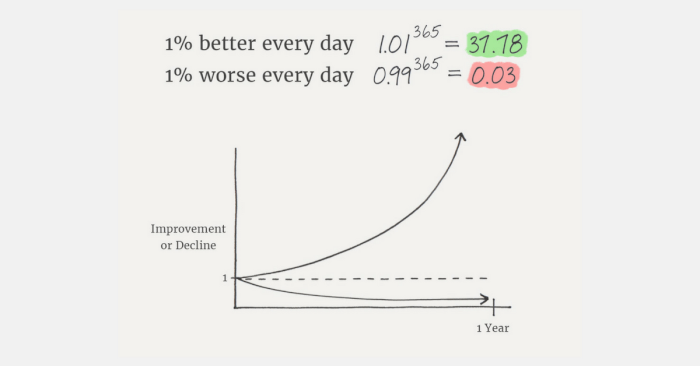
Kaizen is often referred to as the strategy for 1% gains. It is these 1% gains that athletes focus on to improve their performance. The 1% gains are incremental and if one keeps building on the 1% gains the rewards are phenomenal. Continuous improvement is perpetual and so to maintain gains and improvement, one needs to work on them continuously. Continuous improvement is perpetual and so to maintain gains and improvement; you need to work on them continuously.

An easy example is the new year resolution we make every year. How many of these do we actually fulfil and maintain all through the year? At some point, we slip up and then many of the resolutions fall by the wayside. But there is that small group of people, dedicated and committed, who are able to maintain and fulfil all their goals for the year. However, if one commits to continuously improving themselves, then the motivation to achieve the goals set will never die. One will never have to struggle with giving up or giving in because it is hard. The achievements and success in life will be a result of one taking continual incremental steps toward their goals. Continuous improvement is not about reaching the big goals in life but about taking small steps and improving and refining those goals along the way.

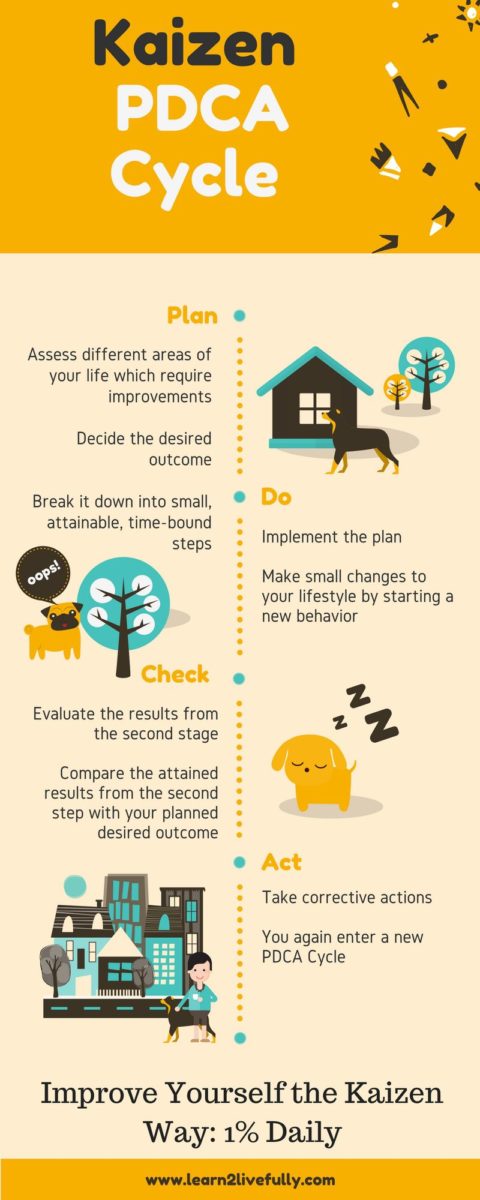
To be successful at the adoption of a continuous improvement lifestyle, the first thing to do is to embrace and accept that the journey of self-improvement and growth will never end, it is a lifelong journey of learning. The steps to improve continuously are as follows:

Step 1: Set goals based on the philosophy of 1% incremental achievements. The setting of the goal is the east part, keeping motivated, focused and on track to achieving the goal is the hard part. Continous Improvement provides one with a system or a process that one can you commit to to enable one to achieve any goal they set. 1% does not seem much, but being slightly better today as compared to yesterday will gradually add up and the goal will be achieved in no time. This system of being slightly better each day enables one to avoid feeling like a failure and being subject to self-anger and derision when one gives up.

Step 2: Break down the system into small actions: When one is attempting to be just 1% better each day, then it’s not about random bursts of improvement in fits and bursts. Continuous improvement is a journey of personal growth where one is making long-term steady progress. This approach of self-improvement will give one the sustainable long-term changes they seek to improve their lives and achieve goals.

As an example, if you are trying to lose weight, instead of obsessing with the ideal weight, start by thinking on how you are going to achieve a healthy lifestyle. Create a system which includes diet and exercise and then break that system down into smaller actions or behaviours which you can follow without exerting yourself too much. Like, you could start walking or exercising and everyday or every week, do something slightly more. Commit to these actions on a daily basis until it becomes a habit. Keep going until the goal is reached.

Step 3: Keep track of your 1% success: It is very important that you measure and track your 1% successes. This is a crucial factor about incremental achievement. Evaluating and measuring improvements are important for one’s own motivation and commitment to the journey. If one is not measuring progress, the subconscious brain will kick in and sabotage progress by convincing one that it is all too hard and that they are not making any progress at all. The subconscious brain only believes what one tells it. Unfortunately, we have told our brain a lot of untruthful things over a long period of time about how we are a failure, not motivated and never really achieved anything in life. The subconscious brain, as a result, believes all these facts that we have told it to be true. Measuring and evaluating our 1% successes is key to us retraining our subconscious to believe that Yes – we can achieve our goals and succeed in life.

Source

Continuous Improvement does not focus on making huge gains or big improvements all at once. Instead, it focuses on long-term steady progress. When one follows the philosophy of Continuous Improvement, they won’t radically change their life, but over time with consistent and constant improvement and change, they will find that they are living their life to the fullest – empowered, resilient and thriving.

Poem: I am a Reader

As you all know I love books. I am an avid reader, though recently I feel I have not been reading as much as I used to and should do. While thinking about something else to write, I thought of books and this poem came unbidden. Maybe this is my subconscious telling me to read more.

I am a Reader

I am a reader, I live in many worlds
An adventure, romance, crime or thriller
I choose the world I want to go to
What will it be today? What would I choose?

I open the book and settle in with a contented sigh
And soon say to this world a goodbye
As I drown myself in a world full of intrigue and suspense
Heroes full of valour and villains with an air of menace

Or shall I indulge in some heady romance?
Where emotions run deep and the characters rave and rant
Or shall I take a trip to the top of the mountains or the deepest ocean?
Sitting in one place, travelling without a care or caution

I am a reader, there’s a constant movie running in my head
And so when I watch a movie, I am always upset
The film on-screen can never match up to the one in my imagination
I am disappointed yet again, go back to my books and let the magic happen

Books are special, books are magical
With books, there’s never a moment that’s not dull
Books help us know ourselves and let us roam
And all this, from the comfort of our home

So pick up a book and bid now adieu
Let the magic of the written word envelop you
And tell yourself that you too are a reader
An adventurer, a detective, a romantic and most importantly, a dreamer!