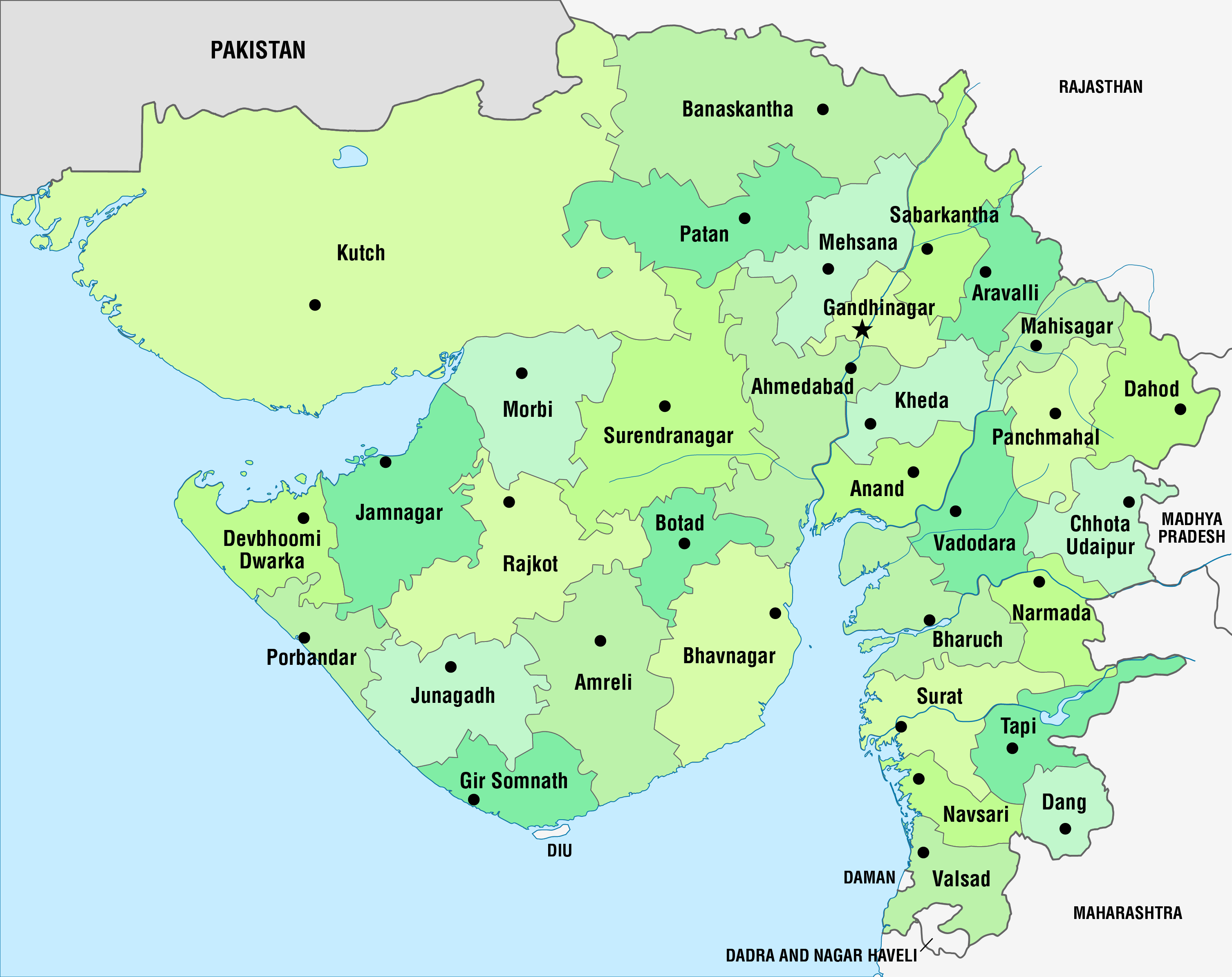
Located in India’s westernmost part, bordering Pakistan, the state of Gujarat has a 1,600 km long coastline, most of which lies on the Kathiawar peninsula. The fifth largest state by area and the ninth largest state by population, Gujarat with its population in excess of 60 million is bordered by Rajasthan to the northeast, Dadra and Nagar Haveli and Daman and Diu to the south, Maharashtra to the southeast, Madhya Pradesh to the east, and the Arabian Sea and the Tharparkar, Badin and Thatta districts of Pakistani province of Sindh to the west. The capital city is Gandhinagar, while its largest city is Ahmedabad. Gujarat’s economy is one of the strongest in the country at number five and is built upon the business acumen of its people.
Historically, the north was known as Anarta, the Kathiawar peninsula, “Saurastra”, and the south as “Lata”. Gujarat was also known as Pratichya and Varuna. The Arabian Sea makes up the state’s western coast. Gujarat has the longest coastline – 24% of the Indian coastline is in this state and is dotted with 41 ports: one major, 11 intermediate and 29 minor.
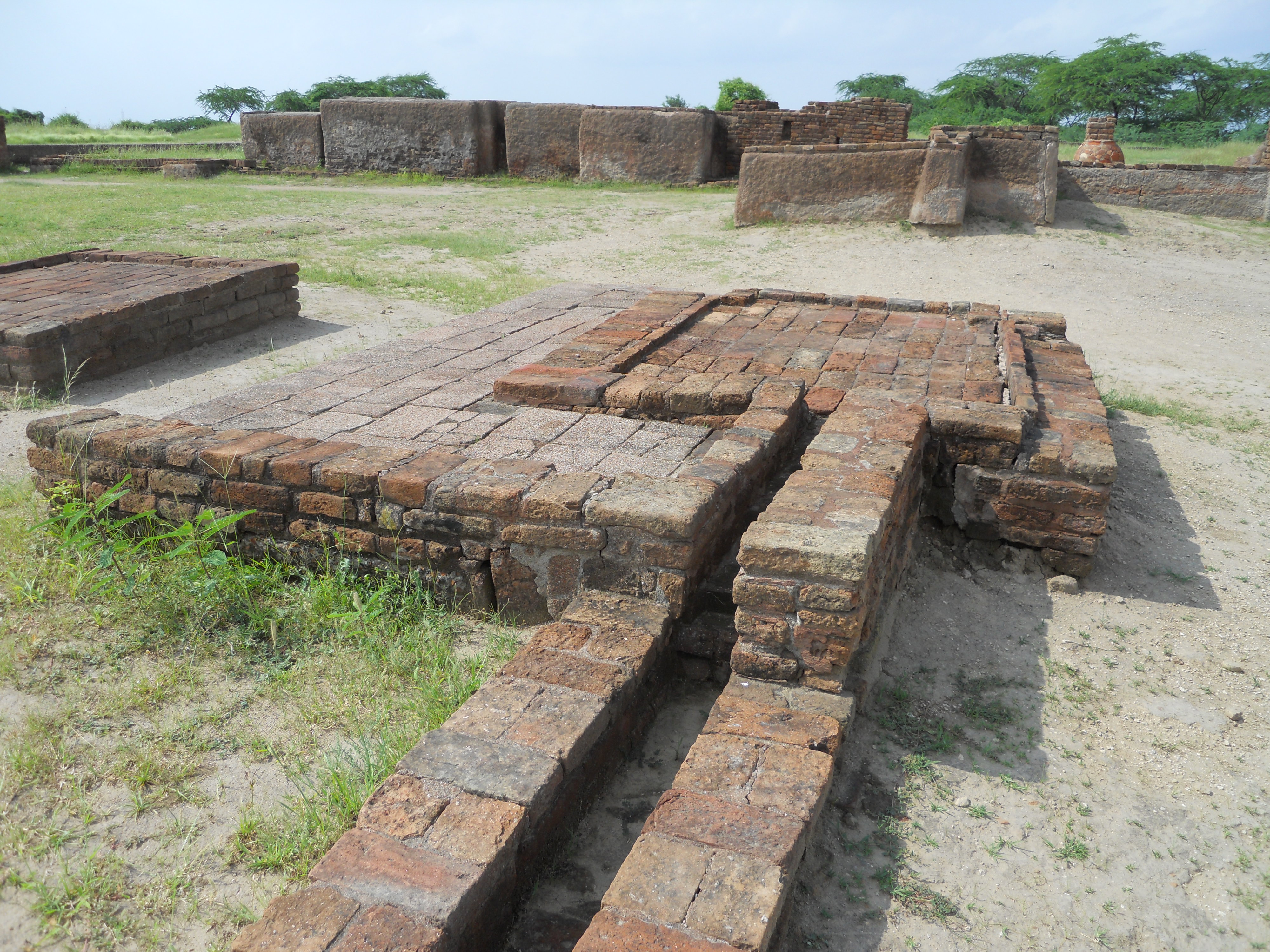
The state encompasses some sites of the ancient Indus Valley Civilisation, such as Lothal, Dholavira and Gola Dhoro. Lothal is believed to be one of the world’s first seaports. Gujarat’s coastal cities, chiefly Bharuch and Khambhat, served as ports and trading centres in the Maurya and Gupta empires, and during the succession of royal Saka dynasties from the Western Satraps era. Along with Bihar and Nagaland, Gujarat is one of the three Indian states to prohibit the sale of alcohol. Gir Forest National Park in Gujarat is home of the only wild population of the Asiatic lion in the world.
The word Gujarat is derived from the Sanskrit term Gurjaradesa, meaning “The Land of the Gurjaras”, who ruled Gujarat in the 8th and 9th centuries. Parts of modern Rajasthan and Gujarat have been known as Gurjaratra or Gurjarabhumi or land of the Gurjars for centuries before the Mughal period.
Present day Gujarat was one of the main central areas of the Indus Valley Civilisation. It contains ancient metropolitan cities from the Indus Valley such as Lothal, Dholavira, and Gola Dhoro. The ancient city of Lothal was where India’s first port was established. The ancient city of Dholavira is one of the largest and most prominent archaeological sites in India, belonging to the Indus Valley Civilisation. The most recent discovery was Gola Dhoro. Altogether, about 50 Indus Valley settlement ruins have been discovered in Gujarat.
There is clear historical evidence of trade and commerce ties between ancient Gujarat and Egypt, Bahrain and Sumer in the Persian Gulf during the time period of 1000 to 750 BC. There was a succession of Hindu and Buddhist states such as the Mauryan Dynasty, Western Satraps, Satavahana dynasty, Gupta Empire, Chalukya dynasty, Rashtrakuta Empire, Pala Empire and Gurjara-Pratihara Empire, as well as local dynasties such as the Maitrakas and then the Chaulukyas who ruled the state.
The early history of Gujarat reflects the imperial grandeur of Chandragupta Maurya who conquered a number of earlier states in what is now Gujarat. Pushyagupta, a Vaishya, was appointed the governor of Saurashtra by the Mauryan regime. He ruled Girinagar which is now modern-day Junagadh between 322 to 294 BC and built a dam on the Sudarshan lake. Emperor Ashoka, the grandson of Chandragupta Maurya, not only ordered engraving of his edicts on the rock at Junagadh but asked Governor Tusherpha to cut canals from the lake where an earlier Mauryan governor had built a dam. Between the decline of Mauryan power and Saurashtra coming under the sway of the Samprati Mauryas of Ujjain, there was an Indo-Greek defeat in Gujarat of Demetrius. In 16th century manuscripts, there is an apocryphal story of a merchant of King Gondaphares landing in Gujarat with Apostle Thomas. The incident of the cup-bearer torn apart by a lion might indicate that the port city described is in Gujarat.
For nearly 300 years from the start of the 1st century AD, Saka rulers played a prominent part in Gujarat’s history. Mahakshatrap Rudradaman I founded the Kardamaka dynasty which ruled from Anupa on the banks of the Narmada up to the Aparanta region which bordered Punjab. In Gujarat, several battles were fought between the south Indian Satavahana dynasty and the Western Satraps. The greatest and the mightiest ruler of the Satavahana Dynasty was Gautamiputra Satakarni who defeated the Western Satraps and conquered some parts of Gujarat in the 2nd century AD. The Kshatrapa dynasty was replaced by the Gupta Empire with the conquest of Gujarat by Chandragupta Vikramaditya. Vikramaditya’s successor Skandagupta left an inscription around 450 AD on a rock at Junagadh which gives details of the governor’s repairs to the embankment surrounding Sudarshan lake after it was damaged by floods. The Anarta and Saurashtra regions were both parts of the Gupta empire. Towards the middle of the 5th century, the Gupta empire went into decline. Senapati Bhatarka, the Maitraka general of the Guptas, took advantage of the situation and in 470 AD he set up what came to be known as the Maitraka state. He shifted his capital from Giringer to Valabhipur, near Bhavnagar, on Saurashtra’s east coast. The Maitrakas of Vallabhi became very powerful with their rule prevailing over large parts of Gujarat and adjoining Malwa. A university was set up by the Maitrakas, which came to be known far and wide for its scholastic pursuits and was compared with the noted Nalanda University. It was during the rule of Dhruvasena Maitrak that Chinese philosopher-traveler Xuanzang or I Tsing visited in 640 AD along the Silk Road.
Gujarat was known to the ancient Greeks and was familiar with other Western centers of civilisation through the end of the European Middle Ages. The oldest written record of Gujarat’s 2,000-year maritime history is documented in a Greek book titled The Periplus of the Erythraean Sea: Travel and Trade in the Indian Ocean by a Merchant of the First Century.
In the early 8th century, the Arabs of the Umayyad Caliphate established an empire in the name of the rising religion of Islam, which stretched from Spain in the west to Afghanistan and modern-day Pakistan in the east. Al-Junaid, the successor of Qasim, finally subdued the Hindu resistance within Sindh and established a secure base. The Arab rulers tried to expand their empire southeast, which culminated in the Caliphate campaigns in India fought in 730; they were defeated and expelled west of the Indus river, probably by a coalition of the Hindu rulers Nagabhata I of the Pratihara Dynasty, Vikramaditya II of the Chalukya dynasty and Bappa Rawal of Guhila dynasty. After this victory, the Arab invaders were driven out of Gujarat. In the late 8th century, the Kannauj Triangle period started. The three major Indian dynasties – the northwest Indian Gurjara-Pratihara Dynasty, the south Indian Rashtrakuta Dynasty and the east Indian Pala Empire – dominated India from the 8th to 10th centuries. During this period the northern part of Gujarat was ruled by the north Indian Gurjara-Pratihara dynasty and the southern part of Gujarat was ruled by the south Indian Rashtrakuta dynasty until it was captured by the south Indian ruler Tailapa II of the Western Chalukya Empire.
Zoroastrians from Greater Iran migrated to the western borders of South Asia which were then Gujarat and Sindh during the 8th or 10th century, to avoid persecution by Muslim invaders who were in the process of conquering Iran. The descendants of those Zoroastrian refugees came to be known as the Parsi community both in present day India and Pakistan.
The Chaulukya dynasty ruled Gujarat from 960 to 1243 AD and at that time, Gujarat was a major center of Indian Ocean trade, and their capital at Anhilwara (Patan) was one of the largest cities in India, with population estimated at 100,000 in the year 1000. After 1243, the Solankis lost control of Gujarat to their feudatories, of whom the Vaghela chiefs of Dholka came to dominate Gujarat. In 1292 the Vaghelas became tributaries of the Yadava dynasty of Devagiri in the Deccan. Karandev of the Vaghela dynasty was the last Hindu ruler of Gujarat. He was defeated and overthrown by the superior forces of Alauddin Khalji from Delhi in 1297. With his defeat, Gujarat became part of the Muslim empire, and the Rajput hold over Gujarat would never be restored.
An independent Muslim community continued to flourish in Gujarat for the next hundred years, championed by Arab merchants settling along the western coast belonging to the Shafi’ite madhhab. From 1297 to 1300, Alauddin Khalji, the Turko-Afghan Sultan of Delhi, destroyed the Hindu metropolis of Anhilwara and incorporated Gujarat into the Delhi Sultanate. After Timur’s sacking of Delhi at the end of the 14th century weakened the Sultanate, Gujarat’s Muslim Rajput governor Zafar Khan Muzaffar also known as Muzaffar Shah I asserted his independence, and his son, Sultan Ahmed Shah who ruled between 1411 to 1442, established Ahmedabad as the capital. Khambhat eclipsed Bharuch as Gujarat’s most important trade port.
Later, a close alliance between the Ottoman Turks and Gujarati sultans to effectively safeguard Jeddah and the Red Sea trade from Portuguese imperialism, encouraged the existence of powerful Rumi elites within the kingdom who took the post of viziers in Gujarat keen to maintain ties with the Ottoman state. The Mughal emperor Humayun, had also briefly occupied the province in 1536, but fled due to the threat Bahadur Shah, the Gujarat king, imposed. The Sultanate of Gujarat remained independent until 1572, when the Mughal emperor Akbar the Great conquered it and annexed it to the Mughal Empire. The Surat port then became the principal port of India during Mughal rule to gain widespread international repute. The city of Surat, famous for its cargo export of silk and diamonds had come on a par with contemporary Venice and Beijing which were some of the great mercantile cities of Europe and Asia, and earned the distinguished title, Bab al-Makkah or Gate of Mecca.
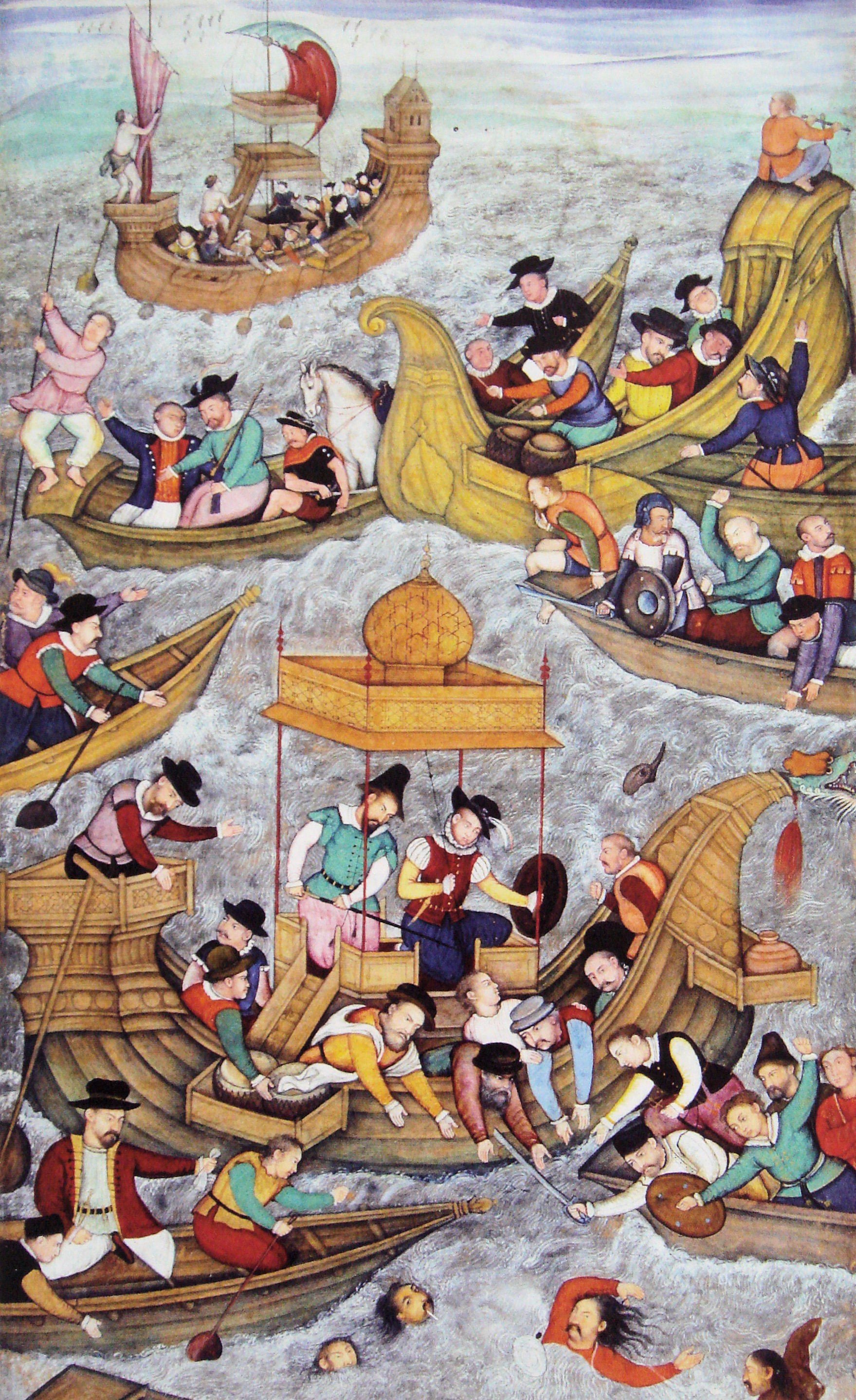
In 1497, Portuguese explorer Vasco da Gama is said to have discovered the Europe-to-India sea route which changed the course of history, thanks to Kutchi sailor Kanji Malam, who showed him the route from the East African coasts of Mozambique sailing onwards to Calicut off the Malabar coast in India. Later, the Gujarat Sultanate allied with the Ottomans and Egyptian Mamluks naval fleets led by governor-generals Malik Ayyaz and Amir Husain Al-Kurdi, vanquished the Portuguese in the 1508 Battle of Chaul resulting in the first Portuguese defeat at sea in the Indian Ocean. To 16th-century European observers, Gujarat was a fabulously wealthy country. The customs revenue of Gujarat alone in the early 1570s was nearly three times the total revenue of the whole Portuguese empire in Asia in 1586–87, when it was at its height. When the British arrived on the coast of Gujarat, houses in Surat already had windows of Venetian glass imported from Constantinople through the Ottoman empire. The conquest of the Kingdom of Gujarat marked a significant event of Akbar’s reign. Being the major trade gateway and departure harbour of pilgrim ships to Mecca, it gave the Mughal Empire free access to the Arabian sea and control over the rich commerce that passed through its ports. The territory and income of the empire were vastly increased.
For the best part of two centuries, the independent Rajput Sultanate of Gujarat was the cynosure of its neighbours on account of its wealth and prosperity, which had long made the Gujarati merchant a familiar figure in the ports of the Indian Ocean. Gujaratis, including Hindus and Muslims as well as the enterprising Parsi class of Zoroastrians, had been specialising in the organisation of overseas trade for many centuries, and had moved into various branches of commerce such as commodity trade, brokerage, money-changing, money-lending and banking. By the 17th century, Chavuse and Baghdadi Jews had assimilated into the social world of the Surat province, later on their descendants would give rise to the Sassoons of Bombay and the Ezras of Calcutta, and other influential Indian-Jewish figures who went on to play a philanthropical role in the commercial development of 19th-century British Crown Colony of Shanghai. Spearheaded by Khoja, Bohra, Bhatiya shahbandars and Moorish nakhudas who dominated sea navigation and shipping, Gujarat’s transactions with the outside world had created the legacy of an international transoceanic empire which had a vast commercial network of permanent agents stationed at all the great port cities across the Indian Ocean. These networks extended to the Philippines in the east, East Africa in the west, and via maritime and the inland caravan route to Russia in the north.
When the cracks had started to develop in the edifice of the Mughal Empire in the mid-17th century, the Marathas were consolidating their power in the west. Chatrapati Shivaji, the great Maratha ruler, attacked Surat in southern Gujarat twice first in 1664 and again in 1672. These attacks marked the entry of the Marathas into Gujarat. However, before the Maratha inroads into Gujarat, the Europeans had made their presence felt, with the Portuguese leading them, followed by the Dutch and the English. The Peshwas had established their sovereignty over parts of Gujarat and collected taxes and tributes through their representatives. Damaji Gaekwad and Kadam Bande divided the Peshwa’s territory between them, with Damaji establishing the sway of Gaekwad over Gujarat and made Baroda or present day Vadodara in southern Gujarat his capital. The ensuing internecine war among the Marathas was fully exploited by the British, who interfered in the affairs of both Gaekwads and the Peshwas. In Saurashtra, as elsewhere, the Marathas were met with resistance. The decline of the Mughal Empire helped form larger peripheral states in Saurashtra, including Junagadh, Jamnagar, Bhavnagar and a few others, which largely resisted the Maratha incursions.
In the 1600s, the Dutch, French, English and Portuguese all established bases along the western coast of the region. Portugal was the first European power to arrive in Gujarat, and after the Battle of Diu, acquired several enclaves along the Gujarati coast, including Daman and Diu as well as Dadra and Nagar Haveli. These enclaves were administered by Portuguese India under a single union territory for over 450 years, only to be later incorporated into the Republic of India on 19 December 1961 by military conquest. The British East India Company established a factory in Surat in 1614 following the commercial treaty made with Mughal Emperor Nuruddin Salim Jahangir, which formed their first base in India, but it was eclipsed by Bombay after the English received it from Portugal in 1668 as part of the marriage treaty of Charles II of England and Catherine of Braganza, daughter of King John IV of Portugal. The state was an early point of contact with the west, and the first British commercial outpost in India was in Gujarat.
Later in the 17th century, Gujarat came under control of the Hindu Maratha Empire that rose defeating the Muslim Mughals and who dominated the politics of India. Most notably, from 1705 to 1716, Senapati Khanderao Dabhade led the Maratha Empire forces in Baroda. Pilaji Gaekwad, first ruler of Gaekwad dynasty, established the control over Baroda and other parts of Gujarat. The British East India Company wrested control of much of Gujarat from the Marathas during the Second Anglo-Maratha War in 1802–1803. Many local rulers, notably the Rajput Maratha Gaekwad Maharajas of Baroda (Vadodara), made a separate peace with the British and acknowledged British sovereignty in return for retaining local self-rule. An epidemic outbreak in 1812 killed half the population of Gujarat.
Gujarat was placed under the political authority of the Bombay Presidency, with the exception of Baroda state, which had a direct relationship with the Governor-General of India. From 1818 to 1947, most of present-day Gujarat, including Kathiawar, Kutch and northern and eastern Gujarat were divided into hundreds of princely states, but several districts in central and southern Gujarat, namely Ahmedabad, Broach (Bharuch), Kaira (Kheda), Panchmahal and Surat, were governed directly by British officials.
After Indian independence and the partition of India in 1947, the new Indian government grouped the former princely states of Gujarat into three larger units; Saurashtra, which included the former princely states on the Kathiawad peninsula, Kutch, and Bombay state, which included the former British districts of Bombay Presidency together with most of Baroda state and the other former princely states of eastern Gujarat. Bombay state was enlarged to include Kutch, Saurashtra (Kathiawar) and parts of Hyderabad state and Madhya Pradesh in central India. The new state had a mostly Gujarati-speaking north and a Marathi-speaking south. Agitation by Gujarati nationalists, the Mahagujarat Movement, and Marathi nationalists, the Samyukta Maharashtra, for their own states led to the split of Bombay state on linguistic lines; on 1 May 1960, it became the new states of Gujarat and Maharashtra. In 1969 riots, at least 660 died and properties worth millions were destroyed.
The first capital of Gujarat was Ahmedabad; the capital was moved to Gandhinagar in 1970. The Nav Nirman Andolan, a socio-political movement of 1974, was a students’ and middle-class people’s movement against economic crisis and corruption in public life. This was the first and last successful agitation after the Independence of India that ousted an elected government.
The 2001 Gujarat earthquake’s epicentre was located about 9 km south-southwest of the village of Chobari in Bhachau Taluka of Kutch District. This earthquake’s magnitude of 7.7 shock killed around 20,000 people, including at least 18 in South-eastern Pakistan, injured another 167,000 and destroyed nearly 400,000 homes.
In February 2002, the Godhra train burning lead to statewide riots, resulting in the deaths of 1044 people – 790 Muslims and 254 Hindus, and hundreds missing still unaccounted for. The Akshardham Temple was attacked by two terrorists in September 2002, killing 32 people and injuring more than 80 others. National Security Guards intervened to end the siege killing both terrorists. On 26 July 2008 a series of seventeen bomb blasts rocked the city, killing and injuring several people.
The Sabarmati River is the largest river in Gujarat followed by the Tapi, although the Narmada covers the longest distance in its passage through the state. The Sardar Sarovar Project is built on the Narmada River and it is one of only three rivers in peninsular India that run from east to west – the others being the Tapi River and the Mahi River. Gujarat has some of the major mountain ranges of India, including the Aravallis, the Sahyadris or what is commonly known as the Western Ghats, the Vindhyas and the Saputaras. Girnar is the tallest peak and Saputara is the only hill-station in the state. The Rann of Kutch is a seasonally marshy saline clay desert located in the Thar Desert biogeographic region in between the province of Sindh and the state of Gujarat situated 8 kilometres from the village of Kharaghoda in the Surendranagar District and Pakistan’s Sindh province. The name “Rann” comes from the Gujarati word rann which means “desert”.
As per the 2011 census, the state has one of the lowest sex ratios in the country. There are 918 girls for 1000 boys. Hindus makes up the biggest number of residents at about 88.5% with Muslims constituting about 10% and the others the balance 1.5% of the population. Gujarat has the third-largest population of Jains in India, following Maharashtra and Rajasthan. The state’s official language is Gujarati which is spoken natively by about 86% of the population. People from the Kutch region also speak in the Kutchi mother tongue, and to a great extent appreciate Sindhi as well. Memoni is the mother tongue of Kathiawar and Sindhi Memons, most of them who are exclusively Muslims.
The best time to visit the state is between une to March, when the weather is pleasant as compared to the summer, when heat and humidity rules the roost.
So let’s go and visit Vibrant Gujarat as the state tourism puts it. This time, instead of starting with a state’s capital city and then fanning outwards, I am going to start first with South Gujarat which is the part closest to my home state of Maharashtra and then move to Central Gujarat, North Gujarat and then loop back to Saurashtra and Kutch.