Festivals of India: Akshaya Tritiya

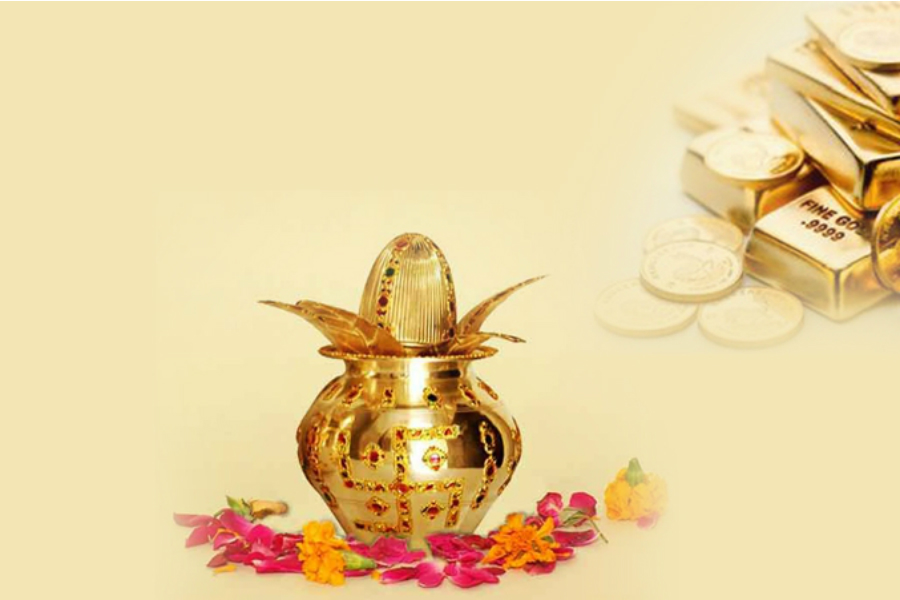
Also known as Akti or Akha Teej, Akshaya Tritiya is an annual spring time festival celebrated by Hindus and Jains. It falls on the third Tithi or lunar day of bright half or Shukla Paksha of the Vaisakha month which falls every year between April and May according to the lunisolar Hindu calendar. It is observed as an auspicious time regionally by Hindus and Jains in India and Nepal, as signifying the “third day of unending prosperity”. The word Akshaya means “never diminishing” as the festival is associated with wealth, prosperity and happiness and Tritiya means third day. This year’s Akshaya Tritiya fell yesterday, April 26. This day is said to be very auspicious if you are planning on starting a new venture as anything started on this day will be successful.

Akshaya Tritiya has lot of religious significance for both Hindus and Jains. This day is the birthday of Lord Parashurama, one of the ten Dashavataras of Lord Vishnu and is also the starting day of Treta Yuga after Satya Yuga. It was on Akshaya Tritiya that the poor Brahmin Sudama offered flattened rice or aval to Lord Krishna, who in turn blessed him with bountiful wealth and happiness. On this day, it is said Lord Krishna gave the Akshaya Patra to Draupadi when the Pandavas started for the Vanavasa, so that they always have food in abundance. The sage Veda Vyasa started writing the epic Mahabharata on this day and it was the day when the holy river Ganges descended upon the Earth. The annual Puri Jagannath Rath Yatra also begins on this day.
Source

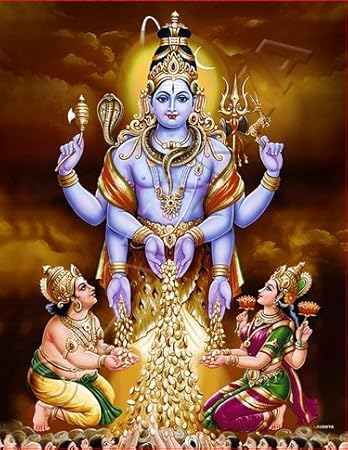
It is also belived that the God of Wealth and the treasurer of all deities ‘Kubera’ received his riches and position by praying to Lord Shiva at Shivapuram on Akshaya Tritiya. For the Jains, this day commemorates the day the first Tirthankara, Rishabhdev ended his year-long asceticism by consuming sugarcane juice poured into his cupped hands. Some Jains refer to the festival as Varshi Tapa and on this day, fasting and ascetic austerities are marked by Jains, particularly at pilgrimage sites such as Palitana in Gujarat.

Akshaya Tritiya is considered a very auspicious day because it is a day of manifold blessings. People believe that any good work done on this day will give exponential returns. This is why this day is considered very auspicious to buy gold, silver and precious stones. Goddess Lakshmi signifies wealth and it is said that if one invests in gold, silver or precious stones silver on this day, she will bless you with prosperity and wealth.

This year’s festivities are bound to be very muted because of the COVID-19 panademic worldwide, but if there is just one thing I would pray for on this way would be that we find a cure to this virus soon and things get back to normal!

Leaving you with this Kanakadhara Stotram which Adi Shankaracharya recited for a poor couple on this day at whose house he stopped for Bhiksha or alms and was offered their only available gooseberry. This version of the stotram is sung by the unparalleled M.S Subbalakshmi and is my favourite version.

2020 Week 17 Update

As of now, Singapore has the highest number of Covid-19 positive cases in Southeast Asia. We are now in excess of 12,000 cases with the vast majority of cases now daily coming in from work permit holders who live in foreign worker dormitories. This is also due to the very aggressive testing that is being undertaken in the dormitories. A few days in the begining of the week saw more than 1,000 cases on a daily basis, but in the past few days, this number has been steadily decreasing, which is some consolation. Also, Singapore’s circuit breaker has now been extended for a month more till 1st June, so that’s another four more weeks of staying home.

The children finished their first week of school with Home Based Learning and this will go on for the whole term. Hopefully the circuit breaker is lifted in early June and they can actually start going to school. The school holidays has also been preponed to start from 4th May and school will resume when (hopefully) the circuit breaker ends in early June. The syllabus for the national exams this year has been cut across the board and I know some students are panicking about it!

Remember the video call I mentioned with my school classmates? We spoke with each other and most of us saw each other after a few decades! And as if this triggered some sort of switch, our WhatsApp grew exploded and people reached out to other classmates whom they were in touch with and got them to join the group. This past week has been very delighful with lots of old memories remembered and ignited. My hope is that when the situation stabilises, we have a full class reunion.

Stay home and stay safe everyone!

In My Hands Today…

Scenes from Early Life – Philip Hensher

This image has an empty alt attribute; its file name is 13447923.jpg

“At that time, there were children you weren’t supposed to play with. You knew why. Their parents had been informers during the war. And it hadn’t been long since you could have got into trouble for singing a song. My grandfather hid all his Bengali poetry in the cellar.

“I was a baby during the war. We stayed inside for months. All my aunts took turns in feeding me. I couldn’t be heard to cry. You see, there were soldiers in the streets. They would have known what a crying baby meant. So I had to be kept silent. No, not everyone came out of the war alive.”

One family’s life, and a nation – Bangladesh – being created through conversation, sacrifice, songs, bonds, blood, bravery and jokes.

World Book and Copyright Day

Also known as World Book Day and or International Day of the Book, the World Book and Copyright Day is an annual event organized by the United Nations Educational, Scientific and Cultural Organization or UNESCO to promote reading, publishing, and copyright. World Book Day was first celebrated on 23 April 1995, and continues to be recognized on that day. A related event in the United Kingdom and Ireland is observed in March.

I have written in detail about the event previously here, here and here, so just pop by there for more information on the history of this day.

World Book and Copyright Day is a celebration to promote the enjoyment of books and reading. Each year, on 23 April, celebrations take place all over the world to recognize the scope of books – a link between the past and the future, a bridge between generations and across cultures. On this occasion, UNESCO and the international organizations representing the three major sectors of the book industry – publishers, booksellers and libraries, select the World Book Capital for a year to maintain, through its own initiatives, the impetus of the Day’s celebrations.

The 2020 World Book Capital or WBC is Kuala Lumpur, Malaysia. Kuala Lumpur or KL as it is known in the region, was selected on the recommendation by the World Book capital Advisory Committee, comprising representatives of the International Publishers Association (IPA), the International Federation of Library Associations (IFLA) and UNESCO based on applications received from cities all over the world. To know more, here’s the link to the website of the Kuala Lumpur World Book Capital. Previous World Book Capitals have been Sharjah in 2019, Athens in 2018, Conakry in 2017 and Wroclaw in 2016. UNESCO is also accepting applications for the World Book Capital for 2022 and the deadline for the same is Thursday 25 June 2020 in case anyone is interested for their city to become the WBC. The application form and more information is available on the UNESCO website.

Why April 23? It is because 23 April is a symbolic date in world literature. It is the date on which several prominent authors, William Shakespeare, Miguel Cervantes and Inca Garcilaso de la Vega all died. Therefore this date was a natural choice for UNESCO at its 1995 General Conference, held in Paris, to pay a world-wide tribute to books and authors on this date, encouraging everyone to access books.

Today with schools and other institues of learning closed because of the panademic caused by Covid-19, and people having to limit their time spent outside their homes, it is all the more important that all of us continue to read, to leverage the immense power that books wield and expand their horizons. Books are the best medium to stimulate our minds and creativity, while ensuring we stay inside.

For parents, please take time to read on your own or with your children not just in April, but throughout the year. With your children, celebrate the importance of reading, foster your children’s growth as readers and promote a lifelong love of literature.

Books allow you to travel distances, go to worlds not available on this earth and have zany adventures, all from the comfort of your chair, sofa or bed. Books are the best ways to allow your imagination to soar and combat the lonliness that most of us are feeling right now.

As someone who loves reading, I can’t emphasise books enough. Today when electronic gadgets affect our minds to the extent that we get bored in a matter of minutes, a good book, which can capture and sustain our interest for a few hours is invaluable. We read and then we grow our minds, our thinking not only becomes critical, we also become open to other view points.

From a parents perspective, reading is essential for a child’s mental well-being. I remember dragging myself down to our community library about 15 days post partum, armed with BB & GG’s birth certificates to get them their own library cards. I also used to borrow books for them on a weekly basis until they were old enough to borrow their own books.

A 2019 study published in the US found that parents who regularly read with their toddlers were less likely to be overly harsh with them and the children more likely to be better behaved. Of course, we all know that a child who reads performs better academically. A European study published earlier this year in February suggested that children and teens who read a good quality book daily may benefit from improved academic performance at school. Reading naturally improves your language and it doesn’t just have to be English, but yes, that’s the language that has the biggest benefit because we generally tend to read more in this language. But if you want to improve any langague, read more in that language and see how your spoken and written skills bloom. Reading can also improve children’s receptive language skills. A British study which reviewed 40 years of reading intervention studies from the US, South Africa, Canada, Israel and China, found that children who were read to at a young age showed improved receptive language skills, which is the ability to understand information. The children who were read to also showed smaller but still positive improvements in their expressive language, which is how a child puts their thoughts into words such as vocabulary and grammar, and pre-reading skills, such as how words are structured.

So there you have it, the benefits of reading and what a good book does to you. So spend this time where we are quarantined, locked down or just advised not to venture out with a good book and read together as a family! Sit in a comfortable position, grab a good book, have some hot coffee or tea next to you with some snacks and read away! Aah, bliss!!!

In My Hands Today…

Offshore – Penelope Fitzgerald

On the Battersea Reach of the Thames, a mixed bag of the slightly disreputable, the temporarily lost, and the patently eccentric live on houseboats, rising and falling with the great river’s tides.

Belonging to neither land nor sea, they cling to one another in a motley yet kindly society. There is Maurice, by occupation a male prostitute, by happenstance a receiver of stolen goods. And Richard, a buttoned-up ex-navy man whose boat dominates the Reach. Then there is Nenna, a faithful but abandoned wife, the diffident mother of two young girls running wild on the waterfront streets.

It is Nenna’s domestic predicament that, as it deepens, draws the relations among this scrubby community together into ever more complex and comic patterns.