Chow Chow (aka Chayote) Kootu

A kootu is another traditional South Indian food item. Kootus are generally vegetables mixed with a lentil or dal (usually moong, but can be others also) with a coconut/chilli gravy all mixed together. This is another example of Indian meals being complete meals as this kootu will have proteins from the lentils, plus fibre from the vegetables. This is usually eaten with a carbohydrate like rice or roti and you have all the important parts of a meal together.

Today’s recipe is Chayote or Chow Chow Kootu

Chayote is an edible plant belonging to the gourd family, being roughly pear-shaped and light green in colour. The skin is not used in Indian cooking and the flesh has a bland taste. This means it takes on any flavouring that is added to it. The seeds are generally not used in cooking.

Chow Chow Kootu

Ingredients:

  • 3 Chayotes (peeled, seeds removed and diced)
  • ½ cup Moong Dal
  • 3 tbsps Channa Dal
  • ½ tsp turmeric powder
  • salt to taste
  • ½ cup freshly grated cocounut (you can use frozen coconut if you don’t have access to fresh coconut. I have used frozen coconut in this recipe)
  • 4-5 fresh green chillies (this is what I used, but please adjust according to the intensity of the chillies and your spice tolerance level)
  • ½ tsp cumin seeds
  • ¼ tsp mustard seeds
  • 1 tsp oil
  • ¼ tsp urad dal
  • A small sprig of curry leaves
  • A pinch of asafetida

Method:

In a pressure cooker, cook the moong dal and 2 tbsps of the chana dal with ¼ tsp of turmeric powder. While the dals are cooking, peel the chow chow, remove the seeds and chop into small, bite-sized cubes. Cook the chow chow in a pan with very little water, ¼ tsp of turmeric powder and some salt.

In a mixer, add the coconut, cumin seeds and chillies and grind it to a fine paste without adding too much water. Some people prefer to add yoghurt here, but I don’t, preferiing to add water to provide the moisture to grind it.

Once the Chayote is cooked but firm, add the dal to it along with the coconut mixture. Adjust the salt and let it boil for a while, around 5-7 minutes. Then turn off the gas and start the tempering to finish the dish.

In a smaller skillet, pour 1 tsp oil oil and wait for it to heat up. Once heated up, put the mustard seeds and wait for it to pop. Once it pops, add the urad dal, curry leaves and asafetida and lightly stir. When the urad dal starts to brown remove from flame and add it to the kootu. Mix well and serve with rice or rotis.
Shall I??

On Tuesday evening after dinner, we went to visit my in-laws who live a 10-15 minute walk/5 minute drive. My Father In Law (FIL) has just been diagnosed with Lung Cancer and so we wanted to go meet him.

While coming back home, somehow, the topic of discussion went to the question of citizenship. S and the kids are all Singaporeans while I still retain my Indian passport. I really don’t know why I still have not taken the final step to get my red passport (A Singapore passport is red in colour, hence the line). BB & GG had a lot of questions as to why I did not change allegiances. Actually there is no great reason except for the fact when I could first do it, I was not ready mentally, maybe for sentimental reasons and so put it off. Now my re-entry permit expires in 2017 and so have time till then to swing either way. Actually, these days, I identify myself more Singaporean than Indian as the India I grew up in is not really in existence now. I just need to get a few things clarified the next time I go to Mumbai (legal stuff) and then I can take the final step towards renouncing my citizenship.

Like I told BB & GG, I am Singaporean in my heart – I stand up when Majulah Singapura is played (the Singapore national anthem) and recite the pledge with my right hand over my heart like the millions of Singaporeans and so it’s just formalities now.

In fact, here’s a short anecdote to illustrate this. Earlier this week, I was at an international school for an event. The chief guest was an Member of Parliament and while we were waiting, the school’s PA system asked the school to stand for the national anthem. I looked around and found everyone still sitting, so I got up and asked “Shouldn’t we stand” and then everyone stood up!

GG very categorically told me that I should become a Singaporean very soon just like her, BB and Daddy as we’re one family and everyone should be the same! So yeah, in the next two years, that’s a goal to reach!

One benefit of having a Singapore passport is leaving behind all the visa hassles I’ve had to undergo since coming here. Singapore citizens can travel visa free to many countries in the world, while Indians need a visa for practically every country. So this means impromptu trips will be more of a norm, rather than what we are doing now – which is planning and getting my visas everywhere we need to go!

Carrot Chutney/Thuvaiyal

My definition of a Thuvaiyal is a chutney to which coconut has been added. A chutney is a mixture of vegetables and spices. A thuvaiyal, on the other hand, has in addition to the chutney ingredients, coconut to give it some body.

I had some carrots which were slightly bitter to taste. I didn’t know what to do with them, then remembered this thuvaiyal that my mom used to make. This thuvaiyal  can be eaten with idli/dosa/bread or even mixed with rice. My mom used to make thuvaiyals to be eaten with rice when she didn’t want to cook much that day.

Carrot Thuvaiyal

Ingredients:

  • 1 cup chopped carrots
  • 1/2 cup grated coconut
  • 1 tsp mustard seeds
  • 4-5 dried red chillies
  • 1 tsp urad dal
  • a pinch of asafoetida
  • a small lime-sized ball of tamarind
  • 1 tsp oil
  • Salt to taste
Method:
Heat oil in a pan and put in the mustard seeds. When they pop, add the urad dal, asafoetida and red chillies. Stir for a few seconds and then add the carrots and tamarind. Fry for a while till the carrots a bit soft and the raw smell goes away. You do not need to cook the carrots, but they do need to lose the raw hardness. When the carrots soften, remove from the fire and let it cool.
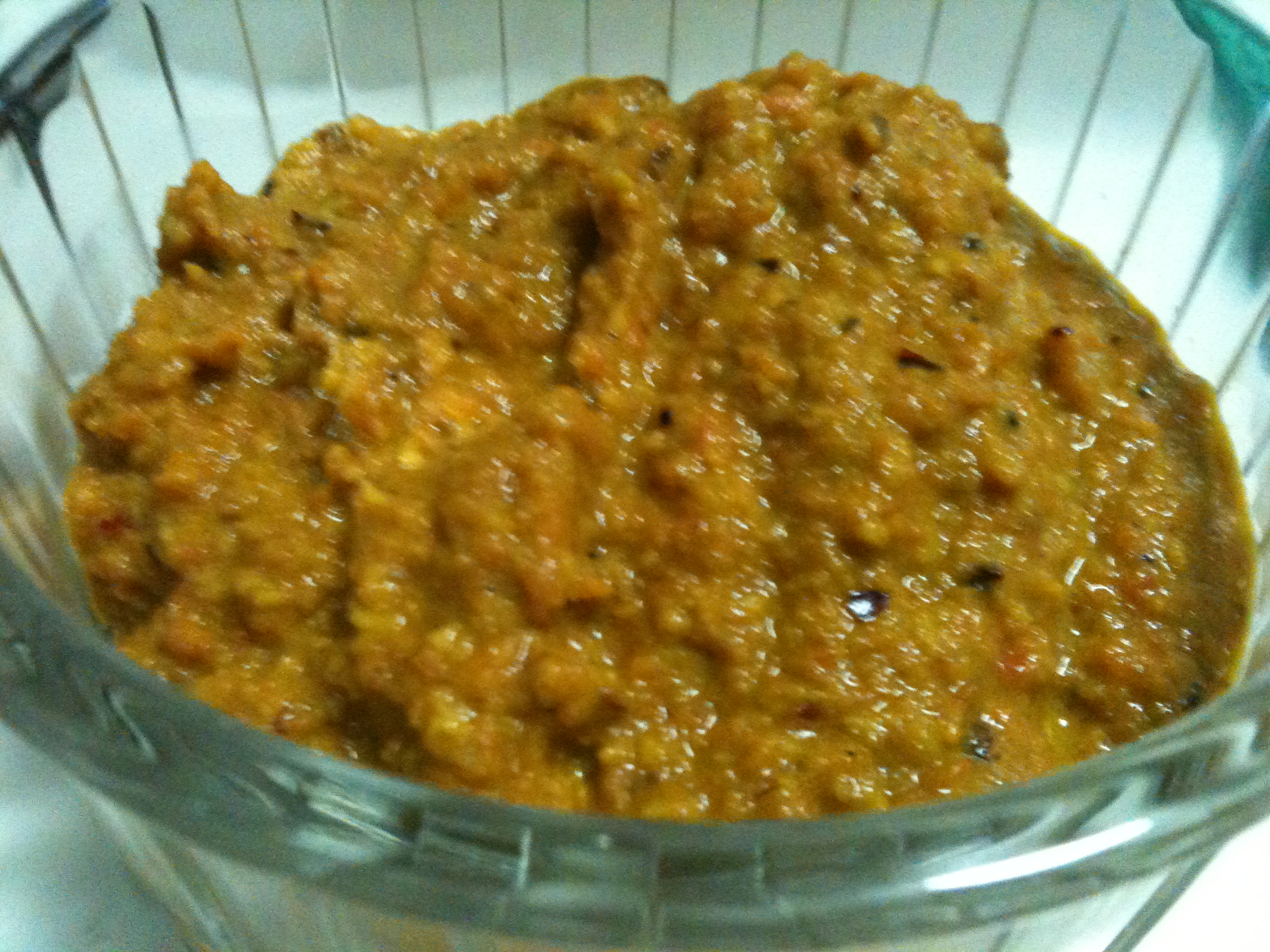
When the carrots mixture are cool, blend it in a mixer with coconut adding water if needed. Since my carrots were a bit bitter, I added some jaggary to this, but if you have sweet carrots, you can omit this. Once the carrot-coconut mixture is finely ground, add salt to taste and transfer to a serving bowl. This can be eaten mixed with rice when you don’t want to cook or eaten with idli, dosa or even with bread. This keeps for upto a week in the fridge.

Milagai Podi

Milagai Podi or Gunpowder as it is commonly called, is a staple in most South Indian homes. It is basically a coarse to fine powder made out of different lentils and chillies. The powder is used as an accompaniment to Idlis and Dosas and is eaten with a serving of sesame or gingelly oil poured in it and mixing it up. The oil tones down the spiciness and dryness of the powder.

Different communities and families play around with the basic recipe to have a milagai Podi recipe which is unique to their home. This version was taught to me by my mother and is probably a variation of what is made in most Tamil Brahmin households.


Milagai Podi

Ingredients:

I cup Chana Dal

1 cup Urad Dal

¾ cup white Sesame seeds

1 cup chopped dry red chilies

1 tsp oil

¼ tsp asafetida

2 tbsps jaggary

Salt to tast

Method:

Before starting, soak the sesame seeds in water for around 10-15 minutes. While it is soaking, dry roast the chana dal and urad dal separately. Keep stirring the dal while roasting so that they do not burn. This is an important part of the whole cooking process. The dals should be totally dry and if you bite a piece, it should not have any softness or wetness in it. Once the dals are roasted, put them in separate plates to cool. At this point, strain the sesame seeds and dry roast it too. When the seeds start popping, it usually means they are done. At this point, pop a few into your mouth. If they crackle, they are done. Put this also in a separate plate to cool down. Now pour 1 tsp of oil (any oil can be used, I used my normal cooking oil, which is a blend of canola and olive oils) and add the asafetida powder. Then add in the chillies and stir for around 5-7 minutes. Switch off the gas and now we are ready for the blending. The chillies can be kept in the pan itself to cool down.

Once the dals are cool, grind each of them separately in a mixer. I prefer to have the podi more fine than coarse, but that is personal choice. If you prefer a coarser podi, grind it that way. Once you’ve ground the chana dal, put it in a big bowl to mix. Then grind the urad dal and the sesame seeds separately and add it to the bowl. Now grind the chillies and add it to the mixed lentils. Lastly, take the jaggary and run it in the mixer to powder it (if you have pre-powdered jaggary, this step is redundant) and add it to the bowl. Using a spoon or your hands, if you prefer, mix the various powders thoroughly. Add salt to taste and the podi is ready.

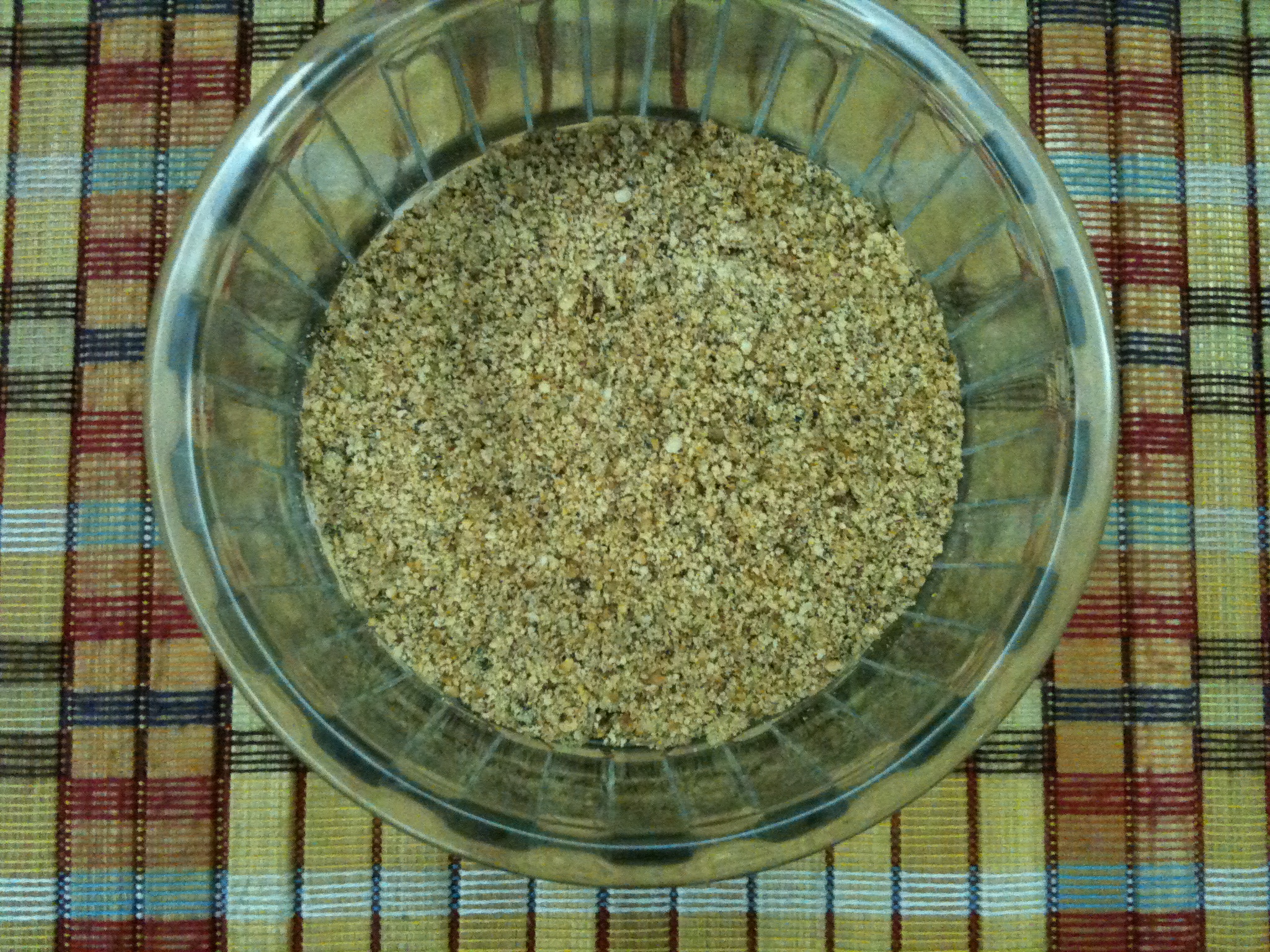
The colour of the podi will vary, depending on the type and colour of the red chillies. For best colour, use Kashmir chillies, they give you oodles of colour without being very spicy. The chillies I had were not Kashmiri chillies, so the colour is like this.

This recipe gives approximately 3 cups of powder, so if you want more or less, just reduce the proportions accordingly. The proportions according to my mom is like this for urad dal, chana dal, chillies and sesame seeds 1:1:1:3/4

Reminiscences

Yesterday, I accidently clicked on my old blog which I used to host on Blogger. So I started reading my old entries. I started blogging way back in 2007 and was a very sporadic blogger, blogging a total of 62 blog posts over a two year period. Compare this with this blog now and I’ve sure come a long way.

In March 2007 when BB & GG were about 3.5 years old, I wrote the following post, and when I re-read it yesterday, I realised that 4.5 years later, it still held true..

Girls and Boys

Being the mom to a girl/boy pair of twins has certainly given me loads of food for thought. It’s quite fascinating to see how girls and boys behave under certain situations – given that the external environment is the same for them both. This brings to my mind the “Nature versus Nurture” theory that I learned in Psychology class way back in college. The gist of that theory is that “What determines a human being’s behaviour patterns? Is it his internal genetic make-up or is it the external factors which make a person what he/she is and how they behave?”

With the Pilot and Princess, I have always tried to be fair – I never made any distinctions between the two, especially in terms of gender specific toys and games. But surprisingly the age-old gender distinctions are very clear in our home. The Princess loves playing with her dolls and Barbie collections and the Pilot is vehicle mad. But there are some blurred spaces – the Princess likes to play with blocks and the Pilot with their little laptop (guess that is because it is a Ferrari model and all the games are car based).

But it is in temperaments that I am most surprised about. Contrary to perception that girls are made of ‘sugar and spice and all that is nice’, the Princess is the more assertive and dominating twin. The Pilot on the other hand easily gives in to his sister, but he is learning to be more assertive now. The Princess can shriek, rant and throw tantrums with the best of them and she is not afraid of anyone and anything. If we try to punish her, she probably will come back to me and I am really dreading her teens! The Pilot is more sensitive and a look from me is enough to make him back down.

It was fun to read old posts. I will trawl my old Blogger blog and put in posts that I feel are good to put here. There are some interesting posts about when BB & GG were little as well as other snippets!