In My Hands Today,,,

Never Not Working: Why the Always-On Culture Is Bad for Business–and How to Fix It – Malissa Clark
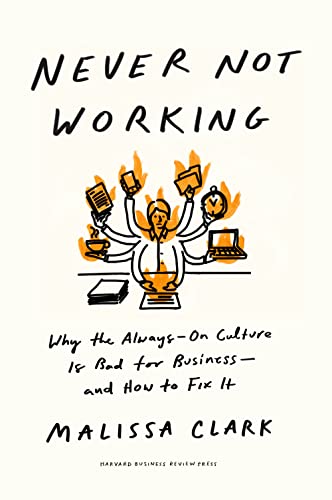
The always-on hustle culture creates an unhealthy, counterproductive relationship with work.

Many workers believe that to compete with other top talent they must embrace a culture that rewards long hours and constant connection to work. Businesses and society have encouraged this by endorsing busyness, overwork, and extreme commitment as the most valued traits in workers.

Sometimes that endorsement is explicit, as when Elon Musk told Twitter employees to work “long hours at high intensity” or get fired. But more often it’s an implicit contract, a buildup of organizational and cultural norms and the adoption of new technologies that increasingly make it easy to tether people to work. Either way, this workaholic behavior is unhealthy and counterproductive for workers and for organizations. It’s time to fight back.

Malissa Clark—the preeminent researcher on workaholic culture—shows you how in Never Not Working . Finally, a book that looks at overwork and burnout not just from the individual’s perspective but from an organizational perspective, too. Clark delivers a comprehensive, nuanced definition of workaholism, busting myths along the way—such as the idea that the number of hours worked is the strongest predictor of workaholic tendencies. (It’s not.) She also helps you see if you’re creating workaholics in your organization or if you’re falling prey to the phenomenon yourself. Clark shows you how to escape the trap of putting work at the center of everything and thus losing your well-being—or your company’s performance—in the process. Deeply researched and written for everyone, from leaders to individual contributors, Never Not Working is the essential guide to identifying workaholism in yourself and others and starting on the road to recovery.

In My Hands Today,,,

Why We Remember: Unlocking Memory’s Power to Hold on to What Matters – Charan Ranganath

Memory is far more than a record of the past. In this groundbreaking tour of the mind and brain, one of the world’s top memory researchers reveals the powerful role memory plays in nearly every aspect of our lives, from recalling faces and names, to learning, decision-making, trauma and healing.

A new understanding of memory is emerging from the latest scientific research. In Why We Remember , pioneering neuroscientist and psychologist Charan Ranganath radically reframes the way we think about the everyday act of remembering. Combining accessible language with cutting-edge research, he reveals the surprising ways our brains record the past and how we use that information to understand who we are in the present, and to imagine and plan for the future.

Memory, Dr. Ranganath shows, is a highly transformative force that shapes how we experience the world in often invisible and sometimes destructive ways. Knowing this can help us with daily remembering tasks, like finding our keys, and with the challenge of memory loss as we age. What’s more, when we work with the brain’s ability to learn and reinterpret past events, we can heal trauma, shed our biases, learn faster, and grow in self-awareness.

Including fascinating studies and examples from pop culture, and drawing on Ranganath’s life as a scientist, father, and child of immigrants, Why We Remember is a captivating read that unveils the hidden role memory plays throughout our lives. When we understand its power– and its quirks–we can cut through the clutter and remember the things we want to remember. We can make freer choices and plan a happier future.

In My Hands Today…

Housewife: Why Women Still Do It All and What to Do Instead – Lisa Selin Davis

The notion of “housewife” evokes strong reactions. For some, it’s nostalgia for a bygone era, simpler and better times when men were breadwinners and women remained home with the kids. For others, it’s a sexist, oppressive stereotype of women’s work. Either way, housewife is a long outdated concept—or is it?

Lisa Selin Davis, known for her smart, viral, feminist, cultural takes, argues that the “breadwinner vs. homemaker” divide is a myth. She charts examples from prehistoric female hunters to working class housewives in the 1930s, from First Ladies to 21st century stay-at-home moms, on a search for answers to the problems of what is referred to as women’s work and motherhood. Davis discovers that women have been sold a lie about what families should be. Housewife unveils a interdependence, rather than independence, is the American way.

The book is a clarion call for all women—married or single, mothers or childless—and for men, too, to push for liberation. In Housewife , Davis builds a case for systemic, cultural, and personal change, to encourage women to have the power to choose the best path for themselves.

In My Hands Today,,,

Million Dollar Weekend: The Surprisingly Simple Way to Launch a 7-Figure Business in 48 Hours – Noah Kagan

The founder and CEO of AppSumo.com, Noah Kagan, knows how to launch a seven-figure business in a single weekend—and he’s done it seven times. Million Dollar Weekend will show you how.

Now is the best time in history for entrepreneurship. More than ever, the world needs new businesses and it’s cheaper than ever to create them.

And, let’s be most day jobs suck. People spend too much time doing too much work for too little money—and they know it. They want out.

But, if the barriers to starting a business are getting lower and lower, why is it SO HARD TO DO for SO MANY PEOPLE? Why are there so many wantrepreneurs playing at business on social media and so few entrepreneurs actually running them?

Ask

All those Frequent Excuses are solvable. The plan is simple—so simple it can be completed in a single weekend, but so powerful that Kagan has used to build seven businesses now worth more than $1

By Monday, you’ll have a market-tested, scalable business idea and you’ll be a entrepreneur on the path to seven figures. Million Dollar Weekend is the path to creating your dream life and attaining financial freedom. LFG.

In My Hands Today,,,

Why We Read: On Bookworms, Libraries, and Just One More Page Before Lights Out – Shannon Reed

We read to escape, to learn, to find love, to feel seen. We read to encounter new worlds, to discover new recipes, to find connection across difference, or simply to pass a rainy afternoon. No matter the reason, books have the power to keep us safe, to challenge us, and perhaps most importantly, to make us more fully human.

Shannon Reed, a longtime teacher, lifelong reader, and New Yorker contributor, gets it. With one simple goal in mind, she makes the case that we should read for pleasure above all else. In this whip-smart, laugh-out-loud-funny collection, Reed shares surprising stories from her life as a reader and the poignant ways in which books have impacted her students. From the varied novels she cherishes ( Gone Girl , Their Eyes Were Watching God ) to the ones she didn’t ( Tess of the d’Urbervilles ), Reed takes us on a rollicking tour through the comforting world of literature, celebrating the books we love, the readers who love them, and the surprising ways in which literature can transform us for the better.