 Singapore has been named the 8th least corrupt country in the world and tops the Asian rankings. It received a score of 85 out of 100 in the Corruption Perception Index which is issued by Transparency International which measures perceived levels of public sector corruption worldwide.
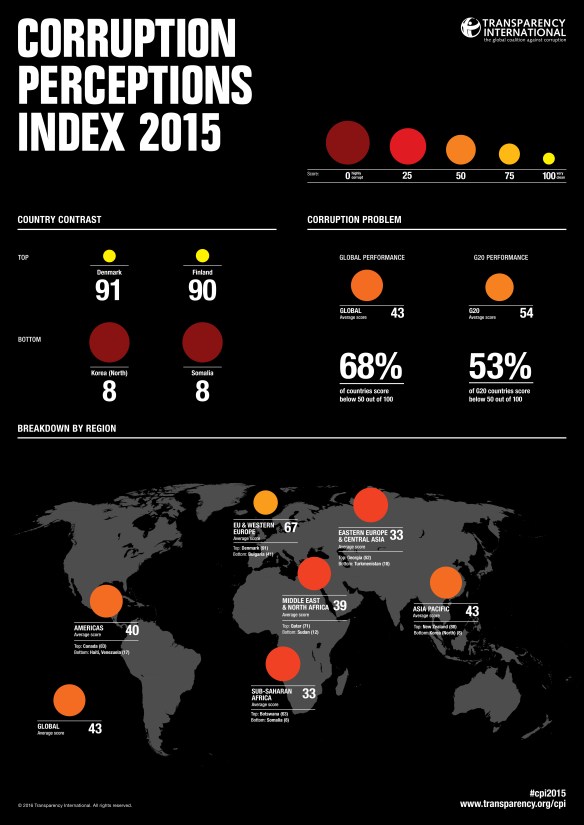 Worldwide two-thirds of the 168 countries which were tracked actually scored below 50 on a scale from 0 (perceived to be very corrupt) to 100 (perceived to be very clean)
The top spot went to Denmark for the second time in a row with a score of 91. The top ten countries are in the order of rank – Denmark, Finland, Sweden, New Zealand, Netherlands, Norway (joint 5th with Netherlands), Switzerland, Singapore, Canada and Germany
So what made Denmark score so well? According to Transperancy International, top performers share key characteristics: high levels of press freedom; access to budget information so the public knows where money comes from and how it is spent; high levels of integrity among people in power; and judiciaries that don’t differentiate between rich and poor, and that are truly independent from other parts of government.
Somalia and North Korea ended the list at the bottom with a score of only 8. The other countries in the bottom ten were Afghanistan, Sudan, South Sudan, Angola, Libya, Iraq, Venezuela and Guinea-Bissau. Conflict and war, poor governance, weak public institutions like police and the judiciary, and a lack of independence in the media characterise the lowest ranked countries.
 So how do countries closer to home stack up? Hong Kong which is seen as a competitor to Singapore in many aspects was at 18 as was Japan. Singapore’s nearest neighbor and the closest ASEAN country is at 54 with the other ASEAN countries much below Malaysia. Thailand is next at 76, followed by Indonesia at 88, Philippines at 95, Vietnam at 112, Laos at 139, Myanmar at 147 and Cambodia bringing up the rear at 150.
India’s score of 38 made it at number 176 along with Bosnia and Herzegovina, Brazil, Bukina Faso, Thailand, Tunisia and Zambia. India’s closest neighbours fare as follows: Sri Lanka and China at 83, Pakistan at 117, Nepal at 130 and Bangladesh at 139.
The results are not that surprising given Singapore’s strong stance on corruption. The country publically names and shames those, especially civil servants and those in high office who are accused of corruption. They also employ legal proceedings against them and sentence them. Hence the high score, which, given how corruption is dealt in the country, could also be higher!
Now, in the other countries in South and Southeast Asia, corruption is a way of life. Corrupt economies do not function as well as non-corrupt ones as the very fact of corruption prevents the natural law of economy from functioning well and freely.
Many people just automatically add the cost of corruption to whatever they need to pay for, especially when dealing with government officials. It is due to this that most people do not have any faith in their public servants, elected or otherwise. Implementation of public services suffers as those need to be paid for, even if they are the basic essentials which every citizen is entitled to. Another casualty is justice as more often than not, justice is either delayed or denied as some of the judiciary may be in the pay of the offenders and let them go scot-free.
Corruption also leads to a loss of growth in that country’s economy as many investors would be reluctant, rightly so, to invest in the country, leading to unemployment or underemployment, lack of infrastructure and development of regions which need them the most. This in turn leads to regression of female empowerment, gender imbalance and female infanticide.
Reading the last two paragraphs make me realise all these are hallmarks of countries which have low Gross Domestic Product (GDP) which is the most commonly referenced figure which covers the national economy of any country and which is used to determined to estimate how wealthy or poor a country and it’s people. Click here and here to understand GDP and GDP with Purchasing Power Parity (PPP) which explains the concepts so much better than I can hope to…


So where does your country stack up?

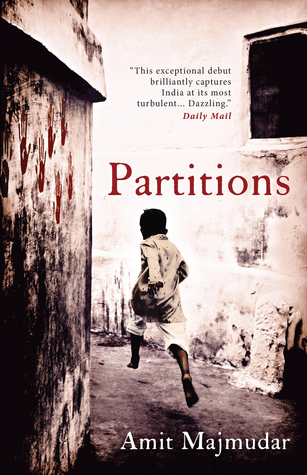
 When travel writer Christopher Stewart arrives at a riverside resort in Kerala, India to meet Koman, Radha’s uncle and a famous dancer, he enters a world of masks and repressed emotions. From their first meeting, both Radha and her uncle are drawn to the enigmatic young man with his cello and his incessant questions about the past. The triangle quickly excludes Shyam, Radha’s husband, who can only watch helplessly as she embraces Chris with a passion that he has never been able to draw from her. Also playing the role of observer-participant is Koman; his life story, as it unfolds, captures all the nuances and contradictions of the relationships being made–and unmade–in front of his eyes.

 Memories and Such