Placebo and Nocebo Effects: When Belief Enters the Body

The word placebo is often used as a polite dismissal. If something works in a way we do not quite respect, we shrug and say it was “just a placebo”, as though nothing real occurred. That assumption is wrong.

In medical research, a placebo is usually an inactive treatment used as a comparison against an active drug. But the placebo effect is not the sugar pill itself. It is the measurable improvement in symptoms that can arise from expectation, trust, ritual, context and meaning. When patients believe they are receiving help, when a clinician communicates confidence, when care is delivered with attention and clarity, symptoms such as pain, nausea, fatigue and anxiety can genuinely shift.

The nocebo effect is the corresponding phenomenon in the opposite direction. Negative expectations can produce real worsening. If patients are warned that a medication frequently causes headaches, more of them report headaches, even when given an inactive tablet. If risk is described in ominous language, distress can increase. The suffering is not imagined. It is a physiological response shaped by fear, attention and anticipation.

This is where the conversation often derails.

On one side, people dismiss symptoms as “all in the mind”. That phrase is not only inaccurate, but it is also damaging. When someone is told their pain or fatigue is psychological in a dismissive tone, they are not simply being corrected. They are being invalidated. Stress and expectation can influence symptoms, but influence is not fabrication. Every sensation you experience is processed by the brain. That does not make it voluntary. To suggest otherwise is to confuse mechanism with blame.

On the other side, there is an equal and opposite exaggeration: the idea that mindset can cure anything. Placebo effects are real, but they are not limitless. They tend to be strongest in conditions where perception, attention and behaviour are closely linked to experience, such as pain or mood. They are far less powerful in structural disease or mechanical injury. No amount of positive thinking will repair a fracture or eliminate a malignancy. Recognising placebo effects does not undermine scientific medicine. It strengthens it by acknowledging that treatment outcomes are shaped not only by molecules, but by context.

Healthcare makes the ethical stakes clear. Clinicians are required to explain risks and side effects. Patients deserve transparency. Yet the way information is framed matters. Vague warnings and dramatic phrasing can amplify nocebo responses. Balanced, proportionate communication can reduce unnecessary anxiety without withholding facts.

The question is not whether placebo and nocebo effects exist. They do. The question is whether we engage with them consciously and responsibly.

Deception may appear tempting. If belief produces benefit, one might argue that small lies are harmless. But trust is not an optional extra in medicine. It affects adherence, follow-up, disclosure and long-term safety. Damaging trust for short-term symptom relief is a poor trade. Research into open-label placebos, where patients are informed that they are receiving an inactive pill yet still sometimes improve, suggests that benefit does not require trickery. Context, ritual and expectation can be acknowledged openly. That points towards a more nuanced ethical position: honesty paired with thoughtful communication.

It might seem that these dynamics belong only in hospitals and clinics. But the nervous system that responds to a doctor’s tone also responds to a manager’s email, a partner’s silence, a financial headline. The scale changes, the wiring does not.

In the workplace, expectation shapes performance in subtle ways. If a project is introduced as likely to fail, people approach it defensively. Attention narrows. Minor setbacks confirm pessimism. Energy contracts. That resembles a nocebo pattern: anticipation influencing outcome through behaviour and perception.

Yet blind optimism is no solution. Overconfident leadership can suppress early warning signs and discourage dissent. In that sense, forced positivity can function as its own nocebo, not by producing fear, but by producing denial. Calibrated expectation works better. Name the difficulty. Outline the plan. Avoid prophecy.

Relationships are equally sensitive to expectation. If you expect neglect, you may interpret neutral behaviour as indifference. You may watch tone and timing for evidence. The other person may feel scrutinised and withdraw, and the relationship shifts in line with your fears.

Still, it would be simplistic to attribute every conflict to negative expectation. Sometimes patterns are real. The discipline lies in asking whether your interpretation is grounded in repeated behaviour or fuelled by prior hurt. Expectation can distort perception, but it can also sharpen it. The difference is evidence.

In education, beliefs about ability influence effort. Students who are told improvement is possible with practice are more likely to persist. Students who internalise labels such as “not academic” often disengage. That mirrors placebo logic: belief shaping behaviour, behaviour shaping outcome. But encouragement must be credible. Praise that ignores reality erodes trust.

Money is particularly vulnerable to collective expectations. Widespread economic pessimism can alter spending and investment behaviour, sometimes contributing to the very downturn people fear. At a personal level, constant exposure to catastrophic financial narratives can produce paralysis. Yet reckless optimism carries its own risk. Markets and livelihoods are influenced by structural forces, not affirmations. Once again, calibration matters.

Politics, too, reveals how expectations can be scaled up. Repeated messaging that emphasises threat and decline can alter public mood and social trust. At the same time, slogans that promise effortless prosperity without substance can soothe temporarily while obscuring complexity. In public life, framing is powerful. But citizens are not patient enough to be nudged through suggestion. Accurate information remains essential.

A boundary is necessary here. Placebo and nocebo thinking is most useful where outcomes are influenced by perception, motivation, interpretation and behaviour. It is far less useful where outcomes depend primarily on structural, mechanical or biological forces beyond immediate psychological influence. Belief may affect how we cope with those realities, but it does not replace them.

This distinction protects us from two mistakes. The first is blaming individuals for circumstances that require systemic change. The second is ignoring the genuine role of expectation where it meaningfully shapes experience.

The wellness industry often operates in the space between these mistakes. Ritual does matter. Expectation does matter. Behaviour change does matter. But these truths are frequently stretched. A product is marketed not simply as helpful, but as transformative. Testimonials become proof. Improvement is attributed solely to the purchase, while setbacks are blamed on insufficient belief or discipline.

Here, placebo language becomes commercially convenient. If belief forms part of the mechanism, failure can be reframed as a deficit in belief. That shifts responsibility away from evidence and onto the consumer. Hope itself is not the problem. The problem is when hope is monetised in ways that resist scrutiny.

Positive thinking culture walks a similar line. Expecting improvement can motivate effort and reduce anxiety. But when positivity becomes social pressure, it silences legitimate distress. Struggle begins to look like moral failure. That is not resilience. It is suppression.

Perhaps the most useful insight from placebo and nocebo research is not that belief controls reality, but that context quietly shapes it. Language, repetition, authority and ritual influence interpretation. Interpretation influences behaviour. Behaviour influences outcome.

So what can an ordinary person do with this understanding?

  1. First, examine your framing. When you predict failure, ask what evidence supports that prediction. Are you preparing wisely, or rehearsing fear?
  1. Second, be deliberate about information intake. Repeated exposure to alarmist narratives can prime nocebo-like responses. Seek proportionate, accurate sources rather than constant escalation.
  1. Third, choose routines that create stability. A consistent sleep schedule, a predictable morning ritual, and a clear weekly plan. These are not magical interventions. They are signals of safety that reduce unnecessary physiological noise.
  1. Fourth, practise precise language with others. When discussing risk, pair it with probability and a plan. Avoid vague prophecies.
  1. Finally, allow complexity. Symptoms can be influenced by stress without being imaginary. Hope can be useful without being magical. Belief participates in biology, but it does not dominate it.

Placebo and nocebo effects remind us that expectation enters the body. It does not control everything. But it is never irrelevant. So what can an ordinary person do with this understanding?

  1. First, examine your framing. When you predict failure, ask what evidence supports that prediction. Are you preparing wisely, or rehearsing fear?
  1. Second, be deliberate about information intake. Repeated exposure to alarmist narratives can prime nocebo-like responses. Seek proportionate, accurate sources rather than constant escalation.
  1. Third, choose routines that create stability. A consistent sleep schedule, a predictable morning ritual, and a clear weekly plan. These are not magical interventions. They are signals of safety that reduce unnecessary physiological noise.
  1. Fourth, practise precise language with others. When discussing risk, pair it with probability and a plan. Avoid vague prophecies.
  1. Finally, allow complexity. Symptoms can be influenced by stress without being imaginary. Hope can be useful without being magical. Belief participates in biology, but it does not dominate it.

Sometimes the story we repeat most quietly is the one that shapes us most deeply.

Placebo and nocebo effects remind us that expectation enters the body. It does not control everything. But it is never irrelevant. The deeper question is not whether belief matters. It does. The deeper question is this: what expectations are you repeating often enough that they have begun to feel like fact? The deeper question is not whether belief matters. It does. The deeper question is this: what expectations are you repeating often enough that they have begun to feel like fact?

2026 Week 29 Update

This week has felt like one of quiet convergence. Several threads that have been developing over the past few months seemed to come together, not with dramatic fanfare, but with a growing sense of direction. There were important conversations, careful preparation, thoughtful revisions, and the feeling that groundwork laid over many weeks is slowly beginning to open new possibilities. It was less about reaching the finish line and more about recognising that the path ahead is becoming clearer.

Alongside the practical work, there was also a quieter theme running beneath it all: refinement. Not just refining projects and ideas, but refining how I work, how I organise my thoughts, and how I present myself. Sometimes progress isn’t about doing more; it’s about doing the important things with greater clarity and intention. The week also carried a sense of looking ahead. Plans for the coming months started to feel more tangible, and while many pieces are still unfolding, there is growing confidence that they are moving in the right direction. It has been a reminder that meaningful opportunities rarely appear overnight. More often, they emerge from conversations, preparation, persistence, and the willingness to keep showing up.

Perhaps that’s the best way to describe this week: a week of quiet confidence. Not because everything is certain, but because there is an increasing trust that patient, consistent effort has a way of creating its own momentum. Sometimes the biggest shifts happen so gradually that we only recognise them when we pause long enough to look back.

Today’s quote is by Yoda, the wise Jedi Master from the Star Wars universe, created by filmmaker George Lucas. Revered for his wisdom, humility, and deep understanding of the Force, Yoda serves as a mentor to generations of Jedi. The meaning of this quote goes far beyond the fictional world in which it was spoken. At first, the quote may seem harsh. After all, isn’t trying a good thing? But Yoda is pointing to something deeper than simply making an effort.

The quote challenges the mindset we often adopt when we leave ourselves an easy escape route. Sometimes we say, “I’ll try,” when what we really mean is, “I’ll give it a go, but I’m already preparing myself to give up if it gets difficult.” Yoda encourages a different approach: wholehearted commitment. When we decide to do something, we fully engage with the task instead of approaching it with hesitation or self-doubt.

This doesn’t mean success is guaranteed. We may still fail, encounter setbacks, or need multiple attempts before achieving our goal. The difference lies in our attitude. A committed person learns from failure and continues moving forward, while someone who is merely “trying” may stop at the first obstacle. The quote is therefore about commitment rather than perfection.

There is also an important lesson about self-belief. Our actions are often limited not by our abilities but by the stories we tell ourselves about what is possible. When we fully commit to a goal, we stop dividing our energy between action and doubt. We become more resilient, resourceful, and willing to persist until we find a way forward.

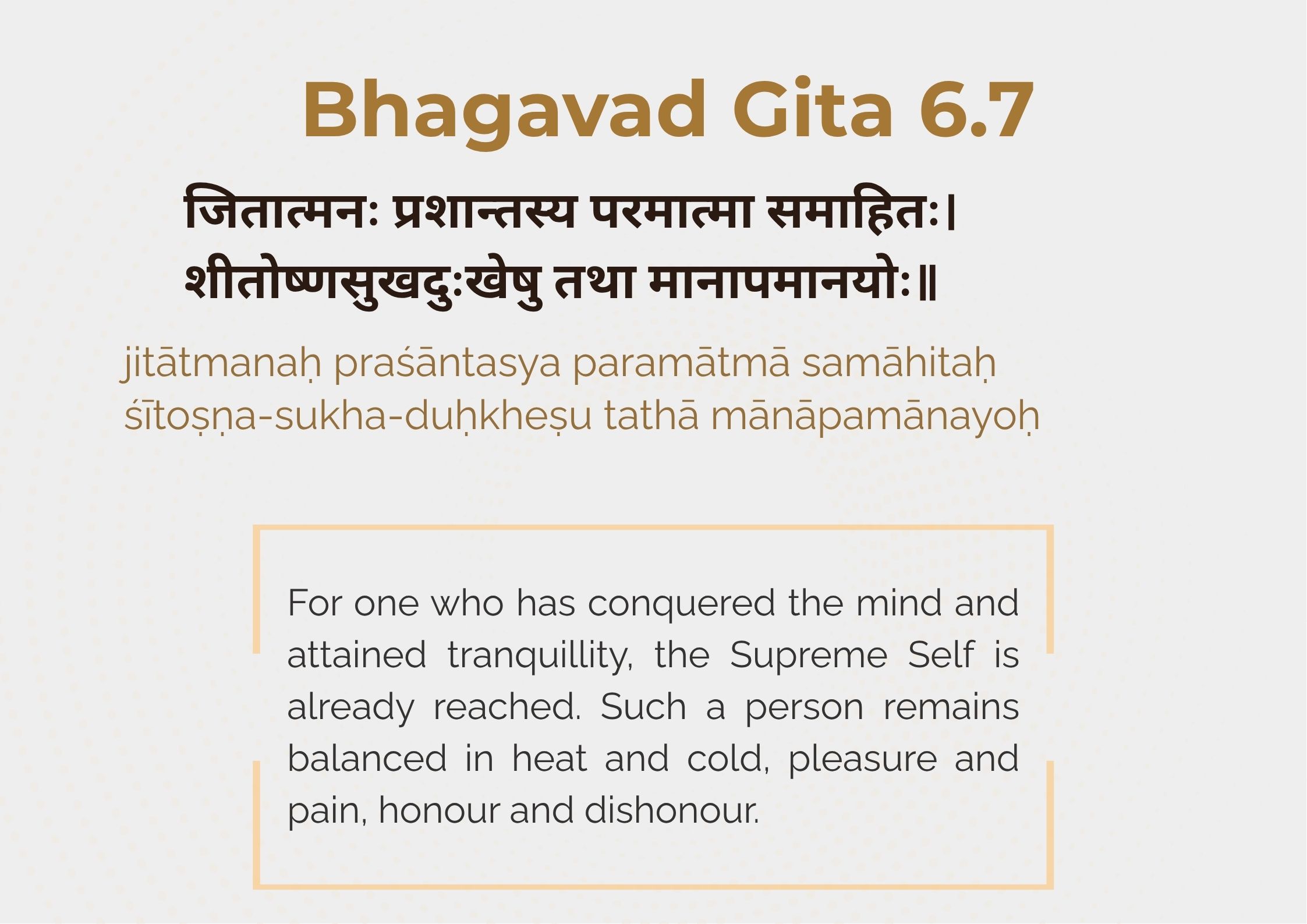
This week’s quote from the Bhagavad Gita comes from verse 6.7, which is about mastering the mind. Many of life’s greatest battles take place within us. The mind constantly compares, worries, remembers, anticipates, and judges. It revisits old conversations, imagines future problems, and creates stories that may never come true. Left unchecked, it can become a source of endless restlessness.

Krishna teaches that lasting peace begins with mastering the mind rather than trying to control the world around us. External circumstances will always fluctuate. People will praise us one day and criticise us the next. Success and setbacks will come and go. If our peace depends entirely on these changing conditions, we will never truly feel settled.

The person who has learned to calm the mind develops a different kind of stability. They are not easily thrown off course by discomfort, disappointment, or approval. Their sense of self comes from something deeper than public opinion or temporary circumstances.

This mastery does not happen overnight. It requires practice, awareness, and patience. Yet every moment spent observing rather than reacting strengthens this inner foundation.

When the mind becomes quieter, we begin to experience life more clearly. We stop being pushed around by every passing thought and emotion. In that stillness, we discover a deeper sense of peace that no external event can easily take away.

And this week I learned that you can strengthen confidence in your ability to handle whatever comes your way. Start by building awareness of your physical reactions to stresses, and practice intentional breathing to bring your body into a calmer state. The more you connect with your inner stillness, the easier it becomes to loosen the grip that external chaos has on your emotional well-being. There’s no point in worrying about external factors, since you can’t control them anyway. Instead, take a small pause before responding. That brief moment of space allows a new perspective to emerge, and often, that’s all it takes to move calmly through situations that trigger intense reactions. With time, calm becomes your natural state and a way of life.

And on that note, stay happy, remain positive and have a wonderful week!

2026 Week 28 Update

Today’s quote is an ancient Indian proverb, coming from the rich tradition of Ancient Indian wisdom, where many teachings emphasise living with awareness, purpose, and inner alignment. Rooted in philosophies found across texts such as the Upanishads and other spiritual traditions, these proverbs encourage looking beyond outward appearances and listening to the deeper wisdom of the heart. This proverb reminds us that not everything that attracts our attention deserves our time, energy, or commitment. We live in a world full of things that sparkle, impress, and tempt us. New opportunities, possessions, achievements, and experiences constantly compete for our attention. They may catch our eye because they are exciting, fashionable, or admired by others. But lasting fulfilment comes from something much deeper.

What captures the heart is different. It resonates with our values, our purpose, and our authentic selves. It is the work that gives us meaning rather than just recognition, the relationships that nourish rather than merely entertain, and the dreams that continue to call us long after the initial excitement has faded. The proverb also encourages discernment. It reminds us that life is shaped as much by what we choose not to pursue as by what we do. Every commitment requires time and energy, both of which are limited. If we chase every shiny possibility, we risk becoming distracted and exhausted. But when we choose the things that truly matter to us, our efforts become more focused, meaningful, and rewarding. There is another layer to this wisdom. What captures the eye often satisfies for a moment; what captures the heart has the power to transform us. It encourages growth, resilience, and a deeper sense of purpose. While outward attractions may change with time, the things that speak to the heart tend to remain constant, quietly guiding us through different seasons of life.

The first full week of July felt like one of quiet momentum, where much of the progress happened beneath the surface. Professionally, it was a week of refining, reviewing, and laying groundwork rather than celebrating finished outcomes. There was satisfaction in seeing a significant piece of work finally come together after careful thought and multiple revisions, along with the encouraging feeling that new conversations and potential collaborations may be beginning to open unexpected doors. It was also a reminder that many opportunities start not with certainty, but with a simple conversation.

Beyond work, the week was deeply reflective. I found myself thinking about the threads that have quietly woven through my life for decades: curiosity, learning, writing, and the joy of exploring ideas for no reason other than to understand them. There was a growing realisation that many of the things I once considered distractions or unfinished projects may actually be expressions of who I am, rather than evidence of inconsistency. Some discoveries don’t close chapters; they simply help us understand the story we’ve been living all along.

It was also a week of looking inward. I spent time reflecting on my own strengths, contradictions, and the direction I want the next chapter of life to take. Instead of asking, “What should I become?” the question slowly shifted toward, “Who have I been all along?” Sometimes the most important discoveries are not about becoming someone new, but recognising the person who has quietly been there from the beginning.

Looking back, this week wasn’t defined by dramatic events. It was defined by clarity. By connecting dots that had existed for years. And by the growing confidence that the future doesn’t need to be invented from scratch; it can be built from the parts of myself that have always been there, patiently waiting to be recognised.

This week’s verse from the Bhagavad Gita is from verse 2.15, which is steady in joy and sorrow. According to this verse, most of us spend our lives chasing pleasant experiences and avoiding painful ones. We celebrate success and fear failure. We welcome praise and dread criticism. Our emotional state often rises and falls according to circumstances we cannot fully control. The Gita offers a different path. Krishna speaks of the person who remains steady regardless of whether life brings joy or sorrow. This steadiness is not indifference. It is not a lack of feeling. Rather, it is the ability to remain anchored even when the winds around us change direction.

A calm lake reflects the sky clearly because its surface is undisturbed. In the same way, a steady mind allows us to see situations clearly instead of reacting impulsively. We become less driven by fear, ego, and emotional turbulence. This verse reminds us that true strength is often quiet. It is found in the ability to remain composed during uncertainty, disappointment, and success alike. Life will always bring both pleasant and unpleasant experiences. The goal is not to eliminate either one. The goal is to develop a stability that is deeper than both. When we do, we discover a peace that is no longer dependent on external circumstances.

This week I learned that even in the midst of difficult times, there will be moments throughout the day where joy sneaks up on you. Embrace those moments fully. It’s often the smallest things, like moments of unexpected kindness from a stranger, something silly that makes you laugh, or the smile of someone you love. These moments make it a bit easier to navigate grief that can feel all-consuming. One day at a time, you will move through this phase of pain. Light will return to the spaces that feel dark now.

And on that thoughtful note, here’s to a fantastic rest of July. Stay well, stay positive and keep smiling!

2026 Week 27 Update

I can’t believe we are looking at the second half of 2026! The older I grow, the faster the days and years seem to fly by. The first half of 2026 has felt less like a series of dramatic milestones and more like the steady construction of a life that is gradually becoming more intentional. It has been a season of building foundations rather than chasing quick wins. Professionally, there have been new responsibilities, meaningful collaborations, creative projects, and the quiet satisfaction that comes from seeing ideas slowly take shape. Much of the work has happened behind the scenes, planting seeds whose results may only become visible much later. Creatively, this has been one of my busiest periods in years. Writing has remained a constant thread, whether through reflections, photography, long-form articles, or exploring new ideas. Along the way, I’ve discovered that creativity isn’t always about waiting for inspiration. More often, it’s about showing up consistently and allowing small acts of creation to accumulate into something meaningful.

Personally, this year has been one of balance. Balancing ambition with patience, work with rest, and looking ahead while staying present. It has also been a reminder that life keeps evolving. Family roles continue to change, routines shift, and time seems to move faster with each passing month. There have been moments of excitement, moments of uncertainty, and moments of quiet reflection, each contributing something valuable. Perhaps the greatest lesson these six months have taught me is that progress rarely arrives with fanfare. It is found in the conversations that strengthen relationships, the habits that become second nature, the courage to try something new, and the willingness to keep going even when the destination isn’t yet visible.

As I look toward the second half of the year, I do so with a sense of quiet optimism. There is still much to learn, much to create, and many chapters yet to be written. If the first half of 2026 has been about laying strong foundations, perhaps the months ahead will be about building upon them, one thoughtful step at a time.

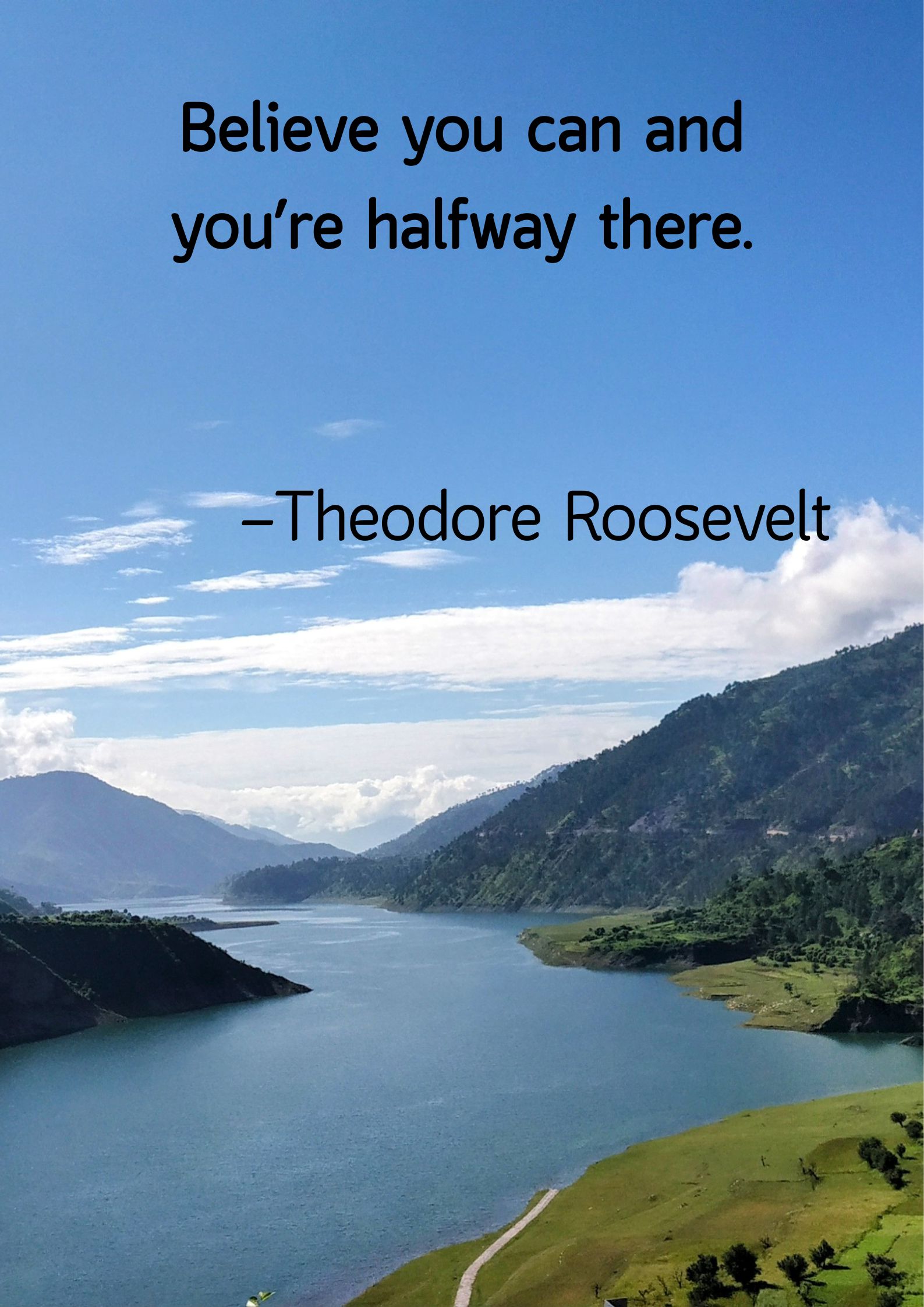
Today’s quote by the 26th President of the United States, Theodore Roosevelt, highlights the powerful role that belief plays in achieving any goal. Before we take the first step, before we learn a new skill or overcome a challenge, we first need to believe that success is possible. Without that belief, we often give up before we’ve even begun. Roosevelt isn’t suggesting that confidence alone guarantees success. Belief is not a substitute for hard work, preparation, or perseverance. Instead, he is pointing out that self-belief removes one of the greatest obstacles we face: the doubt that tells us we are not capable. When we believe in ourselves, we are far more likely to take action, persist through setbacks, and remain committed when progress is slow.

The quote also reminds us that many limitations begin in the mind. Fear of failure, fear of criticism, or fear of not being good enough can prevent us from trying at all. Self-belief doesn’t eliminate those fears, but it gives us the courage to move forward despite them. Every achievement begins with the willingness to say, “I think I can do this.” There is also an important lesson about momentum. Once we believe something is within reach, our actions begin to align with that belief. We seek opportunities, develop skills, and notice possibilities we might otherwise have ignored. In that sense, belief truly does put us “halfway there” because it transforms intention into action.

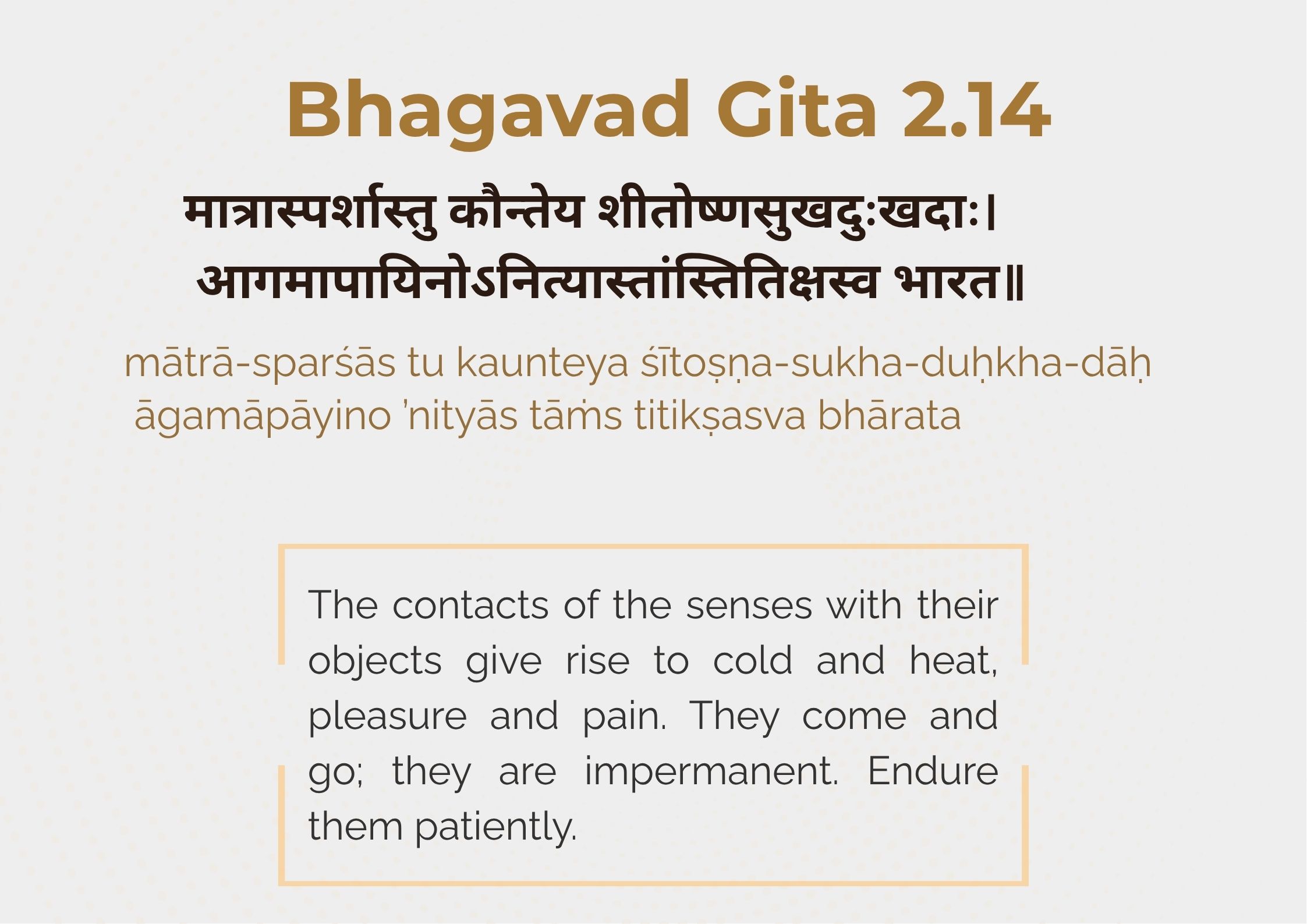
Today’s quote from the Bhagavad Gita comes from chapter 2.14 and is about enduring what comes and goes. One of the most comforting truths in the Bhagavad Gita is also one of the simplest: everything passes. When life is going well, we often wish the moment would last forever. When life becomes difficult, we fear that our pain will never end. Yet Krishna reminds Arjuna that both joy and sorrow are temporary visitors. They arrive, stay for a while, and eventually leave.

This does not mean we should ignore our feelings or pretend that suffering does not hurt. It simply means that we should not build our identity around temporary experiences. A difficult season is not our entire life. A moment of success is not our permanent reality. Much of our anxiety comes from treating passing circumstances as if they will last forever. The Gita invites us to take a longer view. The challenge is not to eliminate discomfort but to learn how to endure it with patience and dignity.

Like the changing seasons, life moves through cycles. By remembering this, we become less overwhelmed by hardship and less attached to fleeting pleasures. We learn to trust that what comes will go, and that we have the strength to remain standing through it all.

And this week, the most important thing I learnt was to give yourself time. Clarity will set in, and it will all make sense why things had to happen the way they did. You will begin to see that there is a lot of good in your life despite the challenges and disappointments, and you’ll remember how much you still have to be grateful for. When you stop fixating on what didn’t go as planned, you move more quickly toward the outcomes that are truly meant for you. You will find a way to thrive through this painful chapter, and you will attract such abundant gifts that you’ll realize that you can always trust the process completely.

And on that note, here’s to a fantastic second half of 2026, may the rest of the year bring what each of us want in our hearts!

2026 Week 26 Update

Johann Wolfgang von Goethe was a German poet, novelist, playwright, scientist, and philosopher, widely regarded as one of the greatest literary figures in history. Best known for works such as Faust and The Sorrows of Young Werther, Goethe explored themes of human potential, creativity, nature, and personal growth. His writings continue to inspire readers with their timeless insights into the human experience. This quote speaks to the transformative power of self-trust. Many of us spend a great deal of our lives looking outward for answers, seeking approval, advice, or reassurance before making decisions. While guidance from others can be valuable, Goethe reminds us that the most important compass we possess is within ourselves.

Trusting yourself does not mean believing you will always be right. It means having confidence that, whatever happens, you can learn, adapt, and find your way forward. Self-trust is built through experience. It grows every time you make a difficult decision, recover from a setback, or discover strengths you didn’t know you had. Over time, you begin to realise that uncertainty is not something to fear, but something you are capable of navigating. The quote also suggests that much of life’s confusion comes not from a lack of answers, but from doubting our own judgment. When we constantly question ourselves or compare our path with others, we become disconnected from our values and intuition. Trusting yourself brings clarity because your choices become aligned with who you truly are, rather than with who you think you should be.

This doesn’t mean life suddenly becomes easy. Challenges remain, mistakes still happen, and unexpected turns are inevitable. But with self-trust, you approach them differently. You stop waiting for certainty and start living with confidence that you can handle whatever comes next.

This week, the Bhagavad Gita in verse 2.50 tells us that knowledge must culminate in action.The Gita does not end clarity in contemplation. It directs it into conduct. Yoga is skill in action. Wisdom refines execution, it purifies motive, it sharpens discernment in decision. Clarity is not withdrawal from responsibility, it is precision within it. June closes where it must, not in abstraction, but in competent action guided by understanding.

This week was a super productive week and there seems to be small slice of happy news. BB may be getting his first big boy job. While university has been postponed for a couple of years for him, it is not off the table. GG will end her six month internship this month and then, it’s back to school for her last year. As for me, work and writing keeps me busy.

This week I learnt that when you attach yourself to a particular label, you limit yourself. Don’t forget that we are constantly evolving. We have many dimensions. These labels limit what is possible for you. A few years down the line, you may feel like a completely different person. Practice observing your thoughts and stories you believe about yourself. When an unhelpful thought pops up in your mind, you have to choose not to believe it. It will lose all power over you if you don’t give your attention to it. Allow beautiful, new possibilities to be fulfilled by yourself.

And on that note, have a beautiful week, and a wonderful month of July!