In My Hands Today…

Family Matters – Rohinton Mistry

Rohinton Mistry’s enthralling novel is at once a domestic drama and an intently observed portrait of present-day Bombay in all its vitality and corruption. At the age of seventy-nine, Nariman Vakeel, already suffering from Parkinson’s disease, breaks an ankle and finds himself wholly dependent on his family. His step-children, Coomy and Jal, have a spacious apartment (in the inaptly named Chateau Felicity), but are too squeamish and resentful to tend to his physical needs.

Nariman must now turn to his younger daughter, Roxana, her husband, Yezad, and their two sons, who share a small, crowded home. Their decision will test not only their material resources but, in surprising ways, all their tolerance, compassion, integrity, and faith. Sweeping and intimate, tragic and mirthful, Family Matters is a work of enormous emotional power.

In My Hands Today…

A Walk Across the Sun – Corban Addison

When a tsunami rages through their coastal town in India, 17-year-old Ahalya and Ghai and her 15-year-old sister Sita are left orphaned and homeless. As they struggle to make sense of the wreckage of their lives, they are abducted by human traffickers and thrust into a hidden world of sexual violence and illicit commerce, where the most valuable prize is the innocence of a child.

Halfway across the world, in Washington D.C., an attorney Thomas Clarke faces his own personal and professional crises. Haunted by the tragic death of his infant daughter and estranged from his wife, he pursues a pro bono sabbatical in India with an NGO that targets the sub-continent’s human traffickers. In Mumbai his conscience awakens as he sees firsthand the horrors of the sex trade and the corrupt judicial system that fosters it. When he learns the fate of Ahalya and Sita, Clarke makes it his personal mission to rescue them, setting the stage for a deadly showdown with an international network of ruthless criminals.

Pulao/Biryani With A Twist

I recently read somewhere in the Internet about the street foods in Mumbai and that started a nostalgic tone for me. I love the street food that Mumbai has to offer, be it vada pav, or the ubiquitous bhel puri, sev puri and pani puri or Mumbai’s very own pav bhaji. Vendors who sell this yummy dish also make a rice dish with the vegetables that go into the bhaji making a fairly different type of pulao/biryani. This pulao is therefore inspired by the pav bhaji pulao.

Pulao/Biryani with a Twist
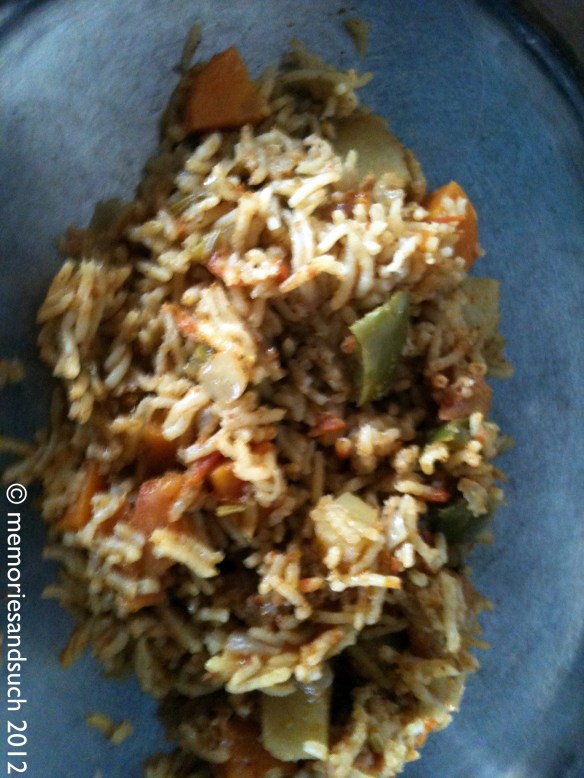
Ingredients:

  • 11/2 cups basmati rice, washed and soaked for atleast 20 minutes
  • 2 medium sized onions, chopped finely
  • 1 fairly big potato, peeled and cubed into bite-sized pieces
  • 1 carrot, peeled and cubed into bite sized pieces
  • 1/2 cup frozen green peas
  • 1 green capsicum, cut into bite-sized pieces
  • 4 medium sized tomatoes, finely chopped
  • 2 flakes of garlic, finely chopped
  • 1 inch piece of ginger, peeled and finely chopped
  • 1 tsp cumin seeds
  • 1/4 tsp turmeric powder
  • 1 tsp (or more) red chilli powder
  • 1 tsp cumin seed powder
  • 1 tsp coriander seed powder
  • 2 tsps (or more) pav bhaji masala
  • 1 tsp sabzi masala (optional)
  • Salt to taste
  • 2 tbsps oil

Method:
Heat oil in a pan and when it is fairly hot, put in the cumin seeds. When it splutters, add the garlic, stir for a few seconds, then add the ginger and give it a quick stir.

Next, add the onions, capsicum, carrots, peas and potatoes in the following order making sure you give a quick stir before you add the next vegetable. Now add the tomatoes and the spices and stir well. Once all the vegetables have been nicely coated with the spices, add the rice from which the water has been completely drained.

Stir and let the rice mix well with the vegetables and let it cook for a couple of minutes.

Now transfer everything to a rice cooker, add around 2.5 cups of water and let it cook.

When the rice is done, keep it covered for another 10 minutes, then fluff lightly with a fork, garnish with coriander leaves and serve hot.

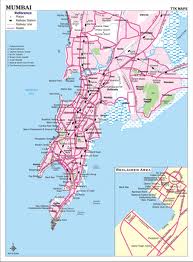
Bombay/Mumbai – what do you call it?

Image from here

Mumbai, India’s commercial capital (debatable now, but I like the ephithet), the city that never sleeps. I found this in my previous blog and thought this was a beautiful tribute to my hometown. This was actually circulated to me by email eons ago and I am not the original author. I do not know who that is, so can’t give credit where it’s due. If you do know the author, please do let me know and I’ll give credit.

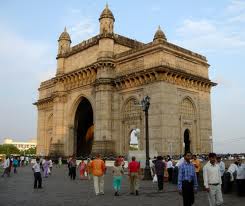
Gateway of India

Image courtesy from this site
Bambai meri jaan….

  • A City where everything is possible, especially the impossible.
  • Where lovers first love and then marry, Where there is place for every Tom, Dick and Harry
  • Where telephone bills make a person ill, Where a person cannot sleep without a pill.
  • Where carbon-dioxide is more than oxygen, Where the road is considered to be a dustbin,
  • Where college canteens are full and classes empty, Where Adam teasing is also making an entry,
  • Where a cycle reaches faster than a car, Where everyone thinks himself to be a star,
  • Where sky scrapers overlook the slum, Where houses collapse as the monsoon comes,
  • Where people first act and then think, Where there is more water in the pen than ink,
  • Where the roads see-saw in monsoon, Where the beggars become rich soon,
  • Where the roads are levelled when the minister arrives,
  • Where college admission means hard cash, Where cement is frequently mixed with ash.
  • This is Mumbai my dear, But don’t fear, just cheer, come to Mumbai every year!

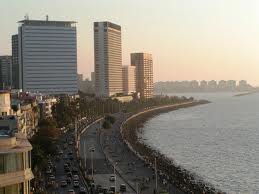
The iconic Marine Drive or Queens Necklace

Picture from here

23 Things that prove you are a Bombayaite 

  1. You say “town ” and expect everyone to know that this means south of Churchgate.
  2. You speak in a dialect of Hindi called ‘Bambaiya Hindi’, which only Bombayites can understand.*
  3. Your door has more than three locks.
  4. Rs 500 worth of groceries fit in one paper bag.
  5. Train timings (9.27, 10.49 etc) are really important events of life.
  6. You spend more time each month traveling than you spend at home.
  7. You call an 8′ x 10′ clustered room a Hall.
  8. You’re paying Rs 10,000 for a 1 room flat, the size of walk-in closet and you think it’s a “steal.”
  9. You have the following sets of friend: school friends, college friends, neighborhood friends, office friends and yes, train friends, a species unique only in Bombay.
  10. Cabbies and bus conductors think you are from Mars if you call the roads by their Indian name, they are more familiar with Warden Road, Peddar  Road, Altamount Road
  11. Stock market quotes are the only other thing besides cricket which you follow passionately.
  12. The first thing that you read in the Times of India is the “Bombay Times” supplement.
  13. You take fashion seriously.
  14. You’re suspicious of strangers who are actually nice to you.
  15. Hookers, beggars and the homeless are invisible.
  16. You compare Bombay to New York’s Manhattan instead of any other cities of India.
  17. The most frequently used part of your car is the horn.
  18. You insist on calling CST as VT, and Sahar and Santacruz airports instead of Chatrapati Shivaji International Airport.
  19. You consider eye contact an act of overt aggression.
  20. Your idea of personal space is no one actually standing on your toes.
  21. Being truly alone makes you nervous.
  22. You love wading through knee deep mucky water in the monsoons, and actually call it ”romantic’.
  23. Only in Bombay , you would get Chinese Dosa and Jain Chicken.

In My Hands Today…

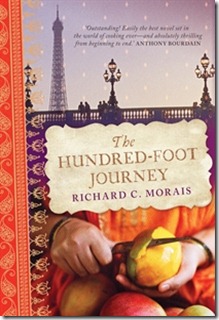
The Hundred Foot Journey – Richard C. Morais

The Hundred Foot Journey is the story of Hassan Haji, a boy from Mumbai who embarks, along with his boisterous family, a picaresque journey from London and then across Europe, before they ultimately open a restaurant opposite a famous chef, Madame Mallory, in the remote French village of Lumière. A culinary war ensues, pitting Hassan’s Mumbai-toughened father against the imper \ious Michelin-starred corden bleu, until Madame Mallory realises that Hassan is a cook with a natural talents far superior to her own.

Full of eccentric characters, hilarious cultural mishaps, vivid settings and delicious meals described in rich, sensuous detail, Hassan’s charming account lays bare the inner workings of the elite world of French haute cuisine, and provides us with an affirming and poignant coming-of-age tale