Ikigai: Your Raison D’être in Life

A couple of months back, I came across this Japanese term, ‘Ikigai’ which essentially means finding your passion in life and leading your life according to that, in other words, your ‘raison d’être’ and the term really intrigued me. In other words, Ikigai is what makes you get up each morning and jeep going even when the going gets tough.

When I read more about this term, I thought that perhaps this was the missing link in our lives. If we lived a life worth living, if we did something which makes us jump out of bed each morning and looked forward to each new day, then wouldn’t that be the best thing ever? We would never have to work a day in our lives and life will be so much smoother without the usual angst work generates within us.

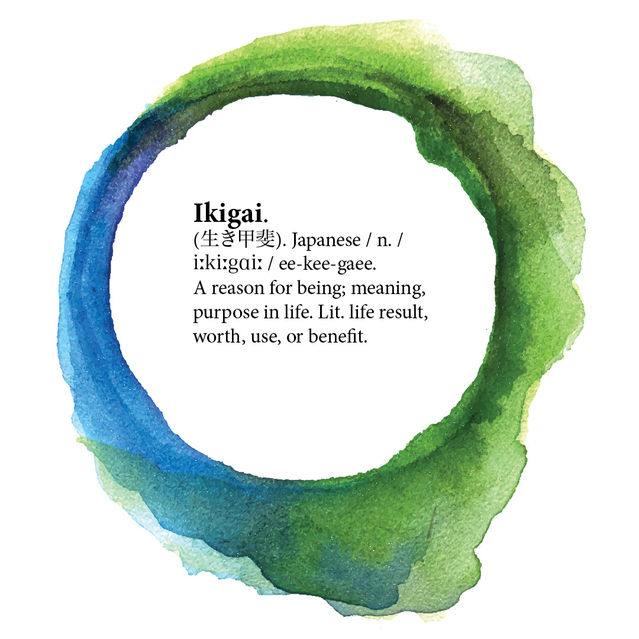
Ikigai which is pronounced as it is spelt, is a Japanese concept which means, “a reason for being”. The word “Ikigai” is usually used to indicate the source of value in one’s life or the things that make one’s life worthwhile. The word translated to English roughly means “thing that you live for” or “the reason for which you wake up in the morning.”

Each individual’s Ikigai is personal to them and specific to their lives, values and beliefs. It reflects the inner self of an individual and expresses that faithfully, while simultaneously creating a mental state in which the individual feels at ease. Activities that allow one to feel Ikigai are never forced on an individual; they are often spontaneous, and always undertaken willingly, giving the individual satisfaction and a sense of meaning to life.

According to best seller author Dan Buettner, Ikigai lies at the cross section between your values, what you like to do and what you are good at. When you are able to figure that out, you have found your personal Ikigai.
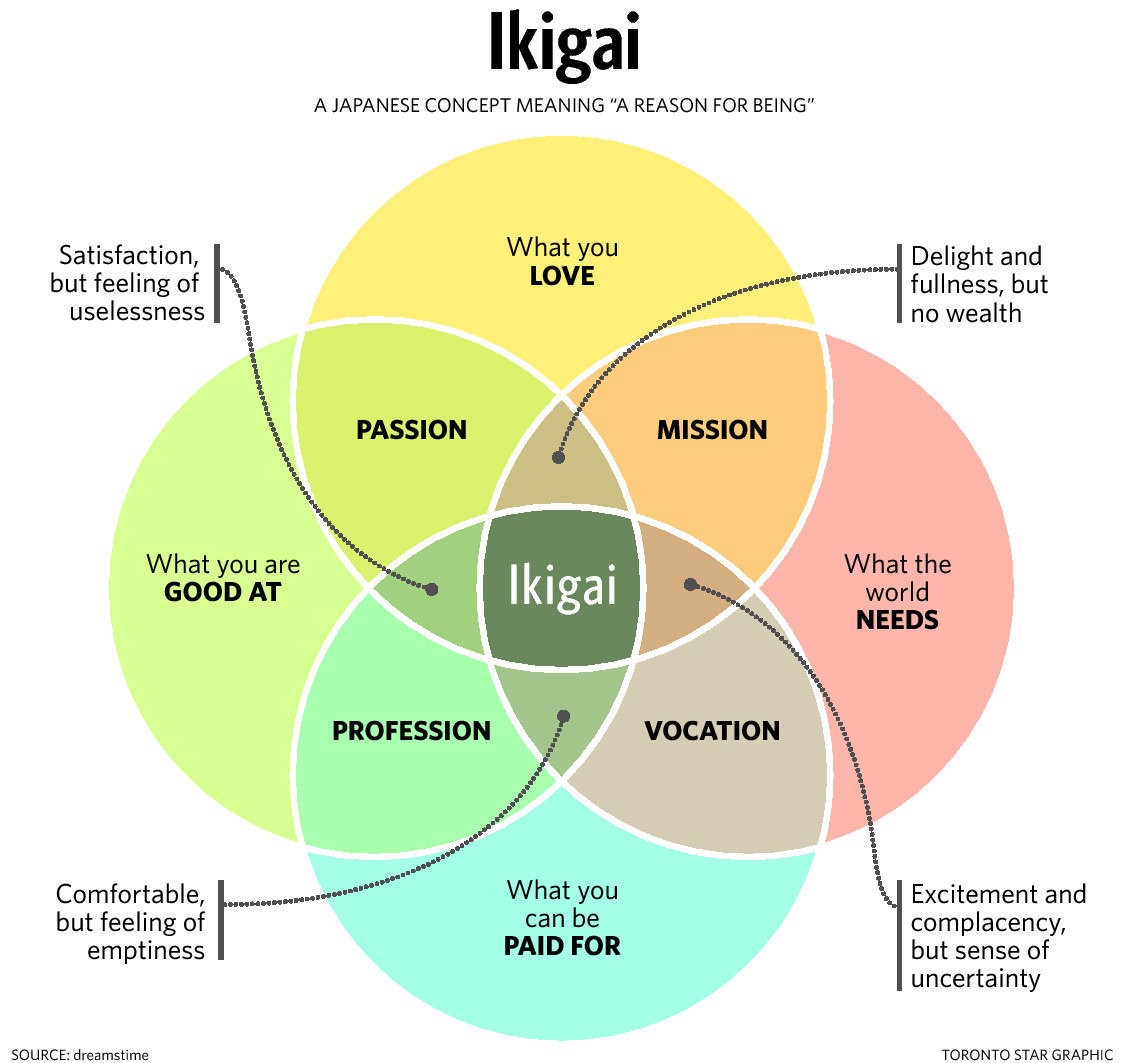
So how do you find out your own personal Ikigai? Make four lists – the first one being your passion in life or what you love doing, the second being your mission in this world or what you feel this world needs, the third list being the able to figure what you are good at or your vocation in life and the last list being what you can get paid for doing your vocation which is essentially your profession. The intersection of these four lists will allow you to figure your personal and unique Ikigai.

In their book Ikigai: The Japanese Secret to a Long and Happy Life, Hector Garcia and Francesc Miralles break down the ten rules that can help anyone find their own Ikigai:

  1. Stay active and don’t retire
  2. Leave urgency behind and adopt a slower pace of life
  3. Only eat until you are 80 per cent full
  4. Surround yourself with good friends
  5. Get in shape through daily, gentle exercise
  6. Smile and acknowledge people around you
  7. Reconnect with nature
  8. Give thanks to anything that brightens our day and makes us feel alive.
  9. Live in the moment
  10. Follow your Ikigai

While the concept has been around for centuries now (it originated in the Heian period, sometime during the period 794 to 1185 AD), the majority of us, including the Japanese people haven’t quite figured it out yet.

There have been studies which say that Ikigai promotes a sense of wellbeing which is probably why the Japanese and particularly Okinawians where this concept is said to have originated live the longest. It was statistically proven that presence of Ikigai is correlated with a lower level of stress and an overall feeling of being healthy. The feeling of Ikigai balances out the secretion of neurotransmitters such as dopamine, serotonin and β-endorphin. Some studies demonstrate that a sense of purpose or goal in life or Ikigai is negatively correlated with a need for approval from others and anxiety and studies also found that Ikigai is associated with longevity among Japanese people.

Human beings are born curious. Our insatiable drive to learn, invent, explore, and study deserves to have the same status as every other drive in our lives. So go and channel that curiosity and maybe you will be able to find that sweet spot in your life which is your Ikigai. Once you do, use it every day. Find things to do, simple or complex in your day to day lives which would be an expression of your Ikigai and once you have found and pursued it, you will realise that anything else is just compromise.

I am going to leave you with a Youtube video where Dan Buettner speaks in a Ted-Ed video on how to live to more than a 100 where he also speaks about Ikigai.

Snow Plow Parenting: Making life easier for their children

I recently came across this term “Snow Plow Parent” while reading an article online and was intrigued with the term.

The “Snow plow parent” is defined as a person who constantly forces obstacles out of their kids’ paths. They have their eye on the future success of their child, and anyone or anything that stands in their way has to be removed. Other terms used for this type of parenting are bulldozer parenting and lawnmower parenting.

I actually didn’t think this was very wrong, as most of us parents do help our children and try to make their lives as easy as possible. I am myself a snow plow parents, but how serious this is, I am not sure.

Similar to helicopter parenting, snow plow parents also hover and micro-manage their children’s lives, but they do it with an eye to the future. They want to remove any pain or difficulties from their children’s paths so that their kids can succeed. They are the parents sitting in the principal’s office asking about extra courses or for special allowances for their child. According to educators, there is a sense of entitlement to snow plowers: They blame the school when things go wrong and never accept anything less than first place for their child.

Research shows that helicopter parenting can have a negative effect on kids. They are less resilient, and less likely to take risks. They never develop proper coping skills or the maturity to make decisions on their own. Experts fear that children of snow plow parents will have similar issues—they won’t be able to handle failure or solve problems independently. Kids of snow plow parents may quit something instead of settling for second best.

It is said that snow plow parents go to whatever lengths necessary to prevent their child from having to face adversity, struggle, or failure and that this parenting style really focuses on short-time goals for parents and their kids. Their question is, “If I could make this easier for my child, why wouldn’t I do that?” And I ask why not?

I do agree that sometimes focusing on short-term parenting goals will take away from the practice of important, long-term goals that kids can benefit from like resiliency, grit, problem-solving, conflict resolution and coping skills. A child, if capable, should learn to advocate for themselves. When parents remove obstacles for their child they are really taking away that opportunity for kids to learn those problem-solving techniques.

These parents often have good intentions and are motivated by not wanting their children to experience struggle. But, these habits don’t provide a foundation for long-term happiness, they can actually strengthen a child’s anxiety of failure. 

I personally don’t feel that there is anything wrong in being a snow plow parent. Even though BB & GG turn 16 this year, I still drop them when they need to get to someplace which is either too far to get there by public transport or is someplace difficult to get to (I mean multiple transfers and unreliable buses). I also helped them edit their early application statements so that they have the best shot at getting an admission into the course of their choice. Though I think I will stop short of being that parent who reaches out to their professors and lecturers when they start tertiary education (or will I?)

I know that they are getting older and hence I need to loosen the apron strings. I am trying, but I also know that as teens, they don’t know (or probably don’t care enough) to see what lies ahead. It’s going to take a while, at least for me, but I hope that by the time GG & BB reach university, I have taught them well enough that they take the right actions to reach their version of success.

Again, culturally most Indian parents are snow plowers by nature and I guess I still have enough Indianness in me that I am programmed to think like that. I don’t want them to make the mistakes I made in life and live to regret it, so If I can share what they should and should not do to get ahead of the rat race, then as I see it, why not?

This is probably one of the most controversial subjects I have written about and one where I have not been objective, because I just could not be with such a topic. Are you a parent who tries to make life a little easy for your child? Let me know in the comments below.

Why Girls do better in school, but Boys excel in the workplace?

Source

This is a scene common across schools, colleges and universities around the world. A girl is most likely the topper of her cohort and more girls occupy the top positions than boys. Logical expectation would be that these same women who are so successful in school, would continue their successful run when they enter the workforce. But this does not really happen. You don’t see many women in the higher positions at work, there, it is the men who hold a staggering 95 percent of the top positions in the largest public companies.

I have always wondered why this happens. What happens to women that they are not able to replicate the success they have in school at work. Some weeks back, I happened to read an article in the newspaper, authored by Lisa Damour, a practising clinical psychologist and author of the forthcoming book, ‘Under Pressure: Confronting the Epidemic of Stress and Anxiety in Girls’ which tried to explain this phenomena and so I thought I should share this here in case there are others, parents with daughters who wonder why their daughter who was successful in school is not able to climb the corporate ladder just as fast.

A study by journalists Katty Kay and Claire Shipman on what deters professional advancement in women found that it was a shortage of confidence rather than a shortage of competence that was the reason for this lack of advancement.

When it comes to wok-related confidence, they found that men are far ahead. “Underqualified and underprepared men don’t think twice about leaning in,” they wrote. On the other hand, “Overqualified and over prepared, too many women still hold back. Women feel confident only when they are perfect.”

This is so true! I find myself constantly nagging at BB to study, while he is very nonchalant about the whole thing. He always assures me that what he is done should be enough to get through the exam. GG on the other hand, is always at her desk, writing notes, studying for a test or just revising previously studied topics. I have to force her to take breaks, while I have to do the exact opposite with BB.

In fact it’s a common refrain in our home that if BB needs an hour to study a certain topic, then GG takes at the very least double that time to study the same topic. For subjects where she is stronger, she will still take time to polish her work, while BB will just skate through.

According to the article I read, it is this experience of being successful in school with little to no effort is the probably the crux to helping our sons develop confidence because they can see that they can accomplish much by just relying on their wits and memory power. School for them, serves as a test track, one where they develop skills and build beliefs in their abilities and grow increasingly confident about relying on it. Our daughters on the other hand, miss the chance to gain confidence in their abilities if they always count on intellectual ability to get ahead in life.

So how do we get our hyper conscientious girls and boys (exceptions do happen across the norm) to build both confidence along with competence at school?

For starters, both parents and teachers can and should stop praising inefficient overwork, even if it results in good grades. I am really guilty of this as I think I am old school in thinking that the longer you spend studying, the better it is. According to the author, gendered approaches to learning set in early, so it’s never too soon to start working against them.

We should also encourage girls towards a different approach to school, one that’s more focused on economy of effort, rather than how many hours they out in.

One thing as parents we can do is to teach them to become more tactical in their studying, to get them to figure how to continue to learn and get the same grades, while at the same time do a bit less. This, they can do by taking a sample test before they start studying to see how much they know before they can figure out what else they need to do to get to the level they need to be for that topic.

Teachers can also help here. When a girl with high grades turns in extra work to be marked, the teacher should ask if this is because she still can’t really understand the topic, or if it is because it’s only for bragging rights or to become a teacher’s pet. If it’s the former, then that’s great, because she knows where she lacks and is working towards it. But if it’s the latter, then the teacher needs to let her know that it is unnecessary and that she should focus her time on things that really matter.

Finally, as parents and teachers, it is our duty to keep reaffirming to our daughters that it is normal and healthy to feel some anxiety about school. Too often girls are anxious about being anxious, so they turn to excessive studying for comfort. We should remind them that being nervous about school and tests is a good thing and it means they care about it, which is only right.

Not everyone wants to become a CEO, but even If that’s the case, as a parent, we worry that our daughters will be eventually crushed by the weight of her own academic habits. While a degree of stress is good and allows a person to grow, working hard all the time with no breaks is very unhealthy and unsustainable in the long run, even for the most academically dedicated student. There is a very severe case of burnout waiting to happen.

Actually a lack of confidence is not the only thing keeping women from top jobs. Women also face gender bias, sexual harassment and very powerful structural barriers in the workplace. I have written about the issues women face in the workplace earlier, here and here. But gaining confidence in the workplace is something we can address, starting from shoring up their confidence right from school.

Many professional men brim with confidence because they have spent years getting to know their abilities. Women should arrive at work with that same confidence, that’s the only way we can ensure equality in a world where women hold up half the sky.

15th Birthday Letter to GG & BB

Happy birthday GG & BB! You turned 15 over the weekend and as it happens every year, I can’t help but think of the two little babies I brought into this world who would fit comfortably in the crook of my arms. You’ve both grown up so much now, with BB towering more than a head over me. GG, who is my little chilli padi is still slightly miffed at the genes she got handed out at birth which makes her only chest high to her brother, but you are a feisty girl who is slowing becoming a lovely, graceful, but still a very feisty young woman.

Fifteen years back, I fell in love, irrevocably and completely and this feeling has only intensified in the intervening years. I can still remember the first words I uttered when I woke up from my anaesthesia were about you both and since that second, your well-being and happiness has been the absolute priority in my life.

Some days I lie in bed and start to worry and freak out. You both are fifteen now and only a few years away from legal adulthood. Very soon, you will finish school and life as I know it will end. You both will become more independent and mum will only be a peripheral part of your lives. I don’t know if I am ready for these changes yet. BB will go on to do his National Service in 3-4 years (depending on what educational route you take to after your O levels) and then will change into a man! I will surely miss my sweet little boy, but I can’t stop nature having her way, right?

BB, you are a sweetheart and I don’t say this because I am your mum and am biased (well, that too). You are one of the sweetest boys I have met (and thanks to you I have met many) who does not have a bad bone in his head or his heart. You always think the best of everyone and even when you get bullied, you’d rather just brush it off or keep it to yourself just because you don’t want to get someone in trouble. But you should learn to take a stand. When you leave the protected environment of your school and go out into the world, you will soon realise man comes in many forms and so when you don’t learn to stand up for yourself, you may find yourself pushed down to the bottom of the barrel.

GG, you are such a sweetheart, so giving and caring. You own each room when you enter it because of your personality. You are a natural leader, something I always knew and I am glad this year you got to showcase it to others when you became the Vice President of your CCA. You have a wonderful work ethic, one that will be an asset to you in the years to come. I have no doubt that irrespective of the career path you choose, you will become someone who is very successful (whatever your definition of success is). I know you dislike certain subjects in school, but you still work hard on those just because you have a natural desire to excel and set personal high standards for yourself. Keep doing that and success will kiss your feet always.

Happy birthday to my sweethearts! It was your birthday, but my present has and always has been the two of you – the best thing in my life!

Parenting: When teens push your buttons

By their very definition and age, teens tend to be self-centred and when they are in this phase, they tend to be rude and curt to people around them, including parents and this, in turn, makes people think, they are being disrespectful. But this a phase, which they outgrow once they become older and thus, more mature and learn to navigate the pitfalls of social conversations.

While I won’t say BB & GG are outright disrespectful, they do, at times, push as many buttons as they can, to see how much they can get away with. I looked and searched online for ideas I can implement at home to nip this in the bud and at the same time, teach them life skills.

We have to understand that this is happening to pretty much every child who enters the teenage years and so as parents and rational adults, we need to tackle this calmly without really reacting to their rude behaviour. They will try and push boundaries, it’s in their blood, but remember, we do not stoop to their level and react and act like them.

Focus on the behaviour and not on the person behaving and set clear rules on what constitutes good behaviour. Also, make sure your teen knows the consequences of bad behaviour and make sure you go through on those consequences when rules are broken.

Be a role model to your child, model the same behaviour you want to see in your child

Ignore mild forms of disrespect. It’s best to ignore mild forms of disrespect like rolling eyes, not replying to questions, shrugging shoulders etc. Ignoring such behaviour will let them know that you don’t give importance to such behaviour and hopefully, this kind of behaviour will peter off gradually.

Speak to them, often and even when they are uncommunicative. I always ask GG & BB how their day was and more often than not, the response I get is either, ‘the usual’ or ‘nothing much’. I don’t give up and sit and ask them in detail and with this try to open communication channels between us. It’s easier with GG (maybe because she is a girl) than BB, but I am not giving up and hope there will be a day when he is as much a chatty Kathy as GG is.

Hope these tips are useful for you when you are dealing with an uncommunicative and unresponsive teen. Do comment below on how you deal with your teen!