In My Hands Today…

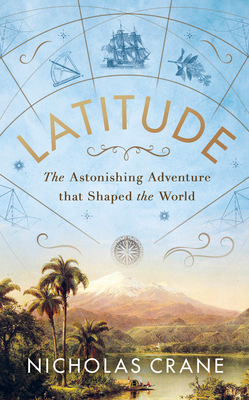
Latitude: The astonishing journey to discover the shape of the earth – Nicholas Crane

The year is 1735.
Twelve unruly men board ships bound for South America.
Their mission? To discover the true shape of the earth.
They will be exposed to a wilderness of dangers none can imagine.
The survivors won’t return for ten years.

They knew the world wasn’t a sphere. Either it stretched at the poles or it bulged at the equator. But which?

They needed to know because accurate maps saved lives at sea and made money on land. But measuring the earth was so difficult that most thought it impossible.

The world’s first international team of scientists was sent to a continent of unmapped rainforests and ice-shrouded volcanoes where they attempted to measure the length on the ground of one degree of latitude.

Beset by egos and disease, storms and earthquakes, mutiny and murder, they struggled for ten years to reach the single figure they sought.

Latitude is an epic story of survival and science set in mountain camps and remote observatories. A breathtaking tale of courage in adversity, it is celebrated today as the first modern exploring expedition.

In My Hands Today…

Becoming Fluent: How Cognitive Science Can Help Adults Learn a Foreign Language – Roger J. Kreuz, Richard Roberts

Adults who want to learn a foreign language are often discouraged because they believe they cannot acquire a language as easily as children. Once they begin to learn a language, adults may be further discouraged when they find the methods used to teach children don’t seem to work for them. What is an adult language learner to do? In this book, Richard Roberts and Roger Kreuz draw on insights from psychology and cognitive science to show that adults can master a foreign language if they bring to bear the skills and knowledge they have honed over a lifetime. Adults shouldn’t try to learn as children do; they should learn like adults.

Roberts and Kreuz report evidence that adults can learn new languages even more easily than children. Children appear to have only two advantages over adults in learning a language: they acquire a native accent more easily, and they do not suffer from self-defeating anxiety about learning a language. Adults, on the other hand, have the greater advantages—gained from experience—of an understanding of their own mental processes and knowing how to use language to do things. Adults have an especially advantageous grasp of pragmatics, the social use of language, and Roberts and Kreuz show how to leverage this metalinguistic ability in learning a new language.

Learning a language takes effort. But if adult learners apply the tools acquired over a lifetime, it can be enjoyable and rewarding.
Genres
Nonfiction
Language
Linguistics
Science
Psychology
Audiobook
Self Help

In My Hands Today…

All the Knowledge in the World: The Extraordinary History of the Encyclopedia – Simon Garfield

The encyclopaedia once shaped our understanding of the world.

Created by thousands of scholars and the most obsessive of editors, a good set conveyed a sense of absolute wisdom on its reader. Contributions from Albert Einstein, Sigmund Freud, Orville Wright, Alfred Hitchcock, Marie Curie and Indira Gandhi helped millions of children with their homework. Adults cleared their shelves in the belief that everything that was explainable was now effortlessly accessible in their living rooms.

But now these huge books gather dust, and sell for almost nothing on eBay, and we derive our information from our phones and computers, apparently for free. What have we lost in this transition? And how did we tell the progress of our lives in the past?

All the Knowledge in the World is a history and celebration of those who created the most ground-breaking and remarkable publishing phenomenon of any age. It tracks the story from Ancient Greece to Wikipedia, from modest single-volumes to the 11,000-volume Chinese manuscript that was too big to print. It looks at how Encyclopaedia Britannica came to dominate the industry, how it spawned hundreds of competitors, and how an army of ingenious door-to-door salesmen sold their wares to guilt-ridden parents. It explains how encyclopaedias have reflected our changing attitudes towards sexuality, race and technology, and exposes how these ultimate bastions of trust were often riddled with errors and prejudice.

With his characteristic ability to tackle the broadest of subjects in an illuminating and highly entertaining way, Simon Garfield uncovers a fascinating and important part of our shared past, and wonders whether the promise of complete knowledge – that most human of ambitions – will forever be beyond our grasp.

In My Hands Today…

Slow Death by Rubber Duck: How the Toxic Chemistry of Everyday Life Affects Our Health – Rick Smith, Bruce Lourie

Pollution is no longer just about belching smokestacks and ugly sewer pipes – now, it’s personal.

The most dangerous pollution has always come from commonplace items in our homes and workplaces. Smith and Lourie ingested and inhaled a host of things that surround all of us all the time. This book exposes the extent to which we are poisoned every day of our lives. For this book, over the period of a week – the kind of week that would be familiar to most people – the authors use their own bodies as the reference point and tell the story of pollution in our modern world, the miscreant corporate giants who manufacture the toxins, the weak-kneed government officials who let it happen, and the effects on people and families across the globe. Parents and concerned citizens will have to read this book.

Key concerns raised in Slow Death by Rubber Duck include flame-retardant chemicals from electronics and household dust polluting our blood; toxins in our urine caused by leaching from plastics and run-of-the-mill shampoos, toothpastes and deodorant; mercury in our blood from eating tuna; and the chemicals that build up in our body when carpets and upholstery off-gas.

Ultimately hopeful, the book empowers readers with some simple ideas for protecting themselves and their families, and changing things for the better.

In My Hands Today…

How to Survive History: How to Outrun a Tyrannosaurus, Escape Pompeii, Get Off the Titanic, and Survive the Rest of History’s Deadliest Catastrophes – Cody Cassidy

A detailed guide to surviving history’s most challenging threats, from outrunning dinosaurs to making it off the Titanic alive

History is the most dangerous place on Earth. From dinosaurs the size of locomotives to meteors big enough to sterilize the planet, from famines to pandemics, from tornadoes to the Chicxulub asteroid, the odds of human survival are slim but not zero—at least, not if you know where to go and what to do.

In each chapter of How to Survive History, Cody Cassidy explores how to survive one of history’s greatest threats: getting eaten by dinosaurs, being destroyed by the asteroid that wiped them out, succumbing to the lava flows of Pompeii, being devoured by the Donner Party, drowning during the sinking of the Titanic, falling prey to the Black Death, and more. Using hindsight and modern science to estimate everything from how fast you’d need to run to outpace a T. rex to the advantages of different body types in surviving the Donner Party tragedy, Cassidy gives you a detailed battle plan for survival while helping you learn about the era.