In My Hands Today,,,

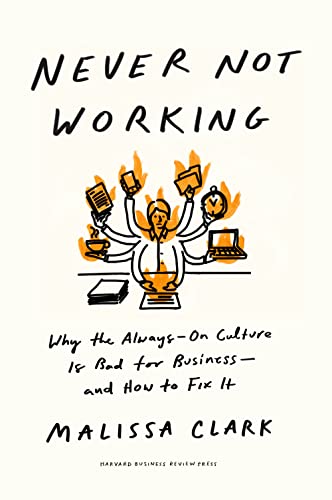
Never Not Working: Why the Always-On Culture Is Bad for Business–and How to Fix It – Malissa Clark

The always-on hustle culture creates an unhealthy, counterproductive relationship with work.

Many workers believe that to compete with other top talent they must embrace a culture that rewards long hours and constant connection to work. Businesses and society have encouraged this by endorsing busyness, overwork, and extreme commitment as the most valued traits in workers.

Sometimes that endorsement is explicit, as when Elon Musk told Twitter employees to work “long hours at high intensity” or get fired. But more often it’s an implicit contract, a buildup of organizational and cultural norms and the adoption of new technologies that increasingly make it easy to tether people to work. Either way, this workaholic behavior is unhealthy and counterproductive for workers and for organizations. It’s time to fight back.

Malissa Clark—the preeminent researcher on workaholic culture—shows you how in Never Not Working . Finally, a book that looks at overwork and burnout not just from the individual’s perspective but from an organizational perspective, too. Clark delivers a comprehensive, nuanced definition of workaholism, busting myths along the way—such as the idea that the number of hours worked is the strongest predictor of workaholic tendencies. (It’s not.) She also helps you see if you’re creating workaholics in your organization or if you’re falling prey to the phenomenon yourself. Clark shows you how to escape the trap of putting work at the center of everything and thus losing your well-being—or your company’s performance—in the process. Deeply researched and written for everyone, from leaders to individual contributors, Never Not Working is the essential guide to identifying workaholism in yourself and others and starting on the road to recovery.

In My Hands Today,,,

Clear Thinking: Turning Ordinary Moments into Extraordinary Results – Shane Parrish

Few things will change your trajectory in life or business as much as learning to think clearly. Yet few of us recognize opportunities to think in the first place.You might believe you’re thinking clearly in the moments that matter most. But in all likelihood, when the pressure is on, you won’t be thinking at all. And your subsequent actions will inevitably move you further from the results you ultimately seek—love, belonging, success, wealth, victory.

According to Farnam Street founder Shane Parrish, we must get better at recognizing these opportunities for what they are, and deploying our cognitive ability in order to achieve the life we want.

Clear Thinking gives you the tools to recognize the moments that have the potential to transform your trajectory, and reshape how you navigate the critical space between stimulus and response. As Parrish shows, we may imagine we are the protagonists in the story of our lives. But the sad truth is, most of us run on autopilot. Our behavioral defaults, groomed by biology, evolution, and culture, are primed to run the show for us if we don’t intervene.

At our worst, we react to events without reasoning, not even realizing that we’ve missed an opportunity to think at all. At our best, we recognize these moments for what they are, and apply the full capacity of our reasoning and rationality to them.Through stories, mental models, and more, Parrish offers the missing link between behavioral science and real-life outcomes. The result is a must-have manual for optimizing decision-making, gaining competitive advantage, and living a more intentional life.

In My Hands Today,,,

Slow Productivity: The Lost Art of Accomplishment Without Burnout – Cal Newport

From the New York Times bestselling author of Digital Minimalism and Deep Work , a groundbreaking philosophy for pursuing meaningful accomplishment while avoiding overload

Our current definition of “productivity” is broken. It pushes us to treat busyness as a proxy for useful effort, leading to impossibly lengthy task lists and ceaseless meetings. We’re overwhelmed by all we have to do and on the edge of burnout, left to decide between giving into soul-sapping hustle culture or rejecting ambition altogether. But are these really our only choices?

Long before the arrival of pinging inboxes and clogged schedules, history’s most creative and impactful philosophers, scientists, artists, and writers mastered the art of producing valuable work with staying power. In this timely and provocative book, Cal Newport harnesses the wisdom of these traditional knowledge workers to radically transform our modern jobs. Drawing from deep research on the habits and mindsets of a varied cast of storied thinkers – from Galileo and Isaac Newton, to Jane Austen and Georgia O’Keefe – Newport lays out the key principles of “slow productivity,” a more sustainable alternative to the aimless overwhelm that defines our current moment. Combining cultural criticism with systematic pragmatism, Newport deconstructs the absurdities inherent in standard notions of productivity, and then provides step-by-step advice for workers to replace them with a slower, more humane alternative.

From the aggressive rethinking of workload management, to introducing seasonal variation, to shifting your performance toward long-term quality, Slow Productivity provides a roadmap for escaping overload and arriving instead at a more timeless approach to pursuing meaningful accomplishment. The world of work is due for a new revolution. Slow productivity is exactly what we need.

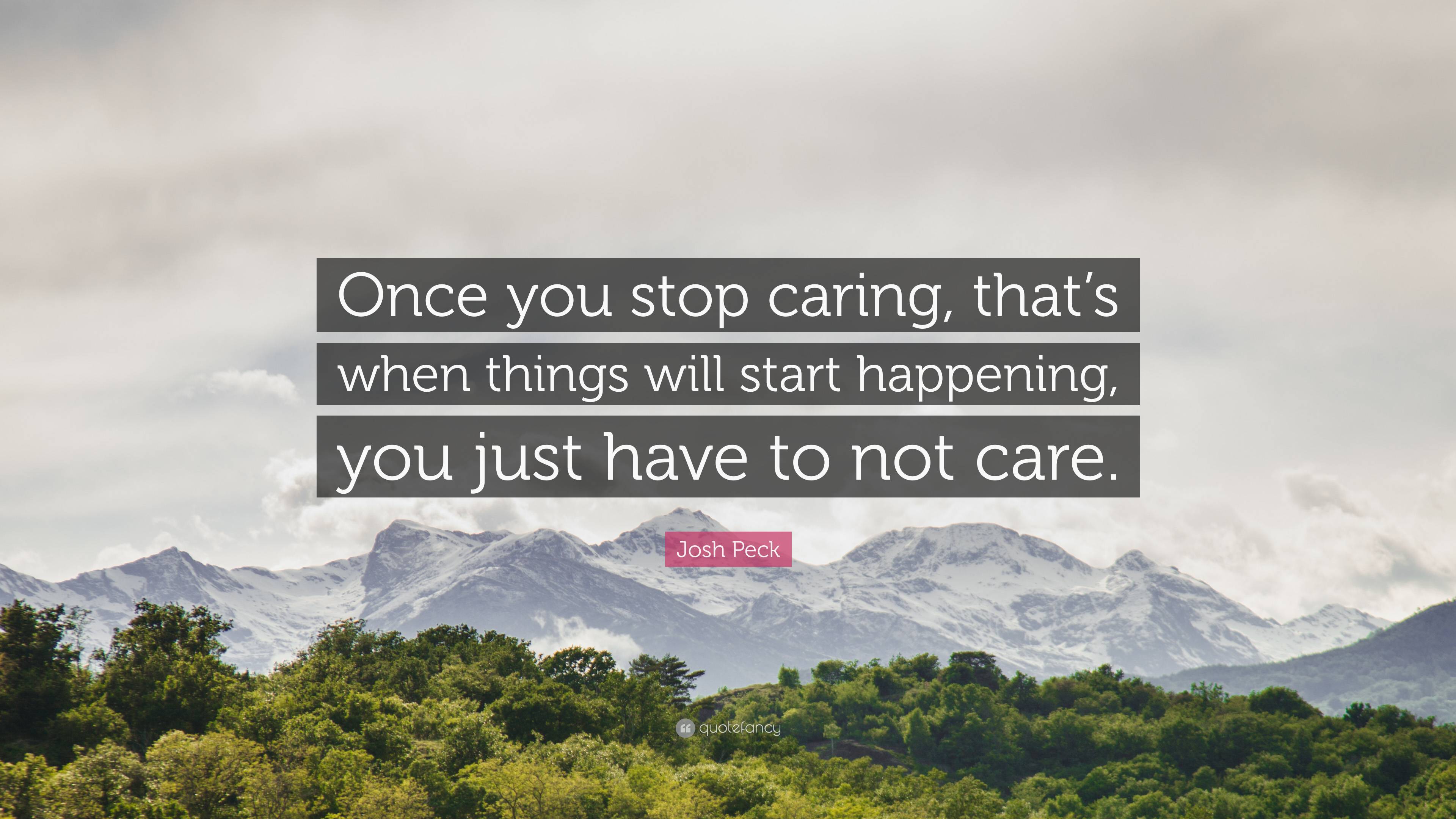
The Paradox of Not Caring: A Hidden Catalyst for Excellence

A couple of weeks ago, I came across this phrase and it instantly intrigued me.

To care usually guides our actions, shapes our relationships, and defines our sense of purpose and meaning. Yet, there lies a paradox, a curious interplay between indifference and significance, detachment and engagement. However, when we stop caring about something we previously wanted, sometimes it just comes up in front of us. This paradox of not caring, often dismissed as apathy or indifference, belies a complex web of psychological, social, and philosophical dynamics that merit closer examination.

Apathy, often described as a lack of interest, enthusiasm, or concern, represents a state of emotional detachment and disengagement from the world around us. It manifests as a pervasive sense of indifference or indifference towards one’s own life, relationships, and responsibilities. At first glance, apathy may seem inconsequential—a mere absence of caring or concern. However, upon closer examination, it reveals itself as a paradoxical state wherein the absence of caring paradoxically holds profound significance, shaping our perceptions, decisions, and actions in subtle yet profound ways.

Apathy often stems from psychological factors such as depression, burnout, or trauma, which can dampen one’s ability to experience emotions and engage with the world. It may serve as a coping mechanism for overwhelming stress or emotional pain, offering a refuge from the demands and pressures of daily life. Social and cultural norms can also contribute to apathy, shaping our attitudes towards success, ambition, and achievement. In societies that prioritise individualism and materialism, apathy may arise as a response to societal pressures to conform to rigid expectations and standards.

At the individual level, apathy manifests as a lack of motivation, initiative, or interest in pursuing personal goals and aspirations. It may lead to feelings of emptiness, meaninglessness, and existential despair, as individuals struggle to find purpose and fulfillment in their lives. On a broader societal level, apathy can manifest as social indifference or complacency towards pressing issues such as inequality, injustice, and environmental degradation. It may result in a collective numbness or resignation, as people become desensitised to the suffering and injustices that pervade the world.

For individuals, apathy can have profound consequences, undermining their mental health, relationships, and overall well-being. It may lead to feelings of isolation, alienation, and disconnection from others, as well as a sense of futility or hopelessness about the future. On a societal level, apathy can perpetuate systems of inequality, oppression, and injustice by fostering a culture of complacency and inaction. It may hinder efforts to address pressing social and environmental challenges, exacerbating existing disparities and marginalizing vulnerable populations.

But here lies the paradox’s magic: In not caring, we discover hidden reservoirs of strength. How does this paradox make us better at things? When we release the burden of excessive concern, our minds are clear. Like a painter wiping the canvas, we see the essential strokes. At work or school, this clarity allows us to prioritise, solve problems, and make decisions with precision. Paradoxically, indifference breeds courage. When we stop fearing failure or judgment, we leap into the unknown. Fearlessness fuels creativity, innovation, and bold actions. It’s the artist, unafraid of the blank canvas and the student, unafraid of the unanswered question.

Not caring about trivial distractions streamlines our efforts. We channel energy into what truly matters. At work, it means focusing on impactful tasks. In school, it means studying purposefully rather than drowning in anxiety. The heartache of not caring tempers our resilience. We learn that setbacks don’t define us. Instead, they propel us forward. Like a phoenix rising from ashes, we emerge stronger, ready to face challenges head-on.

So, how do we harness this paradox? It’s not about becoming indifferent automatons. Instead, care deeply about what aligns with your purpose. Let go of the rest. Be aware of when you’re pretending not to care. Is it a shield or a genuine choice? Use detachment as fuel. Let it ignite your curiosity and your hunger for growth.

In the quiet spaces where love and loss entwine, we find the delicate beauty of a heart that refuses to be indifferent. So, embrace the paradox. Dance it, stumble through it, and emerge wiser. For in not caring, we discover the art of caring deeply—for the right things.

In My Hands Today,,,

Supercommunicators: How to Unlock the Secret Language of Connection – Charles Duhigg

Come inside a jury room as one juror leads a starkly divided room to consensus. Join a young CIA officer as he recruits a reluctant foreign agent. And sit with an accomplished surgeon as he tries, and fails, to convince yet another cancer patient to opt for the less risky course of treatment. In Supercommunicators, Charles Duhigg blends deep research and his trademark storytelling skills to show how we can all learn to identify and leverage the hidden layers that lurk beneath every conversation.

Communication is a superpower and the best communicators understand that whenever we speak, we’re actually participating in one of three conversations: practical (What’s this really about?), emotional (How do we feel?), and social (Who are we?). If you don’t know what kind of conversation you’re having, you’re unlikely to connect.

Supercommunicators know the importance of recognizing—and then matching—each kind of conversation, and how to hear the complex emotions, subtle negotiations, and deeply held beliefs that color so much of what we say and how we listen. Our experiences, our values, our emotional lives—and how we see ourselves, and others—shape every discussion, from who will pick up the kids to how we want to be treated at work. In this book, you will learn why some people are able to make themselves heard, and to hear others, so clearly.

With his storytelling that takes us from the writers’ room of The Big Bang Theory to the couches of leading marriage counselors, Duhigg shows readers how to recognize these three conversations—and teaches us the tips and skills we need to navigate them more successfully.

In the end, he delivers a simple but powerful lesson: With the right tools, we can connect with anyone.