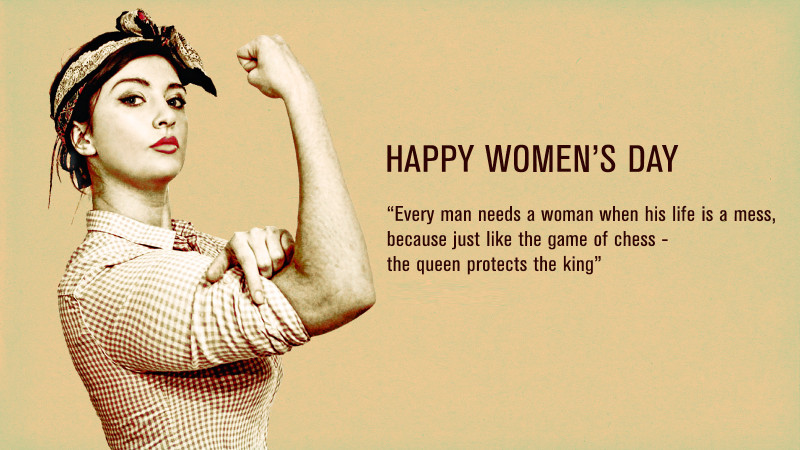
It’s March and this means it’s time for another International Women’s Day which will take place on Sunday. I have written previously about the IWD as it is usually shortened to and you can read more about the history of this day there.
Every day the global IWD committee has a theme and this year’s theme is “Each for Equal”. An equal world is an enabled world. We are all responsible every day for our own thoughts and action, but we can actively choose to challenge stereotypes, fight bias, broaden perceptions, improve situations and celebrate women’s achievements. Together and collectively every one of us can help create a world where gender is a non-issue and this world we live in is a gender equal world.
Equality is not a women’s issue, it’s a business issue. For economies and communities to thrive, it is essential that those countries and communities practice gender equality. A world which is gender-blind is one which is healthier, wealthier and more harmonious, which makes for an ideal world, which is what we aim to reach for, right? The race is on for the gender equal boardroom, a gender equal government, gender equal media coverage, gender equal workplaces, gender equal sports coverage, more gender equality in health and wealth. So this International Women’s Day, let’s make it happen.
So why is this day important and why are government, non-governmental and other organisations making such a big deal about it each year in March? Well, I believe that women should be celebrated every day but since that does not really happen, we take what we get. IWD is the one day in the year that recognises the value that women bring to the table, both individually and collectively and showcases the struggles they have undergone just to pave the way for the next generation.
In today’s world where many women (and men) have the power of social media in their hands (and phones), it is important that we use that power and influence in our hands and get involved and passionate about this cause of ensuring our next generations don’t have to go through the struggles we went through. So take that step and not just campaign and influence, but also celebrate, support, motivate, high-five and hug the females in your life this International Women’s Day.
This is a scene common across schools, colleges and universities around the world. A girl is most likely the topper of her cohort and more girls occupy the top positions than boys. Logical expectation would be that these same women who are so successful in school, would continue their successful run when they enter the workforce. But this does not really happen. You don’t see many women in the higher positions at work, there, it is the men who hold a staggering 95 percent of the top positions in the largest public companies.
I have always wondered why this happens. What happens to women that they are not able to replicate the success they have in school at work. Some weeks back, I happened to read an article in the newspaper, authored by Lisa Damour, a practising clinical psychologist and author of the forthcoming book, ‘Under Pressure: Confronting the Epidemic of Stress and Anxiety in Girls’ which tried to explain this phenomena and so I thought I should share this here in case there are others, parents with daughters who wonder why their daughter who was successful in school is not able to climb the corporate ladder just as fast.
A study by journalists Katty Kay and Claire Shipman on what deters professional advancement in women found that it was a shortage of confidence rather than a shortage of competence that was the reason for this lack of advancement.
When it comes to wok-related confidence, they found that men are far ahead. “Underqualified and underprepared men don’t think twice about leaning in,” they wrote. On the other hand, “Overqualified and over prepared, too many women still hold back. Women feel confident only when they are perfect.”
This is so true! I find myself constantly nagging at BB to study, while he is very nonchalant about the whole thing. He always assures me that what he is done should be enough to get through the exam. GG on the other hand, is always at her desk, writing notes, studying for a test or just revising previously studied topics. I have to force her to take breaks, while I have to do the exact opposite with BB.
In fact it’s a common refrain in our home that if BB needs an hour to study a certain topic, then GG takes at the very least double that time to study the same topic. For subjects where she is stronger, she will still take time to polish her work, while BB will just skate through.
According to the article I read, it is this experience of being successful in school with little to no effort is the probably the crux to helping our sons develop confidence because they can see that they can accomplish much by just relying on their wits and memory power. School for them, serves as a test track, one where they develop skills and build beliefs in their abilities and grow increasingly confident about relying on it. Our daughters on the other hand, miss the chance to gain confidence in their abilities if they always count on intellectual ability to get ahead in life.
So how do we get our hyper conscientious girls and boys (exceptions do happen across the norm) to build both confidence along with competence at school?
For starters, both parents and teachers can and should stop praising inefficient overwork, even if it results in good grades. I am really guilty of this as I think I am old school in thinking that the longer you spend studying, the better it is. According to the author, gendered approaches to learning set in early, so it’s never too soon to start working against them.
We should also encourage girls towards a different approach to school, one that’s more focused on economy of effort, rather than how many hours they out in.
One thing as parents we can do is to teach them to become more tactical in their studying, to get them to figure how to continue to learn and get the same grades, while at the same time do a bit less. This, they can do by taking a sample test before they start studying to see how much they know before they can figure out what else they need to do to get to the level they need to be for that topic.
Teachers can also help here. When a girl with high grades turns in extra work to be marked, the teacher should ask if this is because she still can’t really understand the topic, or if it is because it’s only for bragging rights or to become a teacher’s pet. If it’s the former, then that’s great, because she knows where she lacks and is working towards it. But if it’s the latter, then the teacher needs to let her know that it is unnecessary and that she should focus her time on things that really matter.
Finally, as parents and teachers, it is our duty to keep reaffirming to our daughters that it is normal and healthy to feel some anxiety about school. Too often girls are anxious about being anxious, so they turn to excessive studying for comfort. We should remind them that being nervous about school and tests is a good thing and it means they care about it, which is only right.
Not everyone wants to become a CEO, but even If that’s the case, as a parent, we worry that our daughters will be eventually crushed by the weight of her own academic habits. While a degree of stress is good and allows a person to grow, working hard all the time with no breaks is very unhealthy and unsustainable in the long run, even for the most academically dedicated student. There is a very severe case of burnout waiting to happen.
Actually a lack of confidence is not the only thing keeping women from top jobs. Women also face gender bias, sexual harassment and very powerful structural barriers in the workplace. I have written about the issues women face in the workplace earlier, here and here. But gaining confidence in the workplace is something we can address, starting from shoring up their confidence right from school.
Many professional men brim with confidence because they have spent years getting to know their abilities. Women should arrive at work with that same confidence, that’s the only way we can ensure equality in a world where women hold up half the sky.
A woman today is expected to ‘have it all’. We are expected to do well in school, be accomplished at work, bear children and also bear the bigger share of the household chores pie, which includes raising said children.
A long time ago, as a young fulltime working mother of toddlers, I remember telling a colleague that my job was my second shift and I still had one more shift to do after getting back home before I could finally rest for the day. At that time, I had no idea of the concept of second shift and what it means to a woman and a mother, but I did know that I was bearing up more than my share of both the chores at home, including cooking and cleaning as well as bringing up BB & GG.
In most societies, it is the woman who traditionally looked after the house and hearth while the man went out to work and earn for his family. When times changed and women started getting educated and getting into the workforce, this changed dynamics in the workforce. But in the homes, times have still stood still. Women are still expected to be the primary caregiver at home, the one who is still in charge of the household.
While times are changing and you do see exceptions to this rule, it is rare enough that when a father goes to a mum and baby class (another example of what I am talking, why can’t it be gender neutral), he is still looked at like something in a zoo.
The Second Shift, also known as the Double Burden refers to, “the workload of people who work to earn money, but who are also responsible for significant amounts of unpaid domestic labour.” The term Second Shift comes from Arlie Hochschild’s book of the same name.
This unpaid domestic labour largely falls upon the shoulders of women who work long hours outside of the home and are also expected to do the majority of household labour. These outdated ideals of women as domestic labourers are not solely influenced by tradition and sexism, but also capitalism. Capitalism inherently devalues domestic labour because it is not compensated, therefore placing it subsequent to work that is done outside the home. Not only this, but the false notion that unpaid domestic work is less valuable than paid labour creates a social climate that is that is not conducive to the equality of the sexes, rather, an atmosphere that does not allow women to readily overcome gender inequalities on account that domestic work is still largely seen as a “woman’s job.”
This idea that capitalism exacerbates social issues is easy to visualize. Imagine all the cleaning ads marketed towards women, all the cooking appliances marketed to female homemakers or advertisements about baby products that only feature women as caretakers. Capitalism markets sexist labour dichotomies because they sell, which in effect, only more deeply ingrains our beliefs about women in the home.
While this thought is evolving and has evolved over the years to include men into bearing an equal portion of the household chores and the raising of their children, in Asia, where traditional notions of gender norms still prevail, this is still more of a ‘work in progress’.
In Western and Southern Asia, women represent only a third of the work force. Many of them, even women in more modernized Asian countries, are involved in the informal sector, in traditional jobs for women, such as caring or teaching, without benefits such as employee health insurance or pension plans. The issue of the double burden is exacerbated in Asian countries due to the large cultural norm of women doing care work held by both men and women. In many developed countries, women drop out of work when they have children in order to have more time to take care of them.
In countries where women have to do paid work in order to feed their family, there is a lack of regulation and safety standards regarding female workers due to the large amount of informal work available. In Thailand for example, due to the severe economic crisis in 1997, many women have jobs in the informal industry, and often do home-based work so that they can do their domestic jobs concurrently with their paid jobs. This increases the work intensity by women doing more than one job at a time, and has been shown to have deteriorating effects on women’s health.
This second shift where women work unpaid at home, with nary a word of appreciation from their spouse, family members and even children, where all housework is still considered ‘mum’s work’, is something that young girls are exposed to since childhood. I read of a study in America where girls aged between 10 and 17 spend two hours more time doing chores at home compared to boys of the same age. At the same time, boys doing the same chores are 15% more likely to be paid for them as opposed to the girls who are expected to do it for free because ‘it is something that girls need to learn anyway’!
This could be the reason why there are so few women in the higher echelons of the corporate world. Because of all the additional work that women put in, they are probably too tired to schmooze and network their way to higher and more demanding positions.
This management gap has far-reaching implications, not just for a woman’s career development but for her salary growth and retirement security as well.
It’s not for lack of trying. According to a report, men and women lobby for promotions, ask for feedback, and negotiate salaries at the same rate. Yet employers and managers treat them differently: They punish women for being pushy, while showering men with tougher assignments, more training, and bigger pay checks. The study found that women who negotiate for a promotion or salary bump are 67% more likely than women who don’t to be labelled “bossy,” “too aggressive,” or “intimidating.” And they’re 30% more likely to hear that than men who negotiate. And women feel the disparity. 1 in 4 women feel they’ve missed out on a raise, promotion, or a chance to get ahead because of their gender.
So what can we do to mitigate this and make the world a more equal one for our daughters and granddaughters? The easiest way to change is to change thinking and the best way to do that is to educate our sons and grandsons and make them aware that the society they live in is one where women are just as equal as they are.
We also need to let our daughters and granddaughters know that they are in no way inferior to their male peers and there is no job which is meant specifically for each gender. This wat, we work towards developing a culture and society where equality is something that is taken for granted, just like breathing, where domestic work, rearing of their children is something that is shared between partners and no one person or gender takes on the lion’s share of what is supposed to be shared chores.
This is a long journey, but one in which we have to act today to see the results in the next generation.
There is Chinese saying, attributed to Mao Zedong, which says that women hold up half the sky. But even today in 2019, there exists significant gender gaps across sectors where women have to do so much more to prove that they are just as capable as men.
A World Economic Forum’s Global Gender Gap Report says that, “women represent fewer than 50% of leaders in every industry analysed—and in some fields, like energy and mining or manufacturing, representation of women is far lower, with women holding fewer than 20% of leadership positions. And the rate of progress for women has been slow: over the past ten years, the proportion of female leaders increased by an average of just over 2 percentage points across the 12 industries studied.”
These statistics are really troubling because the report also says that at the current rate, it’ll take 217 years to close the economic gender gap. This means, all things remaining the same, true equality in the workforce won’t be reached until the year 2234. Only then will women have the same earning and leadership potential as men. Startling right? This means that possibly only our great grand- daughters or maybe even four to five generations down the line will our daughters earn the same as our sons.
The International Women’s Day is commemorated across the globe on 8th May, and is celebrated as a day when women are recognized for their achievements without regard to divisions, whether national, ethnic, linguistic, cultural, economic or political. This day first emerged from the activities of labour movements at the turn of the twentieth century in North America and across Europe. After the Socialist Party of America organised a Women’s Day on February 28, 1909 in New York, the 1910 International Socialist Woman’s Conference suggested a Women’s Day be held annually. After women gained suffrage in Soviet Russia in 1917, March 8 became a national holiday there. The day was then predominantly celebrated by the socialist movement and communist countries until it was adopted in 1975 by the United Nations.
The theme for the 2019 International Women’s Day is “Balance for Better” while the United Nations has “Think Equal, Build Smart, Innovate for Change” as their theme for 2019.
Balance for Better means having a more gender balanced world where men and women are equal in every respect. The absence of balance in all aspects of our lives has never been more glaring than now, and so this theme actually notices the absence and celebrates its presence. Balance is not a women’s issue, it’s a business issue. The race is on for the gender-balanced boardroom, a gender-balanced government, gender-balanced media coverage, a gender-balance of employees, more gender-balance in wealth, gender-balanced sports coverage and in pretty much everything we hear, see or do in our daily lives. Gender balance is essential for economies and communities to thrive. This theme is a call-to-action for driving greater gender balance across corporate ranks in both the private and public sectors around the world.
The UN theme of “Think Equal, Build Smart, Innovate for Change” puts innovation by women and girls, for women and girls, at the heart of efforts to achieve gender equality. Achieving a gender-equal world requires social innovations that work for both women and men and leave no one behind. From urban planning that focuses on community safety to e-learning platforms that take classrooms to women and girls, affordable and quality childcare centres, and technology shaped by women, innovation can take the race for gender equality to its finishing line by 2030. It begins with making sure that women’s and girls’ needs and experiences are integrated at the very inception of technology and innovations. It means building smart solutions that go beyond acknowledging the gender gaps to addressing the needs of men and women equally. And ultimately, it needs innovations that disrupt business as usual, paying attention to how and by whom technology is used and accessed, and ensuring that women and girls play a decisive role in emerging industries.
How do you plan to mark this day? I will be joining some women (and men) to make a pledge to build a world where women are equal and just as capable as men, where women not only hold up half the sky, but also will then be able to bear the just fruits of their labour, without wondering if their male colleagues make more than them for doing the same work (and sometimes more).
Happy International Women’s Day! May we live long enough to see true equality happen in our lifetimes!










 Memories and Such