Recipes: Dal Dhokli

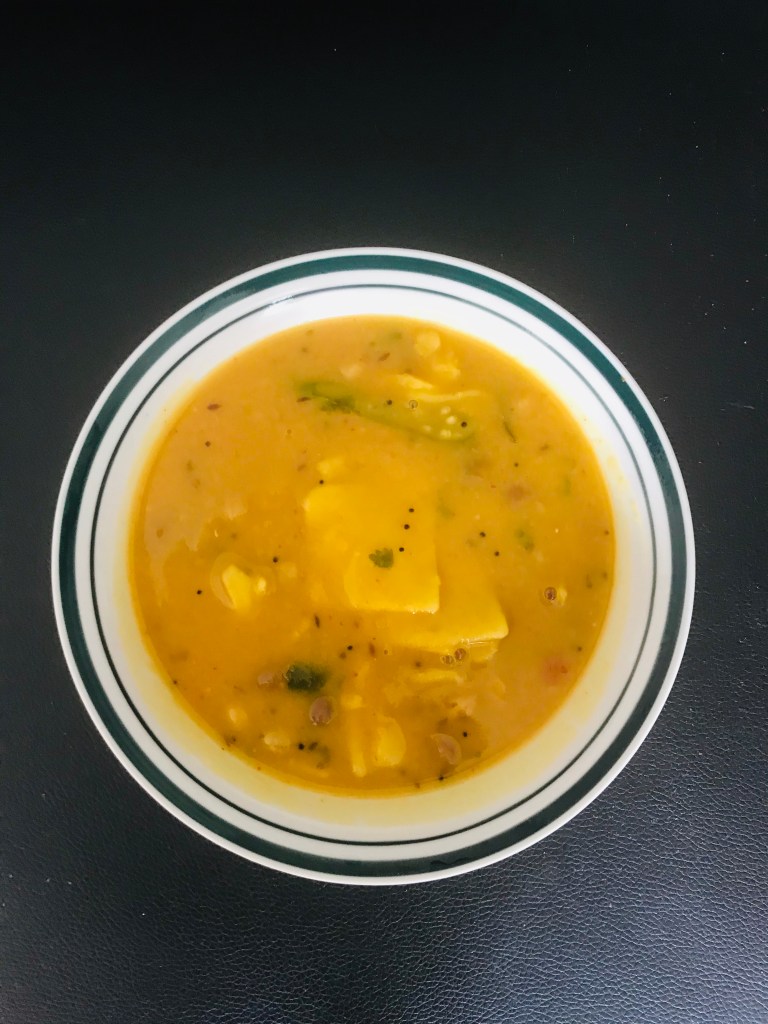
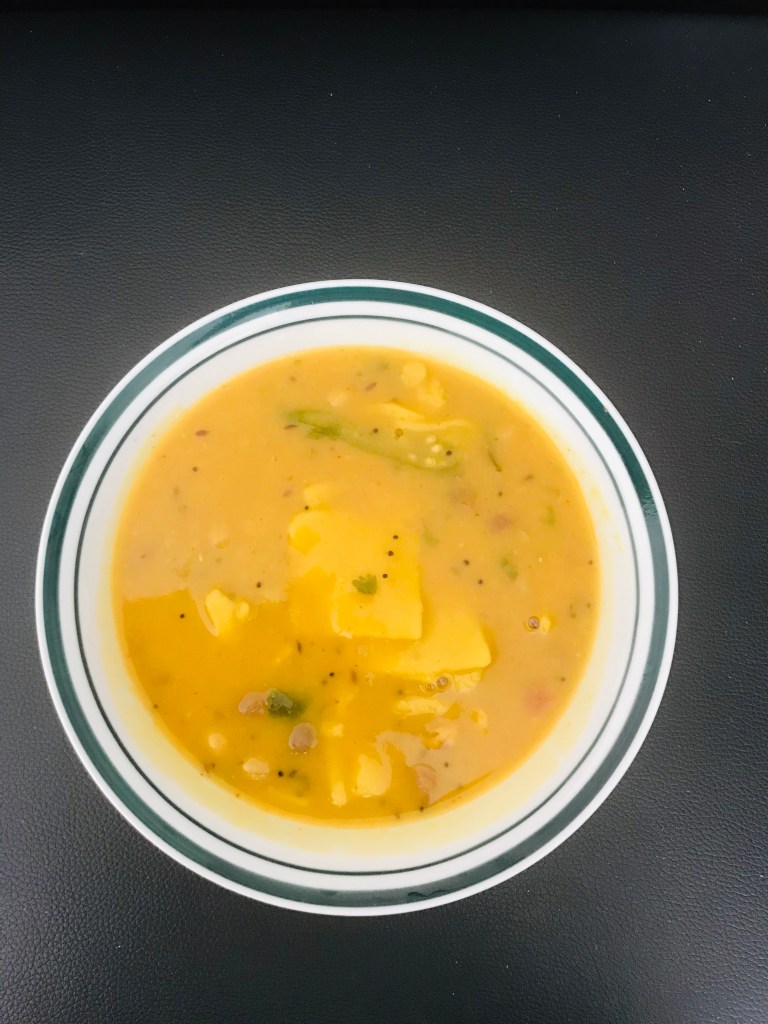
Dal Dhokli is a warm and comforting food from Gujarat. One day, during Singapore’s Circuit Breaker, I woke up with a craving for a dish I had never made. So I decided to make it and this dish pleasantly surprised me. It was warm and comforting and a wonderful addition to my repertoire. You can have this as a hearty soup like we did or over rice as some people do.
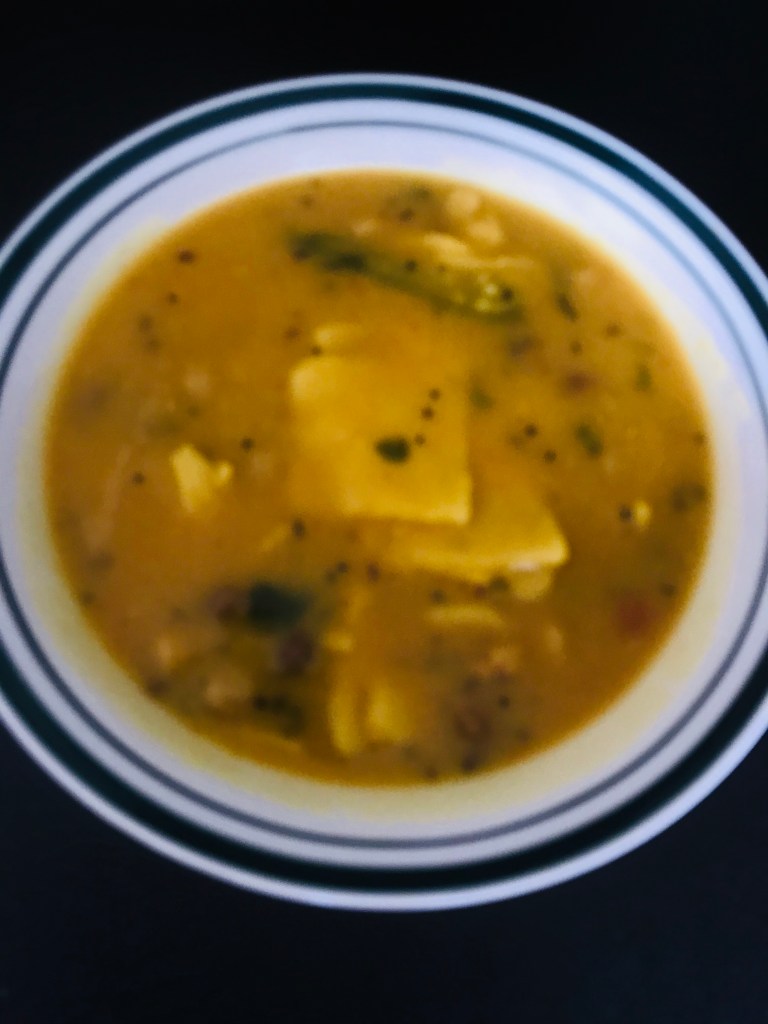
Dal Dhokli

Ingredients:

1 cup Toovar Dal, washed
½ tsp turmeric powder
1 tsp red chilli powder
1 tomato
4-5 cups water plus more, as needed
1 tsp jaggery
2-3 tbsp lemon juice
4 tbsp raw peanuts
1 cup whole wheat flour or atta
2 tbsp chickpea flour or besan
1 tsp caraway seeds or ajwain
2 tbsp ghee
1 tbsp oil
2 green chillies, slit lengthwise
1 tsp mustard seeds
¼ tsp asafoetida powder
1 sprig curry leaves
Salt to taste
Finely chopped coriander leaves to garnish

Method:

Soak about 2 tbsp of the raw peanuts in hot water for 15 minutes, drain and keep aside.
Wash the dal thoroughly and cook it in the pressure cooker along with ¼ tsp turmeric powder, 1 tsp red chilli powder, 2 tbsp peanuts, the tomato which has a cross made on the stem and about 3-4 cups of water.
Pressure cook it for some 4-5 whistles until the dal is completely mushed. If using the stove top, cook until the dal has broken down completely.
Let the pressure be released and then once the cooker can be opened, carefully remove the tomato, peel the skin which should have started to come out and then put the tomato back into the dal.
Whisk the dal until the dal, tomatoes and the peanuts are completely mixed into a mixture. Keep aside.
Kneed the atta, besan, ajwain, ¼ tsp turmeric powder, oil and salt into a soft dough. Keep aside.
Add the jaggery and another cup or two of water and mix well. Put this back into the flame and cook the dal on a slow simmer.
Make small balls from the dough and roll it into a thin circle or chapati.
Cut the chapatti into largish pieces or even strips.
Add these pieces into the simmering dal and add more water if needed.
Let the pieces cook for another 10 mins on a low flame on simmer.
In a small pan heat the ghee and once the ghee is warm, add the mustard seeds and let it crackle. Then add the asafoetida and then the balance peanuts, the curry leaves and the green chilli let the leaves crackle and the chilli start to brown.
When the peanuts become crisp, pour this tempering over the Dal Dhokli and switch off the gas. Add the lemon juice and garnish with coriander leaves.
Serve hot.

Notes: This dish does not keep well as the dough pieces tend to stick together after a while. If you plan on serving this later, then make the dal and about 10 minutes before serving, add the dough pieces and simmer before serving. Add more water if needed as the dough pieces will soak up the water in the dish.
In My Hands Today…

River of Ink – Paul M.M. Cooper

This image has an empty alt attribute; its file name is 25990703._SY475_.jpg

All Asanka knows is poetry. From his humble village beginnings in the great island kingdom of Lanka, he has risen to the prestigious position of court poet and now delights in his life of ease: composing romantic verses for love-struck courtiers, enjoying the confidence of his king and covertly teaching Sarasi, a beautiful and beguiling palace maid, the secrets of his art.

But when Kalinga Magha, a ruthless prince with a formidable army, arrives upon Lanka’s shores, Asanka’s world is changed beyond imagining. Violent, hubristic and unpredictable, Magha usurps the throne, laying waste to all who stand in his way. Under his terrifying rule, nothing in the city is left untouched and, like many of his fellow citizens, Asanka retreats into the shadows, hoping to pass unnoticed by the tyrant. But it seems his new master is a lover of poetry…

To Asanka’s horror, Magha tasks him with the translation of an epic Sanskrit poem, a tale of Gods and nobles, love and revenge, which the king believes will have a civilising effect on his subjects, soothing their discontent and snuffing out the fires of rebellion he suspects are igniting across the island.

Asanka has always believed that poetry makes nothing happen, but as each new chapter he writes is disseminated through the land and lines on the page become cries in the street, his belief and his loyalties are challenged. And, as Magha circles ever closer to the things Asanka treasures most, the poet will discover that true power lies not at the point of a sword, but in the tip of a pen.

International Day of Friendship

As an old saying goes, friends are the family we choose. The role of a friend in someone’s life is great and to a large extent, many of our decisions are determined by what our friends say and do.

Friendship are as important to our wellbeing as eating right and exercising and they also help us grow through each year of our lives. The basic components of any relationship, from our marriage to our coworkers, are all founded in friendship. We learn how to interact with people because of our friends, even the ones that are opposite from us or share a different worldview.

One of the most overlooked benefits of friendship is that it helps keep our minds and bodies strong. In fact, it’s as important to our physical health as eating well and keeping fit. A recent Harvard study concluded that having solid friendships in our life even helps promote brain health. Friends helps us deal with stress, make better lifestyle choices that keep us strong, and allow us to rebound from health issues and disease more quickly. Friendship is equally important to our mental health. One study even suggested spending time with positive friends actually changes our outlook for the better.

Friends don’t completely cure loneliness, but they do help us during lonely times. They teach us how to accept kindness and also to reach out when we need help. Having a steady stream of friends lets us know that some friendships won’t last forever but each one brings something special. We learn more about ourselves and how important it is to have someone, who knows and understands you. A good friend can change our value system so we learn to inject more meaning into our lives. In spending time with friends, we fill up our lives with great conversation, heartfelt caring and support, and laugh out loud fun. When we fall on hard times, friends are there to put things in perspective and help us. When we have success, they’re smiling at our good fortune. We don’t just live when we have healthy friendships, we thrive.

The original idea for a day of friendship came from Hallmark cards in the 1930’s. Originally celebrated on 2nd August, the day was largely viewed cynically by the public as a money making exercise, sales of friendship day cards did not take off in Europe and by the mid-1940’s the day had faded into obscurity in the USA. The idea of a day to honour friendship was, however, adopted by a number of countries in Asia where it remained a popular custom to reserve a day for celebrating friendships and the exchange of gifts between friends.

The first World Friendship Day was proposed for 30 July 1958 by the World Friendship Crusade, an international civil organisation that campaigns to foster a culture of peace through friendship. Many years later, in 2011, the 30th July was declared as the International Day of Friendship by the General Assembly of United Nations.

Source

Because friends are so important in our lives, in 1997, the UN General Assembly made a proposal to make 30 July the International Day of Friendship, which defined the culture of peace as a set of values, attitudes and behaviours that reject violence and endeavour to prevent conflicts by addressing their root causes with a view to solving problems. Recognising that enormous harm and suffering are caused to children through different forms of violence, the UN General Assembly emphasised that the promotion of a culture of peace and non-violence should be instilled in children through education. If children learn to live together in peace and harmony, as friends, that will contribute to the strengthening of international peace and cooperation.

The International Day of Friendship is also based on the recognition of the relevance and importance of friendship as a noble and valuable sentiment in the lives of human beings around the world. The day was proclaimed in 2011 by General Assembly with the idea that friendship between peoples, countries, cultures and individuals can inspire peace efforts and build bridges between communities.

The day places particular emphasis in involving young people, as future leaders, in community activities that include different cultures and promote international understanding and respect for diversity. It is also intended to support the goals and objectives of the Declaration and Programme of Action on a Culture of Peace and the International Decade for a Culture of Peace and Non-Violence for the Children of the World which was supposed to be between 2001 and 2010.

With the growing popularity of social media throughout the world, there has been an increase in celebrating World Friendship day and International Day of Friendship online as well as with community activities in local communities aimed at bringing those of different backgrounds together. How can you, as an individual mark this day? Reach out to a close friend either via telephone or using video to check on them and spend some qulity time together. Because of worldwide lockdowns, you may be unable to meet them physically, but today technology has ensured that distances are now not an issue anymore.

In My Hands Today…

The List – Karin Tanabe

This image has an empty alt attribute; its file name is 15802402.jpg

Meet Adrienne Brown, a twenty-eight-year-old Wellesley College grad who recently left her glamorous job at Town & Country for a spot at the Capitolist. Known simply as the List to Beltway insiders, it’s the only media outlet in D.C. that’s actually on the rise.

Taking the job means accepting a painful pay cut, giving up perks like free Louboutins, and moving back in with her parents, but Adrienne is certain that her new position will be the making of her career. And it is—but not at all in the way that she expects.

The Capitolist runs at an insane pace: Adrienne’s up before five in the morning, writing ten stories a day (sometimes on her BlackBerry, often during her commute), and answering every email within three minutes.

Just when it seems like the frenetic workload is going to break her, she stumbles upon a juicy political affair, involving a very public senator—and her most competitive colleague. Discovering that there’s much more to the relationship than meets the eye, Adrienne realizes she’s got the scoop of a lifetime. But should she go public with the story?

Poem: Wildflowers

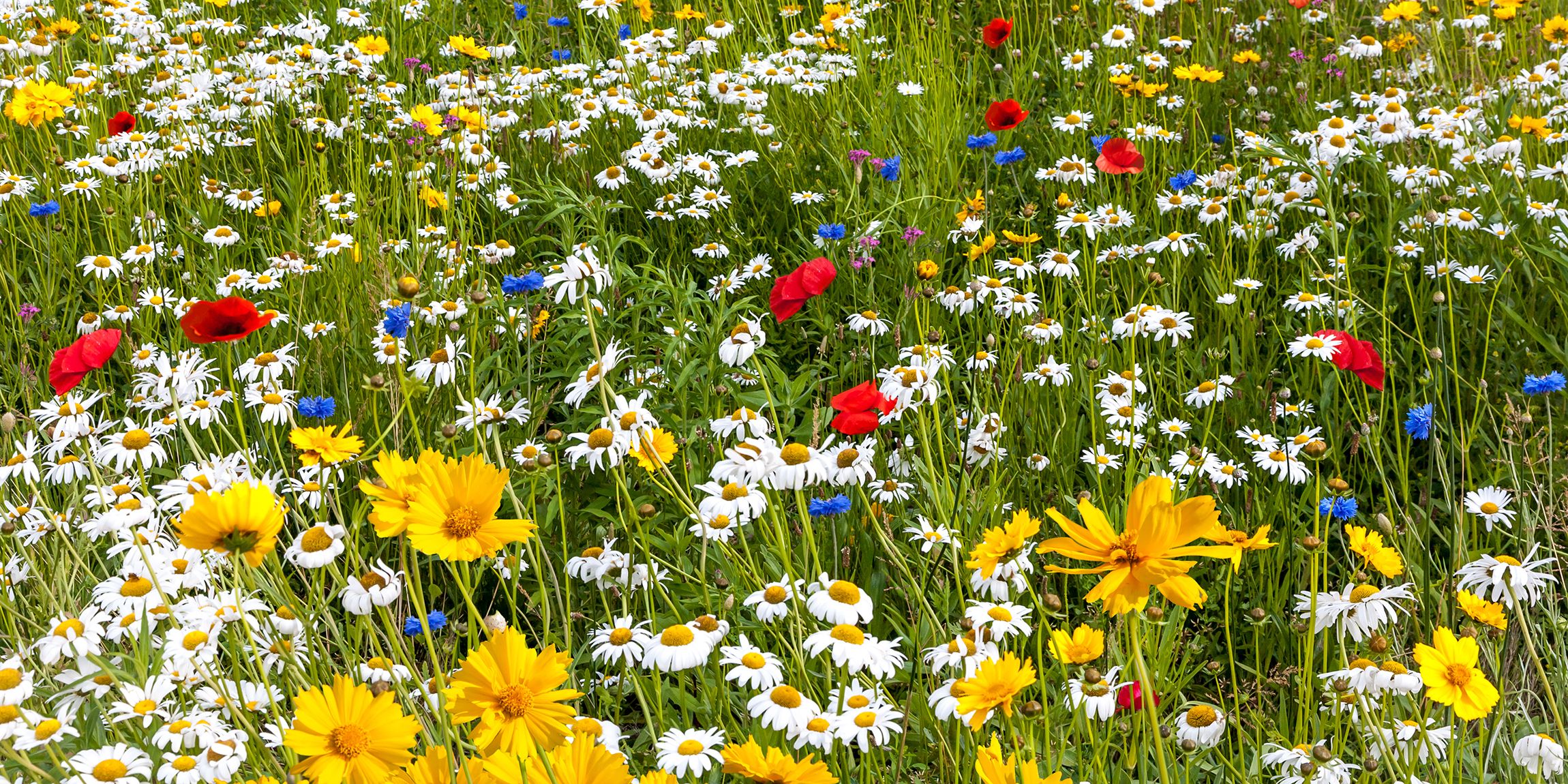
This poem came unbidden to me during Singapore’s Circuit Breaker while on a walk. I really loved the little wildflowers which bloomed during this time when the workers who are famed for keeping Singapore neat and tidy did not work. The public were thrilled with these wildflowers and after letters sent to the National Parks, they have now decided that these blooms will not be cut down in non residential areas.

Wildflowers

I was fed up sitting inside, staring at the same four walls
When I glanced outside and saw the clear blue sky

I knew I had to get out and walk, breathe in the crisp air
I quickly masked up, as that is our new normal and went outside
And started to walk to the nearby park

On the way, I saw empty streets and lonely void decks
Deserted of the usual crowd of people, the world seen probably as small specksLimited to our own area, we are now social distancing you know
We can’t move around as before, we need to keep away, go on with the flow

As I enter the park, I see the wild grass and leaves
On the ground, fallen flowers make a vivid carpet which sway in the breeze
Peering close, I can see small patches of wildflowers
Poking their heads out, fighting to live inspite of everything

I look at these flowers as an analogy of life
In today’s world, we are fighting to survive against all odds
Just as these flowers poke their heads even under difficult conditions
So we should take inspiration from them and try to flourish in the most adverse situations

Be like the wildflower that flourishes inspite of all odds
Be like the wildflower that lives another day despite knowing it may be it’s last