Nainadevi Temple, Nainadevi, Himachal Pradesh
Nestled atop a triangular hill in the Bilaspur district, the Naina Devi Temple is an ancient shrine, dedicated to Goddess Naina Devi. The origins of the temple stretch back in time, with its spiritual significance predating recorded history. While the exact date of its establishment remains uncertain, legends trace its roots to ancient times. One account attributes the temple’s construction to Raja Bir Chand in the 8th century, adding layers of historical depth to this sacred site.
The temple’s location, perched at an altitude of approximately 1,177 m above sea level, offers breathtaking views of the surrounding landscape, including the Holy Anandpur Sahib Gurudwara on one side and the Gobind Sagar Lake on the other.
This site is said to mark the spot where the eyes of Goddess Sati fell. The name Naina means eyes in Sanskrit, connecting to the legend of Sati’s eyes falling at this location. The temple is also known as Mahishapeeth because of the defeat of the demon Mahishasur by the Goddess. According to legend, Mahishasur was a powerful demon who was blessed with the boon of immortality by Lord Brahma, but the condition was that he could be defeated only by an unmarried woman. Due to this boon, Mahishasur started spreading terror on earth and the heaven. To cope with the demon, all Gods combined their powers and created a Devi to defeat him. The Devi was gifted different types of weapons by all Gods. When Mahishasur got mesmerised by the immense beauty of Devi and proposed her to marry him. Devi told him that she would marry him if he would overpower her. During the battle, Devi defeated the demon and took out both his eyes. This urged Gods to happily applaud Jai Naina and hence the name. The Shakti at Naina Devi Temple is called Mahishamardini Devi and the bhairav is known as Krodhishwar.
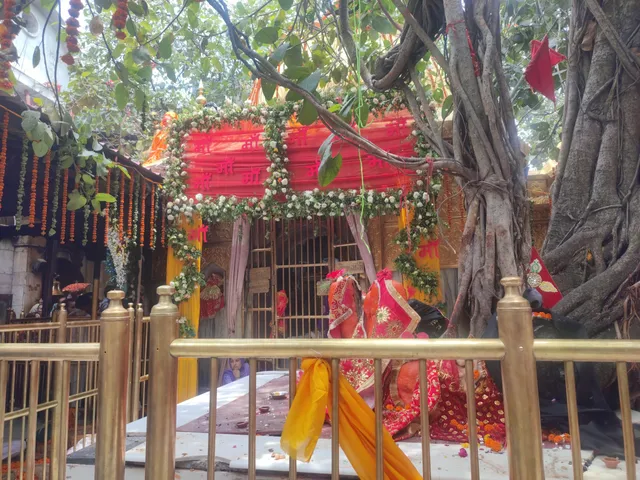
The main shrine reveals images of three deities. Goddess Kali can be traced on the extreme left, the image of Naina Devi is visible in the centre, while Lord Ganesha is on the right side. After crossing the main gate of the shrine, two striking statues of lions are visible, symbolising the goddess’s power and protection. The temple complex houses a huge Peepal tree that is said to have been present for many centuries, adding to the site’s historical and spiritual ambience. On the right side of the entrance to the main shrine, idols of Lord Hanuman and Lord Ganesha are placed, welcoming devotees. Close to the main shrine, there is a small cave known as Shri Naina Devi Cave, adding an element of mystery and spiritual intrigue to the site. In recent times, a cable car facility has been launched to make the journey to the hilltop temple easier and more enjoyable for pilgrims.
The temple comes alive during its numerous festivals and special occasions. Navaratri is celebrated with great fervour at the temple. It attracts devotees from all over the country, with special pujas performed each day to honour the nine forms of the goddess. The Chaitra Purnima Fair is held each year on the full moon of Chaitra, usually in April, drawing large crowds of devotees and tourists alike. Shravan Ashtami is celebrated in July-August and sees a significant influx of pilgrims seeking the goddess’s blessings. On Bhadrapad Shukla Ashtami, a statue immersion ceremony has been celebrated since 1918-19, similar to practices in Maharashtra and West Bengal.
According to local lore, a Gujjar boy named Naina once observed a white cow showering milk on a particular stone while grazing his cattle. This phenomenon repeated for several days. One night, the boy had a dream where the Goddess claimed that the stone was her Pindi or symbolic representation. Upon hearing this story, Raja Bir Chand, convinced by the divine sign, decided to construct the temple atop the hill. A variation of the above legend speaks of Raja Bir Chand himself witnessing the miracle of the white cow showering milk on the stone, leading to his decision to build the temple.
Another intriguing tale suggests that when Raja Bir Chand decided to build a temple for the goddess in the plains, she agreed on the condition that he should not look back while leading her down the hill. Unable to resist his curiosity, the king peeped back, causing the goddess to stop at the current temple site. It is believed that the goddess has the divine power to grant the boon of offspring to those who passionately seek her favor, making the temple a popular pilgrimage site for couples hoping to conceive.
As one stands in the temple courtyard, surrounded by centuries of devotion and the echoes of ancient rituals, one can’t help but feel a connection to the spiritual heritage that has shaped this land for millennia. The Naina Devi Temple, with its blend of myth, history, and living faith, invites all who visit to partake in its timeless spiritual journey.
Chhinnamastika Temple, Chintpurni, Himachal Pradesh
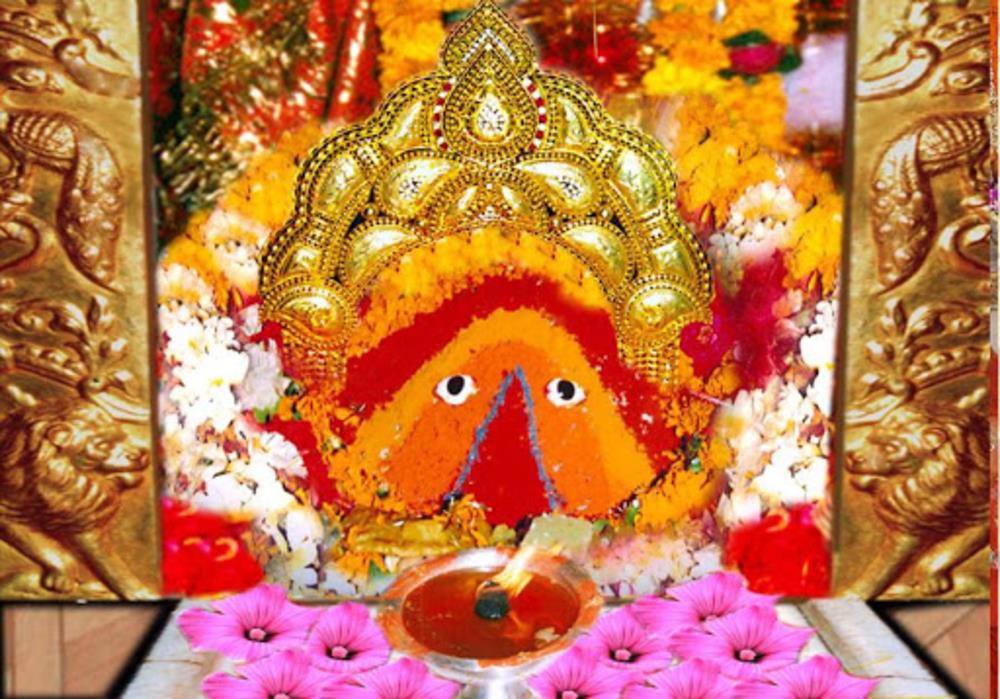
Located in the beautiful hills of Una, the Chhinnamastika Temple in Chintpurni is dedicated to Goddess Chhinnamastika. The temple’s origins predate recorded history and while the exact date of its establishment remains uncertain, local tradition attributes the temple’s founding to Pandit Mai Das, a Saraswat Brahmin, about 12 generations ago, approximately 300 years back. Over time, the village of Chhaproh where the temple was established came to be known as Chintpurni, after the eponymous deity. The temple’s location atop a hill not only provides a serene atmosphere for worship but also offers panoramic views of the surrounding landscape, enhancing the spiritual experience for devotees.
The temple is where the foot of Sati is said to have fallen. The Shakti at the Chhinnamastika Temple is known as Chhinnamastika Devi while the bhairava is known as Rudra Mahadeva. According to Markandeya Purana, goddess Chandi defeated the demons after a fierce battle but two of her yogini emanations, Jaya and Vijaya, were still thirsty for more blood. Goddess Chandi cut off her own head to quench Jaya and Vijaya’s thirst for more blood. Chhinnamasta, the headless goddess, is the great cosmic power who helps the sincere and devoted yogi to dissolve his or her mind, including all the preconceived ideas, attachments and habits into the pure divine consciousness. Cutting off the head suggests the separation of the mind from the body, that is the freedom of the consciousness from the material confines of the physical body.
According to Puranic traditions, Chhinnamastika Mata will be protected by Shiva – Rudra Mahadev in the four directions. There are four Shiva temples – Kaleshwar Mahadev in the east, Narayhana Mahadev in the west, Muchkund Mahadev in the north and Shiva Bari in the south – which are nearly equidistant from Chintpurni. In the garbha griha, the sanctum sanctorum of the temple, the image of Mata Chintpurni is installed in the form of a pindi – a round-shaped stone. The main shrine reveals images of three deities, the goddess flanked by her attendants, Jaya and Vijaya. Unlike many Hindu temples with elaborate idols, the main deity here is represented by the pindi, emphasising the formless aspect of the divine.
The temple comes alive during its numerous festivals and special occasions, including Navratri and Makar Sankranti. Observed on the Chaturdashi during the Shukla Paksha of the Vaishakha month, Chhinnamasta Jayanti commemorates the day when Goddess Shakti took the form of Mata Chhinnamasta. A fair is arranged during this auspicious celebration. Maha Shivaratri is also observed at the temple, highlighting the connection between Shiva and Shakti.
Another legend tells of Goddess Parvati bathing in the Mandakini river with her attendants. Losing track of time, she failed to notice her companions’ growing hunger. When she finally realized their plight, she beheaded herself to feed them with her blood. A variation of the bathing story tells that after slaying demons and drinking their blood, Goddess Chandi’s companions Jaya and Vijaya were still thirsty. The goddess then cut off her own head to satisfy their thirst. An oral tradition connects Chhinnamasta to the Samudra Manthan or the churning of the ocean episode. It’s said that she drank the demons’ share of the elixir of immortality and then beheaded herself to prevent them from acquiring it.
The Chhinnamastika Temple, with its blend of myth, history, and living faith, invites all who visit to partake in its timeless spiritual journey. The temple’s significance extends beyond its religious importance. It serves as a cultural centre, preserving ancient traditions and fostering community bonds.
Mahamaya Temple, Amarnath, Jammu & Kashmir
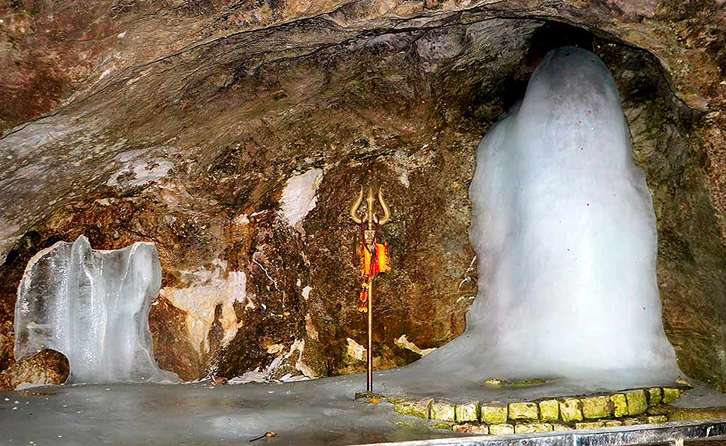
Located within the holy Amarnath Caves, the Mahamaya Temple lies at an altitude of 3,888 m and is believed to be over 5,000 years old. While the exact date of its establishment is unknown, the site’s sacred status stretches back millennia. The Amarnath cave itself is renowned for its naturally formed ice lingam, representing Lord Shiva, which forms each year. According to legend, it was in this cave that Lord Shiva imparted the secret of immortality to his consort Parvati.
A fascinating story from the 15th century adds another layer to the shrine’s history. It is said that a shepherd named Buta Mallik encountered a saint who gave him a bag of coal. Miraculously, upon reaching home, Buta found the coal had transformed into gold. When he returned to thank the saint, he instead discovered the holy cave containing the Shiva Linga. This tale spread, leading to increased worship at the site.
It is believed that Sati’s throat fell at this location, making devotees worship her as Mahamaya or the great illusion. The Bhairava is called Trisandhyeshwar.
Unlike many elaborate temple structures, the shrine is housed within a natural cave. The primary objects of worship – the ice lingam and the Shakti Peetha – are naturally formed. The journey to Amarnath is considered one of the most arduous pilgrimages in Hinduism. The difficult trek through snow-covered terrain is seen as a test of devotion and adds to the spiritual merit of visiting the shrine. Due to its high-altitude location, the shrine is only accessible for a short period during the summer months when the snow melts enough to allow pilgrims to make the journey. The site uniquely combines worship of both Shiva, in the form of the ice lingam, and Shakti, as the Mahamaya Peetha, making it significant for devotees of both deities.
The primary ritual for pilgrims is to have darshan or the sacred viewing of the naturally formed ice lingam, which represents Lord Shiva. Devotees offer prayers and perform rituals dedicated to Goddess Mahamaya, seeking her blessings and divine protection. A unique aspect of worship at this shrine is the offering of Vibhuti or sacred ash as prasad or offering to devotees. This ash is believed to carry the blessings of both Shiva and Shakti. The cave’s serene and spiritually charged atmosphere makes it an ideal place for meditation and the chanting of sacred mantras. The entire pilgrimage to Amarnath is filled with various rituals, from preparatory prayers before beginning the journey to specific observances along the trek.
The most significant period for the Mahamaya Shakti Peeth is during the annual Amarnath Yatra, which typically occurs in July and August. This pilgrimage attracts thousands of devotees who brave the challenging conditions to seek blessings at this sacred site. The month of Shravan in the Hindu calendar usually falls in July-August and is considered especially auspicious for the worship of Lord Shiva and visits to the shrine. While the shrine is not accessible during Maha Shivaratri, it is still an important day of worship and remembrance for devotees of the Amarnath shrine.
It is said that Lord Shiva chose this secluded cave to reveal the secret of immortality to Goddess Parvati, highlighting the site’s connection to profound spiritual wisdom. The tale of Buta Mallik’s miraculous encounter leading to the rediscovery of the holy cave in the 15th century adds a touch of wonder to the shrine’s history. Local legends speak of the goddess Mahamaya’s protective presence over the entire Amarnath region, safeguarding pilgrims on their arduous journey. Some interpretations suggest that the melting and reforming of the ice lingam each year symbolises the cycle of creation and dissolution in the universe, reflecting deep philosophical concepts.
The Mahamaya Shakti Peeth in Amarnath’s unique position high in the Himalayas, its naturally formed objects of worship, and its rich tapestry of legends and spiritual significance make it a truly special place in the landscape of Hindu pilgrimage sites. The story of the Mahamaya Shakti Peeth is ultimately a story of the meeting of earth and sky, of human devotion and divine grace. It teaches us about the power of faith to overcome obstacles, the importance of preserving our natural and spiritual heritage, and the eternal presence of the divine feminine in the cosmic dance of creation.









 Memories and Such