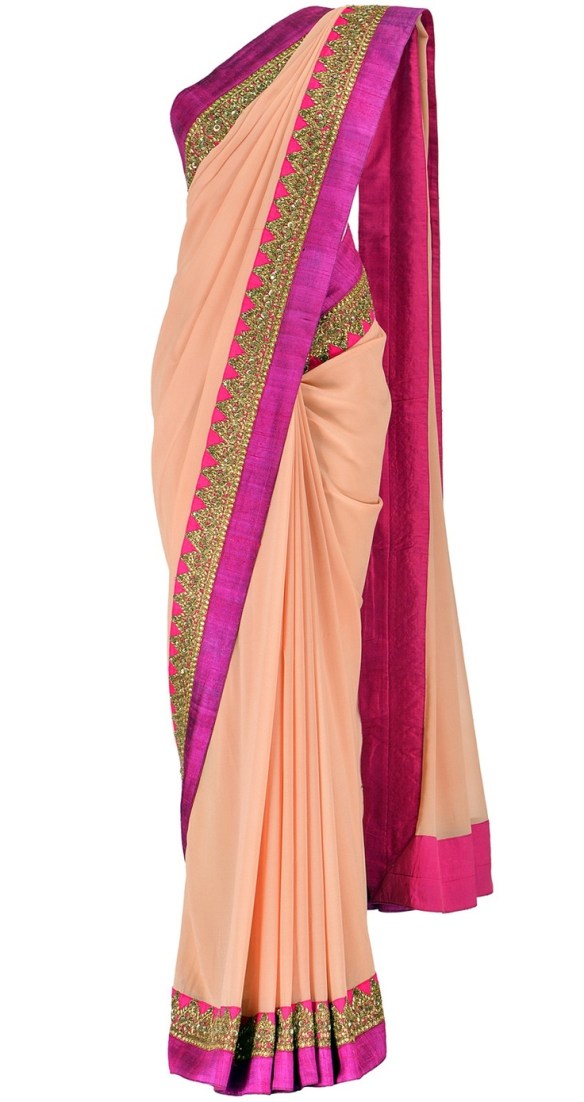
Ode to a Saree

8e68083407d603b3a20f519a36735bc8The very word ‘Saree or Sari’ evokes a sense of pure bliss for the six yards of fabric which exude grace and elegance. This traditional Indian garment for women is in every Indian woman’s wardrobe, even if she is not a saree wearer, but she will wear a saree for very special occasions.

I used to love wearing the saree and have loads of memories pre-marriage of wearing them. Back in college, we used to have ‘Saree Day’ and ‘Traditional Day’ each year, where girls would wear the saree on saree day and either a saree or their traditional dress on traditional day. When we had official functions in college, again the saree would come out and those days the whole college would look so colourful with everyone checking out theirs and their friends sarees and accessories.

Even when I started work, sarees played an important role. Every interview was always in a saree, as this was considered formal wear for women and again when we had important meetings, presentations or visitors we’d all wear sarees to work. Another time the saree was brought out was during festivals. During festivals, everyone came in their festive best and during festivals like Navratri, where each day has a specific colour associated with it, all the women in the office would wear the same colour!
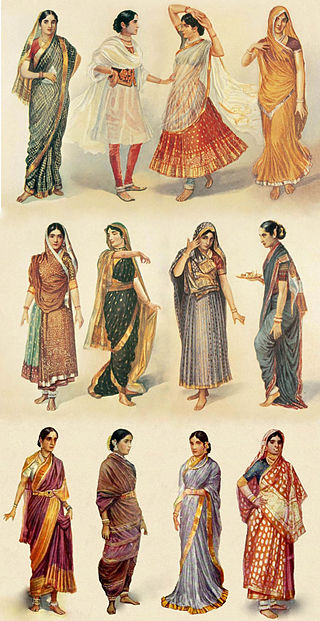
320px-styles_of_sariAfter coming to Singapore, my saree wearing slowed down and after having BB & GG, almost came to a stop! But in the last year or so, I have rediscovered my love for the saree again, what with seeing images of women doing everything in this garment on social media. I’ve now decided to wear them more often, though the heat does everything to discourage me. I’ve also decided to buy more sarees from India’s rich heritage and want to own atleast one saree from every Indian state – from the Bandini of Rajasthan to the Patola of Gujarat to the Kantha of West Bengal to the Muga Silk of Assam to the Sambalpuri of Odisha to the Pochampalli of Telangana to the Paithani from Maharashtra to the Kanjivaram from Tamil Nadu to the Mangalgiri and Gadwal silks from Andhra Pradesh to the Maheshwari and Chanderi from Madhya Pradesh to the Banrasi Silk from Uttar Pradesh to Mysore Silks from Karnataka. The rich cultural heritage of the various Indian states ensure you can never run out of sarees to wear!

Now I am off to arrange my small stack of sarees and make notes on what I need to buy to add to it!

Mindfulness and Meditation: Mastering your mind

mindfulness_poster_UKI’m currently reading Ariana Huffington’s book ‘Thrive’ and though I’m only a third into the book, the chapter on mindfulness and meditation resonates with me.

I’ve been meditating on and off through the years (more off than on if I am honest), but I do practice what I now recognize as mindfulness almost every day.

According to Psychology Today, “Mindfulness is a state of active, open attention on the present. When you’re mindful, you observe your thoughts and feelings from a distance, without judging them good or bad. Instead of letting your life pass you by, mindfulness means living in the moment and awakening to experience.”

nothinglackingMy version of mindfulness is just before I fall asleep. I am not the sort of person, who as soon as my head hits the pillow, I fall asleep. I usually take between 10-15 minutes on a good say to fall asleep and this is when I reflect and recreate my day as well as see where I was wrong and try to re-do that experience. It’s only those admittedly rare days when I am so exhausted that I do go into a deep sleep as soon as my head hits the pillow that these reflections are not done. In between, I’ve tried to meditate, but I find that I do not have the disciple to do it on a daily basis.

After reading the book, I am more than convinced that I should start BB & GG on trying (the operative word here, ever tried to get teens to stay still?). We did try getting them to meditate once, but couldn’t sustain it, but I am going to give it another shot again. With the heavy stress they are under, this may be a good solution to get them to stay grounded and maybe be able to deal with this stress.

To ensure that we get it right this time, I’ve been reading up on the benefits of mindfulness and meditation and from what I’ve read the benefits far, far outweigh the efforts.

I consider meditation to be a part of mindfulness, where we try to still our busy minds and try to be in the present. You can use anything to anchor your mind – a word or even an image. Indians, and specifically Hindus are known to chant “Om” for this and the vibrations this sound makes is supposed to be very good not only for the individual, but also the environment surrounding you and puts you in a relaxed frame of mind, which is what meditation and mindfulness are all about.

mindfulness-for-daily-lifeSomeone who practices mindfulness and meditates on a regular basis is someone who is more satisfied with life, someone who knows and accepts what life brings to them and becomes fully engaged with the ‘now’, rather than the ‘later’. This ability helps cushion you against the adversities that life will inevitably bring to you.
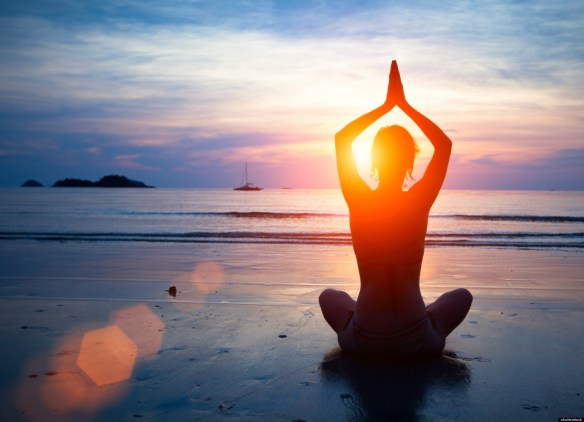
Scientists have also discovered that practicing mindfulness and meditating regularly help you physically – by relieving stress, lowering blood pressure, giving you the ability to manage pain and improve sleep. All this which a twenty-first century worker needs desperately!

mindfulness1The best way to do this is to find a time of the day when you can practice on a regular basis and stick to that. I prefer doing this just before bed, some people prefer doing this first thing in the morning, but it should be your call. Choose a relatively quiet place where you will not be interrupted as well as bombarded by stimuli. Relax your body and mind. You can close your eyes if that helps or you can focus your attention on an object or image. Take deep and confortable breaths and focus your attention on how you breathe. Your mind will start to wander and when it does, gently bring it back to the present. Having something to focus on like a chant or an image helps in this. I also like to keep a timer on my phone for the initial days when I know I can’t focus too much. Start small, maybe 2-3 minutes initially, gradually moving up the time you mediate and be mindful to as long as you can.
If you do this, I’d love to hear how this went. I will be starting this with BB & GG soon and will post a follow-up on this as soon as there’s some benefit. I am hoping that doing this with them for a few weeks will make this a lifelong habit and will help them through their busy and stressful lives.

I’d love to visit….

I love travel, if I could have the time and money, I’d love to travel the world! I remember one of my first conversations with S was exactly this….At some point (has to be soon lol) I will try to see as much of the world as I can…

I am a bit sad that there are so many parts of the world that are now inaccessible to me. With all the terror attacks happening around, travel these days has become something that you fear, rather than cherish. The Middle East has along with the countries to the west of India have now become unsafe to travel and so it’ll be long time before anyone can visit them. And when that happens, will the countries be as they were? Will the historical treasures, some thousands of years old, still survive?

If you read my blogs regularly, you will see I love reading books which are related to the Indian subcontinent as well as other cultures. So I’d love to actually go and visit all these different cultures myself and try and see it on an intimate level. I love going to places which I read about and if I’ve read something recently about a place I am visiting, it makes the place come even more alive to me. Also when I read about a place after I’ve visited it, most times the book becomes more real to me and instead of just reading it, it becomes my personal movie and I can actually ‘see’ the book come to life!

One country I am a bit obsessed with is Pakistan. As an Indian, born post-Independence, growing up, Pakistan was and probably still is in some people’s mind’s ‘the enemy’! Textbooks in school reinforced this and I am sure this is the same thing across the border. My wanting to visit this country may seem strange and slightly weird to any Indian who is reading this! A lot of people I know, including my dad, have memories of independence and the subsequent wars India and Pakistan have waged. I remember the Kargil War which happened when I was working in India. I remember my company going around asking people if they wanted to donate to the war efforts and most, if not all, of the people working in that place decided to donate one day’s salary to the war chest for the soldiers and their kin. My company, if I remember correctly, made a donation equal to what the employees donated. During the 1971 war between India and Pakistan, my dad was a air raid warden for our area and his responsibility was to make sure all houses had blackout paper in their windows and that when the air-raid signal went off, no one had lights shining. My neighbors in India, who are Sindhis were originally from Sindh in Pakistan and came to India as refugees post partition. But to my mind, that is politics and not the people and culture of the country and from an early age, I’ve been fascinated by that country since we share a common history for the last thousands of years, except for the last 60.

One incident comes to mind which crystallized to me just how same and at the same time different we were. I helped out in a project for a professor in a university I was working in Singapore many years back. One component was to translate Indian, specifically Hindi newspapers on specific issues. Since they could not find someone willing to do the translation, I was roped in! The study also had someone from Pakistan doing the same thing for Urdu newspapers and we both sort of translated articles relating to the same incident and the way each side portrayed the incident was a serious relevation to me! What was white on one side was shown to be black or at the very least grey in the other side and vice-versa!

Since coming to Singapore, I’ve met, interacted and befriended many Pakistanis and found them to be just as we are. The specter we always taught about may be politics and when we speak someone ‘across the border’ they are just like us, with the same language, food and clothes. I’ve realized the two things you should not speak are politics and cricket; otherwise we have loads of common things to speak about.

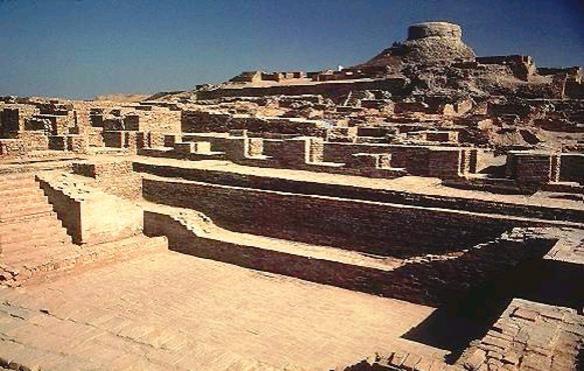
mohenjodaro_sindh

Excavation of Mohenjodaro, source Wikipedia

I know as someone born in India, to parents who are Indian, the chances of me going to Pakistan to see the country is probably as remote as going to the moon! I’d probably hitch a ride to the moon faster than visit Pakistan. I’d love to go and visit the sites of the Indus valley civilization and Mohenjodaro and Harappa and also see the towns and cities I’ve only seen in movies and television shows.

When I see ties between Singapore and Malaysia so cordial and movement between the two countries so easy, I mourn for something similar to happen between India and Pakistan. When we share so much together, why is it so difficult to visit each other? Maybe the politicians and people who govern both countries fear exactly that – that when we realise how similar we are, we won’t need all that hateful rhetoric and live in peace. I do hope one day (not too hopeful that it will happen in my lifetime), this does come true. In the meantime, I will live out my obsession with pictures, books, movies and television!

This actually turned out to be a fun post to write. I’ll do this on and off – listing places I’d love to visit, who knows this may be the key to me travelling there soon!

Is there any country you’d love to visit but can’t for a variety of reasons? I’d love to hear all about it in the comments!

The Greatest Single Bane of Today’s Society – Corruption

CorrSingapore has been named the 8th least corrupt country in the world and tops the Asian rankings. It received a score of 85 out of 100 in the Corruption Perception Index which is issued by Transparency International which measures perceived levels of public sector corruption worldwide.
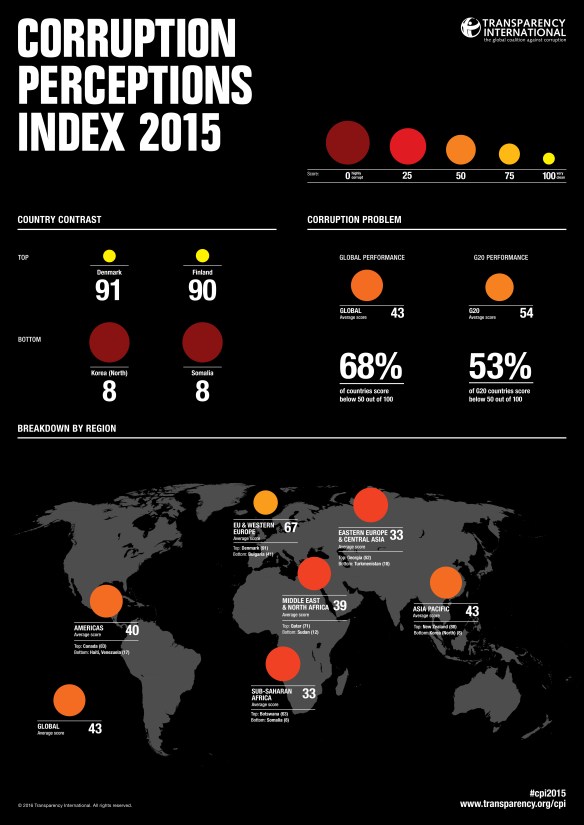
CPI2015_global_ENWorldwide two-thirds of the 168 countries which were tracked actually scored below 50 on a scale from 0 (perceived to be very corrupt) to 100 (perceived to be very clean)
The top spot went to Denmark for the second time in a row with a score of 91. The top ten countries are in the order of rank – Denmark, Finland, Sweden, New Zealand, Netherlands, Norway (joint 5th with Netherlands), Switzerland, Singapore, Canada and Germany

So what made Denmark score so well? According to Transperancy International, top performers share key characteristics: high levels of press freedom; access to budget information so the public knows where money comes from and how it is spent; high levels of integrity among people in power; and judiciaries that don’t differentiate between rich and poor, and that are truly independent from other parts of government.

Somalia and North Korea ended the list at the bottom with a score of only 8. The other countries in the bottom ten were Afghanistan, Sudan, South Sudan, Angola, Libya, Iraq, Venezuela and Guinea-Bissau. Conflict and war, poor governance, weak public institutions like police and the judiciary, and a lack of independence in the media characterise the lowest ranked countries.

CPI_2015_AsiaPacific_ENSo how do countries closer to home stack up? Hong Kong which is seen as a competitor to Singapore in many aspects was at 18 as was Japan. Singapore’s nearest neighbor and the closest ASEAN country is at 54 with the other ASEAN countries much below Malaysia. Thailand is next at 76, followed by Indonesia at 88, Philippines at 95, Vietnam at 112, Laos at 139, Myanmar at 147 and Cambodia bringing up the rear at 150.


India’s score of 38 made it at number 176 along with Bosnia and Herzegovina, Brazil, Bukina Faso, Thailand, Tunisia and Zambia. India’s closest neighbours fare as follows: Sri Lanka and China at 83, Pakistan at 117, Nepal at 130 and Bangladesh at 139.

The results are not that surprising given Singapore’s strong stance on corruption. The country publically names and shames those, especially civil servants and those in high office who are accused of corruption. They also employ legal proceedings against them and sentence them. Hence the high score, which, given how corruption is dealt in the country, could also be higher!

Now, in the other countries in South and Southeast Asia, corruption is a way of life. Corrupt economies do not function as well as non-corrupt ones as the very fact of corruption prevents the natural law of economy from functioning well and freely.
Many people just automatically add the cost of corruption to whatever they need to pay for, especially when dealing with government officials. It is due to this that most people do not have any faith in their public servants, elected or otherwise. Implementation of public services suffers as those need to be paid for, even if they are the basic essentials which every citizen is entitled to. Another casualty is justice as more often than not, justice is either delayed or denied as some of the judiciary may be in the pay of the offenders and let them go scot-free.

Corruption also leads to a loss of growth in that country’s economy as many investors would be reluctant, rightly so, to invest in the country, leading to unemployment or underemployment, lack of infrastructure and development of regions which need them the most. This in turn leads to regression of female empowerment, gender imbalance and female infanticide.

Reading the last two paragraphs make me realise all these are hallmarks of countries which have low Gross Domestic Product (GDP) which is the most commonly referenced figure which covers the national economy of any country and which is used to determined to estimate how wealthy or poor a country and it’s people. Click here and here to understand GDP and GDP with Purchasing Power Parity (PPP) which explains the concepts so much better than I can hope to…

CPI2015_map and country results

CPI2015_map
So where does your country stack up?

My Name is My Own

“What’s in a name? That which we call a rose by any other name would smell as sweet” – William Shakespeare in Romeo and Juliet

Once upon a time…..actually this start has nothing to do with my post today, but since this is something I’ve thought over a long time, I decided to use it!

I’ve been a feminist for a long time, even before I knew what the word meant. I guess, growing up without any brothers meant that my sister and I were given a more liberal upbringing than most girls we knew. That might have been the starting of my innate feminism I guess!

Growing up, I always wondered why a woman should change her name to reflect that of her husband when she got married. I didn’t really do anything about this because this was the norm in India when I was growing up and I didn’t see anyone bucking this. However, this changed when I started working. One of my first supervisors, a wonderful woman, got married when we were working together and didn’t change her name. However, HR assumed she would do so and I remember the first day she came back after her honeymoon, she got a note and in the envelope was her married name: Mrs. XXX

She was furious and sent out a note to HR letting them know that unless she officially sent them intimation about her name change, they could not arbitrarily change her name without her permission. I witnessed the whole drama and asked her why. She replied that she is a person in her own right and is not an extension of her husband and so is not planning to change her name, now or ever. This got me thinking and I also started looking at the possibility of not changing my name when I got married.

When I got married later in life, there was not much time to do anything except get to Singapore after the wedding. In this hustle and bustle, the whole process of changing names just got left over. My passport was in my maiden name and changing names (Indian bureaucracy is to be seen to be believed) would mean I could not fly to Singapore with S. In fact, if I remember correctly, this topic didn’t appear in anyone’s consciousness and I flew to Singapore in my maiden name.

Then I decided, I will not change me name. My whole life, prior to my wedding, was as important to me as my life after it, and so a name change will probably mean starting a new life from zero. Also all school and work records are in my maiden name, so this will mean a big explanation each time I show these records to potential employers. I also thought that since my parents raised me to be the person I am today, it is only right I honour them by continuing to keep my maiden name.

S was cool about this since most women do not change names after marriage in Singapore. This is because they get their National Registration Identity Card (NRIC) at the age of 15, when no-one is married and so girls continue with this name through their lives.

I sometimes wonder if this would have been a bigger issue if I lived elsewhere than Singapore, but c’st la vie!

Isn’t it unfair that guys don’t have to do anything like this? What do you think?