In My Hands Today,,,

Slow Productivity: The Lost Art of Accomplishment Without Burnout – Cal Newport

From the New York Times bestselling author of Digital Minimalism and Deep Work , a groundbreaking philosophy for pursuing meaningful accomplishment while avoiding overload

Our current definition of “productivity” is broken. It pushes us to treat busyness as a proxy for useful effort, leading to impossibly lengthy task lists and ceaseless meetings. We’re overwhelmed by all we have to do and on the edge of burnout, left to decide between giving into soul-sapping hustle culture or rejecting ambition altogether. But are these really our only choices?

Long before the arrival of pinging inboxes and clogged schedules, history’s most creative and impactful philosophers, scientists, artists, and writers mastered the art of producing valuable work with staying power. In this timely and provocative book, Cal Newport harnesses the wisdom of these traditional knowledge workers to radically transform our modern jobs. Drawing from deep research on the habits and mindsets of a varied cast of storied thinkers – from Galileo and Isaac Newton, to Jane Austen and Georgia O’Keefe – Newport lays out the key principles of “slow productivity,” a more sustainable alternative to the aimless overwhelm that defines our current moment. Combining cultural criticism with systematic pragmatism, Newport deconstructs the absurdities inherent in standard notions of productivity, and then provides step-by-step advice for workers to replace them with a slower, more humane alternative.

From the aggressive rethinking of workload management, to introducing seasonal variation, to shifting your performance toward long-term quality, Slow Productivity provides a roadmap for escaping overload and arriving instead at a more timeless approach to pursuing meaningful accomplishment. The world of work is due for a new revolution. Slow productivity is exactly what we need.

In My Hands Today,,,

Fluke: Chance, Chaos, and Why Everything We Do Matters – Brian Klaas

Want to know what chaos theory can teach us about human events? In the perspective-altering tradition of Malcolm Gladwell’s The Tipping Point and Nassim Nicholas Taleb’s The Black Swan comes a provocative challenge to how we think our world works—and why small, chance events can divert our lives and change everything, by social scientist and Atlantic writer Brian Klaas.

If you could rewind your life to the very beginning and then press play, would everything turn out the same? Or could making an accidental phone call or missing an exit off the highway change not just your life, but history itself? And would you remain blind to the radically different possible world you unknowingly left behind?

In Fluke, myth-shattering social scientist Brian Klaas dives deeply into the phenomenon of random chance and the chaos it can sow, taking aim at most people’s neat and tidy storybook version of reality. The book’s argument is that we willfully ignore a bewildering but for a few small changes, our lives—and our societies—could be radically different.

Offering an entirely new lens, Fluke explores how our world really works, driven by strange interactions and apparently random events. How did one couple’s vacation cause 100,000 people to die? Does our decision to hit the snooze button in the morning radically alter the trajectory of our lives? And has the evolution of humans been inevitable, or are we simply the product of a series of freak accidents? Drawing on social science, chaos theory, history, evolutionary biology, and philosophy, Klaas provides a brilliantly fresh look at why things happen—all while providing mind-bending lessons on how we can live smarter, be happier, and lead more fulfilling lives.

In My Hands Today,,,

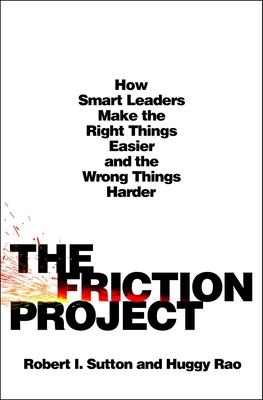
The Friction Project: How Smart Leaders Make the Right Things Easier and the Wrong Things Harder – Robert I. Sutton, Huggy Rao

Every organization is plagued by destructive friction—the forces that make it harder, more complicated, or downright impossible to get anything done. Yet some forms of friction are incredibly useful, and leaders who attempt to improve workplace efficiency often make things even worse. Drawing from seven years of hands-on research, The Friction Project by bestselling authors Robert I. Sutton and Huggy Rao teaches readers how to become “friction fixers,” so that teams and organizations don’t squander the zeal, damage the health, and throttle the creativity and productivity of good people—or burn through cash and other precious resources.

Sutton and Rao kick off the book by unpacking how skilled friction fixers think and act like trustees of others’ time. They provide friction forensics to help readers identify where to avert and repair bad organizational friction and where to maintain and inject good friction. Then their help pyramid shows how friction fixers do their work, which ranges from reframing friction troubles they can’t fix right now so they feel less threatening to designing and repairing organizations. The heart of the book digs into the causes and solutions for five of the most common and damaging friction oblivious leaders, addition sickness, broken connections, jargon monoxide, and fast and frenzied people and teams.

Sound familiar? Sutton and Rao are here to help. They wrap things up with lessons for leading your own friction project, including linking little things to big things; the power of civility, caring, and love for propelling designs and repairs; and embracing the mess that is an inevitable part of the process (while still trying to clean it up).

In My Hands Today,,,

Supercommunicators: How to Unlock the Secret Language of Connection – Charles Duhigg

Come inside a jury room as one juror leads a starkly divided room to consensus. Join a young CIA officer as he recruits a reluctant foreign agent. And sit with an accomplished surgeon as he tries, and fails, to convince yet another cancer patient to opt for the less risky course of treatment. In Supercommunicators, Charles Duhigg blends deep research and his trademark storytelling skills to show how we can all learn to identify and leverage the hidden layers that lurk beneath every conversation.

Communication is a superpower and the best communicators understand that whenever we speak, we’re actually participating in one of three conversations: practical (What’s this really about?), emotional (How do we feel?), and social (Who are we?). If you don’t know what kind of conversation you’re having, you’re unlikely to connect.

Supercommunicators know the importance of recognizing—and then matching—each kind of conversation, and how to hear the complex emotions, subtle negotiations, and deeply held beliefs that color so much of what we say and how we listen. Our experiences, our values, our emotional lives—and how we see ourselves, and others—shape every discussion, from who will pick up the kids to how we want to be treated at work. In this book, you will learn why some people are able to make themselves heard, and to hear others, so clearly.

With his storytelling that takes us from the writers’ room of The Big Bang Theory to the couches of leading marriage counselors, Duhigg shows readers how to recognize these three conversations—and teaches us the tips and skills we need to navigate them more successfully.

In the end, he delivers a simple but powerful lesson: With the right tools, we can connect with anyone.

In My Hands Today…

The Almighty Dollar: Follow the Incredible Journey of a Single Dollar to See How the Global Economy Really Works – Dharshini David

Have you ever wondered why we can afford to buy far more clothes than our grandparents ever could . . . but may be less likely to own a home in which to keep them all? Why your petrol bill can double in a matter of months, but it never falls as fast?

Behind all of this lies economics.

It’s not always easy to grasp the complex forces that are shaping our lives. But by following a dollar on its journey around the globe, we can start to piece it all together.

The dollar is the lifeblood of globalisation. Greenbacks, singles, bucks or dead presidents: call them what you will, they are keeping the global economy going. Half of the notes in circulation are actually outside of the USA – and many of the world’s dollars are owned by China.

But what is really happening as our cash moves around the world every day, and how does it affect our lives? By following $1 from a shopping trip in suburban Texas, via China’s central bank, Nigerian railroads, the oilfields of Iraq and beyond, The Almighty Dollar reveals the economic truths behind what we see on the news every day. Why is China the world’s biggest manufacturer – and the USA its biggest customer? Is free trade really a good thing? Why would a nation build a bridge on the other side of the planet?

In this illuminating read, economist Dharshini David lays bare these complex relationships to get to the heart of how our new globalised world works, showing who really holds the power, and what that means for us all.