A festival unique to the southern states of Tamil Nadu and Kerala, Thiruvathirai or Arudhra Darisanam is a Hindu festival celebrated on the full moon night in the Tamil month of Margazhi (approximately in December–January), which is also the longest night in the year. The Thiruvathirai vrata is one of the eight significant vratas dedicated to Lord Shiva as it is considered to be the nakshaththram of Lord Nataraj and is the longest night of the year. The word
Thiruvathirai or Arudhra in Tamil means “sacred big wave”, that was used when this universe was created by Lord Shiva about 132 trillion years ago. The famous Chidambaram temple in Tamil Nadu, celebrates this temple with great pomp and splendour and has been celebrating for more than 1500 years, as evident from literary and historical evidence in the form of stone inscriptions.

Main Statue of Lord Natraj at Chidambaram Temple…Source
The festival celebrates Lord Shiva’s cosmic dance of Natraj. The cosmic dance of Lord Shiva represents five activities – Creation, Protection, Destruction, Embodiment and Release. In essence, it represents the continuous cycle of creation and destruction. This cosmic dance takes place in every particle and is the source of all energy. Arudra Darshan celebrates this ecstatic dance of Lord Shiva. Arudhra or Thiruvathirai signifies the golden red flame and Shiva performs the dance in the form this red-flamed light. Lord Shiva is supposed to be incarnated in the form of Lord Nataraja during the Arudra Darshan day.
Lord Shiva never took birth and therefore there is no nakshaththram dedicated to celebrate his birthday. It was mentioned in the Hindu mythology that once Lord Vishnu was resting on the great serpent and Adhi seesha felt that He was in some deep thinking. On asking Lord Vishnu told Adhi seesha that he was remembering the dance of Lord Shiva. This answer invoked the desire in Adhi seesha to witness this great dance. He asked Lord Vishnu how this desire could be fulfilled. Lord Vishnu then urged him to do rigorous ‘tapasya’ at Chidambaram’. Adhi seesha followed his advice and devotedly prayed to Lord Shiva for a very long time. At the same there, a muni and devotee of Lord Shiva known as Viyaagra Paadha also lived in that same place. He worshipped to Lord Shiva to obtain the legs of a tiger in order to pluck flowers at the dawn, without being touched by the bees for offering to the God. He also observed ‘tapas’ to see His great ‘Nataraj’ dance. Finally, Lord Shiva was pleased with their prayers and devotion and he showed his ‘Nataraj’ dance in Chidambaram on the day of Thiruvaadhirai. From then onwards the ‘Nataraaja’ image of Shiva is worshipped here with great fervour on this day.
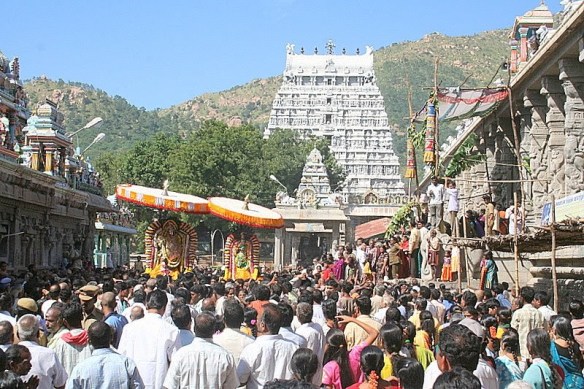
Temple processions during Thiruvathurai….Source
Tamil hymns of Maanikavasagar’s Thiruvasagam (particularly the hymns Thiruvempavai and Thiruppalliezhuchi) are chanted in temples instead of Sanskrit mantras. On the very day of Thiruvathirai, the idols of Nataraja (Lord Shiva) and his consort Shivagami (Parvati) are taken out of the temple premises for a grand procession. It is one of the major events in almost all the Shiva temples in Tamil Nadu.
In Tamil homes, during Tiruvathirai, a special dish called Thiruvadhirai Kali is made. The kali is made with rice, jaggery, moong dal, coconut, cardamom and ghee. The kali is usually eaten with a special curry called Thiruvathirai ezhlu curry koottu which is made out of seven vegetables, that is cooked and served on this day. The vegetables used for this kootu include pumpkin, ash gourd, raw bananas, field beans, sweet potatoes, colocasia, potatoes, eggplants etc.

 Since yesterday was Diwali, here’s a sweet recipe to sweeten your lives. Happy Diwali folks!
 Pal Payasam

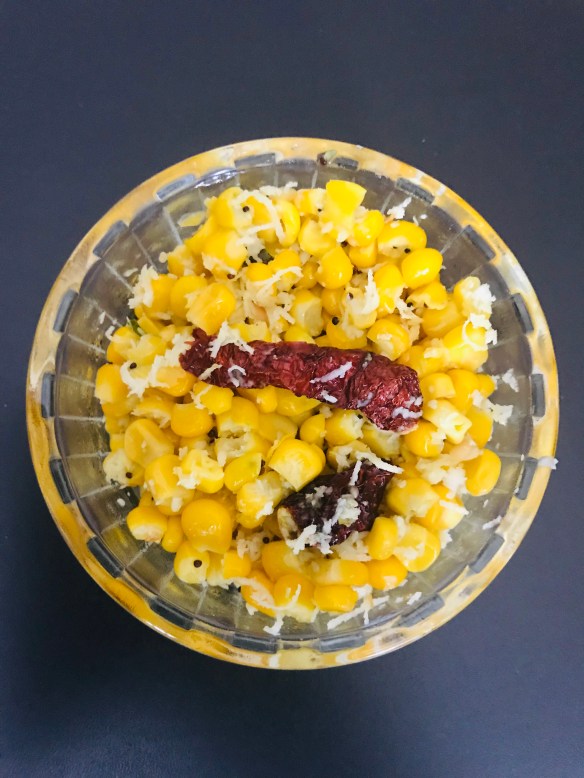 Another Navratri sundal recipe. This one came about serendipitously. I actually wanted to make something sweet that day but became late to make the offering so thought of making something with sweet corn. I made it like any sundal, but changed it up a bit. It also makes a very healthy salad or as a side for your main meal. S loved it so much that he made me make it again the next day.


 Today is Deepavali (as it’s called in South India) or Diwali (as it’s called in the north). Since in Mumbai, people generally refer to it as Diwali, that’s what we call it and will continue to call it irrespective of whether I am referring to it being celebrated in the north or south.
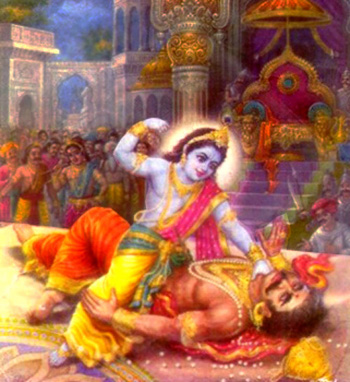 In the southern part of India, Diwali is celebrated as the day Lord Krishna killed the demon Narakasura and is called Naraka Chaturdasi. If the day falls on the new moon day or Amavasya, then you have to wake up very early and take a bath before daylight breaks. A special oil is made the previous night with herbs and spices and this is supposed to ward off the effects of winter. This oil is applied by the oldest woman in the family who is available and is done in front of the family altar. Once you bathe and get ready, you pray to the Lord and then to the elders in the family. You then eat the medicinal preparation made which prepares your stomach for the onslaught of food. Then it’s time to feast the yummy goodies you’ve slaved away at. Children and adults also light firecrackers in the early morning dawn to frighten the demons. Here in Singapore, firecrackers, especially the loud ones which make noise are banned, so we used to buy sparklers for the children when they were younger. Now that they are older, we stop at the goodie eating and visiting the temple.
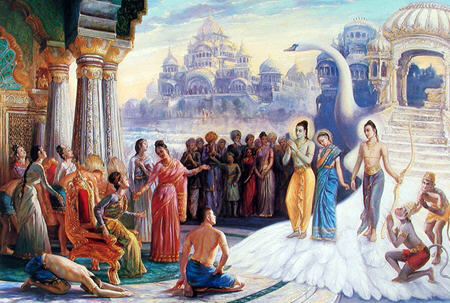 In North India, the day after Naraka Chaturdasi is usually celebrated as Diwali and is the day when Lord Rama reached Ayodhya after fulfiling the promise he made to his stepmother Keykeyi about going on a 14-year exile and in the process, killing the demon king Ravana in what is now present-day Sri Lanka which is celebrated as the festival of Dushhera. On that day, people decorate their homes with diyas and candles just like how the kingdom of Ayodhya had been decorated to welcome their beloved Lord Rama. People perform Laxmi Puja for wealth and also worship Goddess Saraswati for wisdom. Some Indian communities also celebrate their new year during this period and so there’s an additional celebration aspect during the three-four day long festivities.
 Some of the other legends from Indian mythology which are associated with this festival include: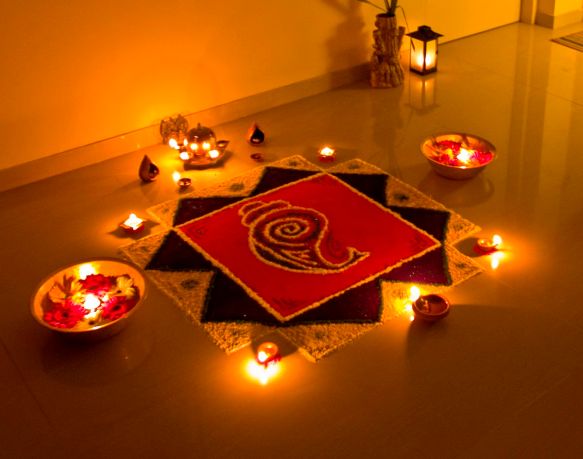

 Memories and Such
