Seven Signs of Life: Stories from an Intensive Care Doctor – Aoife Abbey
Grief. Anger. Joy. Fear. Distraction. Disgust. Hope. All emotions we expect to encounter over our lifetime.
But what if this was every day? And what if your ability to manage them was the difference between life and death?
For a doctor in Intensive Care this is part of the job. Fear in the eyes of a terminally ill patient who pleads with you to not let them die. Grief when you make a potentially fatal mistake. Disgust at caring for a convicted rapist. But there are also moments of joy, like the rare bright spots of lucidity for a dementia patient, or when the ward unexpectedly breaks into song.
Dr Aoife Abbey shows us what a doctor sees of humanity as it comes through the revolving door of the hospital and takes us beyond a purely medical perspective. Told through seven emotions, Seven Signs of Life is about what it means to be alive and how it feels to care for a living.
Tomorrow is World Diabetes Day. As someone who is diabetic, this day is something that I like to write about each year so more people become aware of this silent killer. Created in 1991 by the International Diabetes Federation and the World Health Organisation in response to growing concerns about the escalating health threat posed by diabetes, the World Diabetes Day became an official United Nations Day in 2006. 14 November was chosen to commemorate the day as it is the birthday of Sir Frederick Banting, who co-discovered insulin along with Charles Best in 1922.
The world’s largest diabetes awareness campaign reaching a global audience of over 1 billion people in more than 160 countries, the World Diabetes Day draws attention to issues of paramount importance to the diabetes world and keeps diabetes firmly in the public and political spotlight.
The World Diabetes Day campaign aims to be the platform to promote IDF advocacy efforts throughout the year and be the global driver to promote the importance of taking coordinated and concerted actions to confront diabetes as a critical global health issue. The campaign is represented by a blue circle logo that was adopted in 2007 after the passage of the UN Resolution on diabetes. The blue circle is the global symbol for diabetes awareness. It signifies the unity of the global diabetes community in response to the diabetes epidemic.
Today, world-wide, 463 million adults, or an estimated one in eleven, were living with diabetes in 2019, with the number of people living with diabetes expected rise to 578 million by 2030. Many must live with the complications of diabetes and many still die young as a consequence of their condition. 1 in 2 adults with diabetes remain undiagnosed and the majority have type 2 diabetes. More than 3 in 4 people with diabetes live in low and middle-income countries and 1 in 6 live births or approximately 20 million are affected by high blood glucose or hyperglycaemia in pregnancy. Two-thirds of people with diabetes live in urban areas and three-quarters are of working age. 1 in 5 people with diabetes or about 136 million are above 65 years old. Diabetes caused 4.2 million deaths in 2019 and was responsible for at least $760 billion in health expenditure in 2019, accounting for about 10% of the global total spent on healthcare. The numbers continue to grow but the resources allocated to diabetes are often insufficient and are under increased pressure as a result of the COVID-19 pandemic. The WHO estimates that diabetes services have been disrupted in 50% of countries worldwide.
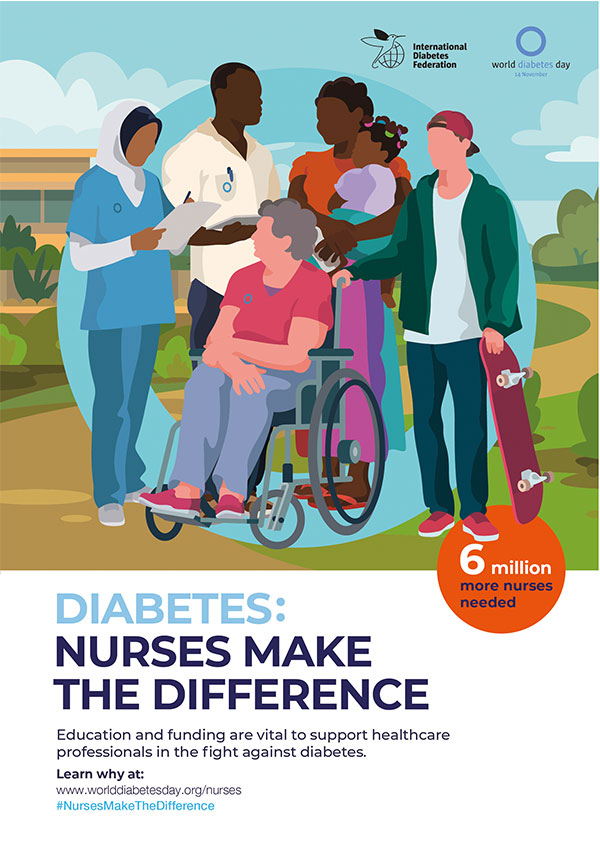
Every year, the World Diabetes Day campaign focuses on a dedicated theme that runs for one or more years. The theme for World Diabetes Day 2020 is The Nurse and Diabetes. This year’s campaign aims to raise awareness around the crucial role that nurses play in supporting people living with diabetes.
Nurses currently account for over half of the global health workforce. They do outstanding work to support people living with a wide range of health concerns. People who either live with diabetes or are at risk of developing the condition need their support too. People living with diabetes face a number of challenges, and education is vital to equip nurses with the skills to support them. As the number of people with diabetes continues to rise across the world, the role of nurses and other health professional support staff becomes increasingly important in managing the impact of the condition. Healthcare providers and governments must recognise the importance of investing in education and training. With the right expertise, nurses can make the difference for people affected by diabetes.
According to the World Health Organization, nurses account for 59% of health professionals and the global nursing workforce is 27.9 million, of which 19.3 million are professional nurses with a global shortage of nurses in 2018 being 5.9 million with 89% of that shortage concentrated in low and middle-income countries. The estimated number of nurses trained and employed needs to grow by 8% a year to overcome alarming shortfalls in the profession by 2030. WHO estimates that the total investment required to achieve the targets outlined in the Social Development Goals by 2030 stand at 3.9 trillion USD – 40% of which should be dedicated to remunerating the health workforce.
As highly valued members of the community, nurses do outstanding work to support people living with a wide range of health concerns. People who either live with diabetes or are at risk of developing the condition need their support too. People living with diabetes face a number of challenges, and education is vital to equip nurses with the skills to support them. The IDF wants to facilitate opportunities for nurses to learn more about the condition and receive training so that they can make a difference for people with diabetes. As the number of people with diabetes continues to rise across the world, the role of nurses and other health professional support staff is becoming increasingly important in managing the impact of the condition. Nurses are often the first and sometimes only health professional that a person interacts with and so the quality of their initial assessment, care and treatment is vital. Nurses play a key role in diagnosing diabetes early to ensure prompt treatment, providing self-management training and psychological support for people with diabetes to help prevent complications and tackling the risk factors for type 2 diabetes to help prevent the condition. Healthcare providers and governments must therefore recognise the importance of investing in education and training. With the right expertise, nurses can make the difference for people affected by diabetes.
In my last year’s post on this day, I have written extensively about the types of diabetes, so read more there.
The word ‘health’ comes from the old English ‘hale’ which means ‘whole’ or ‘complete’. The World Health Organisation or WHO has given an international definition of health: “Health is a state of complete physical, mental and social well-being and not merely the absence of disease or infirmity.”
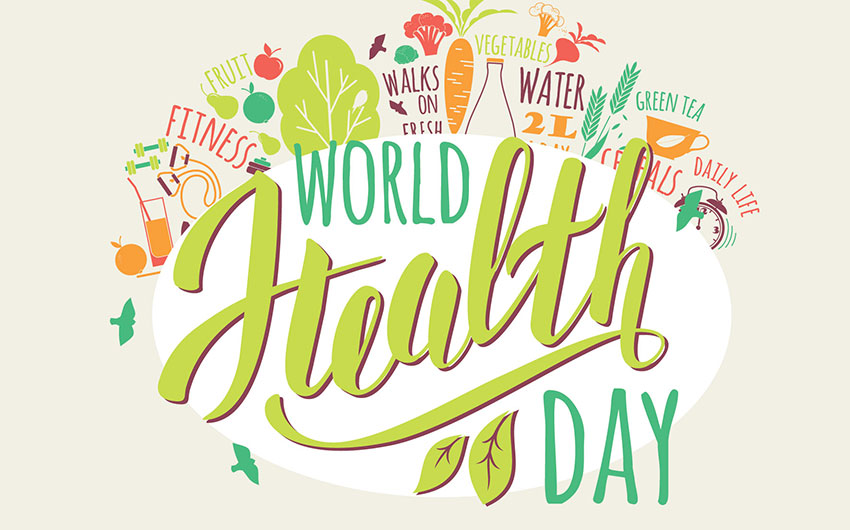
Tomorrow, April 07 marks the celebration of World Health Day. A global health awareness day, this day, held to mark the founding of the World Health Organisation is celebrated every year and is aimed to create awareness of a specific health theme to highlight a priority area of concern for the WHO. On this day, the WHO organizes international, regional and local events on the Day related to a particular theme. World Health Day is acknowledged by various governments and non-governmental organizations with interests in public health issues, who also organize activities and highlight their support in media reports, such as the Global Health Council. The World Health Day is one of eight official global health campaigns marked by WHO, along with World Tuberculosis Day, World Immunization Week, World Malaria Day, World No Tobacco Day, World AIDS Day, World Blood Donor Day, and World Hepatitis Day. Over the past 50 years this has brought to light important health issues such as mental health, maternal and child care, and climate change. The celebration is marked by activities which extend beyond the day itself and serves as an opportunity to focus worldwide attention on these important aspects of global health.
Why is health important? The way the body works depends on a person’s health. The body is designed to deal with everyday obstacles in order to be able to live life to the full, but poor health makes these everyday obstacles become larger and more difficult to overcome. For some the odds of leading a healthy life are stacked against them from the start. Health is important to everything a person does. Poor health affects people differently.
Health is also often thought of in terms of illnesses which endanger it like AIDs, Malaria and Tuberculosis – three of the most devastating diseases and today we could probably include Covid-19 which is has been the deadliest disease our generation has seen which has now been called a pandemic as it has extended over pretty much all continents with the exception of Antartica. The world we live in is a world that is increasingly interconnected and though this brings many benefits it also brings responsibility. Health is a shared responsibility, which means ensuring equal access to essential healthcare and collective action to health threats in different countries to look after those that are sick and to stop deseases from spreading.
The theme for the 2020 edition is a focus on health support staff with the theme being “Support Nurses and Midwives”. World Health Day 2020 will shine a light on the vital role played by nurses and midwives in providing health care around the world, and call for a strengthening of the nursing and midwifery workforce. There was supposed to be “dawn to dusk” advocacy events held around the world to mark World Health Day, but given the conditions we now live in and with health workers globally being streteched thin, I doubt if this is possible. There was supposed to be the launch of the first ever State of the World’s Nursing Report 2020, a report which will provide a global picture of the nursing workforce and support evidence-based planning to optimise the contributions of this workforce to improve health and wellbeing for all. This report will provide a global picture of the nursing workforce and support evidence-based planning to optimize the contributions of this workforce to improve health and wellbeing for all and to make meaningful progress toward UHC and the SDGs. The report will set the agenda for data collection, policy dialogue, research and advocacy, and investment in the health workforce for generations to come. A similar report on the Midwifery workforce will be launched in 2021.
The WHO has also designated 2020 as the Year of the Nurse and the Midwife and the 2020 theme follows this. Nurses and midwives play a vital role in providing health services. These are the people who devote their lives to caring for mothers and children; giving lifesaving immunizations and health advice; looking after older people and generally meeting everyday essential health needs. They are often, the first and only point of care in their communities. The world needs 9 million more nurses and midwives if it is to achieve universal health coverage by 2030. This is why 2020 has been designated the year of the nurse and midwife.
Educating nurses and midwives to international standards makes economic sense. It saves resources by reducing the need for costly and unnecessary interventions and increases quality of care and health for all. Strengthening nursing and midwifery – and ensuring that nurses and midwives are enabled to work to their full potential – is one of the most important things countries can do to achieve universal health coverage and improve health globally. This is especially true in times of epidemics as we are in now. By developing nursing and midwifery, countries can achieve the triple impact of improving health, promoting gender equality and supporting economic growth. Strengthening nursing and midwifery will have the additional benefits of promoting gender equity (SDG5), contributing to economic development (SDG8) and supporting other Sustainable Development Goals.
The goals for World Health Day 2020 include triggering a wave of public appreciation for the work of nurses and midwives and the part they play in delivering health care; raise the profile of nurses and midwives within the health workforce and catalyse support and investment in nurses and midwives.
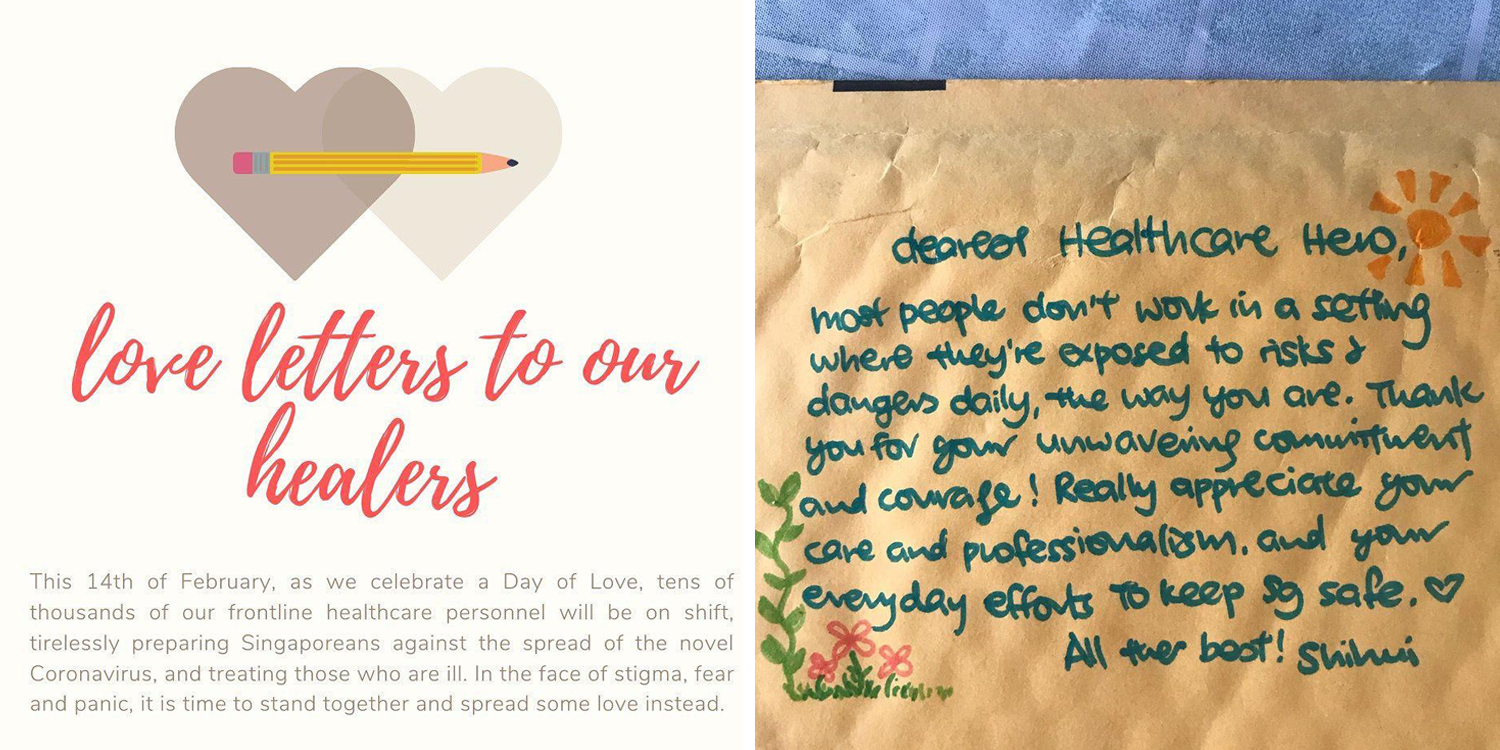
Tomorrow, please remember to thank all healthcare workers in your country. They are risking their lives on a daily basis and in many countries don’t have access to proper preventive personal equipment just so they can save our lives!
Yesterday, 14 November was commemorated worldwide as World Diabetes Day. I didn’t know about this day until earlier this year and as someone who suffers from this condition, I think it’s a pity, but better late than never.
World Diabetes Day (WDD) was created in 1991 by the International Diabetes Federation (IDF) and the World Health Organization (WHO) in response to growing concerns about the escalating health threat posed by diabetes. World Diabetes Day became an official United Nations Day in 2006 with the passage of United Nation Resolution 61/225. It is marked every year on 14 November, the birthday of Sir Frederick Banting, who co-discovered insulin along with Charles Best in 1922.
The day is the world’s largest diabetes awareness campaign reaching a global audience of over 1 billion people in more than 160 countries. The campaign draws attention to issues of paramount importance to the diabetes world and keeps diabetes firmly in the public and political spotlight. The World Diabetes Day campaign aims to promote importance of taking coordinated and concerted actions to confront diabetes as a critical global health issue.
The theme for World Diabetes Day 2019 is Family and Diabetes. Family and the support network around you has a huge impact on diabetes management, care, prevention and education and that is exactly what this year’s theme wants to highlight. The WDD 2019 has three main focus areas: Discover diabetes; Prevent type 2 diabetes and Manage diabetes.
Families are urged to learn more about the warning signs of diabetes and find out their risk of type 2 diabetes. Research conducted by the Federation in 2018 discovered that parents would struggle to spot this serious life-long condition in their own children. Despite the majority of people surveyed having a family member with diabetes, an alarming four-in-five parents would have trouble recognising the warning signs. One-in-three wouldn’t spot them at all. The findings underline the need for education and awareness to help people spot the diabetes warning signs early.
A lack of knowledge about diabetes means that spotting the warning signs is not just a problem for parents, but is an issue impacting a cross-section of society. This is a major concern, due to the signs being milder in type 2 diabetes, the most prevalent form of the condition, responsible for around 90% of all diabetes. One in two people currently living with diabetes are undiagnosed. The vast majority of these have type 2 diabetes. Left untreated or unmanaged, diabetes can lead to life-changing complications. These include blindness, amputation, kidney failure, heart attack and stroke. Diabetes was responsible for four million deaths in 2017. It is no wonder that diabetes has been called a silent killer. Early diagnosis and treatment are key to helping prevent or delay life-threatening complications.
Many cases of type 2 diabetes can be prevented by adopting a healthy lifestyle. Reducing a family’s risk starts at home. When a family eats healthy meals and exercises together, all family members benefit and this in turn, encourages behaviours that could help prevent type 2 diabetes in the family.
Types of Diabetes There are three main types of diabetes:
Type 1 diabetes used to be called juvenile-onset diabetes. It is usually caused by an auto-immune reaction where the body’s defence system attacks the cells that produce insulin. The reason this occurs is not fully understood. People with type 1 diabetes produce very little or no insulin. The disease may affect people of any age, but usually develops in children or young adults. People with this form of diabetes need injections of insulin every day in order to control the levels of glucose in their blood. If people with type 1 diabetes do not have access to insulin, they will die.
Type 2 diabetes used to be called non-insulin dependent diabetes or adult-onset diabetes, and accounts for at least 90% of all cases of diabetes. It is characterised by insulin resistance and relative insulin deficiency, either or both of which may be present at the time diabetes is diagnosed. The diagnosis of type 2 diabetes can occur at any age. Type 2 diabetes may remain undetected for many years and the diagnosis is often made when a complication appears or a routine blood or urine glucose test is done. It is often, but not always, associated with overweight or obesity, which itself can cause insulin resistance and lead to high blood glucose levels. People with type 2 diabetes can often initially manage their condition through exercise and diet. However, over time most people will require oral drugs and or insulin.
Both type 1 and type 2 diabetes are serious. There is no such thing as mild diabetes.
Gestational diabetes (GDM) is a form of diabetes consisting of high blood glucose levels during pregnancy. It develops in one in 25 pregnancies worldwide and is associated with complications to both mother and baby. GDM usually disappears after pregnancy but women with GDM and their children are at an increased risk of developing type 2 diabetes later in life. Approximately half of women with a history of GDM go on to develop type 2 diabetes within five to ten years after delivery.
Other specific types of diabetes also exist.
If you suspect you or a family member is diabetic, please reach out to a health professional immediately so that they can be tested and then given appropriate medication. A family physician is the first and best defence against this disease since they are able to see you at regular intervals and can change the medication or treatment as appropriate as well as test you at appropriate intervals.
I normally don’t post about beauty or skincare and so if I am right, this is a first for me!
But I have been hearing a lot about Korean skincare products and makeup and some time at the beginning of this year, I decided to start a night-time skincare ritual and soon realised that I had already subconsciously incorporated the ten steps.
Living in Singapore means having easy access to Korean and Japanese skincare and beauty products, most of which are highly affordable. This means a lot of the skincare products I use are from these countries. I am a little wary about Japanese and Korean makeup as the colours may not suit my south Asian skin, being more geared to east Asian skin. I like their skincare products because I believe that skin types are pretty much similar across races and so this meant that I could use Korean and Japanese skincare products and also start doing the 10-step skin care.
The 10-Step Skincare method refers to the number of products layered onto the skin one by one. A lot of people (including me) are initially put off by the sheer amount of time that we think this process will take. But after two months of diligently doing it, I can confidently tell you that it does not take more than 10 minutes (more if you are putting on a mask).
Although there are a total of 10 steps in this beauty ritual, most of the time you do between 6-8 steps on any given day or night. It is quite rare that someone does all the steps all the time. The steps change depending on your skin type as well as any seasonal changes where you live. Since I live in the tropics, my skincare regime does not change through the year, but if you are inspired on doing the 10-Step Skincare Regime after reading this post, then please do take note of seasonal changes and your own skin type when you embark on this journey.
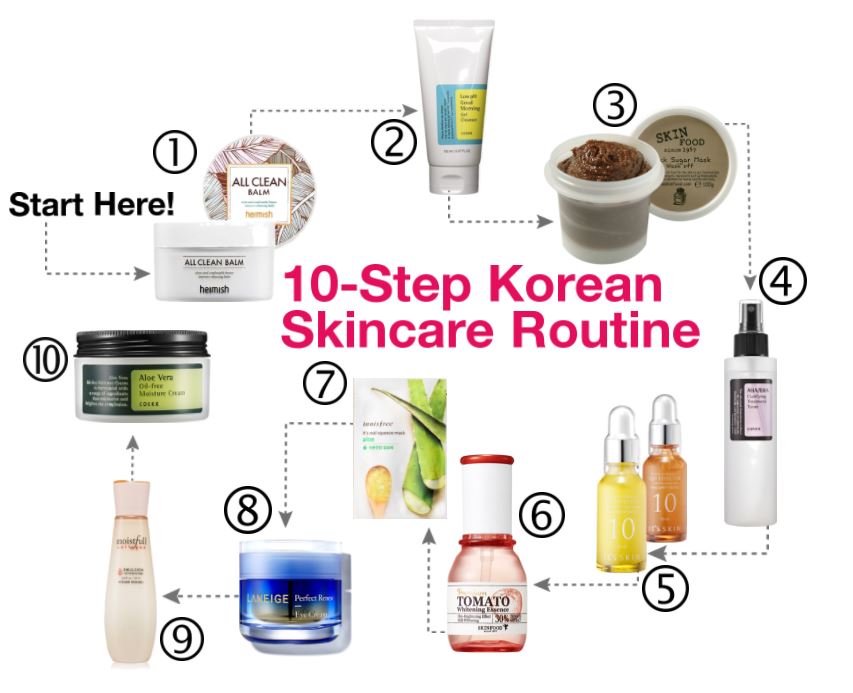
So what’s the Korean 10-Step Skincare Routine? The 10 steps commonly associated with this regime are:
Oil cleanser
Foam/cream cleanser
Exfoliation
Toner
Essence
Treatments
Masks
Eye Cream
Moisturizer
Suncare/Lip Care
Step 1 and Step 2: Double Cleansing
Makeup removal and then cleansing with an oil cleanser is the mainstay of the Korean 10-step regime. Not only are oil cleansers relaxing to use, but applied to dry skin, they also remove all makeup and other oil-based product debris like sebum, sunscreen and pollution particles. You can also massage your skin as you oil cleanse which will stimulate the surface of the skin, preparing it for the products you’re about to apply. It also drains lymphatic glands in your face and neck that can cause puffiness.
Cleansing twice is recommended by dermatologists as it helps to thoroughly remove all impurities that can cause breakouts. Water-based cleansers dissolve the water-based impurities such as dirt and sweat that your oil cleanser didn’t pick up.
I normally don’t use make-up, so generally skip this step, moving straight to my normal cleanser. On days when I do apply some make-up, I usually will use micellar water to remove the make-up before cleansing with my usual foam or cream cleanser.
Step 3: Exfoliation
Exfoliation not only cleans out clogged pores, but it also sloughs off dead skin cells. When you remove this dull layer of cells, brighter skin is revealed. Regular exfoliation will also help your other skincare products absorb and work more efficiently. This step is not recommended for daily use. If you have sensitive skin, you’ll only want to exfoliate once a week. If you have a tougher complexion, you can do it more regularly (about three times a week).
I usually exfoliate around three times a week.
Step 4: Toner
In Korean skincare, toners are typically a thin layer of moisture meant to regulate your pH and soften your skin, preparing it for the steps that will follow. Toners remove any leftover residue from the cleansers while also repairing your skin’s barrier to effectively absorb the moisturisers that follow. Toners also balance the skin’s pH levels, otherwise, the skin can become dry and dehydrated.
I usually apply toner by pouring some in the palms of my hand and then patting it on my skin. I also very lightly slap my skin to help the toner melt into the skin and prep it for the next step.
Step 5: Essence
One of the keys to the glowy results of a regular Korean skincare routine is layering products. Rather than relying on one thick cream to do all the work, Koreans believe that layering products allow the skin to breathe and avoids clogging the pores. So if you think of your toner as the first layer of moisture, think of the essence as the second. These products are typically also thinner in texture, and some even feel watery. They penetrate the skin at a deeper level and aid with the absorption of the products to come.
I pretty much use the essence the same way I use the toner, which is pouring a small amount in the palms of my hands and patting it in with very mild slaps.
Step 6: Treatments
This step includes boosters, serums and ampoules. Packed with powerful ingredients, they target specific skin concerns such as acne, fine lines and hyperpigmentation. This is where you get to play with what you need for your skin. You could also use multiple treatments on the same day, depending on what your skin requires or if you already have perfect skin, you can ignore this step.
I generally use two treatment serums daily, a vitamin C serum and another treatment depending on what my skin needs. I pour a bit in my palms and then pat the serums on my skin. I normally wait for a couple of minutes before the next treatment.
Step 7: Masks
If essences are the heart of Korean skincare, masks or specifically sheet masks are the soul. The key to sheet masks is the sheet, which when in prolonged contact with your face, allows the skin to fully absorb the nutrients and moisture. The purpose of the mask is to give your skin what it needs. Korean sheet masks are also very affordable, especially where I live and it’s very easy to amass a huge stash.
I usually flit between sheet masks and other traditional wash off masks. If I am using a wash off mask, then I do it right after cleansing and before toning. If using sheet masks, then it comes here, in step seven.
Step 8: Eye Cream
The eye cream is not unique to the Korean skincare routine, but it is one of the hardest products to consistently use because it’s more a preventative product if you’re under the age of 40. The eye cream is designed to moisturize the ultra-thin skin around your eyes where crow’s feet and fine lines are bound to appear. However, if you use eye cream regularly before they show up, you’ll see a marked difference in how old you look (or in this case, how young!)
I miss this step more often than I do it, so this post is a reminder for me to do this step more consistently.
Step 9: Moisturiser
More moisture you may be thinking, but in the traditional Korean beauty 10-step routine, you use a cream – also known as an occlusive layer – to seal in all the layers before it. Think of it as making a fragrant stew and putting the lid on the pot. It allows the fragrances and flavours inside to mingle and absorb, which is a lot like what all the luscious ingredients you layered are doing in your epidermis when you add a moisturizer.
I usually use a facial oil and then any normal moisturiser in this step during the day. During the night, I use the facial oil plus a sleeping mask, which I use as a moisturiser since I sleep in an air-conditioned room and I have super dry skin which the air conditioning makes drier.
Step 10: Sun Care/Lip Care
We all know that we should always wear sun protection, even if we are inside the house. It’s the easiest and most effective way to prevent skin cancer as well as ageing that comes from the sun’s harmful rays. It should be the last step, just before you start applying make-up so that it does not get diluted by other skincare products.
I try to use sunscreen as the last step in my morning ritual. This is another step I am sometimes guilty of skipping, especially if I am going to be at home the whole day. But I will make sure I don’t do that and use SPF daily.
In the night, I use a heavy lip balm to finish up my Korean 10-Step Skincare ritual before calling it a night!
My thoughts on doing this diligently for slightly over two months now is that it no longer seems a chore to me now as it was when I first started doing it. Previously, I used to sometimes skip doing a night-time skincare ritual if I was tired or sleepy, but now it’s a part of what I do at night before sleeping, the same as brushing my teeth. It does not take very long to do, I timed it last night and it took me less than 10 minutes to do all steps excluding exfoliation and masking. So to those who are intimidated by the sheer number of steps, take heart that it will become simpler as you continue doing it.
Was this post useful? Did you learn something new? Are you using a skincare regime which is similar to the Korean one? Would love to hear comments, so please write and comment below.



 Memories and Such