In My Hands Today…

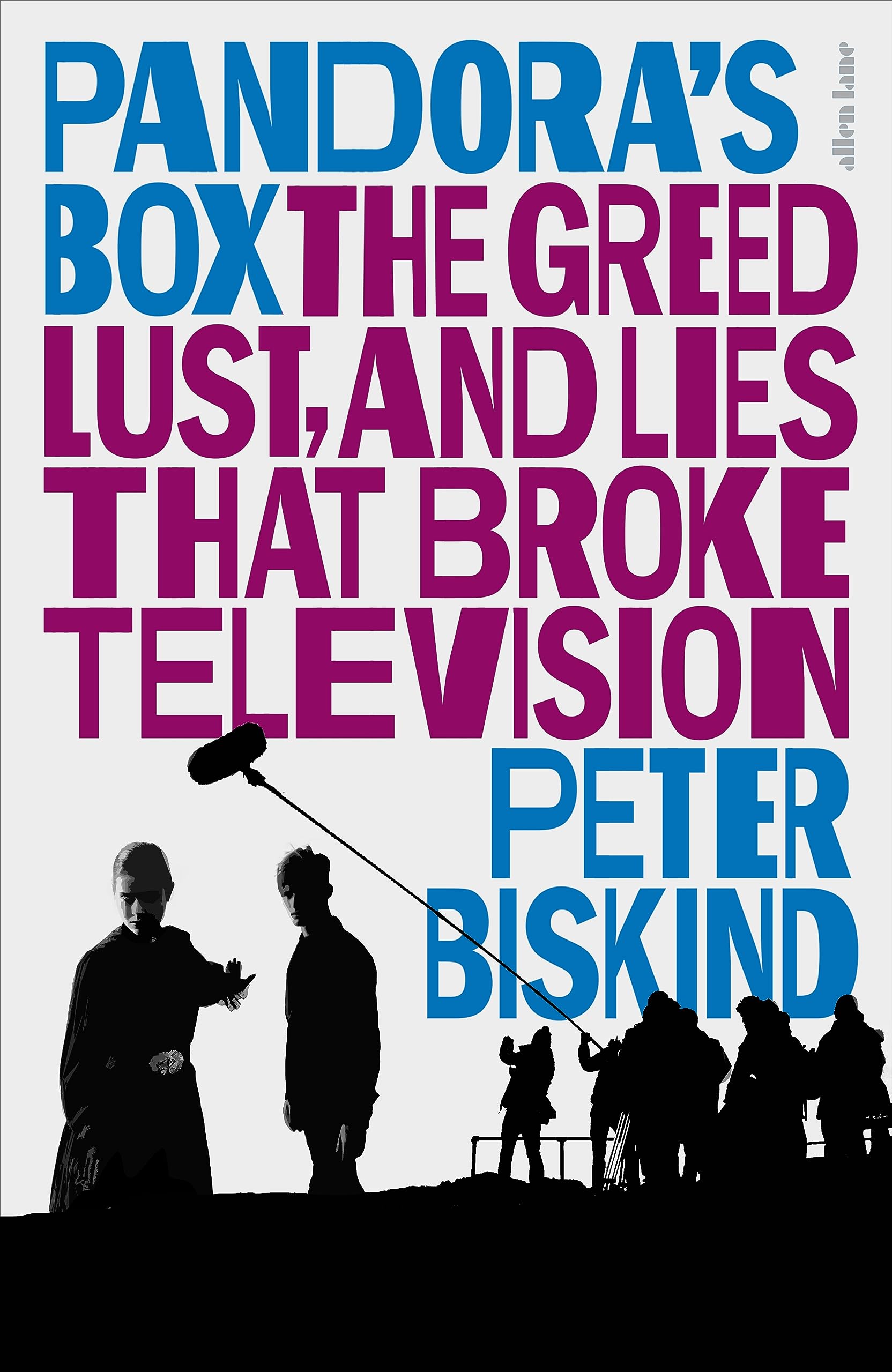
Pandora’s Box: The Greed, Lust, and Lies that Broke Television – Peter Biskind

We are now lucky enough to be living through the era of so-called Peak TV, in which television, in its various formats, has seized the entertainment mantle from movies and dominates our leisure time. How and why this happened is the subject of this book.

Instead of focusing on one service, like HBO, Pandora’s Box asks, “What did HBO do besides give us The Sopranos?” The answer: It gave us a revolution. Biskind bites off a big chunk of entertainment history, following HBO from its birth to maturity, moving on to the basic cablers like FX and AMC, and ending with the streamers and their wars, pitting Netflix against Amazon Prime Video, Max, and the killer pluses—Disney, Apple TV, and Paramount.

Since the creative and business sides of TV are thoroughly entwined, Biskind examines both, and the interplay between them. Through frank and shockingly intimate interviews with creators and executives, Pandora’s Box investigates the dynamic interplay of commerce and art through the lens the game-changing shows they aired—not only old warhorses like The Sopranos, but recent shows like The White Lotus, Succession, and Yellow- (both -stone and -jackets)—as windows into the byzantine practices of the players as they use money and guile to destroy their competitors. With its long view and short takes—riveting snapshots of behind-the-scenes mischief—Pandora’s Box is the only book you’ll need to read to understand what’s on your small screen and how it got there.

World Television Day

Can any of us imagine a world without television. The generation which has grown up with the flickering television screen would probably be as brefet of it as today’s generation without access to the internet.

In 1927, a 21 year old inventor by the name of Philo Taylor Farnsworth invented the world’s first electronic television. He lived in a home without electricity until he was 14 years old. In high school, he began to think of a system that could capture moving pictures, change them into a code, and them move those images with radio waves to different devices. He was years ahead of the mechanical television system as his structure captured moving images using a beam of electrons. Farnsworth later famously transmitted the image of a dollar sign using his television after a fellow inventor asked “When are we going to see some dollars from this thing?” Neither of them knew how prelevant the television would become across the world with young people today having no concept of a world without one. The first mechanical tv station called W3XK, created by Charles Francis Jenkins aired its first broadcast in 1928.

Television continues to be the single largest source of video consumption. I seriously doubt there are many households in this world today who don’t have access to a television set. Though screen sizes have changed, and people create, post, stream and consume content on different platforms, the number of households with television sets around the world continues to rise. The interaction between emerging and traditional forms of broadcast creates a great opportunity to raise awareness about the important issues facing our communities and our planet.

In times of internet, with people hooked to their laptops and mobile screens, does the television still hold importance, one may ask. As per the United Nations, television continues to be the single largest source of video consumption with the number of TV households across the world rising from 1.63 million in 2017 to 1.74 billion by 2023, according to a study. The World Television Day stands as a reminder of the power of visual media and how it helps in shaping public opinion and influencing world politics.

In recognition of the increasing impact television has on decision-making by bringing world attention to conflicts and threats to peace and security and its potential role in sharpening the focus on other major issues, including economic and social issues, the United Nations General Assembly proclaimed 21 November as World Television Day, through resolution 51/205 of 17 December 1996.

World Television Day is not so much a celebration of the tool, but rather the philosophy which it represents. Television represents a symbol for communication and globalisation in the contemporary world. On 21 and 22 November 1996 the United Nations held the first World Television Forum, where leading media figures met under the auspices of the United Nations to discuss the growing significance of television in today’s changing world and to consider how they might enhance their mutual cooperation. That is why the General Assembly decided to proclaim 21 November as World Television Day. This was done in recognition of the increasing impact television has on the process of decision-making. Television was thus acknowledged as a major tool in informing, channelling and affecting public opinion. Its impact and presence and its influence on world politics could not be denied.

Now the day is commemorated with meet-ups at local and global levels to raise awareness among people about the role television plays in communication and globalisation. This day acknowledges the role of broadcast media. Writers, journalists, bloggers and others associated with the medium come together to promote this day. The interaction between emerging and traditional forms of broadcast creates a great opportunity to raise awareness about the important issues facing our communities and our planet. The World Television Day also marks the commitment of governments, news organisations and individuals to deliver unbiased information in times when veracity of content on social media is questionable.

Television Shows

I have never been a huge television fan. Growing up, my dad was against all forms of TV, believing it to be not very good for growing girls and so we were on a very restricted schedule for television watching. The television was only switched on in the evening and we could only watch approved channels and shows.

Of course, most of this was during the era of a single (and later two) state sponsored channels. I remember the happiness people felt when the Indian television industry was opened we got access to a plethora of channels.

I just read the above paragraphs and started laughing! BB & GG can never understand this if I ever explain my growing up days to them. Actually, they too rarely watch television, preferring to get their entertainment through YouTube and other streaming devices.

Anyway, last year when I was bored, one day, I randomly started watching videos on YouTube which popped up on the Recommended feed and I got hooked on to watching dramas from Pakistan. These dramas are in their official language, Urdu, but because it is so similar to the Indian language of Hindi, if you are fluent in Hindi, you understand around 80-90% of what is being said. The rest you can infer from what is happening on the screen. In fact, since the time I have started watching these serials, I can find myself using Urdu words unconsciously!

I now watch dramas and soaps from two channels and love most of them. Unlike the Indian dramas and soaps which were mostly formulaic and with very predictable story lines (mostly about a plucky and pure heroine and her Mother-in-law who spends all her time plotting against her) the dramas from the channels I watch have very good story lines. The best part, unlike most Indian serials, these dramas have a clearly defined story with a start, middle and end and most end in a few months so you never ever got bored of them. This is unlike some serials which have been going on for more than five years!

Stories and plots are also quite sensitively taken and I am surprised (in a good way) to find strong women characters in these serials. The story lines are varied from plots which are sappy love stories to revenge dramas, to a very well taken drama about a girl who is punished for liking a boy and who, against all odds becomes a doctor. Even at this point, she is being discriminated against and I would love to see her reach her goals and cock a finger at her detractors.

What I don’t like about these dramas are probably very feminist in nature, but it is the concept that a girl or even a grown adult belonging to the male of her family; her father first, then her husband and if she doesn’t have a father or husband, then it’s her brother who decides her life. It doesn’t really give the woman, especially those who belong to lower strata of society a voice and many dramas show if a woman is self-sufficient, then she has to endure and wade through the taunts of the people in the society she lives in. Women who are from the more economically advantaged families have it a slightly better though. This is true to a large extent in India also, especially in the semi-urban and rural areas where women are seen as mere chattels and wearing western clothes, using and speaking a mobile phone is seen as the promiscuous behaviour they indulge in. I can go on and on about this, but this is material for another post!

Another thing I don’t like is the concept of triple talaq or the concept where a man holds the woman he is married to absolute hostage because he has the power to divorce her by uttering the words “I divorce you” thrice. In almost every drama or serial I have seen, at some point or the other, a male character will threaten his wife that if she does not do <insert demand by husband> he will divorce her and throw her out of his home. It does not matter if the man was drunk, angry or not in his senses, or even if uttered between just the two of them, the words once uttered become irrevocable. I wonder if this is the real reality in such societies or is something that a director uses to create more drama. I hope it is the latter because such scenes make me as a woman quite upset!

So if anyone wants to want dramas and serials which are different from the typical Indian soaps you see, just look out for Pakistani dramas. You also get a glimpse (even if it is manufactured and not absolutely real) into this country’s culture. If you remember, this was a country I had wanted to visit before I die. Read more about that post here.

Do you watch Pakistani dramas? I’d love to get more recommendations, though these days where I am going to find the time to watch, I don’t know. Do comment below.

 

Reality Television

As I’ve said before this month we’ve been on a revised working schedule due to the YOG (today’s the last day – thank God!), so I’ve been watching some television in the mornings after DH and the kids leave home and I am done with my chores. You must understand that this is something of a treat for me as in the evenings I rarely get to watch what I want because at that time P & D also stake their claim to the television to watch their favorite shows like Scooby Doo, Tom & Jerry, Casper. I too like some of them like Tom & Jerry, The Flintstones, The Jetsons etc as they brings back so many memories of my childhood.

Anyway, I was digressing. So in the mornings I usually watch the lifestyle channels on my cable tv network. I like watching food shows, home makeover shows and in the past few days have caught a few reality shows also.

While I have no issues with people who are willing to put their whole lives for the vicarious entertainment of others, I always wonder about the children there. Some of the shows have multiple seasons and I would assume the kids there would have actually grown up on tv. They would find life with a camera trailing behind them 24/7 as normal. So what happens when the cameras get shut off or the show goes off air? Has anyone thought of this or even done some studies? If someone grows up with the notion that they mean something only when they are on front of a camera or that unless something is scripted, it is not real (did you actually think ‘Reality Television’ was…umm well ‘Real’?). I feel sorry for these children and their future. Hopefully they’ll realize soon that life is not a tv script and that contrary to what they’ve been taught, most people find a camera following them everywhere (except to the powder room I guess) is intrusive.

I typed this post on the way to work. When you have something to say, isn’t it amazing that words just fly from your fingers (in this case thumbs as I was typing on my phone)! Time to get off the bus and so time to post this entry.

The weekend’s almost on us. D&P have math test on Monday so my weekend will be filled with teaching them. What’s your plan for the weekend?