

Thirukkoyilur Temple, Thirukoilure, Tamil Nadu
Thirukkoyilur, located along the banks of the South Pennar River in Tamil Nadu, is one of the most historically and spiritually significant Divya Desams. The presiding deity here is Trivikrama Perumal, with Poongothai Thayar as the goddess. What makes this temple distinct is not only its connection to the Vamana avatar but also its deep link to the birth of Tamil Vaishnavite devotion. It was here, in this town, that the first three Alvars met for the first time. Their meeting was not planned, and yet it changed the direction of devotional history.
The mythology of the temple begins with the story of Vamana and Mahabali. When the asura king Mahabali grew powerful and generous, Vishnu appeared before him in the form of a small Brahmin boy and asked for three steps of land. Mahabali agreed, and in that moment, Vishnu expanded into the vast form of Trivikrama. With one step, he covered the earth, with the second, he spanned the heavens, and for the third, Mahabali offered his own head. The story is familiar, but in Thirukkoyilur, the form of Trivikrama carries a particular emphasis. One foot stands grounded, the other raised high, reminding devotees that humility can transform into boundless expansion. The form suggests that the divine can fill all directions at once, without losing composure.
Yet the temple’s emotional centre lies in another story altogether. On a stormy night, Poigai Alvar sought shelter in a small mandapam in Thirukkoyilur. Soon after, Bhoothath Alvar joined him, and the two adjusted themselves in the tight space. When Pey Alvar arrived, the three stood pressed together in darkness, making room for one another. As lightning flashed, they sensed a fourth presence among them. The space, though small, suddenly felt filled. They realised Vishnu Himself had entered, standing so close that there was no room left for anything else. Each Alvar responded by composing a hymn, lighting what they described as lamps of wisdom, love and vision. That night, devotion found its poetic voice. What began as shelter from rain became the beginning of the Divya Prabandham.
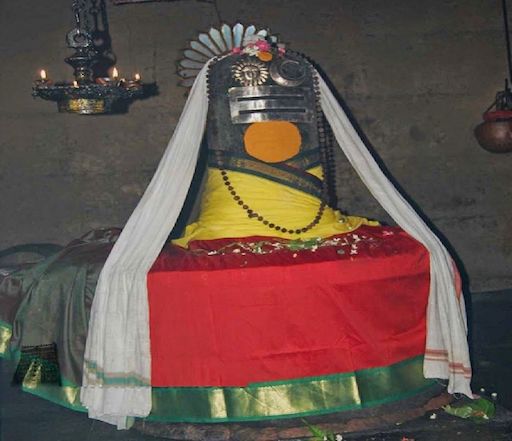
Because of these layered stories, Thirukkoyilur occupies a unique place in Tamil Vaishnavism. It is not only a temple of myth but a temple of literary birth. The meeting of the three Alvars established a devotional tradition that would grow across centuries. Their hymns shaped the spiritual vocabulary of the region and laid the foundation for later saints and scholars. In this sense, Thirukkoyilur represents both expansion and beginning. The cosmic stride of Trivikrama and the intimate gathering of the Alvars reflect two scales of divine presence: vast and immediate.
Historically, the temple reflects its importance. The structure likely dates back to the Pallava period, with significant expansions during the Chola era. The Cholas strengthened the granite foundations, expanded the prakarams and supported ritual practice through land grants and donations. Later rulers, including the Pandyas and Nayaks, added mandapams and reinforced the complex. Unlike smaller rural shrines, Thirukkoyilur carries architectural weight that matches its devotional significance. The tall gopuram rises clearly above the town, and the inner corridors create a sense of movement and continuity.
Inside the temple, the form of Trivikrama immediately draws attention. The raised leg is striking, but the expression remains calm. The energy is expansive, yet controlled. The idol communicates power without aggression. Nearby, Poongothai Thayar’s shrine offers balance. Her presence softens the intensity of the cosmic form, bringing warmth to the space. There is also a shrine dedicated to the three Alvars, reminding visitors that this temple belongs as much to poetry as to mythology.
Worship at Thirukkoyilur follows traditional Vaishnavite practice, with daily rituals carried out in a steady rhythm. The temple becomes especially alive during Brahmotsavam, Vaikunta Ekadasi and Vamana Jayanti. However, the festival honouring the first three Alvars carries particular emotional resonance. During this celebration, their hymns are recited in the very place where they once stood pressed together in the dark. The recitation does not feel ceremonial alone; it feels like a continuation of something that never truly stopped.
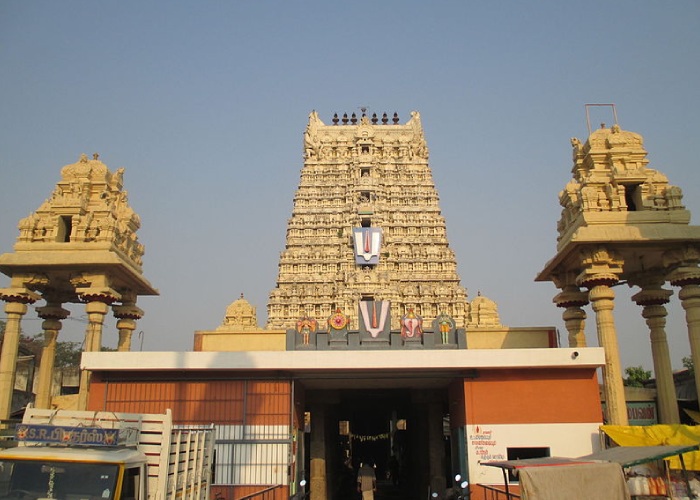
The pilgrimage experience reflects this layered identity. Approaching the temple, the tall gopuram announces its presence from a distance. The streets are lined with small shops and traditional houses, giving the town an older rhythm. Once inside, the prakarams feel spacious and steady. The raised foot of Trivikrama draws the eye upward, while the Alvar mandapam invites quiet reflection. Standing in that small space where three saints once gathered, one begins to understand the deeper message. Revelation does not always require vastness. Sometimes it begins in cramped, uncomfortable spaces where people choose to stand together.
Culturally, Thirukkoyilur stands as a bridge between epic mythology and Tamil bhakti. It connects the Vamana story from the broader Indian tradition with the intimate poetry of the Alvars. The temple reminds devotees that devotion is both personal and communal. The Trivikrama legend teaches humility and surrender, while the Alvar story teaches closeness and shared faith. Together, these narratives shape a temple that speaks to both expansion and intimacy.
In modern times, Thirukkoyilur continues to draw pilgrims, scholars and devotees. Renovations have strengthened the structure, improved lighting and maintained the prakarams without altering the temple’s core identity. It remains a place where one can feel both the weight of history and the immediacy of presence. The lessons embedded here remain relevant. The ego can be dissolved. Small spaces can hold vast truths. Devotion can begin unexpectedly.
Thirukkoyilur ultimately represents the moment when space was filled by divine presence, by poetry and by shared devotion. Trivikrama’s raised foot reminds us that the divine reaches beyond boundaries, while the story of the three Alvars reminds us that when hearts gather sincerely, there is no empty space left. In the larger Divya Desam journey, this temple stands as a place of beginnings, expansion and the quiet birth of something enduring.
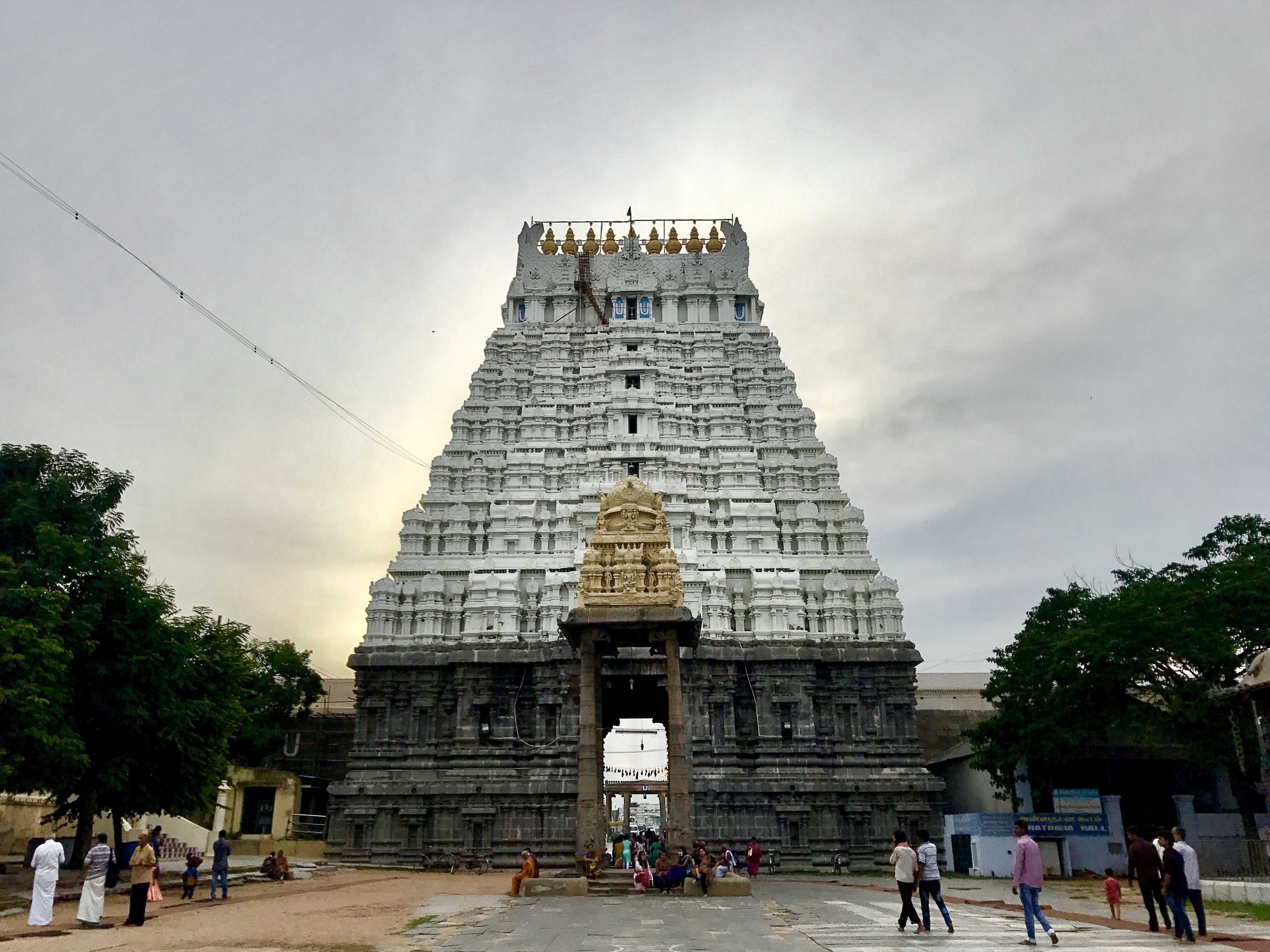
Thirukkachi – Atthigiri Temple, Kanchipuram, Tamil Nadu
Thirukkachi, better known as the Varadaraja Perumal Temple at Atthigiri in Kanchipuram, is one of the most revered Divya Desams in Tamil Nadu. Kanchipuram itself is an ancient temple town, layered with centuries of philosophy, debate and devotion, and within it Atthigiri stands with quiet authority. The presiding deity is Varadaraja Perumal, and the goddess is Perundevi Thayar. The name Atthigiri comes from “Athi,” meaning fig tree, and “giri,” meaning hill. According to tradition, the original idol of the Lord emerged from beneath a sacred fig tree on a small hill, giving the temple both its name and its character. Even today, the sense of elevation remains, not dramatic, but steady and grounding.
The mythology of Thirukkachi begins with Brahma. It is believed that Brahma once performed an Ashwamedha Yagna here to worship Vishnu and seek divine grace. However, Indra grew anxious about losing his own position and tried to disrupt the ritual. Vishnu intervened, protected the sacrifice and appeared as Varadaraja, meaning “the King who grants boons.” The story is not about rivalry as much as it is about reassurance. When devotion is sincere, the divine stands firm. That message has stayed with the temple across centuries.
There is another legend closely tied to this shrine, one that deepens its emotional weight. The temple is associated with Ramanuja, the great philosopher who shaped Sri Vaishnavism. It is said that Ramanuja sought clarity here on key theological questions. Varadaraja Perumal is believed to have responded through his devotee Thirukkachi Nambi, who served the Lord daily. The answers given to Ramanuja here shaped major principles of Vishishtadvaita philosophy. Because of this, Thirukkachi is not only a place of worship but also a place of intellectual and spiritual turning points. The Lord here is seen as one who clarifies doubt rather than creating mystery.

Historically, the temple reflects layers of patronage from Pallava, Chola and Vijayanagara rulers. The Pallavas likely laid the early foundations, but it was the Cholas who expanded the structure and formalised ritual practices. Later, the Vijayanagara kings added the towering gopurams and expansive mandapams that define the temple’s current scale. Walking through the temple complex, you can see this progression. Granite pillars, carved corridors and high walls speak of centuries of continuity. Yet despite its size, the temple does not feel overwhelming. It feels ordered. Balanced. Structured in a way that encourages both movement and pause.
Architecturally, Atthigiri stands apart from many other Divya Desams because of its scale. The massive eastern gopuram rises prominently above Kanchipuram’s skyline, and the hundred-pillared hall reflects the intricate artistry of the Vijayanagara period. Each pillar carries carvings of warriors, dancers and mythological scenes, but none distract from the central focus of the sanctum. Inside, Varadaraja Perumal stands facing west, an unusual orientation that adds to the temple’s uniqueness. His posture is regal but approachable. There is strength in the stance, but also gentleness in the expression. Perundevi Thayar’s shrine lies nearby, radiating warmth and emotional steadiness. Devotees often visit her first before approaching the main sanctum, a quiet acknowledgement that compassion prepares the heart for clarity.
One of the most distinctive aspects of this temple is the legend of the Athi Varadar idol. According to tradition, the original wooden idol carved from the sacred fig tree is kept submerged in the temple tank and brought out for public worship once every forty years. When this happens, millions gather. The atmosphere becomes electric, yet deeply reverent. The rarity of the event reinforces a powerful idea: some forms of grace reveal themselves only occasionally, but they are never absent. Even when unseen, they remain present beneath the surface.
Daily worship at Thirukkachi follows the Vaishnavite tradition, with rituals performed at regular intervals. The rhythm of the temple day carries its own calm assurance. Suprabhatam, alankaram, neivedyam and evening aradhanai unfold without haste. Festivals such as Brahmotsavam and Vaikunta Ekadasi draw large crowds, but the temple’s vast courtyards absorb them without chaos. During Garuda Sevai, Varadaraja Perumal is taken out in procession, and the sight of the deity moving through the temple streets creates a sense of shared devotion that stretches across generations.
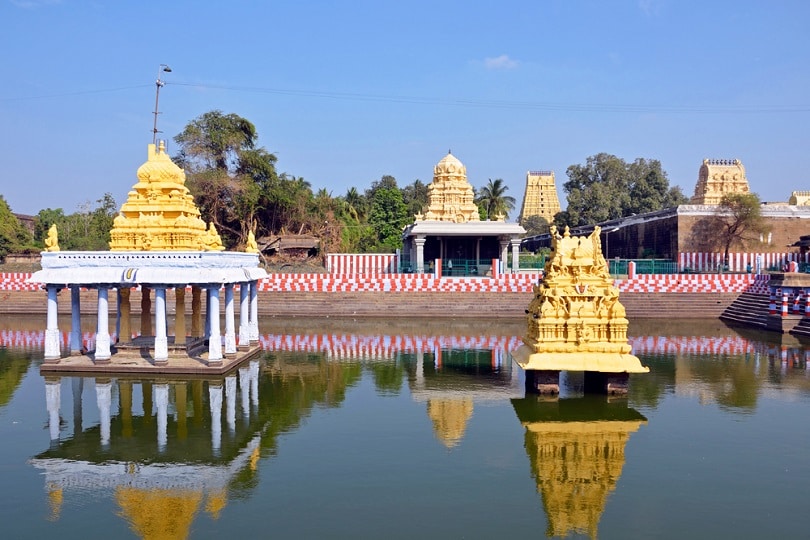
The pilgrimage experience here is layered. Entering through the tall gopuram, you pass through expansive corridors before reaching the sanctum. The journey inward mirrors the internal process many devotees describe — moving from noise to stillness, from distraction to clarity. The temple tank, Anantha Saras, lies nearby, adding reflection to the physical space. The climb up the small hill within the complex reminds you of the temple’s origin story. Even in a vast structure, the memory of the fig tree and the small rise of earth remains central.
Culturally, Thirukkachi holds enormous significance. It stands at the intersection of devotion and philosophy. The connection to Ramanuja ensures that the temple remains central to Sri Vaishnavite identity. The responses given here, believed to have shaped theological understanding, continue to influence discourse even today. Beyond philosophy, the temple also lives in music, literature and community practice. Devotees speak of Varadaraja as a Lord who listens. That perception shapes the way people approach him, not with fear, but with trust.
In modern times, Thirukkachi remains active and well-maintained. Restoration efforts preserve ancient carvings while ensuring structural safety. The temple continues to attract pilgrims not only from Tamil Nadu but from across India and abroad. Despite increased footfall, the sanctum retains a sense of calm. The scale of the complex allows for personal space even during busy days.
Ultimately, Thirukkachi at Atthigiri represents clarity. Varadaraja Perumal is not a distant figure. He is a presence that steadies and answers. The mythology of Brahma’s yagna, the philosophy of Ramanuja and the legend of Athi Varadar all converge here into one message: devotion aligned with sincerity invites response. In the larger Divya Desam journey, this temple stands as a place where doubt is met with explanation and where seeking becomes understanding. It reminds you that elevation does not require height alone; sometimes it begins under a fig tree, in a small rise of earth, with a quiet answer given to a sincere question.

