The Elasticity of Time

I have been feeling this at least since June/July of last year. The days seem to be flying past. I would wake up one morning on a Monday and the next thing I know it’s Friday! The week has zipped past me without really realising it. I used to think it was just me, but on speaking with family and friends, I realised quite a few of them also felt the same. Here we are in the new year and time still seems not to stop. And in the midst of the pandemic when most of us are stuck at home, we would expect time to not pass as fast as it would during a normal time. Instead of time slowing down, it seems to be moving at wrap speed. I decided to see if this is a phenomenon and if this is scientifically true.

Time as a concept is fixed, there is a fixed number of hours in a day and day morphes into the night at a fixed time each day and is constantly moving and changing. What happens now is different from what happens in the next minute. Simply put, this minute you are reading this paragraph, but within the next sixty seconds or slightly later, you will reach the next paragraph and time has shifted.

But it has also been proven that time passes faster at the top of a mountain as opposed to at sea level. The difference is small but can be measured with precision timepieces that can be bought today for a few thousand dollars. This slowing down can be detected between levels just a few centimetres apart: a clock placed on the floor runs a little more slowly than one on a table.

Einstein understood this slowing down of time a century before we had clocks precise enough to measure it. He imagined that the sun and the Earth each modified the space and time that surrounded them, just as a body immersed in water displaces the water around it. This modification of the structure of time influences in turn the movement of bodies, causing them to “fall” towards each other.
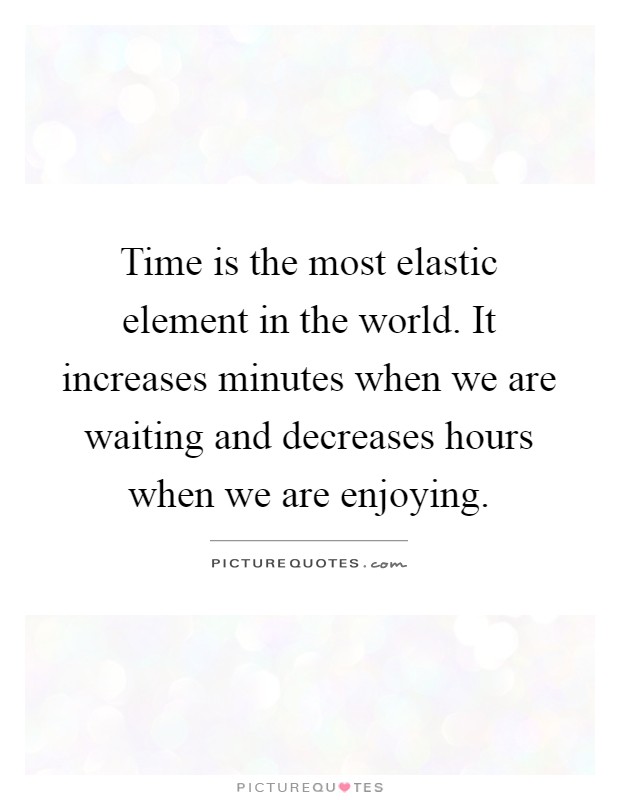
But how does this explain why sometimes time is elastic, why sometimes time moves fast and other times it is as slow as molasses? Why when we are having a bad day, or eagerly awaiting something that will happen tomorrow, a day can feel as long as a year and when you are having fun or are on a holiday, an entire week can pass before you know it and it’s time to go back to our mundane life? This is probably what is the elasticity of time.

While researching this piece, I realised I am not the first to realise this and speak about it. While this has not yet been fully researched, some people feel that it is because we create our own subjective experience of time in our minds and it doesn’t always match up with what we read on the clock or the calendar. A 20-minute lunch with a friend goes by in a flash, while a 20-minute wait for a delayed train can feel interminable, yet in reality of course the duration is identical.

We estimate the passing of time in two ways, either prospectively by how fast is time passing right now or retrospectively by how fast did last week or the last year go by. When we are stuck at home, either in a lockdown or because we are told to work or study from home for the time being, we are stuck with those with whom we live and there are many who are isolated from family and friends and we have the long days to fill up. While work takes a big chunk of our time, we have also found other ways to pass time for when we are not working. We do that by rediscovering our hobbies, watching content online or on television, speaking with family and friends and other ways to fill those hours which we would have otherwise used for socialising. But inevitably, the days start to look and feel a little similar. Weekdays and weekends blend together and we find it hard to distinguish between them and there are many days when I have woken up and it has taken me some time to think about what day it is.
This blurring of days who all look the same leads us to create fewer new memories, which is crucial to our sense of time perception. When each day is either the same or similar to the previous one and the one before that, we fail to distinguish between them. Memories are one of the ways that we judge how much time has passed and so when days look similar or even identical, it just feels like one long day and with nothing to really distinguish between our weekdays and weekends, months go by before we have something new to add to our memory bank. It’s like when we go on a holiday to a new place, time seems to zip by there because everything is new, and when we get home and look back, because there are so many memories of the holiday, it feels like we’ve been away longer that we actually did.

During times like the pandemic, it’s the opposite that happens. Now, if we get to the end of the week and look back, because we have hardly any new memories made, time seems to disappear. It’s a less extreme version of the experience some people have while in prison or when they’re ill. Time passes painfully slowly and they long for it to be over, but when it is and they look back, time can feel as though it has contracted. Of course some of us have found ourselves busier than ever during this period, juggling the technological challenges of working from home with the new job of home-schooling children. So even though we may be busier than ever, we spend all our time at home and this means we don’t have many memories which are not associated with another place or location and this makes us feel that time has just zipped by. Dozens of Zoom calls from the same surroundings can start to merge into one compared with memories of real life where we see people in different places.

Our perception of time in the future has also altered. Pre-pandemic, we thought of the near future when we would take holidays plan for or other events in our lives. But today, we either look to the far future when all this is over or to the immediate future, perhaps planning on what to cook for lunch the next day. Once the pandemic is over, will we look back and see it as one chunk of time or will we be able to distinguish the various months of 2020? I do remember the time in January when Singapore reported its first case. This was just after we went for S’ cousin’s engagement over in Johor Bahru in Malaysia. That was the last time we went out anywhere significantly other than for errands and that day stands out in stark contrast to the rest of the year.

So what do you think of your time during this pandemic? Did time zip past you or was it slow as molasses? Do comment and let me know.

In My Hands Today…

The Moment of Lift: How Empowering Women Changes the World – Melinda Gates

For the last twenty years, Melinda Gates has been on a mission. Her goal, as co-chair of the Bill & Melinda Gates Foundation, has been to find solutions for people with the most urgent needs, wherever they live. Throughout this journey, one thing has become increasingly clear to her: If you want to lift a society up, invest in women.

In this candid and inspiring book, Gates traces her awakening to the link between women’s empowerment and the health of societies. She shows some of the tremendous opportunities that exist right now to “turbo-charge” change. And she provides simple and effective ways each one of us can make a difference.

Convinced that all women should be free to decide whether and when to have children, Gates took her first step onto the global stage to make a stand for family planning. That step launched her into further efforts: to ensure women everywhere have access to every kind of job; to encourage men around the globe to share equally in the burdens of household work; to advocate for paid family leave for everyone; to eliminate gender bias in all its forms.

Throughout, Gates introduces us to her heroes in the movement towards equality, offers startling data, shares moving conversations she’s had with women from all over the world—and shows how we can all get involved.

A personal statement of passionate conviction, this book tells of Gates’ journey from a partner working behind the scenes to one of the world’s foremost advocates for women, driven by the belief that no one should be excluded, all lives have equal value, and gender equity is the lever that lifts everything.

World Braille Day

Many years ago when I was in college, we used to have many visually handicapped students studying there. This was because it was one of the few colleges which had a fully functioning braille library and I remember them starting to add more books and resources to the library. This library was right next to the main college library and we also used to get students from other colleges come to use these resources. At one point, I was also recruited by a friend to act as a writer to a visually handicapped student for the final exam. My experience there was not very good as the student I got was not interested in the exam and since it was my subject and the student was a junior, they used to ask me to write the exam for them with no input from their side for each question. I refused to do so after the first question and the experience ended badly for me. But I did see sincere students who had prepped for the exams and even today, I remember this student who had so much to say that the student writer assigned to them had a cramped hand at the end of the exam!

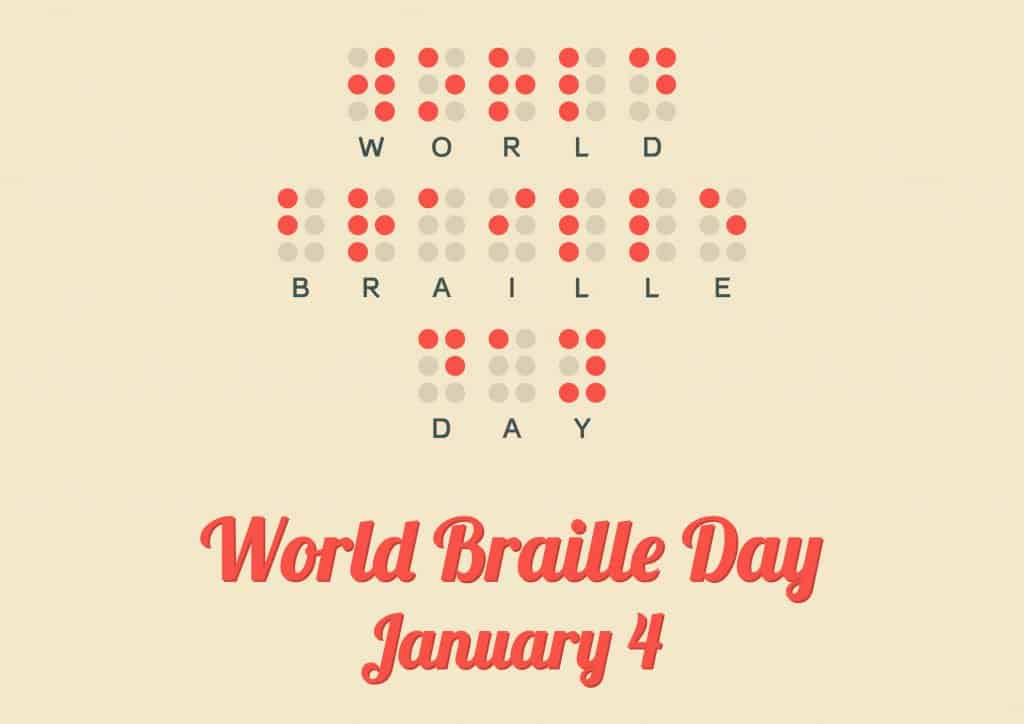
Today is World Braille Day and this post is apt for the day. Celebrated since 2019, World Braille Day is observed to raise awareness of the importance of Braille as a means of communication in the full realisation of the human rights for blind and partially sighted people.

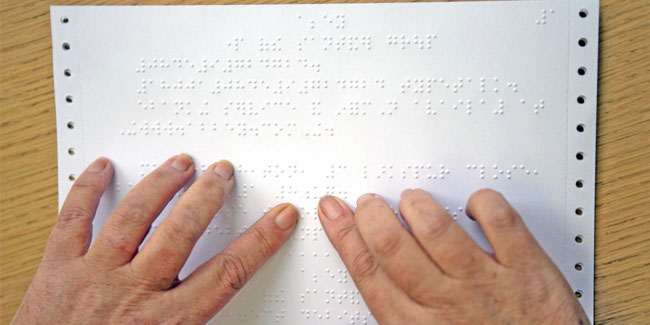
A tactile representation of alphabetic and numerical symbols using six dots to represent each letter and number, and even musical, mathematical and scientific symbols, Braille, named after its inventor in 19th century France, Louis Braille is used by blind and partially sighted people to read the same books and periodicals as those printed in a visual font. Braille is essential in the context of education, freedom of expression and opinion, as well as social inclusion.

Eye conditions are remarkably common. The World Health Organization estimates that globally 36 million people live with blindness and 216 million people have moderate to severe visual impairment. Persons with vision impairment are more likely than those without to experience higher rates of poverty and disadvantage. Vision loss often represents a lifetime of inequality, poorer health, and barriers to education and employment. In November 2018, it was decided to proclaim 4 January as World Braille Day, recognising that the full realisation of human rights and fundamental freedoms relies on an inclusive written promotion. Why 04 January? Because it is the birth anniversary of Louis Braille

World Braille Day is a reminder of the importance of accessibility and independence for people who are blind or visually impaired. Today’s reality is that many establishments such as restaurants, banks, and hospitals don’t offer braille versions of their print materials like menus, statements, and bills. Because of this, people with blindness or visual impairments often don’t have the freedom to choose a meal on their own or keep their finances private. This day spreads awareness about braille and other accessible forms of communication. It makes a visually impaired person be able to access educational opportunities and employment, be independent and be able to communicate with family, friends and society. Everyone deserves and is legally entitled to the same accommodations and service, regardless of ability. Let’s remember that and do our part to make our workplaces and community areas more accessible for everyone.

World Braille Day signifies inclusion and diversity. It is important to celebrate such days so that children become aware that people are different and unique, gaining an awareness of varying needs and requirements. Through celebrating days like this, it helps children raise important questions about additional needs and expands their knowledge of different people in our society.

2021 Week 00 Update

Happy New Year! May 2021 bring to you and your loved ones loads of happiness, abundance, prosperity and good health!

I decided to start this year with the week 0 because this week was split between 2020 and this year and so it’s week 0 according to me.

It was a fairly quiet week at home and Singapore had a very rainy start to 2021. With such a weather, a warm bed with a book and some hot beverage sounds so appealing, but this year because I have decided to finally take my health into my hands, I couldn’t just sit and chill, but had to make sure I walked my targeted steps for the day. I have also decided to read more this year because in 2020, social media and OTT shows took quite a bit of my time which I want to reclaim back. There are other resolutions for the year, but let me see if I can actually keep to them before I share it.

The world is reeling with more than 84 million positive cases and the United States leads the pack with more than 20 million cases and India following behind with 10 million cases and Brazil at number three with close to 8 million cases. But there is a silver lining because many countries have started vaccinations starting with their medical and frontline workers before moving on to their elderly and the vulnerable. In the past week, Singapore has gotten double digit cases more than once and though most of them are imported cases, we also now have at least two local community clusters which are most likely to be cases within a household. Hopefully this gets contained soon and we go back to single digit numbers. Currently there are about 150 active cases in the country.

This year, in my weekly updates, I have decided to spread some positivity and so here’s something I made. I hope to share a new positive thought each week which will brighten up our week. Have a wonderful 2021 and stay healthy!

In My Hands Today…

The Girl Who Escaped ISIS: This Is My Story – Farida Khalaf

A rare and riveting first-hand account of the terror and torture inflicted by ISIS on young Iraqi Yazidi women, and an inspiring personal story of bravery and resilience in the face of unspeakable horrors.

In the early summer of 2014, Farida Khalaf was a typical Yazidi teenager living with her parents and three brothers in her village in the mountains of Northern Iraq. In one horrific day, she lost everything: ISIS invaded her village, destroyed her family, and sold her into sexual slavery.

The Girl Who Escaped ISIS is her incredible account of captivity and describes how she defied the odds and escaped a life of torture, in order to share her story with the world. Devastating and inspiring, this is an astonishing, intimate account of courage and hope in the face of appalling violence.