International Chess Day

A thinking board game, very old in origin, chess is played between two players. The current form of the game emerged in Southern Europe during the second half of the 15th century after evolving from similar, much older games of Indian and Persian origin. Chess is an abstract strategy game and involves no hidden information, played on a square chessboard with 64 squares arranged in an eight-by-eight grid with the object of the game to checkmate the opponent’s king, whereby the king is under immediate attack or in check and there is no way for it to escape.

Chess is an ancient, intellectual and cultural game, with a combination of sport, scientific thinking and elements of art. As an affordable and inclusive activity, it can be exercised anywhere and played by all, across the barriers of language, age, gender, physical ability or social status. A global game, chess promotes fairness, inclusion and mutual respect, and can contribute to an atmosphere of tolerance and understanding among peoples and nations.

Chess is a two-player strategy board game where the aim is to move different types of playing piece, each with a prescribed set of possible moves, around a chequered square board trying to capture the opponents’ king piece. Today there are over 2,000 identifiable variants of the game. One theory is that an early game similar to chess called Chaturanga originated in the Northern Indian Subcontinent during the Gupta period, around 319 – 543 and spread along the Silk Roads west to Persia. Whilst modern Chess is believed to have been derived from Chaturanga which means four divisions referring either to the divisions of the playing pieces into infantry, cavalry, elephantry and chariotry, which in the modern game became the pawn, knight, bishop and rook pieces, or to the fact that the game was played by four players. Chatrang, and later Shatranj, was the name given to the game when it arrived in Sassanid Persia around 600. The earliest reference to the game comes from a Persian manuscript of around 600, which describes an ambassador from the Indian Subcontinent visiting king Khosrow I who ruled between 531 – 579 and presenting him with the game as a gift. From there it spread along the Silk to other regions including the Arabian Peninsula and Byzantium. In 900, Abbasid chess masters al-Suli and al-Lajlaj composed works on the techniques and strategy of the game, and by 1000, chess was popular across Europe, and in Russia where it was introduced from the Eurasian Steppe. The Alfonso manuscripts, also known as the Libro de los Juegos or the Book of Games, a medieval collection of texts on three different types of the popular game from the 13th century describe the game of chess as very similar to Persian Shatranj in rules and gameplay.

Throughout history, games and sports have helped humanity to survive times of crisis by reducing anxieties and improving mental health. While the coronavirus outbreak has forced most gaming and sports activities to scale down, chess has demonstrated remarkable resilience, adaptability and very strong convening power in time of the pandemic. Over the past year, the overall interest in chess is reported to have doubled, with more players than ever coming together to participate in chess events that are being increasingly held through online platforms.

The International Chess Day is celebrated annually on July 20, the day the International Chess Federation or the FIDE was founded, in 1924. The idea to celebrate this day was proposed by UNESCO, and it has been celebrated as such since 1966. On December 12, 2019, the UN General Assembly unanimously approved a resolution recognising the day.

The day is celebrated by many of the 605 million regular chess players around the world. A 2012 Yougov poll showed that a surprisingly stable 70% of the adult population has played chess at some point during their lives. This number holds at approximately the same level in countries as diverse as the US, UK, Germany, Russia, and India. Chess helps us to sharpen our mind-skills, reward ourselves with positive emotions, strengthens character, hones self-discipline, persistence, planning and many other important skills that are needed in life.

I played chess for a bit when I was younger, but because nobody I knew played the game, I gradually stopped playing. When BB & GG were about 10, I introduced them to the game, and they enjoy playing with each other, pitting their skills against each other. They don’t play as often I would like them to, but ever so often, I will find them hunched over a chessboard, trying to kill each other’s rooks, pawns, bishops, horses and elephants. To observe this day, we played chess yesterday, did you?

In My Hands Today…

The Devil in the White City – Erik Larson

Murder, Magic, and Madness at the Fair That Changed America

Two men, each handsome and unusually adept at his chosen work, embodied an element of the great dynamic that characterized America’s rush toward the twentieth century. The architect was Daniel Hudson Burnham, the fair’s brilliant director of works and the builder of many of the country’s most important structures, including the Flatiron Building in New York and Union Station in Washington, D.C. The murderer was Henry H. Holmes, a young doctor who, in a malign parody of the White City, built his “World’s Fair Hotel” just west of the fairgrounds—a torture palace complete with dissection table, gas chamber, and 3,000-degree crematorium. Burnham overcame tremendous obstacles and tragedies as he organized the talents of Frederick Law Olmsted, Charles McKim, Louis Sullivan, and others to transform swampy Jackson Park into the White City, while Holmes used the attraction of the great fair and his own satanic charms to lure scores of young women to their deaths. What makes the story all the more chilling is that Holmes really lived, walking the grounds of that dream city by the lake.

The Devil in the White City draws the reader into a time of magic and majesty, made all the more appealing by a supporting cast of real-life characters, including Buffalo Bill, Theodore Dreiser, Susan B. Anthony, Thomas Edison, Archduke Francis Ferdinand, and others. In this book the smoke, romance, and mystery of the Gilded Age come alive as never before.

Festivals of India: Ashadi Ekadashi

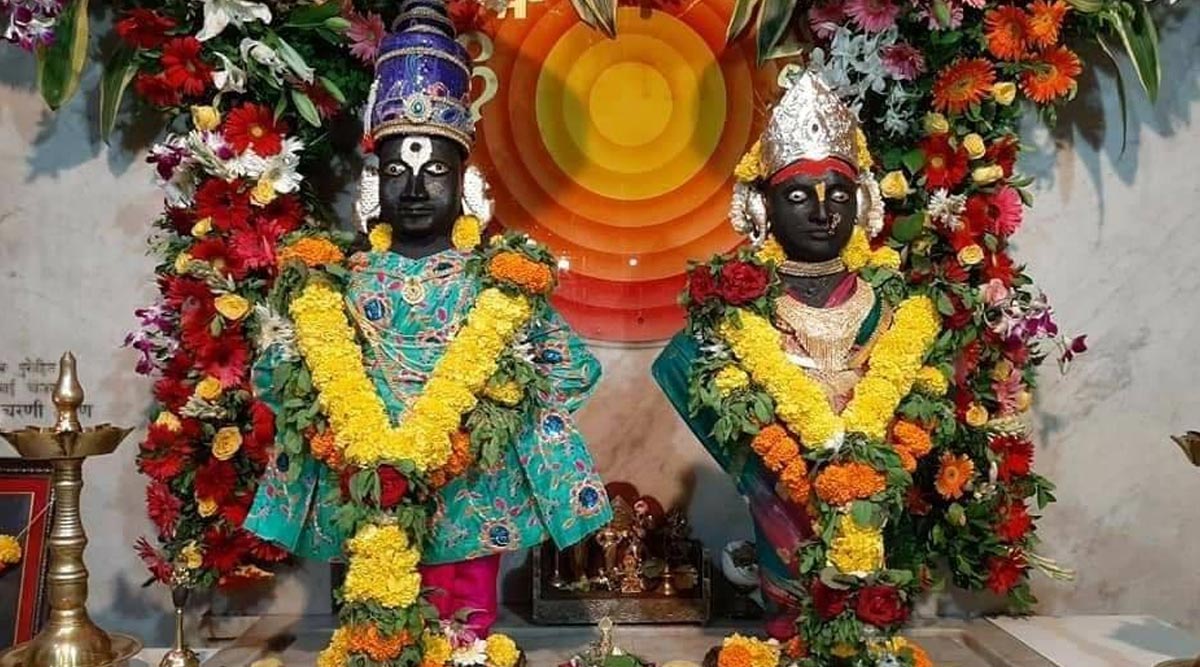
Tomorrow is Ashadi Ekadashi which is also known variously as Shayani Ekadashi which literally means sleeping eleventh or the Maha Ekadashi or the great eleventh or Prathama Ekadashi or the first eleventh. It is the eleventh lunar day or ekadashi of the bright fortnight or shukla paksha of the Hindu month of Ashadha which happens sometime in June or July and so is also known as Ashadhi Ekadashi or Ashadhi. This holy day is of special significance to Vaishnavas, followers of the Hindu protector God, Lord Vishnu.

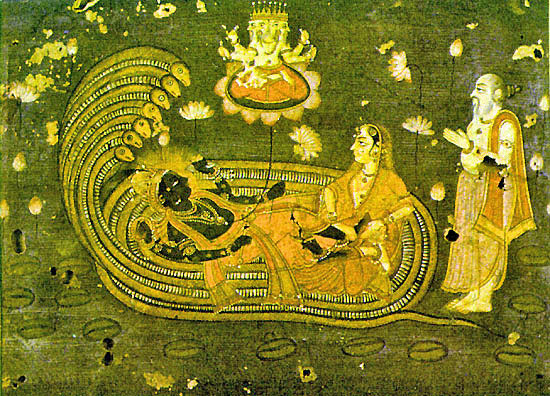
On this day images of Vishnu and Lakshmi are worshipped and the entire night is spent chanting prayers and devotees keep fast and take vows on this day, to be observed during the entire chaturmas, the holy four-month period of rainy season. These may include, giving up a food item or fasting on every Ekadashi day. It is believed that Lord Vishnu falls asleep in Ksheersagar or the cosmic ocean of milk on Shesha naga, the cosmic serpent. Thus the day is also called Dev Shayani Ekadashi or the god sleeping eleventh or Hari Shayani Ekadashi or Vishnu sleeping eleventh. Vishnu finally awakens from his slumber four months later on Prabodhini Ekadashi or the eleventh day of the bright fortnight in the Hindu month of Kartik which comes sometime in October or November. A fast is observed on Shayani Ekadashi. The fast demands abstainance from all grains, beans, cereals, certain vegetables like onions and certain spices.

In the scripture Bhavishyottara Purana, Lord Krishna narrates the significance of Shayani Ekadashi to Yudhishthira, as the creator god Lord Brahma narrated the significance to his son, the sage Narada once. The story of king Mandata is narrated in this context. The pious king’s country had faced drought for three years, but the king was unable to find a solution to please the rain gods. Finally, sage Angiras advised the king to observe the vrata or vow of Dev Shayani Ekadashi and when the king sis so, by the grace of Lord Vishnu, there was rain in the kingdom.

In my home state of Maharashtra, on this day, a huge yatra or religious procession of pilgrims known as Pandharpur Ashadi Ekadasi Waari Yatra culminates at Pandharpur in Solapur district in south Maharashtra, situated on the banks of the Chandrabhaga River. Pandharpur is main center of worship of the deity Vitthal, a local form of Lord Vishnu. Hundreds of thousands of pilgrims come to Pandharpur on this day from different parts of the state with some of them carrying Palkhis or palanquins with the footwear and images of the saints of Maharashtra, each from a different part of the state. As per tradition, saint Dnyaneshwar’s palki leaves from Alandi, while saint Tukaram’s begins at Dehu, both near Pune. The pilgrims are referred to as Warkaris and they sing Abhangas or hymns written by Saint Tukaram and Saint Dnyaneshwar, dedicated to Lord Vitthal. This 700-800 year old tradition takes 21-days of walking from various parts of the state, reaching Pandharpur on Ashadi Ekadashi where they take a holy dip in the sacred Chandrabhaga or Bhima River before proceeding to visit the Vitthal Temple. The road next to our building in Mumbai is part of one of the routes the warkaris take and in the beginning of their trek, one night, we hear them pretty much the whole night, as various groups of warkaris start their journey, singing abhangs and hymns and we just know that Ashadi Ekadashi is just around the corner.

Ashadi Ekadashi is also the beginning of the holy four month period known as Chaturmas from June/July to October/November which will end on Prabodhini Ekadashi, the eleventh day of the bright half of the month of Kartik which is the eighth month of the Hindu lunar calendar. It is believed that the devas of demigods start their four month long sleep on the Ashadi Ekadashi and sjould not be disturbed which is why the Chaturmas period is considered inauspicious for weddings and other celebrations and is considered a suitable time for householders to have an annual renewal of faith by listening to discourses on dharma, and by meditation and vrata or self-control. Penance, austerities, religious observances, recital of mantras, bathing in holy rivers, performing sacrifices, and charity are prescribed. Fasts and purity during this period help maintain health, for which there is likely a scientific rationale, disease spreading more readily with the onset of monsoon. A number of Hindus, particularly those following the Vaishnav tradition, refrain from eating onions and garlic during this period. In Maharashtra, a number of Hindu families also do not eat any preparations made from egg plant, brinjal or aubergene. Asetics or Sanyasis are supposed to halt during this period at one selected place called the monsoon retreat, and give discourses to the public. Major celebrations within this holy period include Guru Purnima, Krishna Janmashtami, Raksha Bandhan, Ganesh Chaturthi, Navratri, Diwali and Champa Sashthi, which as per tradition in Maharashtra, is the day Chaturmas ends.

Source

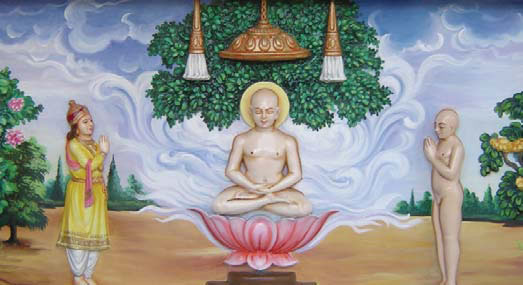
In Jainism this practice is collectively known as Varshayog and is prescribed for Jain monasticism when wandering monks believe that during the rainy season, countless bugs, insects and tiny creatures that cannot be seen in the naked eye take birth massively. Therefore, these monks reduce the amount of harm they do to other creatures so they opt to stay in a single place for the four months to incur minimal harm to other lives. These monks, who generally do not stay in one place for long, observe their annual rains retreat during this period, by living in one place during the entire period amidst lay people, observing a vow of silence, meditation, fasting and other austerities, and also giving religious discourses to the local public. One of the most important Jain festivals, Paryushana, falls during the beginning of this period, which concludes with Kshamavani Diwas or Forgiveness Day, when lay people and disciples say Micchami Dukkadam and ask forgiveness from each other. Amongst Jain merchants, there is a tradition of inviting monks to their respective cities during Chaturmas to give religious instruction.

In Buddhism, it is believed that Gautama Buddha stayed at the royal garden of King Bimbisara of Rajgir, whom he had recently converted, for the period of Chaturmas and gave sermons. This practice is followed by monks to this day. Another reason for ascetics to stay in one place during the rainy season is that the tropical climate produces a large number of insects, which would be trampled by travelling monks.

2021 Week 28 Update

I get this feeling more and more recently that with COVID, we take two steps forward and then three steps backwards! After weeks of low case counts and some days of zero cases, there suddenly erupted a new cluster involving some KTV lounges. A KTV lounge for the uninitiated is a kind of nightclub with karaoke machines and hostesses. The cluster now has grown to more than 88 cases. And here we were thinking that the end is not that far away.

On the other side, Indonesia has emerged as Asia’s hotspot with more than 50,000 cases in a single day displacing India from the position. The super contagious Delta variant is what is wreaking havoc in the archipelago. The Delta variant has now been declared the most dominant strain worldwide having been detected around 100 countries across the world. There are now more than 190 million cases worldwide.

On the other hand, vaccine hesitancy is a real thing with many, even in Singapore, hesitating for various reasons to get vaccinated. Only about a quarter of the world’s population has been vaccinated with at least one dose, while it is less than 7% in India. In Singapore about 70% of the resident population has had at least one dose of the vaccine and about 43% are fully vaccinated. The sooner we all get vaccinated, the better equipped we are to face the uncertainties and life can move on to some sense of normality.

This week was the pretty much the same as last week and the one before that and will probably be similar to the next week. The children are busy with school work and project submissions. Their third semester will end in a couple of months and that’s the halfway point of their poly life, which was spent in home-based learning. This is a sore point with GG as she feels that her experience of poly life has been spoilt because of the pandemic. BB goes to school more than her because of lab and she is very sore about that.

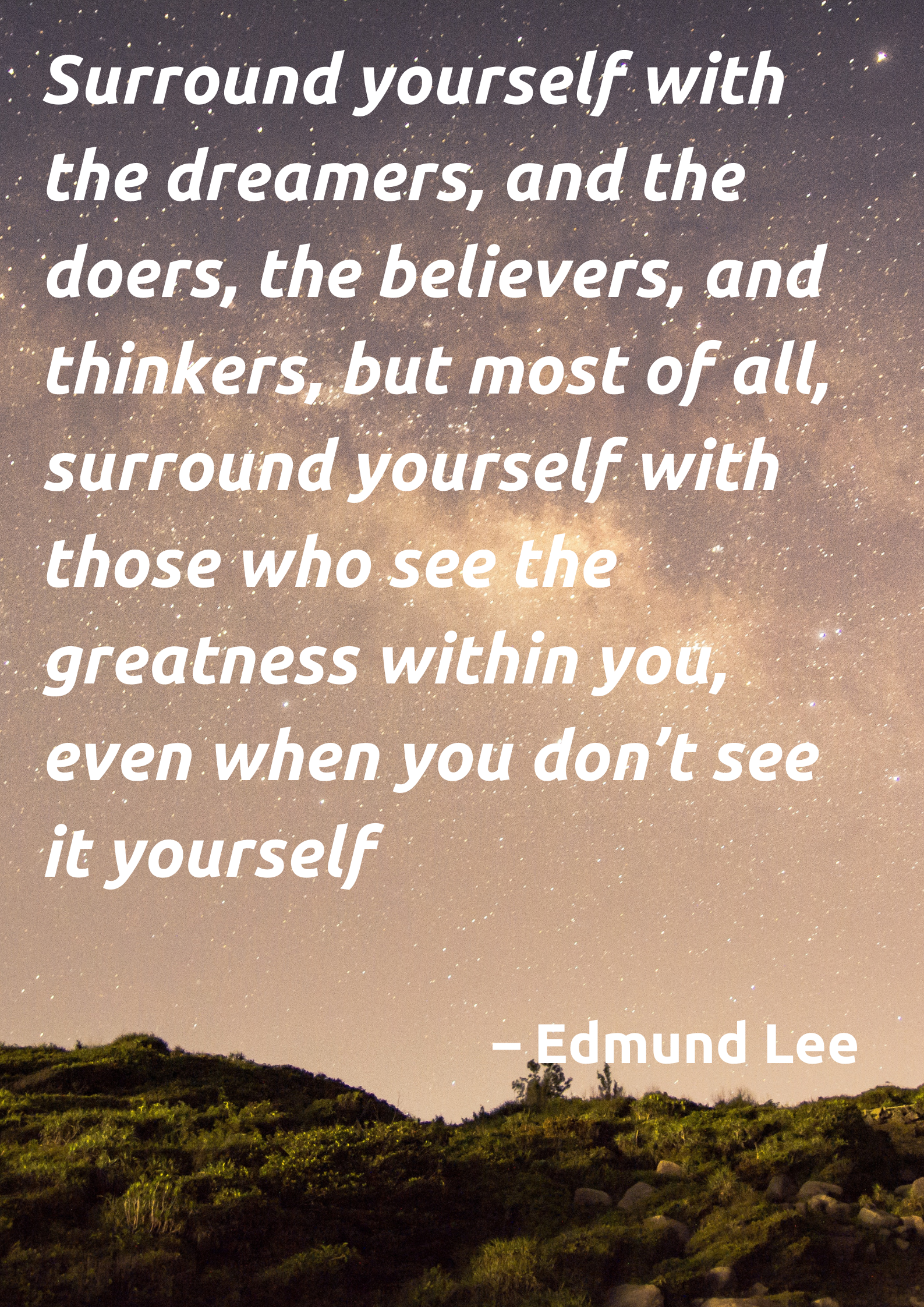
This week’s quote asks us to surround ourselves with those who see the goodness in yourself, so even if you don’t believe in yourself, you have a posse who do and will do their best to boost you up.

That’s all from me for this week, have a great week people and as always, stay safe and stay vaccinated.

In My Hands Today…

The World Is Flat: A Brief History of the Twenty-first Century – Thomas L. Friedman

When scholars write the history of the world twenty years from now, and they come to the chapter Y2K to March 2004, what will they say was the most crucial development?

The attacks on the World Trade Center on 9/11 and the Iraq war? Or the convergence of technology and events that allowed India, China, and so many other countries to become part of the global supply chain for services and manufacturing, creating an explosion of wealth in the middle classes of the world’s two biggest nations, giving them a huge new stake in the success of globalisation?

And with this flattening’ of the globe, which requires us to run faster in order to stay in one place, has the world got too small and too fast for human beings and their political systems to adjust in a stable manner?In this brilliant new book, the award-winning New York Times columnist Thomas Friedman demystifies the brave new world for readers, allowing them to make sense of the often bewildering global scene unfolding before their eyes. With his inimitable ability to translate complex foreign policy and economic issues, Friedman explains how the flattening of the world happened at the dawn of the 21st century; what it means to countries, companies, communities and individuals; and how governments and societies can, and must, adapt.