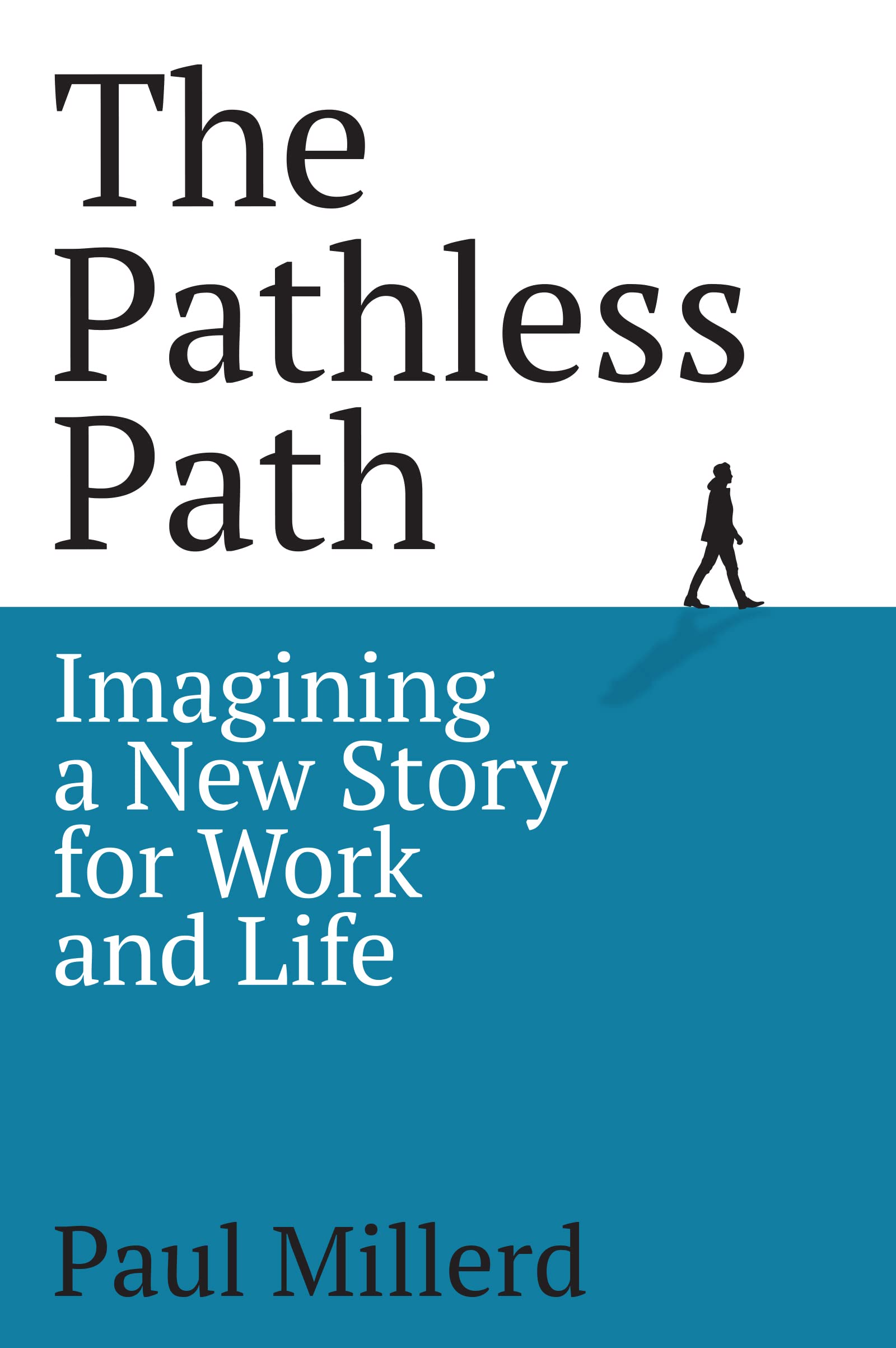
The Pathless Path: Imagining a New Story For Work and Life – Paul Millerd
Paul thought he was on his way. From a small-town Connecticut kid to the most prestigious consulting firm in the world, he had everything he thought he wanted. Yet he decided to walk away and embark on the “real work” of his life – finding the things that matter and daring to create a life to make them happen.
This Pathless Path is about finding yourself in the wrong life, and the real work of figuring out how to live. Through painstaking experiments, living in different countries and the goodwill of people from around the world, Paul pieces together a set of ideas and principles that guide him from unfulfilled and burned out to the good life and all of the existential crises in between.
The Pathless Path is not a how-to book filled with “hacks”; instead, it is a vulnerable account of Paul’s journey from leaving a path centered around getting ahead and towards another, one focused on doing work that matters. This book is an ideal companion for people considering leaving their jobs, embarking on a new path, dealing with the uncertainty of an unconventional path, or searching for better models for thinking about work in a fast-changing world.
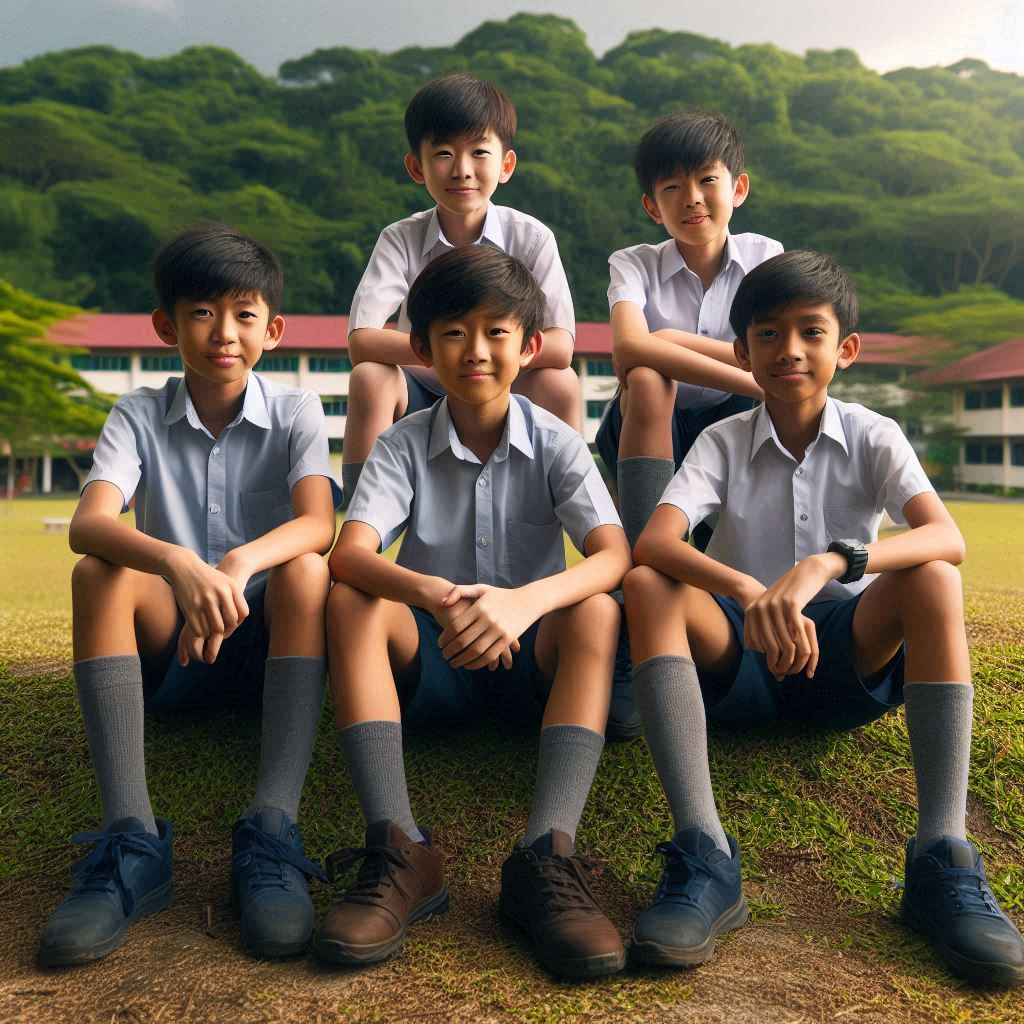
Benji, Salman, Atharva, and Thomas sat on the steps of their primary school, sweat beading on their foreheads in the sweltering June heat. The school grounds were eerily quiet, a stark contrast to the usual cacophony of children’s laughter and shouts. It was the middle of the school holidays, and most of their classmates were at home, enjoying a well-deserved break from the rigorous PSLE preparation that had consumed their lives for months.
“I can’t believe we’re spending our holiday studying,” Benji groaned, closing his math textbook with a thud. “My brain feels like it’s going to explode.” Salman nodded in agreement, absentmindedly doodling in the margins of his science notes. “Yeah, but we can’t slack off now. The PSLE is just a few months away.”
Atharva stretched his arms above his head, his eyes wandering to the dense forest that bordered their school. “You know what we need? An adventure. Something to take our minds off all this studying.” Thomas followed Atharva’s gaze, a mischievous glint in his eye. “Are you thinking what I’m thinking?”
The four boys exchanged knowing looks, a mix of excitement and apprehension coursing through their veins. They all knew what Thomas was suggesting – the forbidden forest. “But we’re not allowed in there,” Salman protested weakly, even as he began packing up his books. “Come on, Salman,” Benji urged, already on his feet. “We’ve been cooped up studying for weeks. What’s the harm in a little exploration?” With a collective nod, the boys made their decision. They quickly gathered their belongings and headed towards the forest’s edge, glancing over their shoulders to ensure no teachers were around to catch them.
As they stepped into the cool shade of the trees, a sense of exhilaration washed over them. The forest was a world apart from their orderly school life – wild, mysterious, and full of possibilities. “This is so cool,” Thomas whispered, his eyes wide as he took in the lush greenery surrounding them. They walked deeper into the forest, the sounds of civilisation fading behind them. The air grew thick with humidity, and the chirping of birds and rustling of leaves created a natural symphony.
After about twenty minutes of walking, Atharva suddenly stopped in his tracks. “Guys, look at that!” he exclaimed, pointing to something partially hidden beneath a tangle of vines. The boys crowded around, their curiosity piqued. As they brushed away the foliage, they gasped in unison. There, half-buried in the earth, was what appeared to be an old metal container.
“What is it?” Salman asked, his voice hushed with awe. Benji knelt down examining the object closely. “It looks like… a World War II relic,” he said, his voice filled with excitement. “Remember those pictures we saw in our history textbook?” Thomas nodded eagerly. “Yeah, from the Japanese occupation! This must be from that time.”
With renewed energy, the boys began to clear away more of the surrounding vegetation. As they worked, the full extent of their discovery became clear. It wasn’t just a single container – they had stumbled upon what appeared to be a small cache of World War II artefacts.
“Look, there’s some kind of insignia on this one,” Atharva pointed out, brushing dirt off a rusty metal box. Salman peered at it, his brow furrowed in concentration. “It looks like the Imperial Japanese Navy symbol. We learned about that in class, remember?” As the boys continued to unearth more items, their excitement grew. They found old canteens, a tarnished compass, and even what looked like parts of an old radio.
“This is incredible,” Benji breathed, carefully turning over a weathered leather pouch in his hands. “It’s like we’ve discovered a piece of history.” But as they delved deeper into their find, Thomas suddenly let out a yelp of pain. “Ouch!” he cried, jerking his hand back from one of the containers. “What happened?” Salman asked concern etched on his face.
Thomas held up his hand, revealing a small cut on his palm. “I think I cut myself on something sharp inside that box,” he explained, wincing. The mood suddenly shifted as the reality of their situation sank in. They were in a forbidden area, handling potentially dangerous artefacts from a war that had ended decades before they were born.
“Maybe we should go back,” Salman suggested, his earlier reservations returning. “We don’t know if these things are safe to touch.” Atharva nodded in agreement. “Yeah, and what if there’s unexploded ordnance or something? We learned about that in history class too.” The boys looked at each other, their earlier excitement now tempered with fear. They had been so caught up in their discovery that they hadn’t stopped to consider the potential dangers. “But we can’t just leave it here,” Benji argued. “This could be important. What if it gets destroyed or someone else finds it and doesn’t report it?”
As they debated what to do, they heard a sound that made their blood run cold – voices coming from the direction of the school. “Oh no,” Thomas whispered, his eyes wide with panic. “Someone’s coming!” The boys scrambled to gather their belongings, their hearts pounding in their chests. But as they prepared to flee, Benji made a split-second decision.
“We have to tell someone about this,” he said firmly. “It’s the right thing to do.” Despite their fear of punishment, the others nodded in agreement. They couldn’t just pretend they hadn’t made this significant discovery. With trepidation, they made their way towards the approaching voices. As they emerged from the treeline, they came face to face with Mr. Tan, their history teacher, and Mr. Lee, the school’s discipline master.
“Boys!” Mr. Lee exclaimed, his face a mixture of relief and anger. “What on earth are you doing in there? You know the forest is off-limits!” Before any of them could respond, Benji stepped forward. “Sir, we’re sorry for breaking the rules, but we found something important in the forest. We think it’s from World War II.”
Mr. Tan’s eyebrows shot up in surprise. “World War II relics? Are you sure?” The boys nodded vigorously, and Atharva added, “There are containers with the Imperial Japanese Navy symbol and lots of old equipment.” Mr. Tan and Mr. Lee exchanged glances, their anger giving way to curiosity and concern.
“Show us,” Mr. Tan said firmly. The boys led the teachers back to their discovery site. As Mr Tan examined the artefacts, his expression grew increasingly serious. “This is indeed a significant find,” he said, carefully inspecting one of the containers. “These appear to be genuine World War II relics, possibly from a Japanese naval outpost or supply cache.”
Mr. Lee, who had been silent until now, spoke up. “Boys, while I’m impressed by your discovery, I hope you understand the gravity of your actions. Entering the forest was not only against school rules but potentially very dangerous.” The four friends hung their heads, the weight of their transgression settling on their shoulders.
“However,” Mr. Lee continued, his tone softening slightly, “your decision to come forward and report your find was the right one. It shows responsibility and maturity.” Mr. Tan nodded in agreement. “Indeed. This discovery could be of historical importance. We’ll need to contact the proper authorities to handle these artefacts safely.”
Over the next few hours, the quiet school became a hive of activity. Police were called, and soon after, a team from the National Heritage Board arrived to assess the discovery. The boys watched in awe as professionals carefully excavated and documented each item they had stumbled upon.
As the day wore on, the full significance of their find became clear. The cache contained not only military equipment but also personal effects and documents that offered new insights into the Japanese occupation of Singapore during World War II.
Dr Lim, the lead archaeologist from the National Heritage Board, approached the boys with a smile. “You’ve made an incredibly important discovery,” she told them. “These artefacts will help us better understand a crucial period in our nation’s history.” Despite their initial fear of punishment, the boys found themselves at the centre of attention, recounting their adventure to officials and even a few reporters who had gotten wind of the story.
As the sun began to set, Mr. Lee gathered the boys for a final word. “While I can’t condone your breaking of school rules,” he began, his tone stern but not unkind, “I am proud of how you handled the situation once you realised the importance of your discovery.”
He paused, looking each boy in the eye. “There will be consequences for entering the forbidden area – you’ll each write an essay on the importance of following rules and the potential dangers of unexplored areas.” The boys nodded, accepting their punishment without complaint.
“However,” Mr. Lee continued, a small smile playing at the corners of his mouth, “in light of the significance of your find, I think we can arrange for you to be involved in the research process if you’re interested. It would be an excellent learning opportunity.” The boys’ faces lit up at this unexpected turn of events. What had started as a reckless adventure had turned into something far more meaningful.
In the weeks that followed, Benji, Salman, Atharva, and Thomas found themselves balancing their PSLE preparations with visits to the Heritage Board, where they learned more about the artefacts they had discovered and the historical context surrounding them. Their find made headlines in local newspapers, and they even featured in a short segment on the evening news. At school, they went from being known as troublemakers to local heroes, with younger students looking up to them in awe.
As the new school term began and the PSLE loomed closer, the boys found themselves changed by their summer adventure. They approached their studies with renewed vigour, understanding now more than ever the importance of knowledge and the excitement of discovery.
On the eve of their PSLE, as they gathered for one last study session, Benji looked around at his friends with a grin. “You know,” he said, “I never thought I’d say this, but I’m kind of glad we broke the rules that day.” The others laughed, nodding in agreement. “Just don’t make a habit of it,” Salman quipped, earning more chuckles from the group.
As they turned back to their books, each boy silently reflected on their extraordinary adventure. They had learned valuable lessons about responsibility, the importance of history, and the unexpected places where knowledge can be found. And as they faced the challenge of the PSLE, they did so not just as students, but as young explorers who had already made their mark on the world.
The author of today’s quote is motivational author, ordained minister, and founder of Life Support System, a platform dedicated to providing uplifting messages and personal growth insights, Steve Goodier. Known for his accessible and encouraging style, Goodier’s work is often quoted in speeches, sermons, and social media as reminders of the simple truths that guide a meaningful life.
Goodier’s quote emphasises the power of inner grounding, the emotional, mental, and spiritual stability that allows you to face life’s challenges with calm and resilience. He suggests that when you’re grounded—anchored in your values, self-awareness, and sense of purpose—you’re better equipped to handle stress, uncertainty, or adversity. Life’s stormiest roads refer to difficult circumstances, crises, or emotional upheavals, and being grounded means you can move through them without being overwhelmed or losing your centre.
Grounding doesn’t mean avoiding storms; it means weathering them with clarity and calmness. It’s about cultivating inner peace and self-trust so that external chaos doesn’t shake your foundation. Whether through mindfulness, connection to nature, spirituality, or simply knowing who you are, grounding helps you respond rather than react and endure rather than escape. Ultimately, the quote serves as a reminder that peace isn’t found in avoiding difficulty but in how we stand in the midst of it. When you’re grounded, even the toughest paths can be navigated with grace.
This week was a calm one, where I worked through my ‘to-do’ lists and completed all pending tasks. I also took time to read and think through what I want to do moving forward. I have a few things on my mind, and once they crystallise, I will share them with you all.
BB & GG are busy with their lives, and there are days I only see them for a bit in the morning and then again in the evening. But that is a feature of being an adult, and I am glad they are living their lives. I am still in the throes of coming back from holiday and can’t wait to go for my next one. But for that, I need to earn money, right?
To all the fathers and father figures who read this space, Happy Father’s Day! May your Father’s Day be filled with joy, laughter, and appreciation!
That’s all from me this week. Stay positive and keep smiling!
Finding Chika: A Little Girl, an Earthquake, and the Making of a Family – Mitch Albom
Chika Jeune was born three days before the devastating earthquake that decimated Haiti in 2010. She spent her infancy in a landscape of extreme poverty, and when her mother died giving birth to a baby brother, Chika was brought to The Have Faith Haiti Orphanage that Albom operates in Port Au Prince.
With no children of their own, the forty-plus children who live, play, and go to school at the orphanage have become family to Mitch and his wife, Janine. Chika’s arrival makes a quick impression. Brave and self-assured, even as a three-year-old, she delights the other kids and teachers. But at age five, Chika is suddenly diagnosed with something a doctor there says, “No one in Haiti can help you with.”
Mitch and Janine bring Chika to Detroit, hopeful that American medical care can soon return her to her homeland. Instead, Chika becomes a permanent part of their household, and their lives, as they embark on a two-year, around-the-world journey to find a cure.
As Chika’s boundless optimism and humor teach Mitch the joys of caring for a child, he learns that a relationship built on love, no matter what blows it takes, can never be lost. Told in hindsight, and through illuminating conversations with Chika herself, this is Albom at his most poignant and vulnerable. Finding Chika is a celebration of a girl, her adoptive guardians, and the incredible bond they formed—a devastatingly beautiful portrait of what it means to be a family, regardless of how it is made.
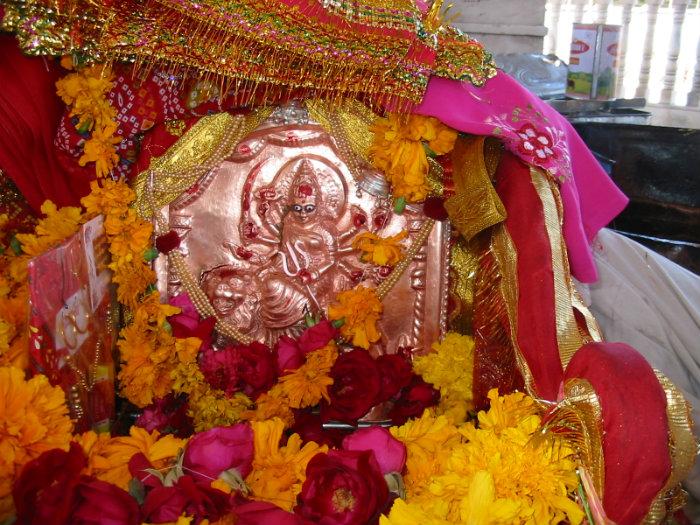
Danteshwari Temple, Dantewada, Chhattisgarh Dedicated to Goddess Danteshwari, the Danteshwari Temple located in the heart of Dantewada in Chhattisgarh is not just a place of worship but a powerful symbol of divine feminine energy and a crucial component of the spiritual landscape of the region.
The Danteshwari Temple was established in the 14th century, though this location has been a place for millennia according to archaeological evidence and ancient texts. The temple’s construction is attributed to the lords of Chindak Nagvanshi of Bastar. An inscription discovered in an archaeological site called Jatanpal reveals that in 1224 Devi Manikeswari was the tutelary deity of King Narsingh Jagdek Bhushan of the Chindak Nagvanshi dynasty. The Bhairamgarh inscription further indicates that the Goddess Danteswari was known as Manikeswari Devi at that time. The temple underwent significant repairs and renovations in the 14th century by Annamdev, the brother of Prataprudra of Warangal.
According to tradition, the temple marks the spot where the tooth or Daanth of Goddess Sati fell after her body was dismembered. At the Danteshwari Temple, the Bhairava presence is unique and intriguing. There is a Bhairav Temple located within the larger Danteshwari Temple complex. Initially, this Bhairav Temple was separate from the main shrine. However, with the construction of the Natamandap, the Bhairav Temple was incorporated into the main structure and still stands today.
Interestingly, two large idols of Bhairo Baba are installed on both sides outside the sanctum. These four-armed idols represent Bhairav Baba, who is considered the bodyguard of Maa Danteshwari. According to Vijendra Jiya, the nephew of the head priest, it is customary for devotees to visit Bhairav Baba after having the darshan of the goddess. It is believed that if devotees please Bhairav Baba, he conveys their wishes to the mother, leading to the swift fulfilment of their desires.
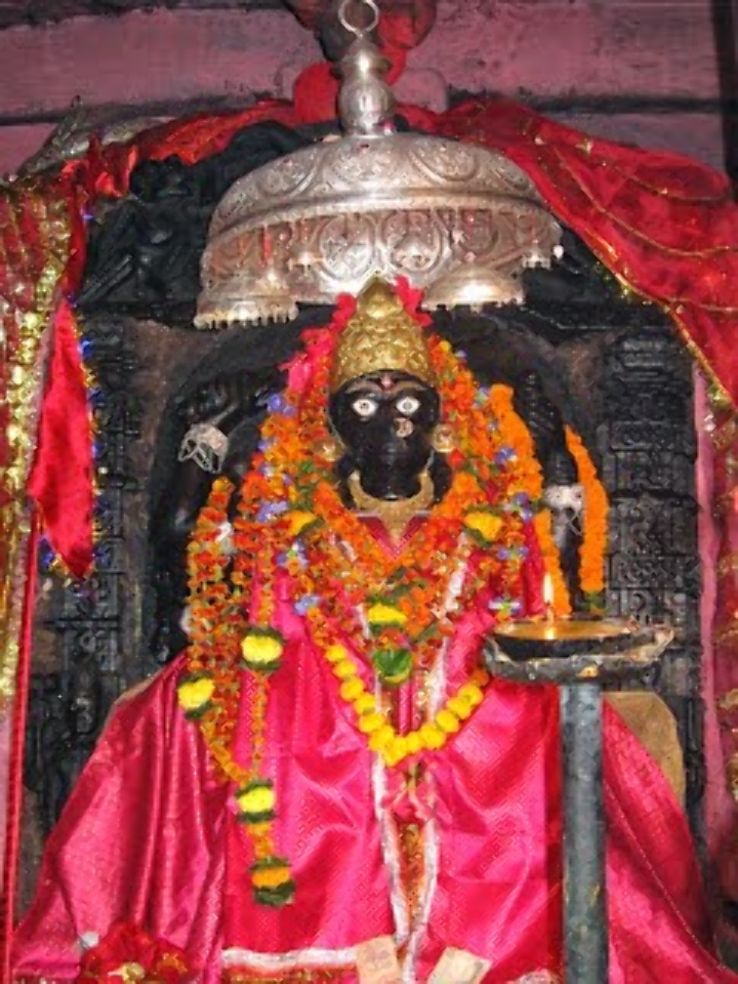
The temple is divided into four parts: the Garbh Griha or the sanctum sanctorum, the Maha Mandap, the Mukhya Mandap, and the Sabha Mandap. The Garbha Griha and Maha Mandap were constructed with stone pieces. The main idol of Goddess Danteshwari is chiselled out of black stone, and a Garuda Pillar stands prominently in front of the temple entrance, serving as a distinctive architectural element. The temple is located in a spacious courtyard surrounded by massive walls with the temple spire or shikhara adorned with intricate sculptural work. There are two Danteshwari temples – one in Dantewada and another in Jagdalpur. While the idol in Dantewada is black, the one in Jagdalpur is white, offering a unique duality in the goddess’s representation.
Throughout the day, multiple pujas are offered to the deity at specific times, accompanied by the chanting of hymns and recitation of sacred texts. These rituals are conducted with precision and adherence to traditional practices. The nine-night Navratri festival is celebrated with great fervour. Devotees participate in elaborate rituals, and the temple sees a surge in visitors seeking the goddess’s blessings.
The Danteshwari Temple is at the heart of the famous Bastar Dussehra celebrations. Unlike the traditional 10-day festival, Bastar Dussehra is a unique 75-day celebration. During this time, the idol of Goddess Danteshwari is taken out of the ancient temple and carried around the city in an elaborate procession, attracting thousands of devotees and tourists. During Navaratri, devotees participate in the Jyoti Kalash Sthapana ritual. This paid process involves lighting lamps in the name of family members and loved ones. In recent years, the temple has hosted over 5,500 Kalash Sthapanas.
Jogi Baithai is a unique ritual involving members of the Halda caste from specific villages becoming jogis or ascetics. The Maharaja himself initiates this ritual, which includes the sacrifice of seven Mangur fish. The jogi observes a strict fast for nine days, neither eating, drinking, nor attending to bodily functions. The temple conducts special worship three times a year – during Shardiya Navratri, Chaitra Navratri, and Phagun Madai, also known as the third Navratri. Every year, more than 7,000 ghee and oil lamps are lit in the temple. Devotees from abroad also participate in this ritual, lighting lamps for nine days.
According to legend, this temple marks the spot where the tooth of Goddess Sati fell during Lord Shiva’s cosmic dance of destruction. This event is said to have occurred in the Satya Yuga, the first of the four yugas in Hindu cosmology. Goddess Danteshwari is traditionally revered as the Kuldevi or family goddess of the Bastar state. The town of Dantewada itself is named after Goddess Danteshwari. Ancient inscriptions suggest that the goddess was initially known as Manikeswari Devi before being recognised as Danteshwari.
Another fascinating story ties the temple to King Annamdev, a 14th-century ruler who is credited with establishing the Bastar kingdom. According to legend, Annamdev was blessed by Goddess Danteshwari with a boon that allowed him to define his kingdom’s boundaries. The goddess instructed him that the territory he could cover while walking with his head held high would become his domain. During his journey, Goddess Danteshwari followed him to protect him, and he could hear her anklets as she walked behind him. However, when he reached a riverbed filled with sand, he could no longer hear her anklets and doubted whether she was still accompanying him. Overcome by curiosity, he turned around—breaking the condition set by the goddess. At that moment, Danteshwari stopped following him but blessed him and vowed to protect his descendants for 22 generations. She also gifted him a piece of fine cloth and declared that the area covered by it would mark his kingdom’s borders.
The Danteshwari Temple is uniquely situated at the confluence of two rivers: Shankini and Dhankini, which are considered sacred by devotees. According to local lore, these rivers were created from two streams of divine energy emanating from Goddess Danteshwari herself. They represent her nurturing and protective aspects. A lesser-known legend states that during ancient times, these rivers were believed to have healing properties due to their divine origin. Devotees who bathed in their waters or drank from them were said to be cured of ailments and cleansed of sins. Even today, pilgrims consider this confluence a sacred spot for purification rituals before entering the temple.
As one stands in the temple courtyard, surrounded by centuries of devotion and the echoes of ancient rituals, one can’t help but feel a connection to the spiritual heritage that has shaped this land for millennia.
Arasuri Ambaji Temple, Ambaji, Gujarat Nestled in the Arasur hills of Gujarat’s Banaskantha district, the Arasuri Ambaji Temple is dedicated to Goddess Ambaji. Archaeological evidence and ancient texts suggest that this location has been a place of worship since the pre-Vedic period. The temple’s antiquity is so profound that its exact date of establishment remains unknown. The original temple is believed to have been built atop the Gabbar Hillock, which is considered the true seat of the goddess. This hilltop shrine continues to be maintained, with a lamp burning continuously, day and night. According to tradition, this site marks the spot where the heart of Goddess Sati fell.
Unlike most Hindu temples, the Arasuri Ambaji Temple does not house an idol of the goddess in its sanctum sanctorum. Instead, a sacred geometric diagram known as the Shree Visa Yantra is the main object of worship. This Vedic text on sacred geometry is fixed on a gold-plated marble inscription in a niche or gokh within the inner sanctum. It is believed to be so powerful that it cannot be photographed and is only worshipped after bandaging the eyes.
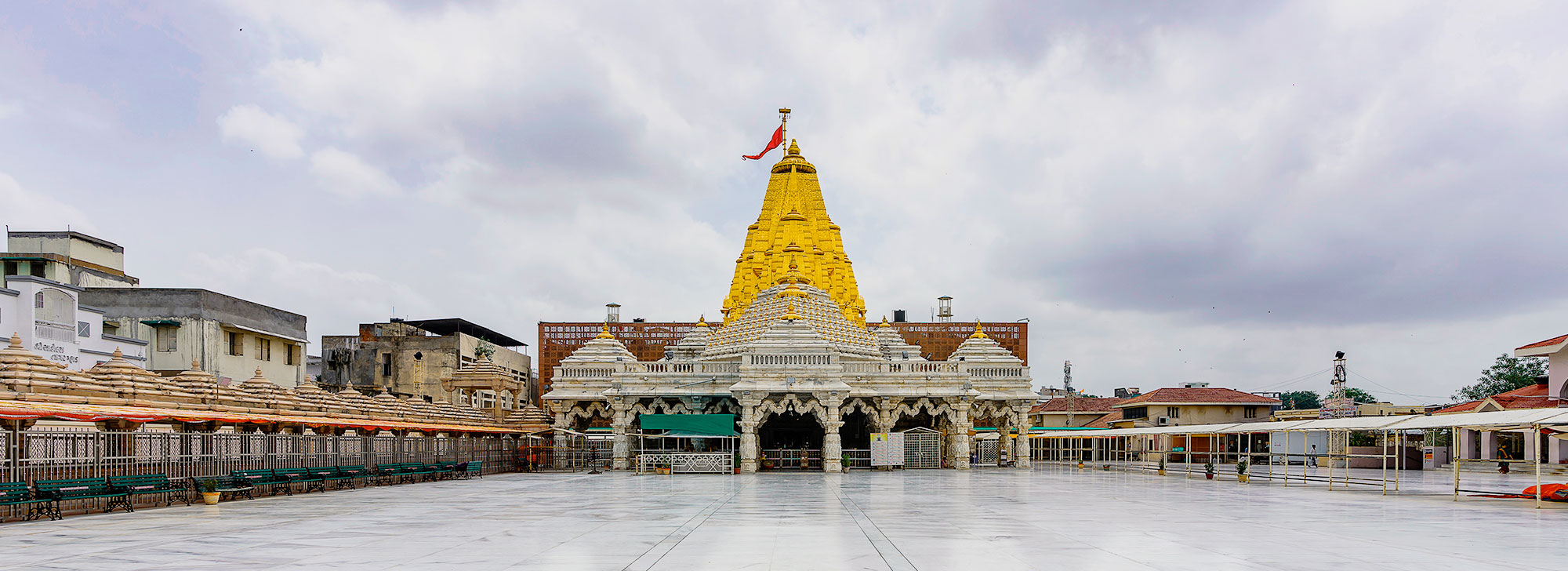
The temple, made of white marble with gold cones, was originally built by Nagar Brahmins. It features a main entrance in the front and only a small side door, as it is believed that the goddess has forbidden the addition of any other door. The temple is surrounded by an open square called Chachar Chowk, where ceremonial sacrifices known as havans are performed. The temple complex includes two shrines – the main temple in Ambaji town and the original hilltop shrine on Gabbar Hill.
The temple follows a strict schedule, opening its doors to devotees from 7 to 11:30 am, then from 12:30 to 4:30 pm, and again between 6:30 to 9 pm every day of the week. A grand fair, Bhadarvi Purnima Mela, is held on the full moon day of Bhadrapada month, attracting devotees from all over the country. The nine-night festival of Navratri is celebrated with great fervour, featuring garba dances and bhavai theatre performances by the Nayak and Bhojok communities. Every full moon day, a large number of devotees throng the temple to offer worship and attend the fair held outside. During Navaratri, devotees participate in the Jyoti Kalash Sthapana, a ritual where they light lamps in the name of family members and loved ones.
A fascinating local legend tells of a king from Danta who fervently prayed to Goddess Ambaji, requesting her to move from her original abode on Gabbar Hill to his town. The goddess agreed to his request on one condition: he must lead her down the hill without looking back even once. As he descended the hill, he could hear the sound of her anklets following him, reassuring him of her presence. Unable to resist his curiosity, the king peeped back, causing the goddess to stop at the current temple site. To this day, devotees consider their pilgrimage incomplete without visiting both the temple in Ambaji town and Gabbar Hill, where a sacred lamp burns perpetually.
It is said that Lord Rama and Lakshmana visited the ashram of Shrungi Rishi during their search for Sita. They were advised to worship Devi Ambaji at Gabbar, where the goddess bestowed upon Rama a miraculous arrow named Ajay, which helped him defeat Ravana. Legend also has it that the hair-removal ceremony or mundan of the infant Krishna was performed on Gabbar Hill in the presence of his foster parents, Nand and Yashoda.
The renowned Rajput king Maharana Pratap was a devoted follower of Arasuri Amba Bhawani. Once saved by the goddess, he gifted his famous sword to her holy feet. According to the Mahabharata, Princess Rukmini worshipped Mata Ambica on Gabbar Hill to invite Lord Krishna to abduct her from her swayamvar. The goddess granted her wish, allowing her to marry Krishna against her family’s wishes.
The Arasuri Ambaji Temple, with its blend of myth, history, and living faith, continues to be a powerful force in Gujarat’s religious landscape, inviting all who visit to partake in its timeless spiritual journey.
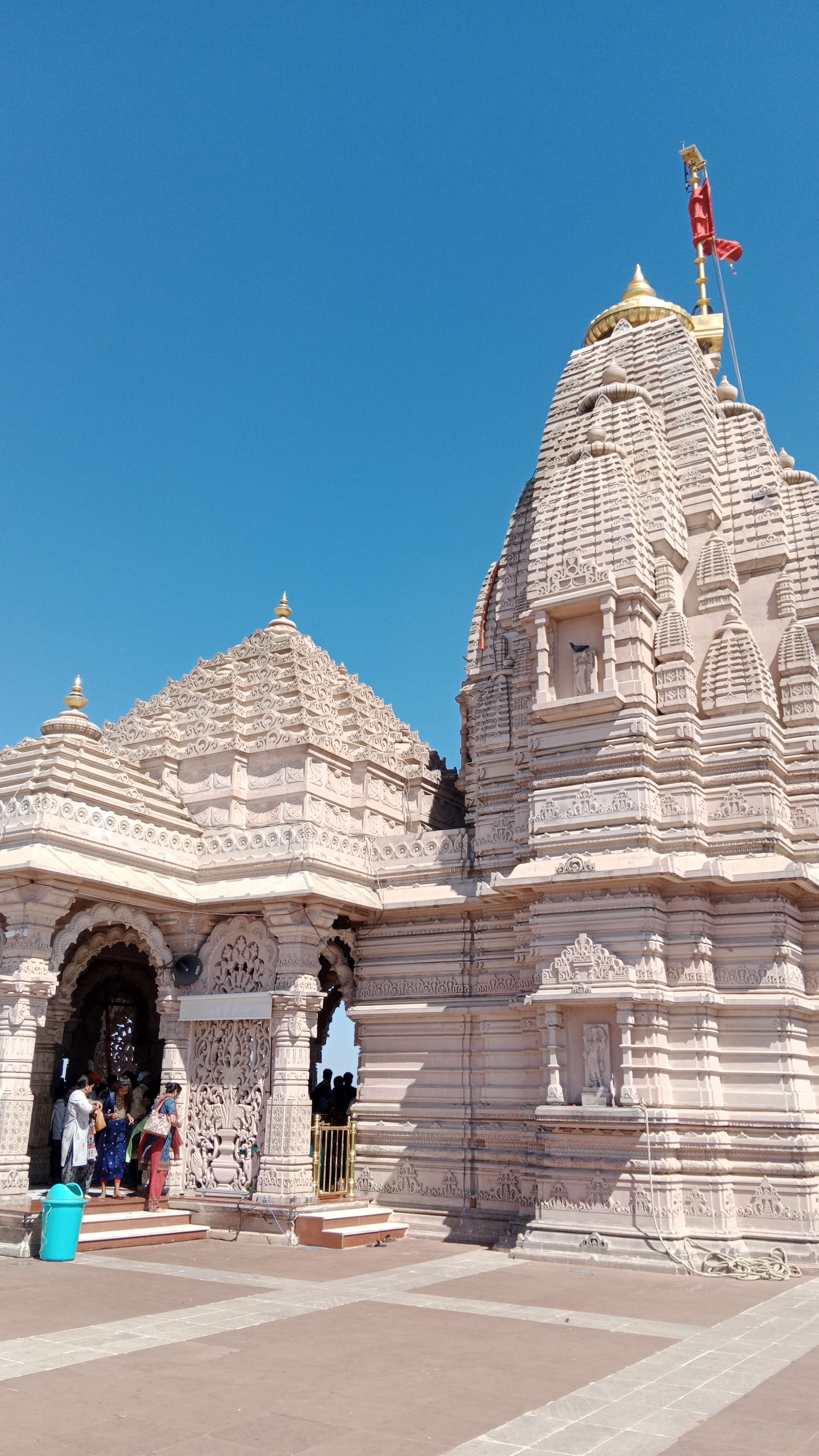
Kaali Mandir, Champaner Pavagadh Archaeological Park, Gujarat Located in the Champaner-Pavagadh Archaeological Park, the Kalika Mata Temple is dedicated to Goddess Kali. Archaeological evidence and ancient texts suggest that this location has been a place of worship since the 10th or 11th centuries. The temple’s antiquity is so profound that it is considered the oldest in the area, predating many of the other structures in the Champaner-Pavagadh complex.
Initially, the Goddess Kalika Mata was worshipped by the local Bhil and Koli people, indigenous tribes of the region. The temple’s significance grew over time, and it was mentioned in the Gangadas Pratap Vilasa Natakam, a 15th-century drama. According to tradition, this site marks the spot where the right toe of Goddess Sati fell.
The temple houses a Kali yantra, a sacred geometric diagram used for worship. This yantra is considered a powerful representation of the goddess. The temple showcases a blend of architectural styles, reflecting its long history and the various influences it has absorbed over time. Situated at the summit of Pavagadh Hill, the temple offers breathtaking views of the surrounding landscape. The temple contains three goddess images: Mahakali Mata in the centre, Kali on the right, and another form on the left. The path to the temple, known as the Patha, is considered the soul of Champaner. It consists of thousands of steps and various decorative and functional structures along the way. One unique aspect of worship here is the tradition of devotees worshipping by beating bell-metal symbols. This practice adds a distinctive auditory element to the devotional atmosphere of the temple.
The temple comes alive during its numerous festivals and special occasions. Navaratri, the nine-night festival is celebrated with great fervour at the temple. It attracts lakhs of devotees from across Gujarat. The temple becomes a hub of activity, with special pujas performed each day to honor the nine forms of the goddess. The Chaitra Purnima Fair is held each year on the full moon of Chaitra, usually in April. Durga Puja which is celebrated in the month of Ashwin or September-October, during the Navaratri festivities, commemorates the triumph of Goddess Durga over the buffalo demon Mahishasura. Mahashivaratri is celebrated in the last week of February, is reminiscent of Lord Shiva bringing Goddess Parvati with him. A grand celebration is arranged by priests and the temple committee.
According to local legend, Sage Vishwamitra constructed an idol of Maa Kalika at the Pavagadh Temple. Locals believe that Vishwamitra’s power brought abundant blessings to the region. Faith-based legend suggests that Pavagadh Hill was formed when God sent a large hill to fill a deep valley created by the falling of Sati’s foot. This was done at the request of Rishi Vishwamitra to prevent his sacred cows from falling into the valley.
The temple has faced its share of historical challenges. In the 15th century, Mahmood Begda captured Pavagadh and damaged the temple, destroying its shikhara or temple spire. As an act of further insult, a Dargah was built directly next to the shikhara in the garbhagrih, the sanctum sanctorum. In recent times, the dargah was peacefully relocated nearby and in 2022, the temple underwent renovations, including the construction of a new shikhara.
The Kalika Mata Temple, with its blend of myth, history, and living faith, continues to be a powerful force, inviting all who visit to partake in its timeless spiritual journey.











 Memories and Such