Sumangali Pooja Part 1

So last weekend, I did the Sumangali Prarthanai which is usually done by a married woman in each family or clan when there is a major ceremony happening in a family like weddings or thread ceremonies. Some families (like my mum) also do this on an annual basis.

The Sumangali Pooja is a typical brahmin function, I can’t say I have seen other communities doing this. In our community, this pooja is done to invoke to seeking the blessings of the ancestral women of the family who enjoyed a long and prosperous family life and left this world as sumangalis (those who died before their husbands) and any young unmarried girls in the family. Every family will differ slightly in the way they do this function, but by and large, the procedure should be more or less similar. Unlike most other functions or religious poojas, this function is a 100% ladies function. The men in the family are only for decorative or helpful purposes and have no real role to play. Usually, the oldest woman present will take the mantle of the master of ceremonies and lead the function as she will be the most knowledgeable of all present.

Usually, these days people have around 5 Sumangalis and 2 young girls, though you can have any odd number like 3, 5, 7, 9 or even 11 and 13! You can invite both married women from within your family or outside for the function. The day before the function, all the invited sumangalis are given sesame oil, shikhakai, and turmeric and henna in advance or in the early hours of the day of pooja. The tradition is they have to apply mehendi and take oil bath and also apply turmeric while taking a bath which is considered very auspicious. They will come home the next day by taking oil bath and wear a 9 yards saree which has been made madi (means they have to wash and dry it separately without touching other clothes or even with their hands). These days, especially in places like Singapore, where a saree is getting rarer, people may not be comfortable wearing a nine-yard saree, so sometimes, they wear a normal six-yard saree or even other clothes, come to the host’s house and then change into the nine-yard saree.

Generally, if a daughter is getting married on the girl’s side they will do it compulsorily before the wedding and keep the daughter who is going to get married as one of the pondugal. But in the boy’s house also they do the sumangali prarthanai but they can either do it before the wedding with their family members or they can either do it once the daughter in law comes into the house. This function should also be done only once a year by a family. So in our case, since I just did the function, if S’ cousin gets married anytime in the next one year, his mum (S’ aunt) can’t do it before the wedding, as it’s usually done. The ideal day of the week for this function is a Friday, but these days with people working and children in school during the week, Fridays are not practical so most people do it on a Sunday. The inauspicious time of Rahu Kaal is also to be taken into account when choosing the time. On Sundays the Rahu kaal is in the afternoon, so this function which ends at lunch is perfect to be done on a Sunday.

 

Growing up in Mumbai

Matunga – for any Tambrahm in Mumbai, especially those of a certain age, the very word evokes the feel of home. Sometimes called ‘Mini Madras’, Matunga in what would be some where in the centre of what is the original city (as opposed to the suburbs) was probably the first place the initial immigrants, young, eager, bright and wide-eyed, came to from Dadar station when their trains from the south arrived in Mumbai all ready to conquer the world, with an introduction to perhaps, if they are lucky, to a relative (distant or otherwise), or maybe someone from the same village they belonged to, or even a relative’s relative!

While I am not sure if this is 100% accurate, from what I’ve heard from my parents and grandparents, most young Tamil Brahmin boys and men started arriving in Mumbai (or Bombay as it was called then) somewhere in the early forties, some years before India would finally throw off the yoke of British dominance and become independent.

Both sets of my grandparents arrived in Bombay somewhere in the early to mid-forties, luckier than most as both my grandfathers had an older brother already settled in the city, in Matunga as it were! If I were to probably measure the distance my paternal and maternal grandparents live away from each other, when they first arrived in the city, it should probably be a maximum of 1 km.

Matunga is the heart of the Tamil Brahmin community in Bombay and as such the roads are filled with the sights and sounds of temple bells and the smells of filter coffee and delicious food!

Temples like Bhajana Samaj, Astika Samaj and Sankara Math, shops like Mysore Concerns, Giri Stores and the row of flower sellers in the road outside the post office along with the vegetable sellers who have carts close-by are all hallmarks of the Tamil Brahmin community in Matunga! Who can forget the Ram Navami and Navaratri celebrations in Bhajana Samaj, the Diwali sweets that always were sold in the hall in Sankara Matt, the banana leaf sold by the vegetable vendors during any major festival, the gaggle of priests, outside the temples, the sound of the temple bells and sugarcane stalks just before Pongal?

When their families grew, both sets of my grandparents moved from their family homes and out of Matunga. But they both didn’t’ pull the umbilical cord too much and move far away. Both of them moved another kilometer away from Matunga in opposite directions actually, and that was where my parents were brought up.

So growing up, we lived in another area which was a fifteen minute walk from Matunga, which was in the periphery of our lives, without actually living there. We used to go to Matunga for literally everything and my mum still goes there atleast two to three times a week for her weekly ‘fix’. This area in Bombay is the lifeline for the community and even today when other mini Matungas have sprung up across the city and suburbs – like Chembur, Chedda Nagar, Bangur Nagar, Mulund, Dombivili, Vashi, etc you can still people who have moved away from Matunga come here on weekends to catch-up with family and friends, eat at childhood haunts and buy essentials which you don’t get anywhere else in the city.

Growing up, there was always this disconnect – we were Tamilians, but without the accent which is usually caricatured in movies and television and always had questions on why we needed to wear a bindi on our forehead or flowers in our hair. In my and my sister’s case, it was compounded by the fact we didn’t go to the school that most of our Brahmin friends and relatives went to (which was a school run by a Tamil trust where the language was taught as a second language)!

Growing up also we were quite insular. I would say this with the benefit of hindsight. Every Tamilan I knew at that point in time was a Brahmin – either from one of the districts of Tamil Nadu or from Palakkad (from Kerala who are called Kerala Iyers or Palakkad Brahmins). Where we stayed, while not in Matunga, was in fact another Tamil conclave, with almost all the 30-40 buildings in the area having a sizeable Tambrahm population each. My building had 19 flats and with the exception of 2-3, every flat was a Tambrahm flat! This was pretty much the case (the percentages being slightly more or less, with some exceptions) for the other buildings in the street I lived in. Even in school, my friends who were Tamil were Brahmins. In fact, coming to Singapore with its vast Tamil population was actually a culture shock to me as I had never seen so many people from so many Tamil communities and the temples were the biggest shock – I had not heard of all the different Gods that were worshipped there (all the temples I visited prior to this were my community temples or the other temples in Mumbai)

Since most of the community emigrated to Bombay around 60-80 years back, the dialect of Tamil, we speak is completely different from what is spoken by the community in places like Chennai and Singapore. Bombay Tambrahms have retained the words and cadence of their speech from all those years while communities in Singapore and Chennai have adopted more of the local language. So the Tamil we speak may actually seem strange to those who don’t speak like this! S used to tell me that they used to be made fun of in school when they spoke Brahmin Tamil, which is why his Tamil sounds more like how it is in movies while mine is the one they make fun of in movies!

Writing this post has made me so nostalgic. I think the next time I go to Mumbai, I will try and capture all the sights and sounds of the city so that every time I miss Mumbai, I have these to see and hear! Also this post has made me realise I need to pen down more about my life, so that GG and BB know what that was like….

Diwali Recipes: 7 Cup Cake

IMG_5059

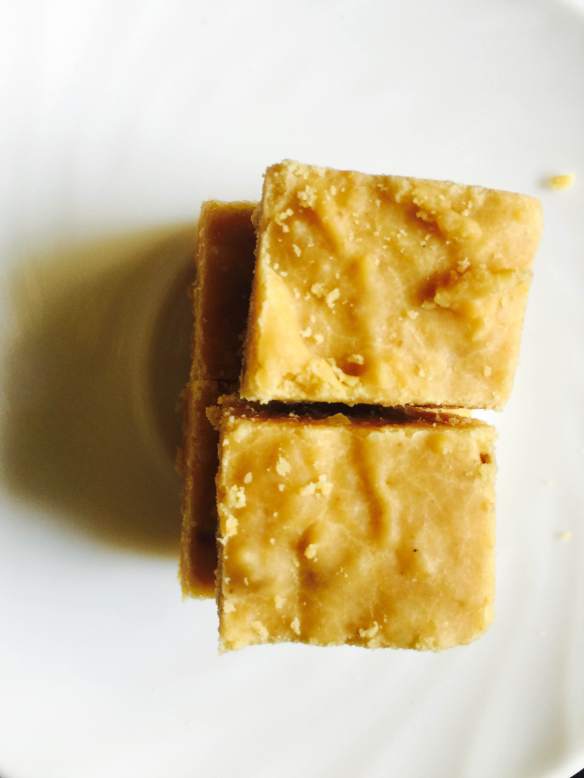
This is another traditional tambram recipe and which is one of my go-to recipes when I need to make something quickly. It does take a bit of time to make, but the efforts are super worth it! The ingredients are given as cups which is where the name of the recipe came from, but essentially it’s just a measure. It doesn’t matter how big your cup size is, just use the same amount for all the ingredients and your cake or barfi will come out fab!

IMG_5057

Ingredients:

  • 1 cup chickpea flour or besan
  • 1 cup ghee
  • 1 cup grated coconut (you can fresh or frozen, I’ve used fresh for this recipe)
  • 1 cup Milk
  • 3 cups Sugar

Method:

  • Take a big plate or cake tin and grease it slightly. Or, you could lightly spray it with oil and then put baking paper over to completely cover it, this reduces the amount of ghee used in the recipe slightly.
  • Fry the chickpea flour or besan in a dry pan and do not overfry it. Stop when it starts changing colour. At this point, add the coconut, sugar and milk to the pan and continue stirring.
  • When the sugar starts to dissolve, add the ghee and keep stirring. You will need to keep stirring the pan, so that the mixture does not catch in the bottom.
  • After about 15 minutes (more or less depending on your quantity), the mixture will start leaving the sides of the pan. At this point, take a few drops and put it in your greased plate. If it stays in shape, it is ready, otherwise continue stirring and repeating this step till you get to this point.
  • Switch off the gas and pour it into your prepared greased plate. Using a clean spatula, level the mixture and make it smooth. Let it cool for a while and when still slightly warm, lightly score lines in the mixture with a knife or pizza cutter. You could cut squares or diamonds in any size. Let it cool completely before transferring to an airtight container.

This should be good for a week or so outside and around 2 weeks or so inside the fridge.

IMG_5060

Diwali Recipes: Coconut Barfi

IMG_5052

Another typical recipe, this one also needs a good bit of stirring so a good arms workout with this one!

IMG_5053
Ingredients:

  • 2 cups grated coconut
  • 1.5 cups Sugar
  • ½ tsp Cardamom Powder
  • 1 cup Water

Method:

  • Take a big plate or cake tin and grease it slightly. Or, you could lightly spray it with oil and then put baking paper over to completely cover it, this reduces the amount of ghee used in the recipe slightly.
  • For this recipe, you need only the white part of the grated coconut. If you plan to grate your own, stop at the point when the brown part starts getting grated. Or you could do what I did, which was to buy freshly grated coconut from your local Indian store.
  • In a pan, saute the grated coconut till you get a nice aroma from it. Do not let it brown. Remove it from the pan and add the sugar and water and let it come to a rolling boil. You can also add a couple of teaspoons of milk to the mixture so that any dirt in the sugar comes up and you can remove it. This trick also makes the barfi more white which is aesthetically more pleasing. At this point, reduce the flame and let it boil till it thickens to a single string consistency.
  • This means that when you take a drop of the mixture from the flame and touch it with your thumb and index finger, it will stick to both fingers and form a kind of string.
  • When the sugar mixture reaches this point, add the grated coconut and stir for a couple of minutes. Add the cardamom powder and continue to stir at a low to medium flame. When the coconut completely absorbs the sugar water mixture and starts to leave the sides, it’s time to take it off the flame. You can also test it by putting a couple of drops in the greased tray. If it stays in shape, it’s time to remove it from the flame, otherwise continue stirring and repeating this step till you get to this point.
  • Switch off the gas and pour it into your prepared greased plate. Using a clean spatula, level the mixture and make it smooth. Let it cool for a while and when still slightly warm, lightly score lines in the mixture with a knife or pizza cutter. You could cut squares or diamonds in any size. Let it cool completely before transferring to an airtight container. This should be good for a week or so outside and slightly more inside the fridge.

IMG_5056

2105 Week 44 Update

Surprisingly this week went by faster than I thought it would. Work-wise, it’s still the same. I don’t have enough work to fill the eight hours at work. The day I have something to occupy my time for atleast half the day, I am happy! I’ve realized it’s far more difficult to pretend to be busy and do work than to actually do something….

Tomorrow is Diwali, the festival of lights and probably the most important festival in the Hindu calendar for the year. I’ve been busy preparing sweets and savories and have over-extended myself this year. Hopefully by the end of the day, I actually finish making all that I have planned for…

Beofre the festival, people clean and if possible, renovate and decorate their homes. The festival is celebrated slightly differently in North and South India. What’s common is the creation of beautiful rangolis or patterns made from coloured flour outside homes and decorated with lamps. The lamps are kept lit throughout the night so as to invite Goddess Lakshmi, the Goddess of Wealth into your home. People also wear new clothes across the country on Diwali and burst fire crackers outside.

In South India, Diwali is celebrated as the day Lord Krishna defeated the evil demon Nakasura and is called Naraka Chaturthi. Here, traditionally, especially in Tamil Brahmin homes, if the festival falls on a new moon, everyone wakes up super early and the lady of the house first takes a bath and lights the lamp. Then one by one, family members come and sit in front of the lamp where the lady of the house will put some gingelly oil which has been prepared the previous evening on them. They then have a bath and come and prostate before the Lord, after which they get their new clothes. Before they start the feating which is typical of the festival, they are also given a medicinal legiyam which sort of helps digest all the fried food and sweets which you eat throughout the day.

In North India, the festival is celebrated as the day Lord Rama, from the epic, Ramayana was welcomed back home to Ayodhya in present day Uttar Pradesh along with his wife Goddess Sita and brother Lord Lakshmana after a 14 year exile. Lamps are lit to welcome the trio. Prayers are also said to Goddess Lakshmi, the goddess of wealth in the evening of Diwali.

Certain communities also welcome their new year on the last day of the celebrations.

Here’s wishing all of you a very Happy Diwali! May the festival of lights light up your lives and bring you happiness and abundant prosperity….