For every sighted person on this earth, without colours, life is bleak and sombre. Our world is awash with colour and in a single day, we see thousands of different hues that our brains interpret as scarlet, yellow, purple and fuchsia, to name a few. Nature employs colour with unparalleled artistry, making sunsets more breath-taking, flowers more exquisite, and wildlife more captivating. And we use colour too in myriad ways throughout the day, whether it is choosing a dress, a lip or nail colour or a new shade for our walls, we give a lot of thought and care to the colours we wear, see and use daily. Colour plays a vitally important role in the world in which we live and colours can sway thinking, change actions, and cause reactions. It can irritate or soothe the eyes, raise blood pressure or suppress appetite. When used in the right ways, colours can even save energy consumption.
The appeal of colour is universal and it plays an important role in our lives. Colour is a source of pleasure to everybody which can change moods, reduce or increase tensions, cause excitement and sometimes have a soothing effect on a tired person. Colours influence us on a few different levels. On one hand, we are conditioned socially and culturally to use specific colours for specific occasions, while on the other hand, depending on how the colour influences us, our reaction also varies. It’s also known that women can see more differentiation in colour than men because colour vision depends on three types of cones, two of which are carried on the X-chromosome: L-cones that are more sensitive to the longer wavelengths of light; and S-cones, to shorter wavelengths. The third cones, M-cones, are sensitive to middle wavelengths. So, men’s brains require slightly longer wavelengths of light to experience the same colours and this may be why men prefer colours with short wavelengths, like darker shades of blue and green, or they prefer shades without any wavelengths at all, like white, black, and grey.

Colours are commonly divided into two categories: warm and cool colours. Warm colours provide the illusion of heat and warmth because they remind us of sunlight or heath. Visually, warm colours will appear closer or like they are advancing towards you. Warm colours are those in shades of red, orange, yellow, and combinations of these. Cool colours on the other hand provide a sense of calm and relaxation because they are a visual reminder of elements of nature like water, sky, grass and even ice and snow and unlike warm colours, cool colours appear to recede or are further away from us. Some examples of cool colours would be colours like blue, purple and green. Warm colours are associated with heightened emotions and passion as well as joy and playfulness and can be stimulating. Cool colours make one feel calm, relaxed and refreshed with their receding effect having a meditative effect. Surrounding oneself with the right colour can improve the mood, relieve stress, and help get a good night’s sleep. Black, white and greys are neutral colours and so when a tint is added, it means adding white to colour, while shade means adding black to colour and tone is to add grey to colour.
40% of people worldwide say their favourite colour is blue, by far the most popular with red the first colour a baby sees, at around 2 weeks of age. Pink is the most calming colour and is used in some prisons and mental health institutions to calm worked-up prisoners and patients. White is considered the safest colour for a car as it is visible both during the day and at night. Red and yellow together are the most appetising colours which are why they’re used in a lot of fast food logos and restaurant decor. Some people have a phobia of colour known as Chromophobia which is an ongoing and irrational fear of colours, often stemming from a traumatic event associated with a particular colour. The colour wheel was invented by Isaac Newton who used a prism in 1665 to turn white light into a rainbow and identified seven colours. He felt the last colour, indigo, was a recurrence of the first colour, red and decided to arrange them in a circle. Colour has a big impact on the first impression with between 62 to 90% of a first impression based on how someone is recognising colour in the situation. To make a strong first impression, one should avoid neutrals and add a pop of bright colour to be more memorable. People are more likely to forget something when it’s in black and white with scientists believing that this may be because colour has a stronger appeal to the sense and as a result makes a more lasting impression on the memory. Wearing black makes one appear more powerful.
Everyone has a favourite colour and there is a science or possibly a pseudo-science behind what this means to one’s personality. Here are some colours and what they mean in a personality.
Black

Those whose favourite colour is black strive for power and control in life, but are often artistic and intuitive and do not share things well with others. They are above average, worldly, conventional, proper, polite, and regal. While black may mean depression to the clinical psychologist, to them, it means dignity. They value their inner world keep their private life private with only those close to them who are privy to their thoughts and feelings. They are articulate and at times dramatic, but not unrestrained and know how to share their point of view with conviction and authority. They maintain self-control easily and can control most situations with others perceiving them as serious, sometimes to the point of seeming intimidating. They are very attention driven and focussed and want to get things right and like to project an air of mystery, which sometimes is a mask for moments of insecurity with people finding that juxtaposition of the conventional and unconventional intriguing.
White
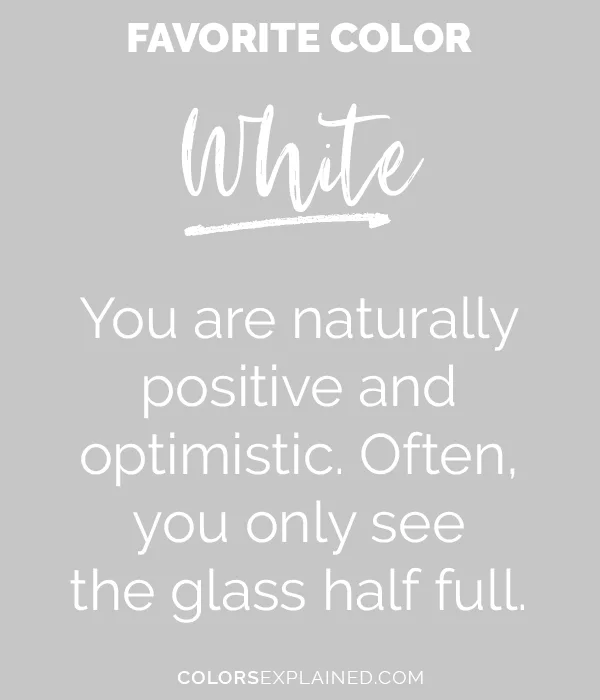
Someone whose favourite colour is white is organised and very independent, and relies on logic to solve problems. They appreciate order and simple elegance with a refined taste and enjoy things that are well crafted and beautiful. They can find treasures in the most unexpected places, are
particular and have high expectations for themselves and others, but don’t deal well with disappointment. They can portray a sense of control no matter what and hide their true feelings.
People may read them as being aloof because of their self-confidence and naturally reserved nature, but when people know them better, they appreciate their mindfulness and wisdom and are often described as an old soul.
Grey

Those who choose grey as their preferred colour are cool and composed and very reliable who tend to conform to keep the peace. They are cautious and seek to strive for compromise in most situations. They seek composure and peace and try very hard to fit themselves into a mould of their own. They are sophisticated and well versed in diplomacy to whom manners and etiquette are important as they feel polished social graces demonstrate respect for themselves as well as others. Professionally, others trust them to set the bar for appropriate behaviour and decorum, but they like to mind their own business and keep to themselves and are comfortable playing the role of a peacemaker. They are perceived as balanced, stable and trustworthy and are appreciated for their gift for identifying alternate avenues and facilitating compromises. They are naturally fair and objective and can put aside personal opinions and feelings and see an issue from all angles.
Red
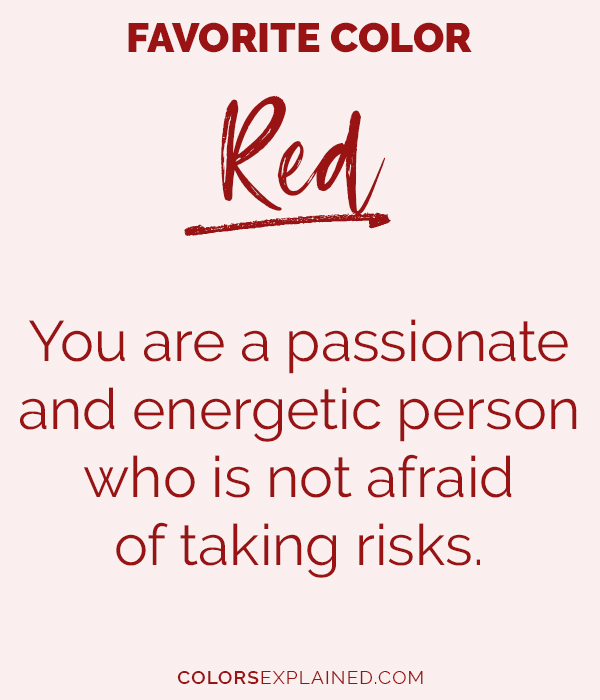
Red lovers have drive and determination and prefer action and risk as well as a need for physical fulfilment and fitness. They are outgoing, assertive, vigorous, and prone to impulsive actions and variable moods, but also feel deep sympathy for their fellow human beings, are an optimist but don’t hesitate to voice out complaints. They have a strong sex drive, are always in the know, present, and always aware of what is going on around them. They exude powerful energy and their presence is always noted. Being outgoing, they are usually the life of the party and the centre of attention. They love big, and at the same time when someone disappoints them or steps on their toes, they don’t hesitate to say exactly how they feel and why and don’t hide their feelings and nip disagreements in the bud, don’t hold grudges and like to move on quickly. Natural leaders who easily gain the respect of their peers and subordinates, they lead with optimism and an animated can-do attitude which is contagious.
Pink
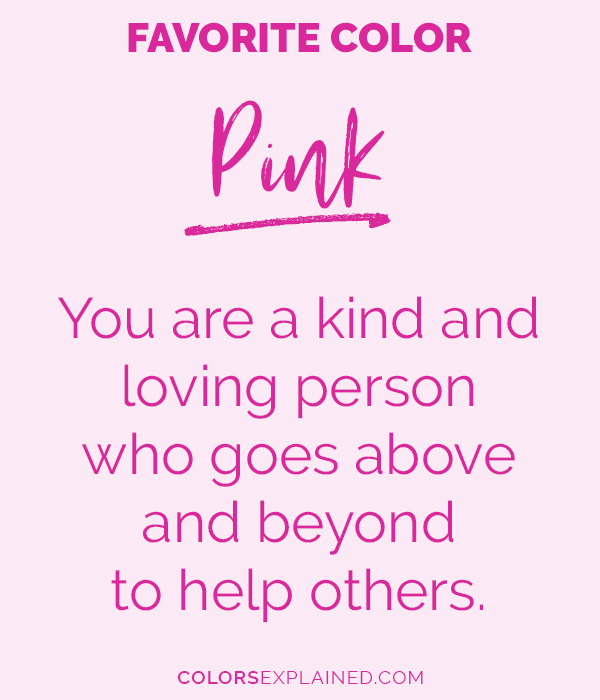
If pink is your favourite colour, all you want in life is unconditional love and to be accepted for who you are by your peers. You are easy-going and have approachable energy and come from a place of assuming the good outweighs the bad in everyone and every situation. Witty and smart, you sparkle socially, particularly in small groups and your caring and encouraging demeanour nurtures long-time friendships and genuinely revel in the success and happiness of others, especially friends and family.
Compassionate, perhaps to a fault, you are the one those closest to you depend on when they need a shoulder to cry on or a boost of confidence. You look at life through rose-coloured glasses and this pretty much sums up your life perspective. Peace, harmony, and calmness are important to you, though you appreciate letting loose on occasion and enjoy embracing all the fun life has to offer.
Orange
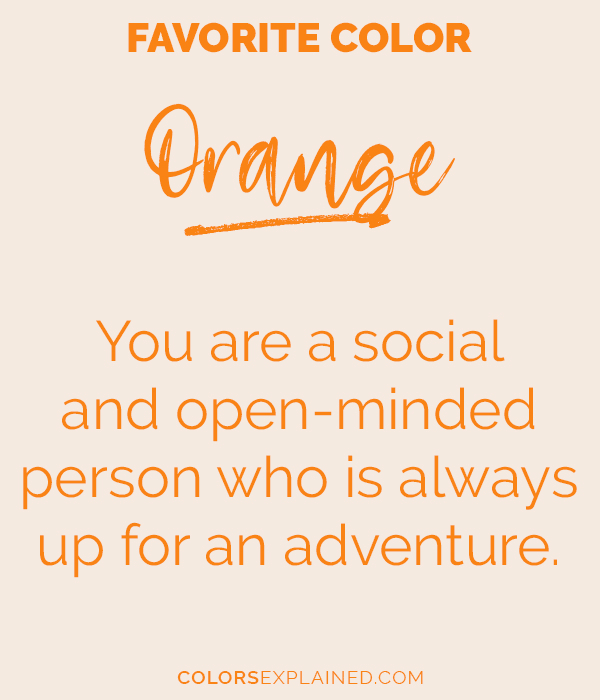
Those who love orange, are the quintessential people person who loves to be with people and socialise, as they want to be accepted and respected as a part of a group. They are good-natured but get swayed by outside opinions. They do good work, have strong loyalties, feel goodwill towards others, and have a solicitous heart. They are the heart and soul of a party and an eternal optimist who fully expects something wonderful to happen to them. These people have perfected the art of being present and living in the moment, focusing on what and who is in front of them. A problem solver at heart, they channel their high energy to inspire and influence others and excel in team building activities due to their natural zest for life and general positivity. No matter what life throws their way, they don’t fold under pressure or cave to panic and take things in stride because surely something wonderful is about to happen!
Yellow
If you love yellow, you enjoy learning and sharing knowledge and you feel a need to always express your individuality. You have a vivid imagination, nervous energy, neatly-formed thoughts and a need to help the world. However, you tend to be aloof and are shy and long to be respected and crave admiration for your wisdom. You’re a safe friend and a reliable confidant and one of your most appealing traits is your consistently sunny and fun disposition with a resolute optimism which is infectious even in the most trying circumstances. An extremely positive person, you refuse to see the glass as half empty and have a reputation of leaping before you look and your impulsiveness sometimes pays off. Your spontaneity and willingness to take action positions you several steps ahead of the competition. You prefer tight-knit social circles to extended networks and those who know you best describe you as happy, imaginative, and highly intellectual.
Brown

Those who say brown is their favourite colour is a great friend who values a stable and simple life over material things. They are shrewd when it comes to money and obstinate in their habits and convictions, parsimonious, dependable and steady. They disdain impulsiveness and are very good bargain hunters. They are simple, genuine and transparent with intentions and get confused by those who have hidden agendas and ulterior motives. They feel the truth is easier to manage and fail to see the value in twisting facts. Dependable and punctual, they have high standards for excellence and experience has taught them that a solid foundation is mandatory for success. They do things slow and steady aka, do it right or not at all, no short-cuts or get rich quick schemes for them and have little patience for the snake oil salesperson type. Family comes first with them and they enjoy the comfort of a stable home where their well-appointed kitchen is the hub of the house.
Purple
Those who choose purple as their favourite colour are perfectionists who require emotional security in life, and are good humanitarians who help others in need. They have a good mind, a ready wit and an ability to observe things that go unnoticed by others. They have a degree of vanity and display creativity in the fine arts. They relish the subtle but recognise the magnificent with their intuition one of their greatest assets and a chatty and clear little voice inside their heads. A people magnet, their charisma draws everyone to them and others perceive them as visionary and are drawn to their innovative spirit. Their creativity is contagious, making it easy to build teams to execute their grand plans. They take pride in marching to the beat of their drum and being unique and don’t care about fitting in, though they appreciate kindred spirits who choose to zig when everyone else zags.
Green
If you have chosen green as the colour you love, you are loyal and consider your reputation as a very important part of your life. You are a good citizen and pillar of the community who is frank, moral, reputable and sensitive to social customs and etiquette. You feel deep affection for your family and have a special connection to nature, it feeds your soul. You dislike chaos and strive for consistency and balance with time management a special strength because you can quickly prioritise. You have business savvy because you target what is most important and delegate what is not and rarely sweat the small stuff as you have a knack for seeing the big picture and understanding multiple points of view. You are admired for your clarity and your objectives and fair outlook of life are respected by those you come in touch with.
Blue
Those who love blue always make an effort to think of others and their needs. They are deliberate and introspective, have conservative convictions, retreat to gentler surroundings in times of stress and are sensitive to the feelings of others. They are a loyal friend and want to lead a quiet life and want to find inner peace and the absolute truth. They value their close-knit group of friends and family and are loyal, perhaps to a fault. They recognise and put the needs of others first, and find being of service fulfilling, yet don’t allow being taken advantage of or for granted. If tested, they will stand their ground with grace and composure and have a keen sense of fair play and like being in charge of keeping order. Because of their reputation for being trustworthy and good with details, they usually end up with the job of scorekeeper. They endear themselves quickly with their uncanny ability to recall names and titbits of info about others and people remember them for being warm, friendly, and engaging.
Did your favourite colour spell out your personality? I’d love to know in the comments.


















/GettyImages-654400557-58ae7ca13df78c345ba39c26.jpg)