World Diabetes Day

World Diabetes Day is an annual global health awareness campaign observed on November 14th. The day was established in 1991 by the International Diabetes Federation (IDF) and the World Health Organization (WHO) in response to the rapidly increasing prevalence of diabetes worldwide. The date, November 14th, was chosen to honour the birthday of Sir Frederick Banting, who, along with Charles Best, first conceived the idea that led to the discovery of insulin in 1922.

The day gained official recognition as a United Nations Day in 2006 with a resolution that acknowledged diabetes as a chronic, debilitating, and costly disease associated with severe complications that pose a significant threat to families, countries, and the entire world. Since its inception, World Diabetes Day has grown into a global campaign reaching millions of people in over 160 countries. It serves as a platform for diabetes awareness and advocacy, uniting the global diabetes community in a collective effort to address the growing diabetes epidemic.

World Diabetes Day plays a crucial role in raising awareness by helping educate the public about diabetes, its risk factors, symptoms, and complications; by encouraging people to get tested, it supports early detection and intervention; the day advocates for better care and pushes for improved access to quality diabetes care and treatment options; it highlights the importance of ongoing research in diabetes prevention and management; and fosters community support by bringing together individuals, healthcare professionals, and organisations to support those affected by diabetes.
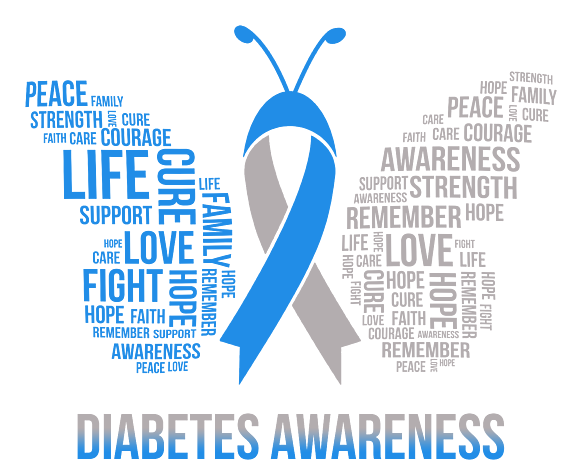
The theme for World Diabetes Day from 2024 to 2026 will be ‘Diabetes and Well-being’. This theme will focus on three key aspects between 2024 and 2026 – physical well-being, societal well-being, and mental well-being. The choice of this theme reflects a holistic approach to diabetes management, recognising that diabetes affects not only physical health but also mental and social well-being. By addressing these interconnected aspects, the campaign aims to improve the overall quality of life for people living with diabetes.

To fully appreciate the importance of World Diabetes Day, it’s crucial to understand the nature of diabetes and its impact on global health. There are two main types of diabetes: Type 1 diabetes is an autoimmune condition where the body doesn’t produce insulin. It’s not preventable and requires daily insulin administration. Type 2 diabetes results from the body’s ineffective use of insulin. It’s often associated with physical inactivity and excess body weight, and in many cases, it’s preventable.

Common symptoms of diabetes include frequent urination, excessive thirst, unexplained weight loss, slow-healing wounds, recurring skin infections, and numbness or tingling in hands and feet. It’s important to note that symptoms can be less pronounced in Type 2 diabetes, and diagnosis may occur years after onset.

The IDF Diabetes Atlas provides alarming statistics on the global diabetes scenario. In 2021, 537 million adults or 1 in 10 were living with diabetes. This number is expected to rise to 643 million by 2030 and 783 million by 2045. Almost half of adults with diabetes or 44% remain undiagnosed, primarily with type 2 diabetes. Over three-quarters of people with diabetes live in low and middle-income countries. 541 million adults are at increased risk of developing type 2 diabetes. Over 1.2 million children and adolescents between the ages of 0 and 19 years live with type 1 diabetes.
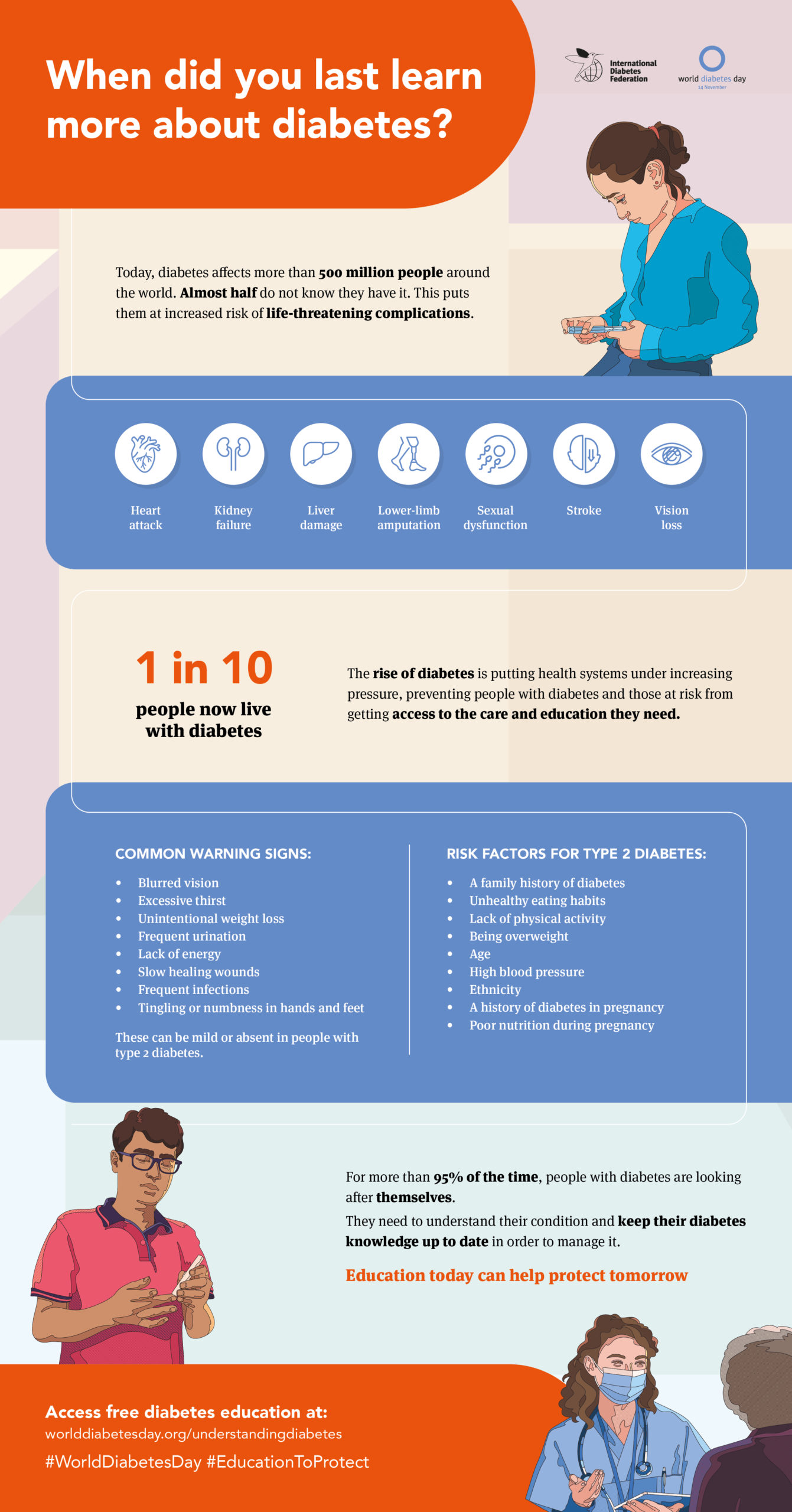
Diabetes imposes a substantial economic burden globally. In 2021, diabetes accounted for at least $966 billion in health expenditure, constituting 9% of the global total spent on healthcare. High blood glucose or hyperglycemia during pregnancy affects one in six live births or about 21 million.

World Diabetes Day serves as a catalyst for various activities and initiatives aimed at raising awareness and promoting better diabetes care. The official colour of diabetes awareness is blue. Wearing blue clothing or accessories on November 14th shows support for the cause. One can use social media and other platforms to educate others about diabetes, its risk factors, and the importance of a healthy lifestyle. Another way is to encourage those at risk to get tested for diabetes, supporting early detection and intervention. One can host or participate in events, workshops, or seminars that raise awareness about diabetes in local communities. The IDF provides an interactive tool for individuals to assess their risk of developing type 2 diabetes.

Healthcare professionals play a crucial role in diabetes management and prevention. World Diabetes Day highlights their importance and provides resources to support their work. The day often features educational sessions for healthcare providers to stay updated on the latest diabetes care practices. It encourages healthcare professionals to engage more effectively with patients, promoting better diabetes management. Healthcare professionals are encouraged to advocate for better diabetes care policies and resources. The day highlights opportunities for healthcare professionals to participate in diabetes research.
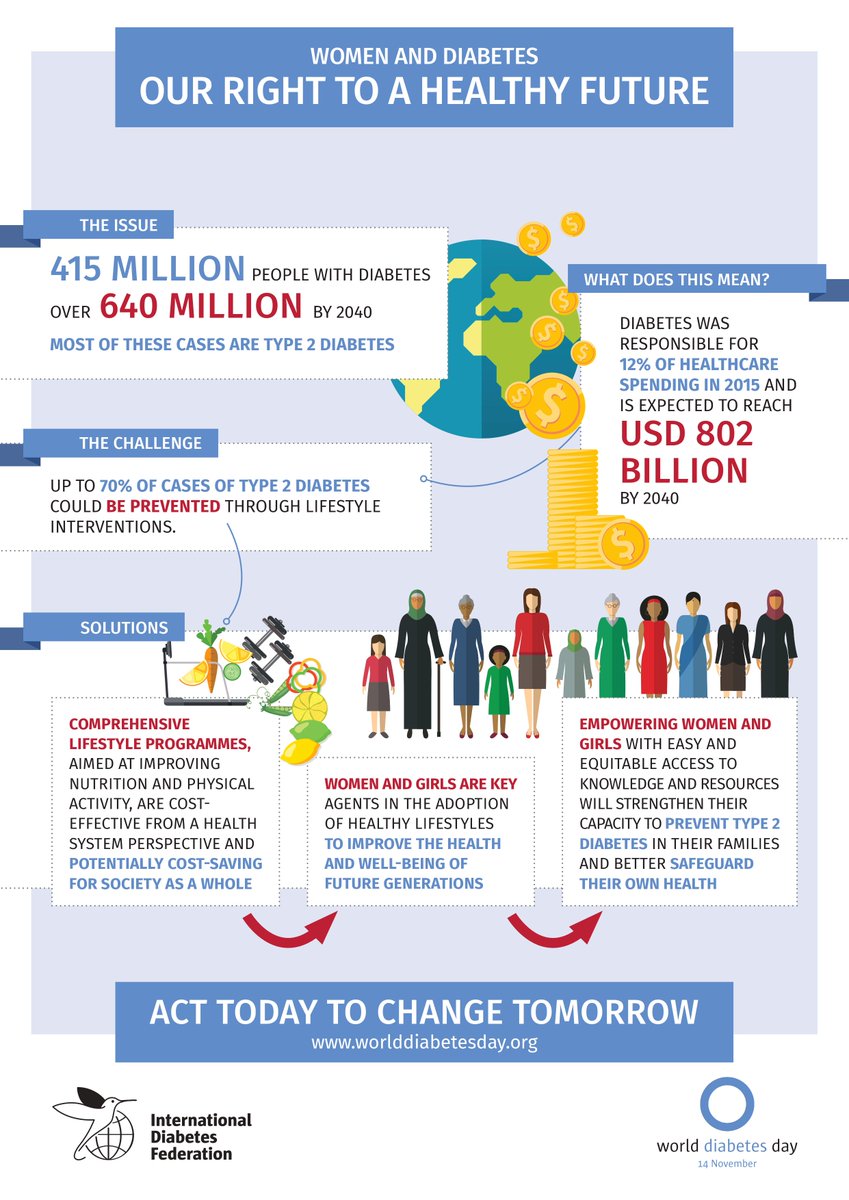
World Diabetes Day emphasises the importance of diabetes prevention and effective management. Key strategies include promoting balanced diets, regular physical activity, and maintaining a healthy weight; encouraging regular check-ups and diabetes screenings, especially for those at higher risk; stressing the importance of following prescribed treatment plans for those diagnosed with diabetes; providing resources and support for people with diabetes to effectively manage their condition; and highlighting new technologies and treatments that can improve diabetes management.

World Diabetes Day fosters global collaboration in the fight against diabetes. This includes international partnerships which encourage cooperation between countries and organisations to address diabetes on a global scale; knowledge sharing and the facilitating the exchange of best practices and research findings across borders; advocating for equitable distribution of diabetes care resources, especially in low and middle-income countries; and promoting consistent policies and guidelines for diabetes prevention and management worldwide.

While World Diabetes Day has made significant strides in raising awareness and improving diabetes care, several challenges remain. These include ensuring equitable access to quality diabetes care, especially in resource-limited settings; combating social stigma associated with diabetes and promoting inclusivity; addressing the gap in access to diabetes management technologies between high and low-income countries; managing the increasing prevalence of diabetes alongside other chronic conditions; and developing strategies to engage younger generations in diabetes prevention and awareness.
World Diabetes Day stands as a beacon of hope and action in the global fight against diabetes. Today, the focus is shifting towards a more holistic approach to diabetes care, encompassing physical, societal, and mental well-being. The day serves not only as a reminder of the challenges posed by diabetes but also as a celebration of the progress made in diabetes care and management. It unites millions of people worldwide in a common cause, fostering a sense of community and shared purpose.

World Diabetes Day remains a crucial platform for raising awareness, promoting prevention, and advocating for better care. It reminds us that while diabetes is a serious condition, it is manageable with the right knowledge, support, and resources.

In My Hands Today…

Excuse Me While I Disappear: Tales of Midlife Mayhem – Laurie Notaro

A laugh-out-loud spin on the realities, perks, opportunities, and inevitable courses of midlife.

Laurie Notaro has proved everyone she didn’t end up in rehab, prison, or cremated at a tender age. She just went gray.

At past fifty, every hair’s root is a symbol of knowledge (she knows how to use a landline), experience (she rode in a car with no seat belts), and superpowers (a gray-haired lady can get away with anything).

Though navigating midlife is initially upsetting―the cracking noises coming from her new old body, receiving regular junk mail from mortuaries―Laurie accepts it. And then some.

With unintentional abandon, she shoplifts a bag of russet potatoes. Heckles a rude driver from her beat-up Prius. And engages in epic trolling on Nextdoor.com. That, says Laurie, is the brilliance of growing older. With each passing day, you lose an equivalent amount of fear. And the #1 New York Times bestselling author has never been so fearlessly funny as she is in this empowering, candid, and enlightening memoir about living life on the other side of fifty.

Short Story: The Homecoming

A young Brahmin named Narayan lived in the small town of Narmadapuram, nestled along the banks of the sacred Narmada River. Born into a family of priests, Narayan was raised in a household steeped in tradition and discipline. His father, Pandit Raghav, was a strict and learned man who upheld the values of their lineage with unwavering resolve. Narayan often felt the weight of his father’s expectations pressing down on him.

At 18, Narayan had just completed his class 12 exams. The day was bright and filled with promise, and his friends had convinced him to celebrate their newfound freedom. They planned a day of fun, laughter, and indulgence. Little did Narayan know that this day would change his life.

“Come on, Narayan! Let’s have some fun!” his friend Vikram urged, a mischievous grin on his face. “We’ve earned it!” 

With a mix of excitement and apprehension, Narayan agreed. They ventured into the heart of the town, where the air was filled with the aroma of street food and the sounds of celebration. As the sun dipped lower in the sky, they found themselves at a local eatery, where the boys ordered meat dishes and drinks.

Just as they were enjoying their meal, Narayan’s father appeared at the entrance, his face a mask of fury. “Narayan!” he bellowed, his voice echoing through the crowded eatery. “What have you done?”

Narayan’s heart sank. He had never seen his father so angry. “Baba, I—”

“Silence!” Pandit Raghav interrupted, his voice cold and unforgiving. “You have disgraced our family. You’re a Brahmin, and you should know better than to indulge in such vices.”

Without waiting for an explanation, Raghav turned and stormed out, leaving Narayan, humiliated and bewildered. The laughter of his friends faded into the background as he realised the gravity of his father’s words.

“Get out of my house!” Raghav had shouted when they returned home. “You’re no son of mine.”

His wife and other children’s words had no impact on Raghav and with a finality, he shut the door in Narayan’s face. With that, Narayan was cast out, forced to leave the only home he had ever known. He wandered the streets of Narmadapuram, lost and alone, the weight of his father’s rejection heavy on his heart.

For the next 14 years, Narayan roamed the vast landscapes of India. He travelled from the bustling streets of Mumbai to the serene hills of Rishikesh, seeking solace in the beauty of the world around him. He took on various jobs, from working as a waiter to assisting in temples, trying to find a sense of belonging.

Despite the freedom he experienced, Narayan felt a void in his heart. He missed his family, especially his younger sister, Radha, and his brother, Lakshman. Memories of their childhood together haunted him, but pride and fear kept him from returning home.

As the years passed, Narayan grew into a man of resilience and wisdom. He learned to appreciate the diversity of life and the lessons it offered. Yet the longing for his family never faded. Over the years Narayan had worked his way up in the hospitality industry and now owned a small, but thriving cafe in Pune’s Fergusson College Road, which was a big hit with students and office goers for the eclectic cuisine it offered.

Narayan was also married by now to Sayali, and had a two-year-old son, whom he had named Ram, in honour of his father. He seemed to have a happy life, but the ache in his heart would not go away. Sayali would often find introspective and sad, but knew enough of his life to not probe further. 

One fateful day, at the cafe, Narayan encountered an old neighbour from Narmadapuram. The man whom he knew as Abhay bhaiya was about a decade older than him. Abhay was with a woman and a teenager who looked just like him. As Abhay was eating, he kept staring at Narayan and while paying the cost of their meal, approached him with a warm smile.

“Is that you, Narayan? My, how you’ve changed!” Abhay exclaimed. Narayan felt a mix of emotions. “Yes, it’s me, Abhay bhaiya,” he replied cautiously. Abhay introduced him to his wife and son, who was now enrolled in Fergusson College. Narayan wanted to ask about his family but hesitated. Seeing this, Abhay decided to broach the topic. 

“Your family is fine, though your mother has never stopped pining for you. And your father is distraught that, in anger, he threw you out of the house. He repented the next day and looked all over for you, but could never find you,” Abhay continued, his expression turning sombre. “Lakshman in his final year of college and studies engineering in Indore while Radha is getting married soon, just after Diwali.”

The news struck Narayan like a lightning bolt. His heart raced as he processed the information. Radha was getting married? He had missed so much of their lives, and now he was about to miss the most significant moment for his sister.

That night, Sayali knew something was bothering Narayan, but waited for him to open his heart to her. Finally after a while, Narayan heaved a huge sigh and turned to his wife. “We are going home for Diwali”, he proclaimed. Sayali was stunned and just looked at her husband as she processed his proclamation. Sayali knew in her heart this was what was needed for Narayan to heal and she turned to her husband with a huge smile. “Yes, let’s go home for Diwali, it is time Siddarth knows this part of his family”. 

With a newfound determination, Narayan set out for Narmadapuram. The journey was filled with memories of his childhood, his parents, and his siblings, but also tainted by the pain of his departure. A few days later, Narayan finally arrived at the familiar streets of his hometown. The sights and sounds flooded back, and he felt a mix of nostalgia and anxiety. Would his family accept him after all these years?

The streets of Narmadapuram were adorned with lights and decorations to welcome the festival of lights. The air was filled with the scent of sweets and the sounds of laughter. Narayan stood outside his childhood home, his heart pounding in his chest. Taking a deep breath, he stepped forward and knocked on the door. Moments later, it swung open to reveal his mother, her eyes widening in shock.

“Narayan?” She gasped, tears welling up in her eyes. “Maa,” he replied, his voice trembling. “I’m home.”

His mother rushed forward, enveloping him in a warm embrace. “Oh, my son! We thought we had lost you forever!”

As they embraced, Narayan felt the weight of the years lift from his shoulders. He stepped inside, where his father stood, his expression a mix of surprise and disbelief.

“Baba,” Narayan began, but Raghav held up a hand. “Let’s talk later,” he said, his voice softening. “I need time to process this.” Narayan nodded, understanding the complexity of emotions swirling within his father. He turned to see Radha and Lakshman watching from the side, their faces filled with joy and surprise.

“Bhaiya!” Radha exclaimed, rushing forward to hug him. “I can’t believe you’re here!” “Radha, I’ve missed you so much,” Narayan replied, his heart swelling with love for his sister.

“This is Sayali and Siddharth, your daughter-in-law and grandson,” Narayan introduced his family to his family. His mother stopped her daughter-in-law from entering the house, rushing to the kitchen to bring the aarti thali or the veneration tray, to welcome her grandson and daughter-in-law into their family.

“This Diwali is the best gift I have received,” Narayan’s mother exclaimed when she sat down after a hectic day surrounded by her family. “Not only is my daughter going to her home, but to fill this void, I have now gotten another daughter and a grandson.” 

As the days passed, Narayan settled back into the rhythm of family life. The wedding preparations for Radha were in full swing, and the house was filled with laughter and excitement. Narayan, Sayali and Siddharth helped wherever they could, feeling a sense of belonging that had always been missing in their lives. 

On the day of the wedding, the atmosphere was electric. The house was adorned with flowers, and the sounds of traditional music filled the air. Narayan watched as Radha, radiant in her bridal attire, prepared to embark on this new chapter of her life. As the ceremony unfolded, Narayan felt a profound sense of gratitude. He had returned just in time to witness his sister’s happiness, and he knew he was exactly where he was meant to be.

Later that evening, as the celebrations continued, Narayan found a quiet moment outside the house. The sky was painted with stars, and the air was filled with the sweet scent of marigolds. He took a deep breath, reflecting on how far he had come. Just then, he heard footsteps behind him. It was Sayali, her face glowing with contentment. “Narayan, I am so glad you decided to come back. Meeting Ma and Baba has been so fulfilling for both me and Siddharth.” 

“Yes, this is truly the homecoming I wondered if I ever would have.” They heard footsteps behind them and soon were surrounded by Raghav, who was carrying Siddharth as if afraid to let him go, as well as his wife and Lakshman. “Narayan, I am sorry; I should not have thrown you out of the house all these years ago. Thank you for coming back and forgiving  me.” With folded hands, Raghav stood before his son, who pulled his father into a hug that erased all those years of loneliness. Father and son stood like that for a while as the years melted away and all the rancour was erased. 

Narayan and his family spent a few weeks with each other before they returned back to Pune. When his parents started growing older and less mobile, Narayan brought them back to Pune to spend their golden years with him and Sayali. Lakshman also found a job in Pune after his course and the family spent many years together.

2024 Week 45 Update

According to Jamaican singer, songwriter, and cultural icon, Bob Marley’s quote reflects a deep insight into the nature of contentment and fulfillment. Marley is saying that true success isn’t measured by competing with others or chasing society’s version of success. Often, we’re so focused on “winning” externally—whether that’s in career, wealth, or status—that we lose touch with what actually brings us peace and happiness. When we let go of the relentless drive to outdo others or to meet external expectations, we can finally achieve a sense of inner victory. Winning, in Marley’s perspective, is about finding joy, acceptance, and meaning in life without needing to constantly race toward an ever-shifting finish line. This perspective invites us to shift our focus inward and consider what truly makes us feel fulfilled and happy, rather than only striving to meet external standards or goals.

And this quote is very timely for me this week. I have been plagued by many aches and pains this week in multiple parts of my body. One of the pain points is one of my ankles which is very painful especially when I walk. So this week, I have decided to take it slow and not walk as much as I do so that I can heal from it.

GG is extremely busy with school as she has exams starting next week and that will be end of her third semester. The difficulty level is ramping up and during term time, I can hear her muttering and grumbling about the course! BB is enjoying his driving course which should end sometime this month. We are also enjoying BB’s time with us as this portion of his course is stay-out which means he stays at home and goes to camp in the morning and returns home in the evening.

That’s all from me today. Stay positive and keep smiling!

In My Hands Today…

Code Dependent: Living in the Shadow of AI – Madhumita Murgia

A riveting story of what it means to be human in a world changed by artificial intelligence, revealing the perils and inequities of our growing reliance on automated decision-making

On the surface, a British poet, an UberEats courier in Pittsburgh, an Indian doctor, and a Chinese activist in exile have nothing in common. But they are in fact linked by a profound common experience—unexpected encounters with artificial intelligence. In Code Dependent , Murgia shows how automated systems are reshaping our lives all over the world, from technology that marks children as future criminals, to an app that is helping to give diagnoses to a remote tribal community.

AI has already infiltrated our day-to-day, through language-generating chatbots like ChatGPT and social media. But it’s also affecting us in more insidious ways. It touches everything from our interpersonal relationships, to our kids’ education, work, finances, public services, and even our human rights.

By highlighting the voices of ordinary people in places far removed from the cozy enclave of Silicon Valley, Code Dependent explores the impact of a set of powerful, flawed, and often-exploitative technologies on individuals, communities, and our wider society. Murgia exposes how AI can strip away our collective and individual sense of agency, and shatter our illusion of free will.

The ways in which algorithms and their effects are governed over the coming years will profoundly impact us all. Yet we can’t agree on a common path forward. We cannot decide what preferences and morals we want to encode in these entities or what controls we may want to impose on them. And thus, we are collectively relinquishing our moral authority to machines.

In Code Dependent , Murgia not only sheds light on this chilling phenomenon, but also charts a path of resistance. AI is already changing what it means to be human, in ways large and small, and Murgia reveals what could happen if we fail to reclaim our humanity.