The Many Lives of Mama Love: A Memoir of Lying, Stealing, Writing, and Healing – Lara Love Hardin
No one expects the police to knock on the million-dollar, two-story home of the perfect cul-de-sac housewife. But soccer mom Lara Love Hardin has been hiding a shady secret: She is funding her heroin addiction by stealing her neighbors’ credit cards.
Lara is convicted of thirty-two felonies and becomes inmate S32179. She learns jail is a class system with a power structure somewhere between an adolescent sleepover party and Lord of the Flies. Furniture is made from tampon boxes, and Snickers bars are currency. But Lara quickly finds the rules and brings love and healing to her fellow inmates as she climbs the social ladder to become the “shot caller,” showing that jailhouse politics aren’t that different from the PTA meetings she used to attend.
When she’s released, she reinvents herself as a ghostwriter. Now, she’s legally co-opting other people’s identities and getting to meet Oprah, meditate with The Dalai Lama, and have dinner with Archbishop Desmond Tutu. But the shadow of her past follows her. Shame is a poison worse than heroin—there is no way to detox. She must learn to forgive herself and others, navigate life as a felon on probation, prove to herself that she is more good than bad, and much more.
Viswakarma Jayanti is a significant festival in India, dedicated to Lord Vishwakarma, the divine architect and craftsman of the gods. The festival honours the contributions of artisans, craftsmen, and engineers who play a crucial role in shaping the world around us.
Lord Vishwakarma is a prominent figure in Hindu mythology, revered as the divine architect and craftsman of the gods. He is often depicted as a deity with multiple arms, holding various tools and instruments associated with construction and craftsmanship. According to Hindu scriptures, Vishwakarma is credited with designing and building some of the most magnificent structures in the universe, including the palaces of the gods, celestial weapons, and even entire cities.
Vishwakarma is believed to be the son of Lord Brahma, the creator of the universe. As the divine architect, Vishwakarma inherited his father’s creative abilities and was bestowed with the responsibility of designing and constructing the physical world. He is often associated with the Rigveda, one of the oldest sacred texts in Hinduism, where he is described as the divine carpenter and the all-seeing god.
Throughout Hindu mythology, Vishwakarma is credited with numerous architectural marvels and inventions. Some of his most notable creations include Swarga Loka which is the heavenly abode of Lord Indra, the king of the gods. Swarga Loka is described as a magnificent palace adorned with precious gems and surrounded by lush gardens. Vishwakarma is believed to have constructed the Pushpaka Vimana, a flying chariot used by the gods. This celestial vehicle is often mentioned in ancient texts and is considered a symbol of advanced engineering and craftsmanship. The legendary city of Dwaraka, the capital of Lord Krishna’s kingdom, is said to have been built by Vishwakarma. The city was renowned for its grandeur and architectural brilliance. The capital city of the Pandavas in the epic Mahabharata, Indraprastha, was also designed by Vishwakarma. The city was known for its opulent palaces, intricate designs, and advanced infrastructure.
Viswakarma Jayanti is celebrated to honour the contributions of Lord Vishwakarma and to seek his blessings for success and prosperity in various fields of craftsmanship and engineering. The festival holds special significance for artisans, craftsmen, engineers, architects, and industrial workers, who consider Vishwakarma as their patron deity. The festival is typically celebrated on the last day of the Bengali month of Bhadra, which usually falls in mid-September. This day is also known as Kanya Sankranti or Bhadra Sankranti. In some regions, the festival is observed on the day following Diwali, the festival of lights.
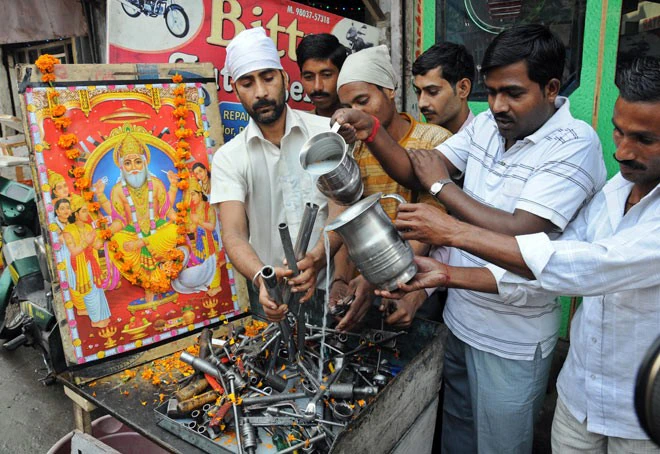
Viswakarma Jayanti is celebrated with great enthusiasm and devotion across India. The celebrations vary from region to region, but some common practices and rituals are observed universally. On Viswakarma Jayanti, devotees set up altars and idols of Lord Vishwakarma in their homes, workshops, and factories. The idols are adorned with flowers, garlands, and other decorations. Special prayers and rituals are performed to invoke the blessings of the divine architect. Devotees offer fruits, sweets, and other delicacies to the deity as a mark of respect and gratitude.
One of the unique aspects of Viswakarma Jayanti is the worship of tools, machinery, and instruments used in various trades and professions. Artisans, craftsmen, and industrial workers clean and decorate their tools and equipment, and perform rituals to seek the blessings of Vishwakarma for their smooth functioning and success in their work. This practice symbolises the importance of tools and machinery in the creation and sustenance of the physical world.
In many regions, community feasts and gatherings are organised to celebrate Viswakarma Jayanti. People come together to share meals, exchange greetings, and participate in cultural programs and activities. These gatherings foster a sense of camaraderie and unity among the community members.
In some parts of India, particularly in the eastern states of West Bengal, Odisha, and Assam, flying kites is a popular tradition on Viswakarma Jayanti. The skies are filled with colourful kites of various shapes and sizes, symbolizing the spirit of freedom and creativity.
Viswakarma Jayanti is steeped in rich mythology and folklore, with numerous stories and legends associated with Lord Vishwakarma and his divine creations. One of the most famous stories associated with Vishwakarma is the creation of the golden city of Lanka. According to Hindu mythology, Vishwakarma built the city of Lanka for Lord Shiva. The city was made entirely of gold and was known for its unparalleled beauty and grandeur. However, Lord Shiva later gifted the city to the demon king Ravana as a reward for his devotion and penance. Lanka became the capital of Ravana’s kingdom and played a central role in the epic Ramayana.
The Sudarshana Chakra, a powerful weapon wielded by Lord Vishnu, is believed to have been crafted by Vishwakarma. According to legend, Vishwakarma created the Sudarshana Chakra using the dust from the sun’s rays. The weapon is known for its incredible speed and precision, and it is said to have the ability to destroy any enemy.
Another interesting story revolves around the birth of Vishwakarma’s daughter, Sanjana. According to mythology, Sanjana was married to Surya, the sun god. However, unable to bear the intense heat and radiance of her husband, Sanjana created a shadow of herself, known as Chhaya, and left her in her place while she went to her father’s house. When Surya discovered the deception, he sought Vishwakarma’s help to reduce his heat and radiance. Vishwakarma agreed and used his divine skills to trim Surya’s radiance, making it bearable for Sanjana to return to her husband.
Viswakarma Jayanti is celebrated with great enthusiasm in various parts of India, each region adding its unique cultural flavour to the festivities. In West Bengal, Viswakarma Jayanti is a major festival, especially among the working class, artisans, and industrial workers. The festival is marked by elaborate rituals, community feasts, and cultural programs. Factories, workshops, and offices are decorated with flowers and lights, and special prayers are offered to Lord Vishwakarma. The tradition of flying kites is also a significant part of the celebrations in this region.
In Odisha, Viswakarma Jayanti is celebrated with great devotion and enthusiasm. Artisans and craftsmen worship their tools and machinery, seeking the blessings of Vishwakarma for success and prosperity in their work. Special rituals and prayers are performed in temples and homes, and community feasts are organized to mark the occasion.
In Karnataka, Viswakarma Jayanti is celebrated particularly among the Vishwakarma community, which comprises artisans, craftsmen, and engineers. The festival is marked by the worship of tools and machinery, special prayers, and community gatherings. Cultural programs and activities are organised to celebrate the contributions of the Vishwakarma community to society.
In Tamil Nadu, Viswakarma Jayanti is celebrated particularly among industrial workers and artisans. Special prayers and rituals are performed in factories, workshops, and homes to seek the blessings of Lord Vishwakarma. The festival is also marked by community feasts and cultural programs, fostering a sense of unity and camaraderie among the people.
In today’s fast-paced and technologically advanced world, the celebration of Viswakarma Jayanti holds significant relevance. The festival serves as a reminder of the importance of craftsmanship, creativity, and innovation in shaping the world around us. It honours the contributions of artisans, craftsmen, engineers, and industrial workers, who play a crucial role in the development and progress of society.
Viswakarma Jayanti highlights the importance of skill development and innovation in various fields of craftsmanship and engineering. The festival encourages individuals to hone their skills, embrace creativity, and strive for excellence in their respective trades and professions. It also serves as an inspiration for the younger generation to pursue careers in craftsmanship and engineering, contributing to the growth and development of the nation.
For the Vishwakarma community, celebrating Viswakarma Jayanti fosters a sense of pride and identity. The festival provides an opportunity for the community to come together, celebrate their heritage, and honour their patron deity. It also serves as a platform to showcase their skills, talents, and contributions to society.
The worship of tools and machinery during Viswakarma Jayanti also emphasises the importance of environmental sustainability. By seeking the blessings of Vishwakarma for the smooth functioning of their tools and equipment, individuals are reminded of the need to use resources responsibly and sustainably. The festival encourages the adoption of eco-friendly practices and technologies in various fields of craftsmanship and engineering.
Viswakarma Jayanti is a celebration of creativity, craftsmanship, and innovation. It honours the contributions of Lord Vishwakarma, the divine architect, and the countless artisans, craftsmen, and engineers who shape the world around us. The festival is marked by elaborate rituals, community gatherings, and cultural programs, fostering a sense of unity and pride among the people.
The Furies: Women, Vengeance, and Justice – Elizabeth Flock
In The Furies, Elizabeth Flock examines how three real-life women have used violence to fight back, and how views of women who defend their lives are often distorted by their depictions in media and pop culture. These three immersive narratives follow Brittany Smith, a young woman from Stevenson, Alabama, who killed a man she said raped her but was denied the protection of the Stand-Your-Ground law; Angoori Dahariya, leader of a gang in Uttar Pradesh, India, dedicated to avenging victims of domestic abuse; and Cicek Mustafa Zibo, a fighter in a thousands-strong all-female militia that battled ISIS in Syria. Each woman chose to use lethal force to gain power, safety, and freedom when the institutions meant to protect them—government, police, courts—utterly failed to do so. Each woman has been criticized for their actions by those who believe that violence is never the answer.
Through Flock’s propulsive prose and remarkable research on the ground—embedded with families, communities, and organizations in America, India, and Syria—The Furies examines, with exquisite nuance, whether the fight for women’s safety is fully possible without force. Do these women’s acts of vengeance help or hurt them, and ultimately, all women? Did they create lasting change in entrenched misogynistic and paternalistic systems? And ultimately, what would societies in which women have real power look like?
Across mythologies and throughout history, the stories of women’s lives frequently end with their bodies as sites of violence. But there are also celebrated tales of women, real and fictional, who have fought back. The novelistic accounts of these three women provoke questions about how to achieve true gender equality, and offer profound insights in the quest for answers.
One of the most valuable skills a young adult can develop is effective time management. The ability to prioritise tasks, meet deadlines, and maintain a healthy work-life balance is crucial for success in both academic and professional settings. Time management is the process of organising and planning how to divide one’s time between different activities. Get it right, and one can end up working smarter, not harder, to get more done in less time – even when time is tight and pressures are high.
Why is time management so critical for young adults? In school, effective time management helps one balance coursework, exams, and extracurricular activities. In the workplace, strong time management skills can set one apart from peers and lead to more opportunities. When one has a clear plan and prioritises tasks, they’re less likely to feel overwhelmed by their workload.
Good time management skills help one make better decisions by allowing one to focus on what’s truly important. By managing time effectively, one can create more space for personal activities and relationships.
Here are some practical strategies and hacks to help a young adult master this essential skill.
One of the most crucial aspects of time management is learning how to prioritise tasks effectively. Here are some techniques to help one do just that:
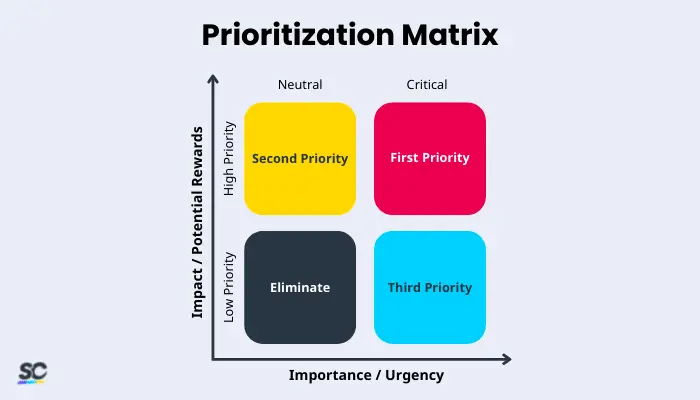
The Eisenhower Matrix: Named after President Dwight D. Eisenhower, this method helps categorise tasks based on their urgency and importance. For tasks that are urgent and important, they need to be done immediately. For the tasks that are important but not urgent, one should schedule them for later. For tasks that are urgent but not important, delegate these tasks if possible. And for those which are neither urgent nor important, they should be eliminated or done last. This technique is particularly useful for managing coursework deadlines and project milestones in both university and professional settings.
To implement this method, create a 2×2 grid with “Urgent” and “Not Urgent” on one axis, and “Important” and “Not Important” on the other. List all tasks and place them in the appropriate quadrant. Focus on the “Urgent and Important” tasks first, then move on to the “Important but Not Urgent” tasks.
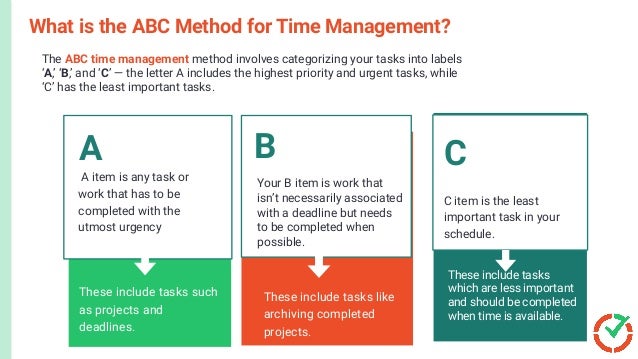
The ABC Method: This technique involves categorising tasks into three groups: A Tasks that are high-priority items that must be done today; B Tasks which are medium-priority items that should be done soon; and C Tasks that are low-priority items that can wait.
To use this method, make a list of all the tasks for the day or week. Assign each task an A, B, or C label. Tackle all A tasks before moving on to B tasks, and so on. This method can be particularly effective for managing daily to-do lists in a fast-paced work environment.
The 1-3-5 Rule: This simple rule helps to structure the daily to-do list. List out 1 big task, 3 medium tasks, and 5 small tasks. By following this rule, one ensures that one is making progress on significant projects while also completing smaller, necessary tasks. This can be especially helpful for balancing major assignments or work projects with smaller daily responsibilities.
Time blocking is a powerful technique that involves scheduling specific periods for different tasks or types of work. Here’s how to implement it effectively:
Review Tasks: Start by listing all the tasks that need to be completed.
Estimate Time Requirements: For each task, estimate how long it will take to complete.
Create Time Blocks: Divide the day into blocks of time, typically 30-90 minutes each.
Assign Tasks to Blocks: Schedule tasks into these time blocks, starting with the most important or challenging tasks during the peak productivity hours.
Include Buffer Time: Leave some space between blocks for unexpected tasks or breaks.
Stick to the Schedule: Try to adhere to the time blocks as much as possible, but be flexible when necessary.
Time blocking helps one focus on one task at a time, reducing the temptation to multitask and increasing overall productivity. This technique can be particularly useful for managing study time at university or structuring the workday in a professional setting.
In today’s digital age, numerous apps and tools can help one manage their time more effectively.
Project Management Tools: Apps like Trello, Asana, or Monday.com can help one organise tasks, collaborate with team members, and track deadlines. These tools are particularly useful for group projects in university or team-based work environments.
Time Tracking Apps: Tools like RescueTime or Toggl can help one understand how they’re spending their time and identify areas for improvement. This can be eye-opening for students trying to optimise their study habits or young professionals looking to boost their productivity.
Calendar and Reminder Apps: Google Calendar, Microsoft Outlook, or Apple Calendar are essential for scheduling classes, and meetings, as well as setting reminders for deadlines. Integrating these tools into one’s daily routine can help one stay on top of their commitments.
Note-Taking and Task Management Apps: Evernote, Notion, or Todoist can help one keep track of tasks, ideas, and important information. These tools can be invaluable for organising lecture notes or managing work-related tasks.
Focus and Productivity Apps: Apps like Forest or Freedom can help one stay focused by blocking distracting websites or apps during study or work hours. These can be particularly helpful when one needs to concentrate on a challenging assignment or important project.
When choosing productivity tools, one should remember that the best app is the one one will use consistently. Start with one or two that address the biggest pain points and gradually incorporate others as needed.
The Two-Minute Rule, popularized by productivity consultant David Allen, states that if a task will take less than two minutes to complete, one should do it immediately rather than putting it off. This rule helps prevent small tasks from piling up and becoming overwhelming. It also gives one a sense of accomplishment throughout the day as one quickly knocks out these minor tasks.
Examples of two-minute tasks might include responding to a quick email, filing a document, making a brief phone call, updating a to-do list etc. By addressing these small tasks immediately, one frees up mental space and reduces the risk of forgetting important details. This can be particularly helpful for managing the many small responsibilities that come with a new job.
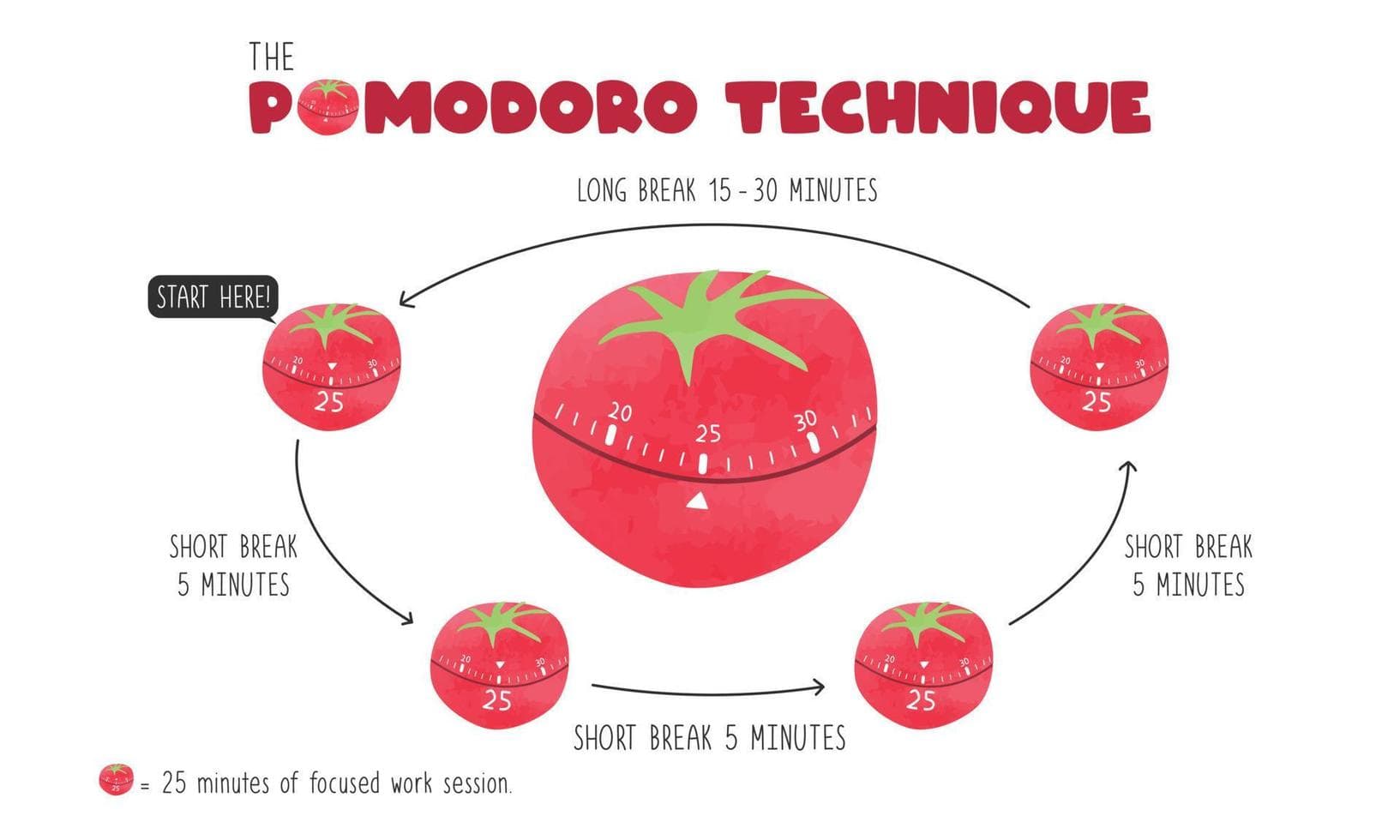
The Pomodoro Technique is a time management method developed by Francesco Cirillo in the late 1980s. It uses a timer to break work into intervals, traditionally 25 minutes in length, separated by short breaks. Here’s how it works – choose a task to work on, set a timer for 25 minutes or one Pomodoro and work on the task until the timer rings. Then take a short break of 5 minutes and after four Pomodoros, take a longer break of 15–30 minutes.
This technique helps one maintain focus and avoid burnout by incorporating regular breaks into their work routine. It’s particularly useful for tasks that require sustained concentration, such as studying for exams or working on complex projects.
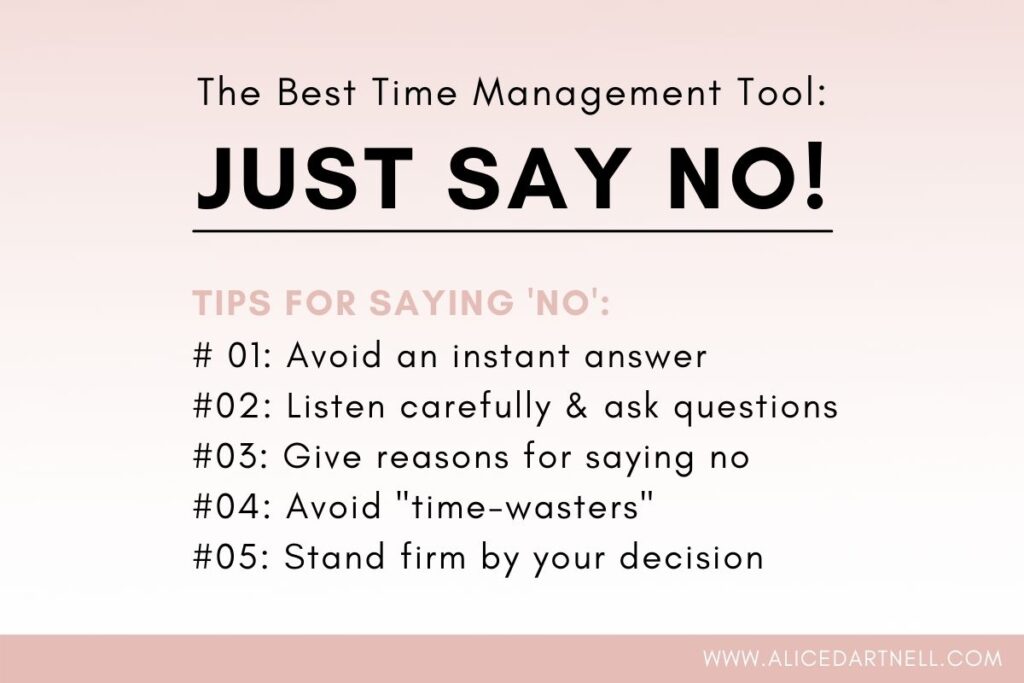
As a young adult, one may feel pressure to say “yes” to every opportunity or request that comes their way. However, learning to say “no” is crucial for effective time management. To do it gracefully, explain that you have a full workload and can’t take on additional tasks at the moment. If possible, suggest a later deadline or propose delegating the task to another team member. Thank the person for thinking of you, even as you decline. Once you’ve made your decision, stick to it. Avoid leaving the door open for negotiation if you truly can’t take on the task.
Remember, saying “no” to less important tasks allows one to say “yes” to opportunities that align with one’s goals and priorities. This skill is particularly important as one navigates the social aspects of university life or manages increasing responsibilities in one’s early career.
How one starts their day can significantly impact their productivity and time management. Developing a consistent morning routine can help one set a positive tone for the day, prioritise one’s most important tasks, and reduce decision fatigue.
As an example of an effective morning routine, wake up at a consistent time each day, engage in light exercise or stretching, practise mindfulness or meditation, review one’s goals and priorities for the day, and tackle one’s most important task first. This is often referred to as “eating the frog”.
One should experiment with different activities and timings to find a routine that works best for them. The key is consistency – stick with the routine for at least 30 days to make it a habit.
In today’s hyper-connected world, distractions are everywhere. Learning to minimise them is crucial for effective time management. Disable non-essential notifications on the phone and computer during study or work hours. Employ tools like StayFocusd or Cold Turkey to block distracting websites during focused work periods. If possible, designate a specific area for studying or working to help the brain associate that space with productivity. When working on a task, keep only the necessary tabs or applications open. Use noise-cancelling headphones as these can help block out ambient noise in busy university libraries or open office environments. Implement “Do Not Disturb” Hours and communicate to roommates or colleagues when one needs uninterrupted focus time.
Remember, it’s not about eliminating all distractions permanently, but rather creating periods of focused work throughout the day.
Hack #9: Utilise the 80/20 Rule aka the Pareto Principle
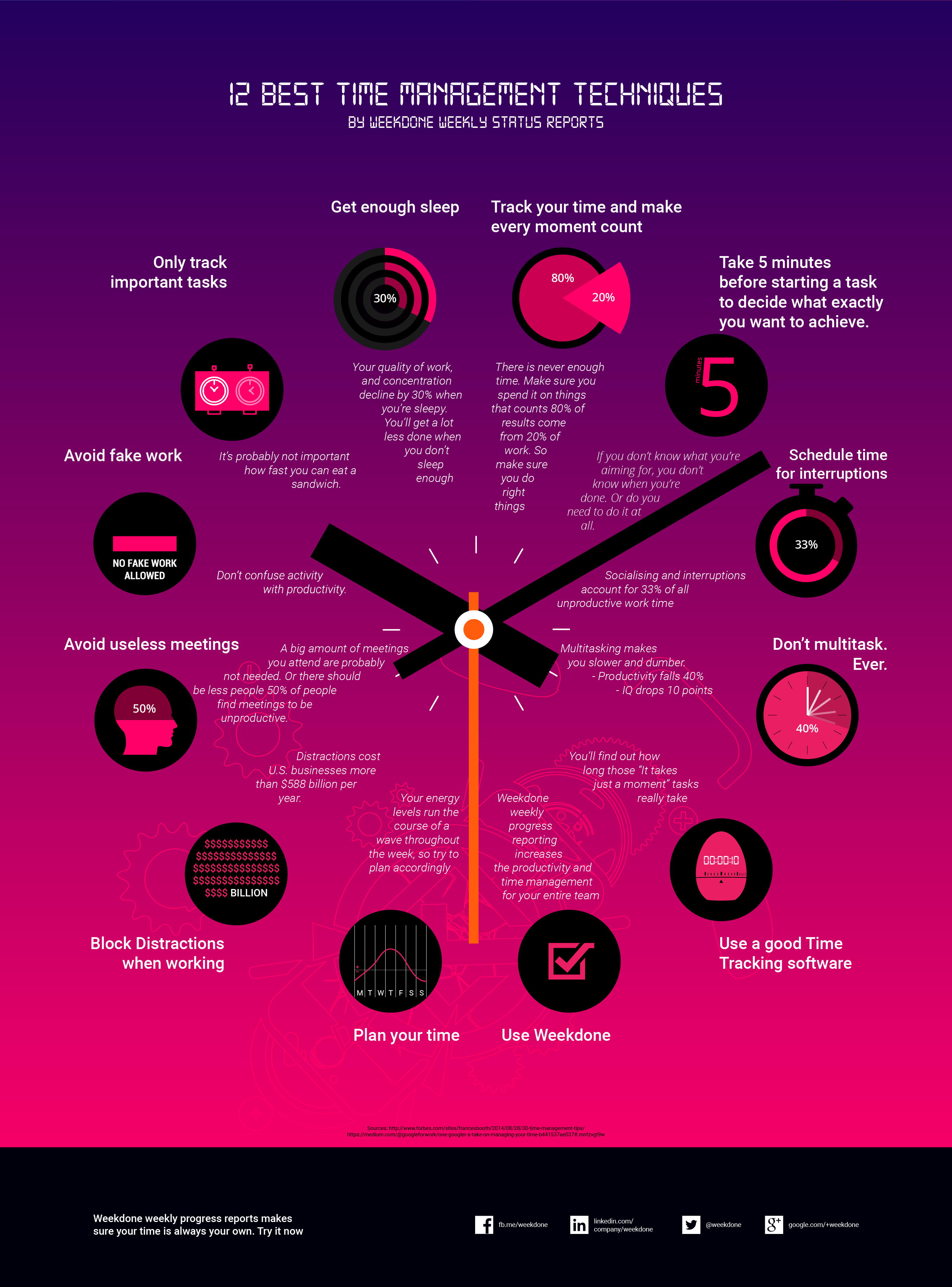
The Pareto Principle, also known as the 80/20 rule, suggests that roughly 80% of effects come from 20% of causes. In the context of time management, this means that 80% of one’s results likely come from 20% of their efforts.
To apply this principle, identify the tasks that contribute most significantly to the goals or results. Prioritise these high-impact tasks. Delegate or eliminate tasks that fall into the less productive 80% when possible.
By focusing on the most impactful tasks, one can achieve better results with less time and effort. This principle can be particularly useful for prioritising study topics before exams or focusing on key projects at work.
Effective time management is an ongoing process of refinement. One should set aside time regularly, weekly or monthly, to review one’s productivity and time management strategies.
Questions one should ask oneself include: what worked well this week/month? Where did one struggle with time management? Are there any tasks one can eliminate, delegate, or optimise? How can one improve one’s productivity in the coming week/month? This practice of regular reflection allows one to continually improve their time management skills and adapt to changing circumstances.
As one progresses in their studies or career, learning to delegate becomes increasingly important. Effective delegation not only frees up one’s time for higher-priority tasks but also helps develop one’s team members’ skills.
To delegate effectively, delegate tasks that others can do or learn from, not just the tasks one doesn’t want to do. Match tasks with team members’ skills and development goals. Communicate expectations, deadlines, and available resources. Empower the person to make decisions related to the task. Offer support without micromanaging. After the task is complete, offer constructive feedback to help the person improve.
Remember, effective delegation is a skill that takes practice. Start small and gradually increase the complexity of tasks one delegated as one and their team members become more comfortable with the process.
Task batching involves grouping similar tasks and completing them in one focused session. This technique can significantly boost one’s productivity by reducing the mental energy required to switch between different types of tasks. Some examples of batch tasks are responding to emails, making phone calls, writing reports or creating presentations, social media updates, or data entry or administrative tasks.
To implement batching, identify similar tasks. Schedule specific time blocks for these batched tasks. Focus solely on that type of task during the designated time block. Take a short break before moving on to a different type of task.
Batching can help one enter a state of flow more easily, leading to increased productivity and higher-quality work. This technique can be particularly useful for managing multiple course assignments or juggling various responsibilities in one’s early career.
This technique, inspired by a quote often attributed to Mark Twain, suggests tackling the most challenging or important task first thing in the morning. The idea is that if one “eats a live frog” first thing in the morning, they’ll have the satisfaction of knowing that it’s probably the worst thing they will do all day.
In practice, this means the task one is most likely to procrastinate on, but that will have the biggest positive impact on their day or week. One should tackle this task first thing in the morning when their energy and willpower are at their highest. Once one has completed their “frog,” the rest of the day will feel more manageable and productive.
This technique helps build momentum for the rest of the day and ensures that the most important work gets done, even if unexpected issues arise later. It can be particularly effective for tackling challenging coursework or important work projects.
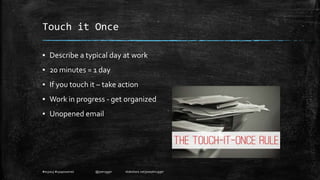
Hack #14: Implement the “Touch It Once” Rule
The “Touch It Once” rule is a simple but effective way to prevent small tasks from piling up and becoming overwhelming. The principle is straightforward: whenever one encounters a task that can be completed in five minutes or less, one should do it immediately rather than putting it off.
This rule can be applied to various situations, including responding to quick emails, filing documents, making short phone calls, or scheduling appointments. By addressing these small tasks immediately, one can prevent them from accumulating and taking up mental space. This approach can help one feel more organised and in control of their workload, whether they’re managing multiple course assignments or juggling various responsibilities in their early career.
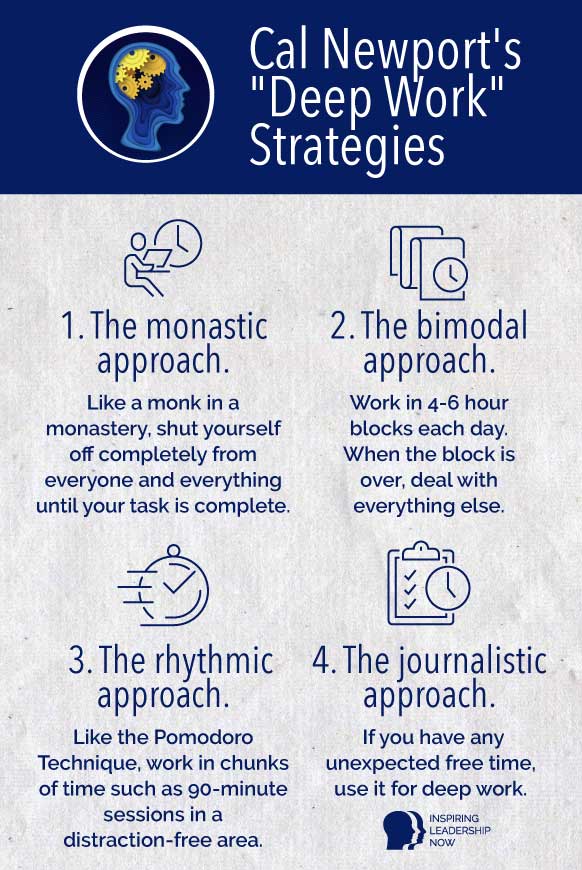
“Deep Work,” a term coined by author Cal Newport, refers to the ability to focus without distraction on a cognitively demanding task. In our increasingly distracted world, the ability to engage in deep work can set one apart and lead to higher-quality outputs.
To cultivate deep work, schedule deep work sessions by blocking out specific times in the calendar for focused, uninterrupted work. Create a distraction-free environment by finding a quiet space, turning off notifications, and communicating unavailability to roommates or colleagues. Start Small and begin with 30-minute deep work sessions and gradually increase the duration as focus improves. Use rituals and develop a routine that signals to the brain it’s time for deep work. This could be putting on noise-cancelling headphones, or brewing a specific type of tea. Practice regularly as like any skill, the ability to engage in deep work improves with consistent practice.
By incorporating deep work into one’s routine, one can tackle complex problems more effectively and produce higher-quality work in less time. This skill is particularly valuable for tackling challenging coursework or making significant progress on important work projects.
Mastering time management is a lifelong journey, not a destination. As a young adult navigating university life or entering the workforce, one has the advantage of developing these crucial skills early, setting a strong foundation for future success. Remember that everyone’s optimal time management strategy is unique – what works for one person may not work for another. The key is to experiment with different techniques, reflect on what works best for an individual, and continually refine the approach.
As one implements these time management hacks, keep in mind that the goal is not to fill every moment of the day with work. Rather, effective time management should create space for both professional productivity and personal fulfilment. By managing time wisely, one will not only excel in academic and professional pursuits but also have the freedom to pursue passions, maintain relationships, and enjoy life outside of work.
One can start small by implementing one or two of these hacks at a time. As they become habits, one can gradually incorporate more strategies into their routine. With patience, persistence, and a willingness to learn, one can develop a personalised time management system that propels one towards one’s goals and helps them thrive.
Remember, time is one’s most valuable resource. By learning to manage it effectively now, one is investing in a future of increased productivity, reduced stress, and greater overall success.
The Hungry Season: A Journey of War, Love, and Survival – Lisa M. Hamilton
As combat rages across the lush highlands of Vietnam and Laos, a child is born.
Ia Moua enters life at the bottom of her world’s social order, both because she is part of Laos’s Hmong minority and because she is female. But when brutal communist rule upends her life and strips Ia of all she loves, this young girl resolves to chart her own defiant path.
With ceaseless ambition and an indestructible spirit, Ia builds a new life for herself and, before long, for her children, first in the refugee camps of Thailand and then in the industrial heartland of California’s San Joaquin Valley.
At the root of her success is a simple growing rice just as her ancestors did. When she gains power and independence, however, Ia must confront all that she left behind—and find a place in her heart for those who left her.
Meticulously reported over seven years and written with the intimacy of a novel, The Hungry Season is an unforgettable tale about hard-won survival and the nourishment that matters most.