The Woman Who Wasn’t There: The True Story of an Incredible Deception – Robin Gaby Fisher, Angelo J. Guglielmo Jr.
The astounding story of Tania Head, whose heartrending account of surviving the World Trade Center attacks made her a celebrity—until it all turned out to be an elaborate hoax.
It was a tale of loss and recovery, of courage and sorrow, of horror and inspiration. Tania Head’s astonishing account of her experience on September 11, 2001—from crawling through the carnage and chaos to escaping the seventy-eighth-floor sky lobby of the burning south tower to losing her fiancé in the collapsed north tower—transformed her into one of the great victims and heroes of that tragic day.
Tania selflessly took on the responsibility of giving a voice and a direction to the burgeoning World Trade Center Survivors’ Network, helping save the “Survivor Stairway” and leading tours at Ground Zero, including taking then-governor Pataki, Mayor Bloomberg, and former mayor Giuliani on the inaugural tour of the WTC site. She even used her own assets to fund charitable events to help survivors heal. But there was something very wrong with Tania’s story—a terrible secret that would break the hearts and challenge the faith of all those she claimed to champion.
Told with the unique insider perspective and authority of Angelo J. Guglielmo, Jr., a filmmaker shooting a documentary on the efforts of the Survivors’ Network, and previously one of Tania’s closest friends, The Woman Who Wasn’t There is the story of one of the most audacious and bewildering quests for acclaim in recent memory—one that poses fascinating questions about the essence of morality and the human need for connection at any cost.
The Bangkok heat clung to everything, even at seven in the evening on Christmas Eve. Sophie wiped sweat from her forehead as she navigated through the crowded Chatuchak Weekend Market, her sister Emma trailing behind, camera in hand.
“This is mental,” Emma laughed, dodging a motorbike taxi. “Christmas in thirty-five degrees. Mum would have a fit seeing us in shorts and tank tops right now.”
Sophie smiled, fingering the small silver lighter in her pocket. Their grandfather’s lighter—the one thing she’d insisted on bringing to Thailand, despite Emma’s protests about unnecessary baggage. The engraved initials “J.H” caught the light from the market stalls as she turned it over in her palm.
They’d planned this trip for months. Two weeks in Thailand, escaping the dreary December rain of Manchester, escaping the first Christmas without their grandfather. The old man had been obsessed with travel stories, filling their childhood with tales of places he’d never quite managed to visit himself.
“Look at this,” Emma called, holding up a Buddha statue made of recycled glass. “Grandpa Joe would have loved this market. All these little treasures.”
Sophie nodded, but her throat felt tight. That’s exactly what he would have said—little treasures. He’d collected them from the few places he had managed to reach: a wooden spoon from Scotland, a pressed flower from Ireland, and a smooth stone from Wales. His mantelpiece had been a museum of modest adventures.
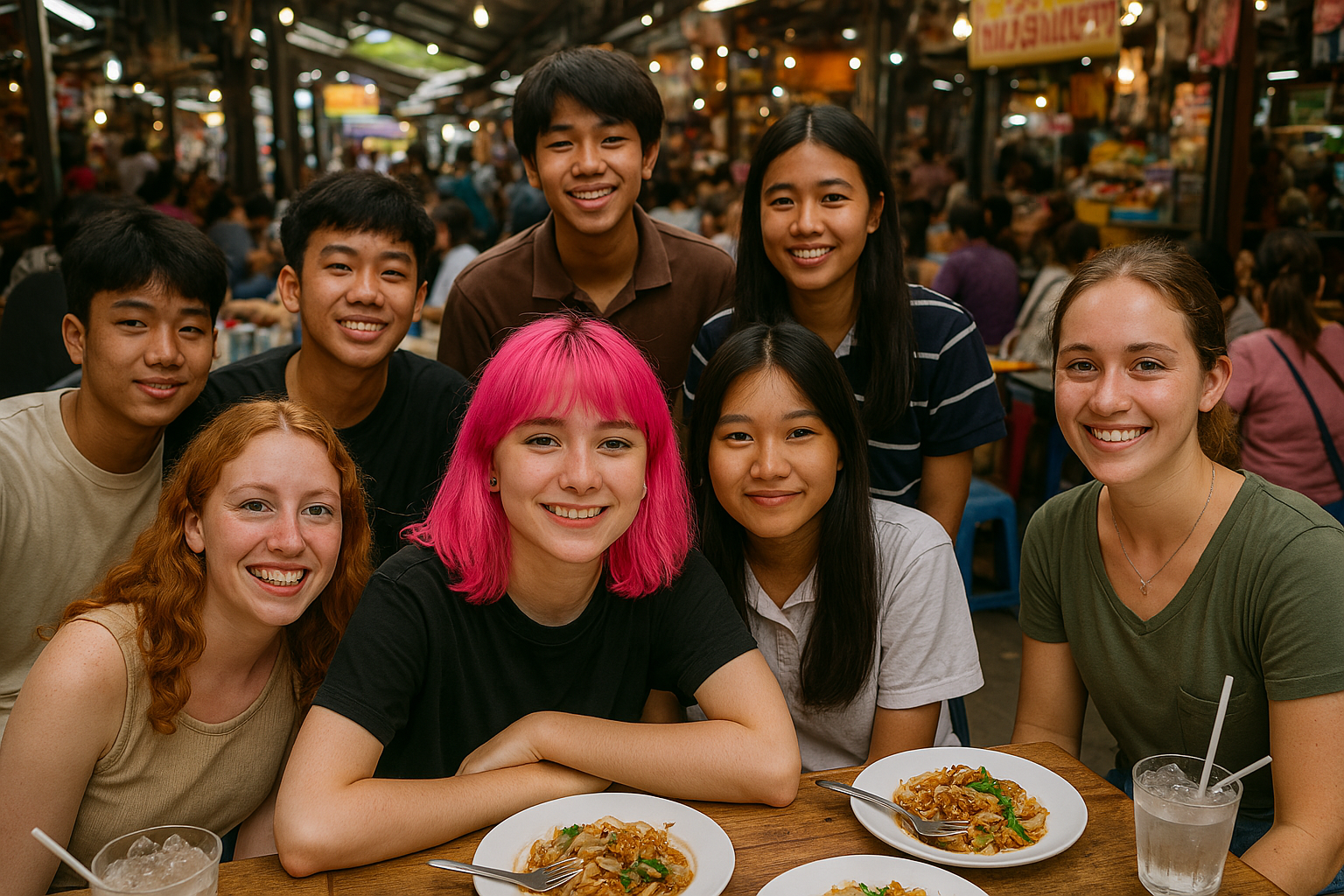
They bought Pad Thai from a street vendor and found a plastic table under string lights. The familiar ache of missing their grandfather settled between them as they ate in comfortable silence. Around them, Thai families laughed and ate together, children running between the stalls with sticky fingers and bright smiles.
“I keep expecting him to text me,” Emma said quietly. “Asking for photos, you know? Making me describe everything in detail.”
Sophie pulled out the lighter, setting it on the table between their steaming plates. The silver caught the warm glow of the market lights.
“I brought this because… I thought maybe I’d leave it somewhere. Like, scatter his ashes or something symbolic.” She gave a small laugh. “Stupid, really. It’s just a lighter.”
Emma reached across and touched the worn metal. “It’s not stupid. Remember how he always carried it? Even after he quit smoking twenty years ago.”
“Emergency fire,” they said in unison, mimicking their grandfather’s gravelly voice. He’d claimed you never knew when you might need to start a campfire or light someone’s way in the dark.
A group of Thai teenagers at the next table burst into laughter, and one of them, a girl about Emma’s age with bright pink hair, caught Sophie’s eye and smiled. Before Sophie could think too much about it, she found herself walking over.
“Excuse me,” she said in careful English. “My sister and I are here for Christmas. We’re from England. Do you… Would you like to share our table? It’s Christmas Eve.”
The pink-haired girl’s eyes lit up. “Oh! Yes, please!” Her friends gathered around, chattering in rapid Thai mixed with English. Their names tumbled out: Nim, Ploy, Bank, and Kao.
Soon, both tables were pushed together, and the teenagers were helping Sophie and Emma order more food, teaching them to say “Merry Christmas” in Thai: “Suk San Wan Christmas.” The lighter sat forgotten on the table as stories were shared through a mixture of languages, Google Translate, and lots of gesturing.
Nim, the pink-haired girl, was studying in Bangkok but was originally from a small village north of the city. She was spending Christmas Eve at the market because she couldn’t afford to travel home until New Year’s.
“Family is very important,” she said, her English careful but warm. “But sometimes… friends are family too, yes?”
Emma and Sophie exchanged glances. Their grandfather had always said that chosen family could be just as precious as blood family.
As the evening wore on, Bank produced a small Bluetooth speaker and played a mix of Thai pop and Christmas songs. When “White Christmas” came on, Nim giggled and pointed at Sophie and Emma.
“You miss white Christmas?” she asked.
“Actually,” Sophie said, surprising herself, “I think I prefer this. The warmth, the food, the…” she gestured around the table, “the people.”
Ploy noticed the lighter then, picking it up carefully. “Very beautiful,” she said.
Sophie found herself explaining about their grandfather, about the trip they’d taken in his memory, and about how she’d planned to leave the lighter somewhere meaningful. As she spoke, she realised the ache in her chest had softened somehow.
“But you know,” she continued, looking around the table at their new friends, “I think he would have loved this. This exact moment.”
Emma nodded, tears in her eyes. “He always said the best souvenirs were the people you met.”
When midnight approached, they all walked to a nearby temple where families had gathered for late-night Christmas prayers, Buddhist families celebrating the Christian holiday with the same spirit of love and togetherness that transcended specific traditions.
Standing there under the temple lights, surrounded by the gentle murmur of prayers in Thai and the warm presence of both strangers and new friends, Sophie made a decision. She pulled out her grandfather’s lighter and handed it to Nim.
“I’d like you to have this,” she said. “My grandfather would have wanted it to travel, to see the world he never got to explore.”
Nim’s eyes widened. “I cannot… this is too precious.”
“Please,” Sophie insisted. “Promise me you’ll carry it somewhere beautiful. Light someone’s way.”
Nim held the lighter reverently, then smiled. “I promise. Emergency fire, yes?”
“Emergency fire,” Sophie laughed, and Emma joined in.
As they exchanged contact information and promised to stay in touch, Sophie realised that this Christmas, sweat-drenched and thousands of miles from home, felt more full of joy and connection than any she could remember. Their grandfather’s lighter was beginning a new adventure, and somehow, so were they.
Walking back through the quieter streets to their hostel, Emma took Sophie’s hand.
“I think Grandpa Joe got his Christmas wish after all,” Emma said.
“What’s that?”
“He always wanted to travel the world and meet interesting people. I think he just did.”
Sophie squeezed her sister’s hand and looked up at the Bangkok sky, where no snow would fall, but where the warmth of human connection felt like the most perfect Christmas gift imaginable.
Your Body in Balance: The New Science of Food, Hormones, and Health – Neal D. Barnard
This nationally bestselling book explains the shocking new science of how hormones are wreaking havoc on the body, and the delicious solution that improves health, reduces pain, and even helps to shed weight.
Hidden in everyday foods are the causes of a surprising range of health problems: infertility, menstrual cramps, weight gain, hair loss, breast and prostate cancer, hot flashes, and much more. All of these conditions have one thing in common: they are fueled by hormones that are hiding in foods or are influenced by the foods we eat.
Your Body in Balance provides step-by-step guidance for understanding what’s at the root of your suffering-and what you can do to feel better fast. Few people realize that a simple food prescription can help you tackle all these and more by gently restoring your hormone balance, with benefits rivaling medications. Neal Barnard, MD, a leading authority on nutrition and health, offers insight into how dietary changes can alleviate years of stress, pain, and illness. What’s more, he also provides delicious and easy-to-make hormone-balancing recipes, including Cauliflower Buffalo Chowder, Kung Pao Lettuce Wraps, Butternut Breakfast Tacos, Mediterranean Croquettes, Apple Pie Nachos, and Brownie Batter Hummus.
Your Body in Balance gives new hope for people struggling with health issues. Thousands of people have already reclaimed their lives and their health through the strategic dietary changes described in this book. Whether you’re looking to treat a specific ailment or are in search of better overall health, Dr. Neal Barnard provides an easy pathway toward pain relief, weight control, and a lifetime of good health.
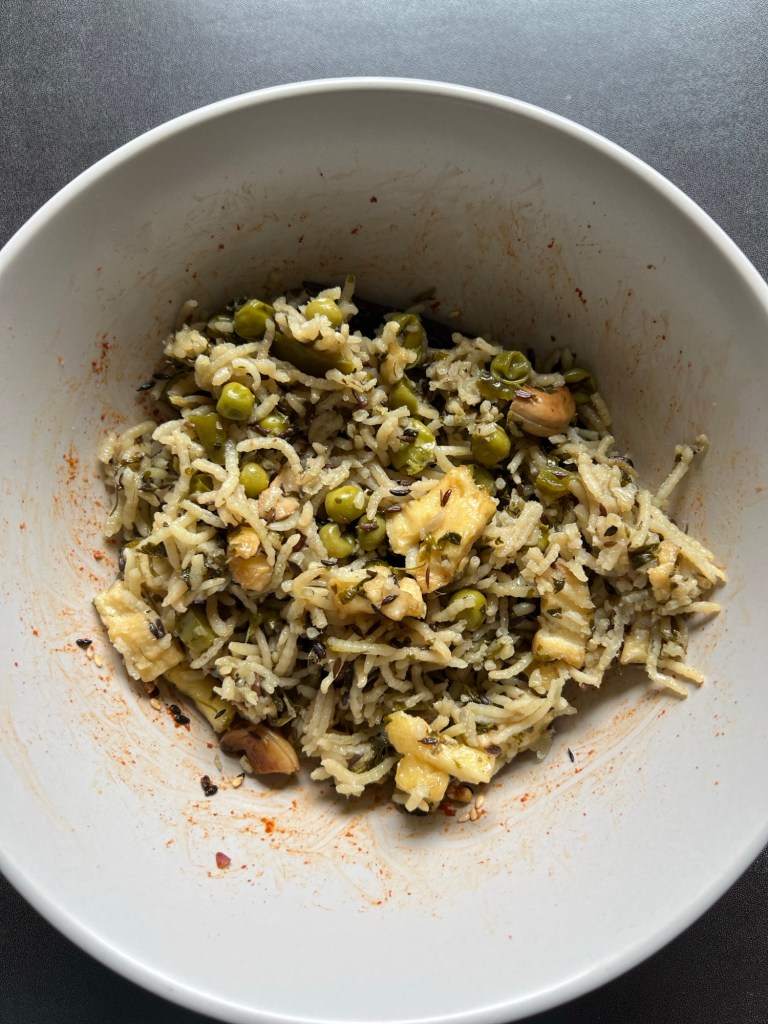
For those who watch this space regularly, you would know how much I love one pot meals. Just put everything together in a rice cooker or pan and let it do its thing. Today’s recipe is my spin on the classic and creamy methi malai mattar. It’s a quick recipe and perfect for those days when you don’t want to spend time in the kitchen and also makes a great addition to someone’s lunchbox.
I didn’t have fresh methi, so I used dried methi or kasuri methi, but if you have fresh methi, go ahead and the recipe will be even tastier.
Methi Malai Mattar Pulao
Ingredients:
1 cup basmati rice
1 small onion, sliced
½ cup fresh or frozen peas
½ cup fresh or frozen paneer, cut into bite-sized pieces
2 tbsp kasuri methi (if using fresh methi, use ½ cup)
2 green chillies, slit
1-inch piece of ginger, peeled and cut into strips
2 tbsp ghee
1 tsp cumin seeds
1 medium-sized dried bay leaf
3-4 cloves
3-4 cardamom
1 piece cinnamon
Salt to taste
2 cups water
Method:
Wash the basmati rice well a few times and soak it for at least 30 minutes. Keep aside.
In a pan, heat the ghee, and when the ghee is warm, put in the cumin seeds and let the seeds pop.
Then add in the bay leaf, cloves, cardamom, and cinnamon and stir for a couple of seconds.
Add the sliced onions and sauté till the onions become translucent and start browning.
Then add the peas and sauté for a bit before adding the paneer pieces.
Now crush the kasuri methi in the palms of your hands and sprinkle it over the peas and paneer. If you are using fresh methi, chop it into small pieces and add it to the pan now.
Drain the rice, add it to the pan, and sauté for a minute.
Season the pulao with salt. My rule of thumb is about 1 tsp of salt per cup of rice, but salt as per your discretion.
If you are using a rice cooker, add the contents of the pan to the rice cooker and add 2 cups of water. Switch on and cook until done.
If continuing on the pan, add the water, lower the flame to medium-low, and cook covered until the rice is completely cooked. Depending on the rice used, you may want to add more water.
Once the rice is done in both the rice cooker and the pan, let it sit for at least 10 minutes before opening it.
Fluff the rice with a spoon and serve hot with a raita and some chips or crisps.
Today’s quote is from Jon Kabat-Zinn, an American mindfulness teacher, scientist, and author who played a major role in bringing mindfulness meditation into mainstream medicine and psychology. He founded the Mindfulness-Based Stress Reduction (MBSR) programme at the University of Massachusetts Medical School and has written influential books such as Wherever You Go, There You Are and Full Catastrophe Living. His work bridges ancient Buddhist practices with modern science, emphasising awareness as a path to healing and clarity.
Kabat-Zinn’s quote turns a common human experience on its head. Boredom is usually something we try to escape. We distract ourselves, scroll our phones, or search for stimulation because boredom feels empty, uncomfortable, or pointless. But Kabat-Zinn invites us to do the opposite: to stay with it and really look at it. When we pay attention to boredom, we begin to notice that it isn’t a single, solid thing. It’s made up of sensations, thoughts, restlessness, impatience, and subtle emotions. There may be tightness in the body, a looping inner voice, or a craving for something “else.” By observing these details, boredom transforms from a dull void into a rich field of experience. What once felt flat suddenly has texture and movement.
This shift reveals a deeper truth about mindfulness. Life becomes interesting not because it changes, but because our attention changes. When we stop demanding that every moment entertain us, we start discovering depth in the ordinary. The breath, sounds in a room, or even the feeling of waiting can become unexpectedly vivid. Boredom, in this sense, is not a problem to solve but an invitation to wake up to the present moment. The quote also challenges our habit of constant stimulation. It suggests that our discomfort with boredom says more about our relationship with our minds than about the moment itself. By learning to be present even when nothing exciting is happening, we cultivate patience, curiosity, and inner freedom.
We’re back in Singapore from a few days in Cameron Highlands. The weather was perfect, mild and chilly at night and when it rained, which was pretty much everyday. The tea plantations were gorgeous, and we purchased so many different kinds of tea from the two major tea plantations that we are good for a good part of 2026. We also spent a day each way in Kuala Lumpur, breaking the 8-9 hour journey into half so that S, who was the only driver, could rest. Hopefully, by the time we do this kind of trip again, either BB or GG or both will have their driver’s license, and they can take over for parts of the journey.
Today’s weekly talk is about happiness. Happiness doesn’t have a specific recipe. There’s no one way to be happy. What brings one person joy may not do the same for someone else. Even the things that once made you happy may have changed over time. Be open to redefining your idea of what a happy life should look like. Instead of chasing someone else’s idea of happiness, honour what feels right for you. Exploring your interests and passions, without worrying about others’ judgment, is key to living authentically. Celebrate the life that is uniquely and beautifully yours.
And on that note, here’s to the penultimate week of 2025. Have you started planning your goals, wishes, and hopes for 2026? I have started the process and will share some with you; some will remain private. Have an incredible end of 2025!







 Memories and Such