Earth Overshoot Day

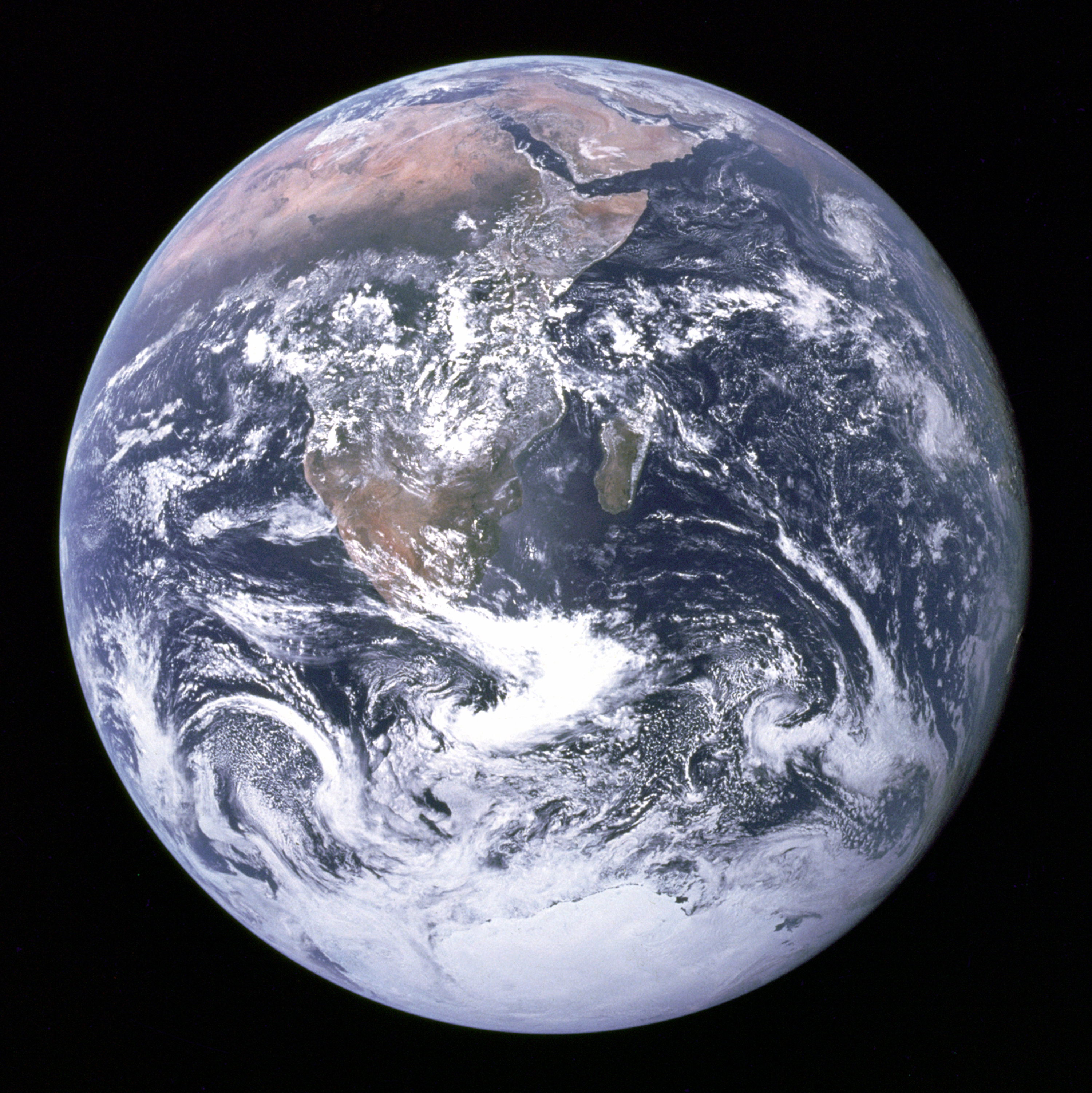
Earth Overshoot Day, an annual marker calculated by the Global Footprint Network (GFN), represents the date when humanity’s demand for Earth’s ecological resources exceeds what the planet can regenerate in that year. First observed in 2006, this day underscores the accelerating imbalance between human consumption and planetary boundaries.

Earth Overshoot Day emerged from the collaborative efforts of Andrew Simms, a researcher at the UK-based New Economics Foundation, and Mathis Wackernagel, co-founder of the Global Footprint Network. Their goal was to translate complex ecological data into a tangible metric to raise public awareness. Using the Ecological Footprint framework, which compares humanity’s resource demand like carbon emissions, and food production, against Earth’s biocapacity (e.g., forest regeneration, fisheries renewal), the GFN identifies the point each year when human activities outpace nature’s ability to recover. By framing ecological overshoot as a “budget deficit,” the initiative urges governments, businesses, and individuals to adopt sustainable practices.

The calculation of Earth Overshoot Day hinges on a simple ratio: dividing Earth’s annual biocapacity by humanity’s ecological footprint and multiplying the result by 365 days. Biocapacity measures the regenerative capacity of ecosystems, such as forests absorbing CO₂ or fisheries replenishing stocks, while the ecological footprint quantifies human demand for resources like cropland, timber, and fossil fuels. Disparities between nations are stark: high-consumption countries like the U.S. exhaust their share of resources within months, whereas others, such as Indonesia, operate within their biocapacity limits. This imbalance highlights the role of overconsumption in wealthy nations as a primary driver of global overshoot.

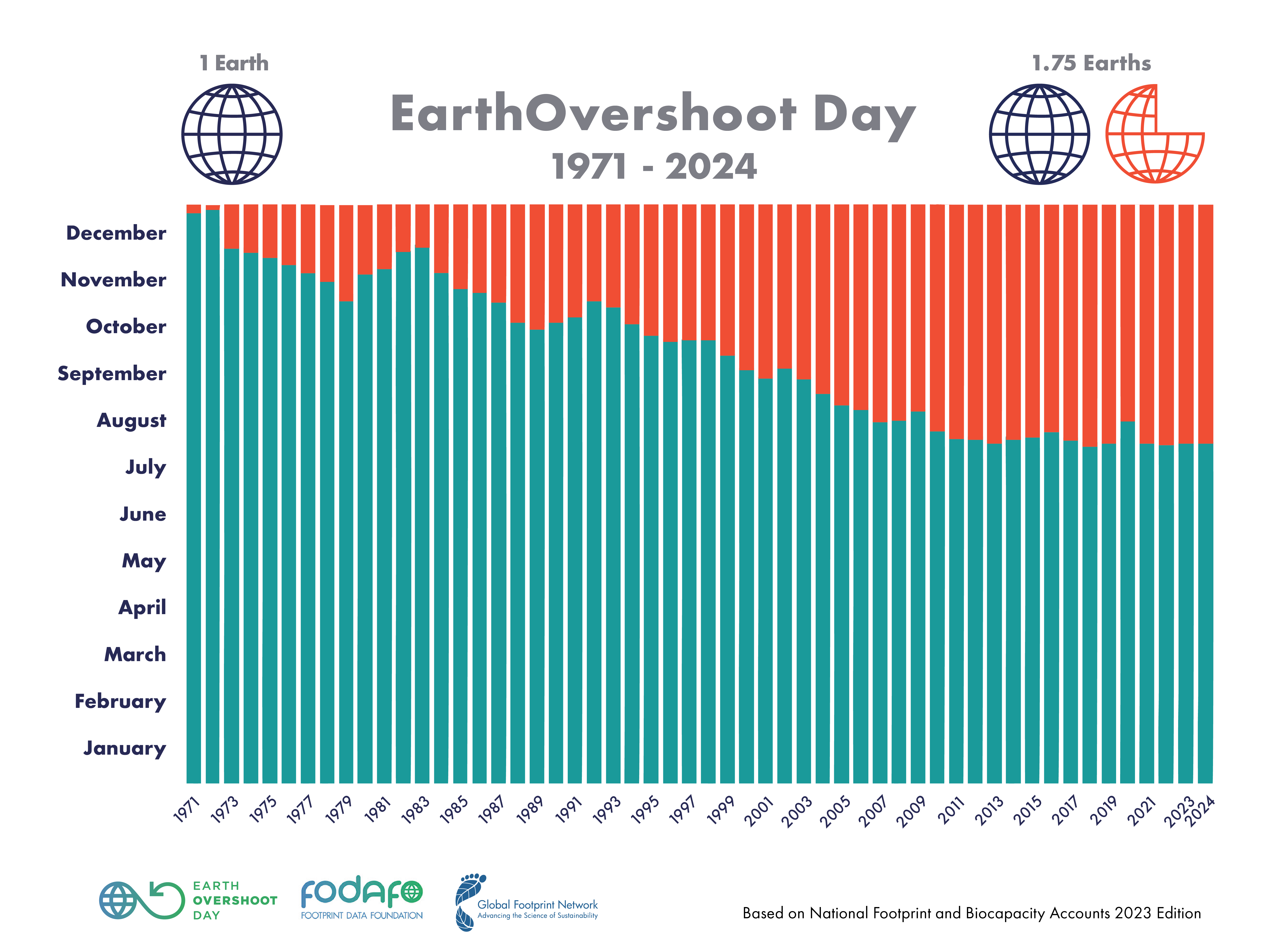
In the early 1970s, humanity’s resource use aligned with Earth’s regenerative capacity, with Overshoot Day falling in late December. However, rapid industrialization, population growth, and rising per capita consumption accelerated the date. By 2000, it had shifted to October 1, and by 2023, to August 2. Temporary delays, such as the 2020 date (August 22), resulted from reduced economic activity during COVID-19 lockdowns, illustrating how systemic changes in energy use and transportation can impact the timeline. Yet, such short-term shifts are unsustainable, emphasising the need for deliberate, long-term solutions.
The primary driver of overshoot is humanity’s carbon footprint, accounting for 60% of the global ecological deficit. Fossil fuel emissions far exceed the planet’s capacity to absorb CO₂, exacerbating climate change. Population growth, tripling since 1950, intensifies demand for food, energy, and goods, while overconsumption in affluent nations widens the gap. For instance, the average American consumes resources at a rate 30 times higher than a citizen of a low-income country. Additional factors include deforestation (10 million hectares lost annually), industrial agriculture (responsible for 70% of freshwater use), and overfishing (34% of fish stocks depleted). Together, these practices degrade ecosystems and undermine Earth’s ability to sustain life.

Ecological overshoot has cascading effects. Biodiversity loss is accelerating, with wildlife populations declining by 69% since 1970, according to the World Wildlife Fund. Climate change fuels extreme weather events, displacing communities and destabilizing economies. Resource depletion, such as collapsing fisheries or degraded soils, threatens food security, while competition for scarce resources exacerbates social inequality. Vulnerable populations, particularly in the Global South, bear the brunt of these impacts, despite contributing minimally to the crisis.
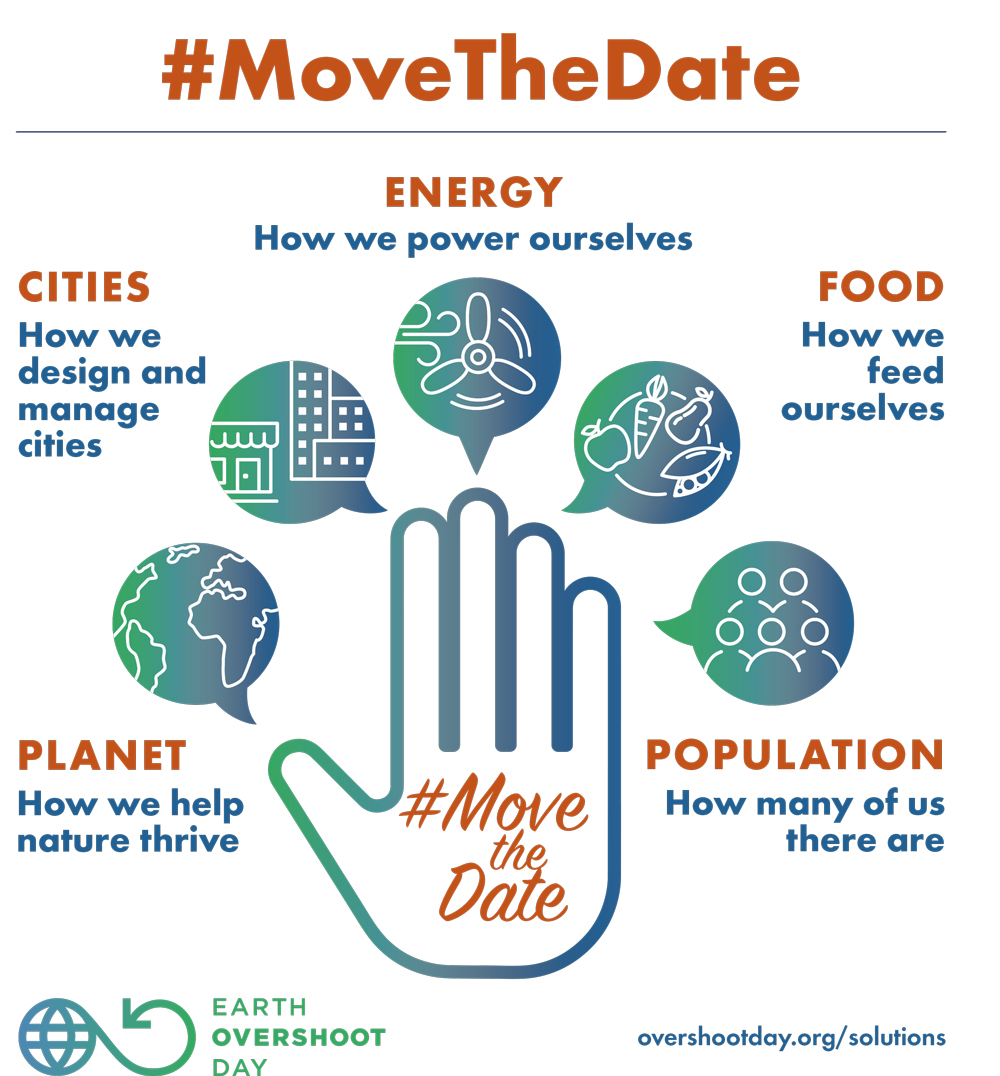
The Global Footprint Network’s #MoveTheDate campaign promotes solutions to push Overshoot Day backward. Transitioning to renewable energy could delay the date by 21 days, while adopting plant-based diets and reducing food waste could add 13 days. Circular economy models, which prioritise recycling and reusing materials, minimise waste and extraction. Urban planning innovations, such as green infrastructure and public transit, reduce cities’ ecological footprints. Policy interventions like carbon pricing, conservation incentives, and international agreements like the Paris Accord, are equally critical. Costa Rica exemplifies progress, generating 98% of its electricity from renewables and doubling forest cover since 1980.
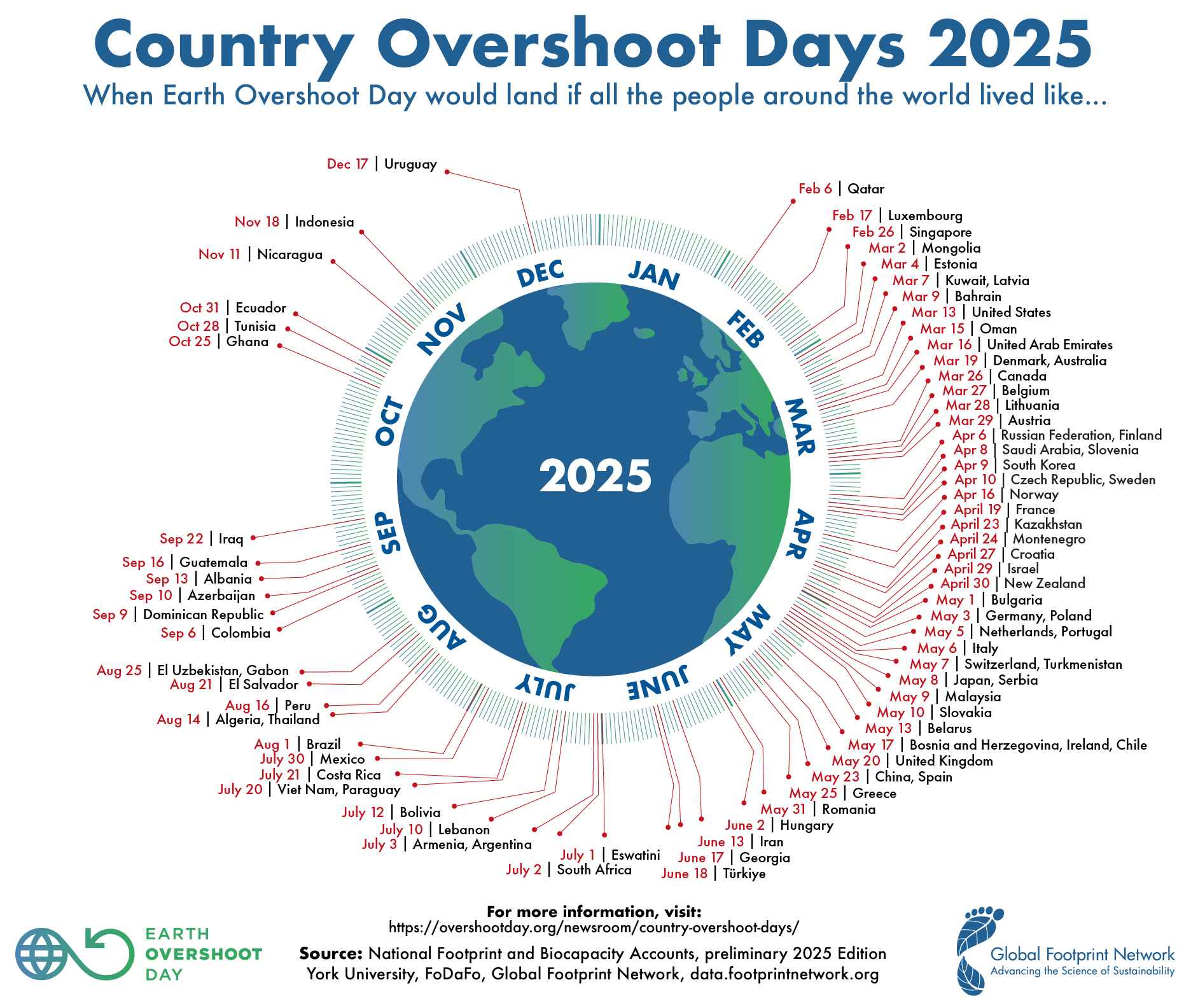
Country Overshoot Day, a national counterpart to Earth Overshoot Day, reveals the disparities in resource consumption between countries by calculating the date each would exhaust Earth’s annual ecological budget if global populations mirrored their residents’ lifestyles. Using the Global Footprint Network’s formula, comparing a nation’s per capita ecological footprint to global biocapacity, these dates range starkly: affluent nations like Qatar and the U.S. overshoot by February and March, respectively, while lower-income countries such as Indonesia and Jamaica often stay within planetary limits until December. High-income nations’ early dates stem from fossil fuel dependence, resource-intensive diets, and consumerism, with the U.S. footprint alone demanding five Earths if universalised. Such overconsumption drives climate change, resource depletion, and land degradation, disproportionately harming vulnerable regions least responsible for the crisis. Solutions include transitioning to renewables like Denmark’s 50% wind-powered grid, adopting circular economies, and enacting policies like carbon taxes. However, equity remains central: wealthy nations must reduce their footprints to leave ecological space for developing countries to meet basic needs. Country Overshoot Days underscore the urgency of aligning national policies with planetary boundaries to ensure a just, sustainable future.

Earth Overshoot Day serves as both a warning and a call to action. While the advancing date reflects humanity’s unsustainable trajectory, it also underscores the potential for change. By prioritizing renewable energy, sustainable consumption, and equitable policies, societies can realign with planetary boundaries. The challenge is monumental, but as initiatives like Costa Rica’s reforestation demonstrate, progress is achievable. Collective action, from grassroots advocacy to global policy, holds the key to moving the date and securing a livable future.

In My Hands Today…

The Whole Foods Diet: The Lifesaving Plan for Health and Longevity – John Mackey, Alona Pulde, Matthew Lederman

The Whole Foods Diet simplifies the huge body of science, research, and advice that is available today and reveals the undeniable consensus: a whole foods, plant-based diet is the optimum diet for health and longevity.

Standing on the shoulders of the Whole Foods Market brand and featuring an accessible 28-day program, delicious recipes, inspirational success stories, and a guilt-free approach to plant-based eating, The Whole Foods Diet is a life-affirming invitation to become a Whole Foodie: someone who loves to eat, loves to live, and loves to nourish themselves with nature’s bounty.

If Whole Foods Market is “shorthand for a food revolution” (The New Yorker), then The Whole Foods Diet will give that revolution its bible – the unequivocal truth about what to eat for a long, healthy, disease-free life.

International Moon Day

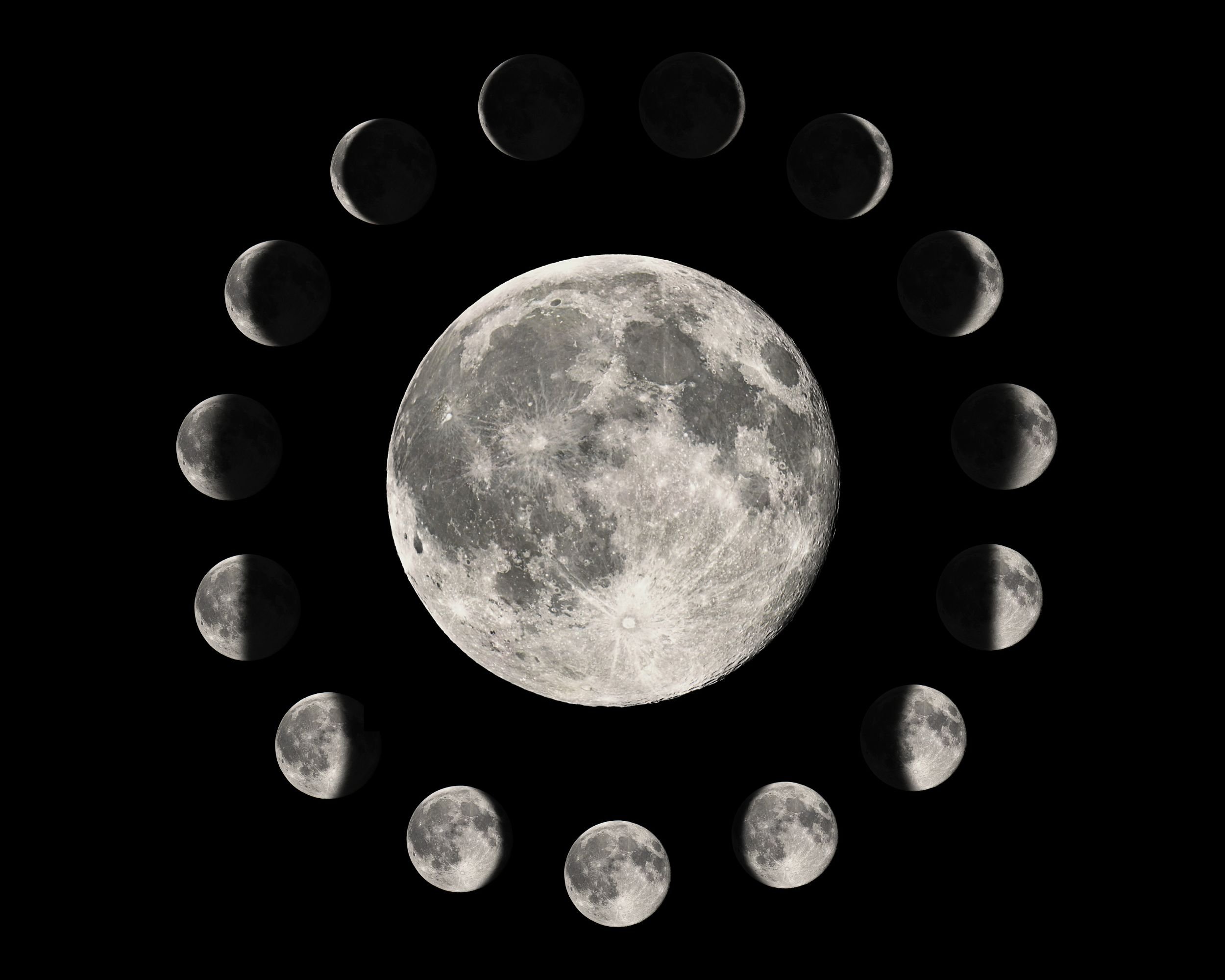
International Moon Day, observed annually on July 20, commemorates humanity’s first crewed lunar landing, the Apollo 11 mission in 1969, while promoting peaceful international cooperation in space exploration. Established by the United Nations in 2021, this day underscores the Moon’s role as a cornerstone of scientific discovery, cultural inspiration, and a stepping stone for future deep-space endeavors.

The Moon has captivated humanity for millennia, inspiring myths, art, and scientific inquiry. Ancient civilisations tracked its phases for agriculture and timekeeping, while Galileo’s telescopic observations in 1609 unveiled its cratered surface. The 20th-century space race transformed lunar exploration from fantasy to reality.

The Cold War rivalry between the U.S. and USSR catalysed early space achievements. The USSR’s Luna 2 (1959) became the first human-made object to reach the Moon, while NASA’s Apollo program, launched in 1961, aimed to land humans on the lunar surface. On July 20, 1969, astronauts Neil Armstrong and Buzz Aldrin made history, symbolising technological prowess and human ingenuity.

Following Apollo, lunar exploration shifted toward robotic missions and international partnerships. The 1994 Clementine mission and 2009 Lunar Reconnaissance Orbiter mapped the Moon’s terrain, while China’s Chang’e program (2013–present) and India’s Chandrayaan missions (2008–2023) reignited global interest. These efforts laid the groundwork for the UN’s designation of International Moon Day in 2021, which was proposed by over 20 nations to celebrate multilateralism in space.

International Moon Day addresses three core objectives. The day honours the Apollo programme’s technological milestones and its message of unity during a divided era. Armstrong’s “giant leap” remains a touchstone for global ambition. The 1967 Outer Space Treaty established space as a shared domain, free from militarisation. International Moon Day reinforces these principles amid modern initiatives like NASA’s Artemis Accords, emphasising transparency and sustainability. With plans for lunar bases and resource utilisation (e.g., water ice extraction), the day advocates for ethical frameworks to prevent environmental harm and ensure equitable benefits.

2025’s theme for International Moon Day is “One Moon, One Vision, One Future”. This theme encapsulates the spirit of unity, collaboration, and sustainability that underpins modern lunar exploration. As nations and organisations worldwide accelerate efforts to return to the Moon, this theme emphasises the Moon’s role as a shared resource, a unifying goal for humanity, and a foundation for intergenerational progress.

The Moon is humanity’s only natural satellite, a singular, unclaimed celestial body that has inspired wonder across cultures for millennia. One Moon underscores two critical principles: a common heritage of humankind and cultural and scientific universality. The theme calls for the preservation of lunar sites like the Apollo landing zones and geological wonders from damage by future missions and ensuring all nations, including emerging spacefaring states, can participate in lunar research and benefit from its resources. One Vision reflects the shift from Cold War-era competition to 21st-century cooperation. Today’s lunar efforts rely on multinational partnerships, blending public and private expertise. The theme urges harmonising standards by aligning safety, communication, and data-sharing protocols across programmes and expanding participation to nations with nascent space programmes, such as African and Latin American countries. One Future highlights the need to balance exploration with responsibility, ensuring the moon remains a viable platform for future generations.

International Moon Day engages diverse stakeholders through educational programmes, public events, digital campaigns, and policy dialogues. The day’s impact extends beyond celebration. It encourages youth to pursue careers in science, particularly in underrepresented regions. Space collaborations, such as the ISS, demonstrate how shared goals can transcend terrestrial disputes while public engagement democratises space discourse, ensuring citizens understand lunar exploration’s societal benefits like medical tech spin-offs.

Obstacles that need to be overcome include geopolitical tensions with competing national agendas that risk fragmenting exploration efforts, technical hurdles, including radiation exposure and life support systems that remain unsolved. Among the varied ethical dilemmas, balancing commercial interests like mining with lunar preservation.

The Artemis program aims to return humans to the Moon by 2026, including the first woman and person of color. Concurrently, the China-Russia International Lunar Research Station (ILRS) project targets a 2035 completion. Such initiatives, coupled with advances in AI and robotics, could establish a sustained human presence by the 2040s.

International Moon Day is both a tribute to past achievements and a call to action. As humanity stands on the brink of a new lunar era, collaboration and sustainability must guide our path. By uniting nations under shared goals, we ensure the Moon remains a beacon of hope, not just for exploration, but for global unity.

2025 Week 29 Update

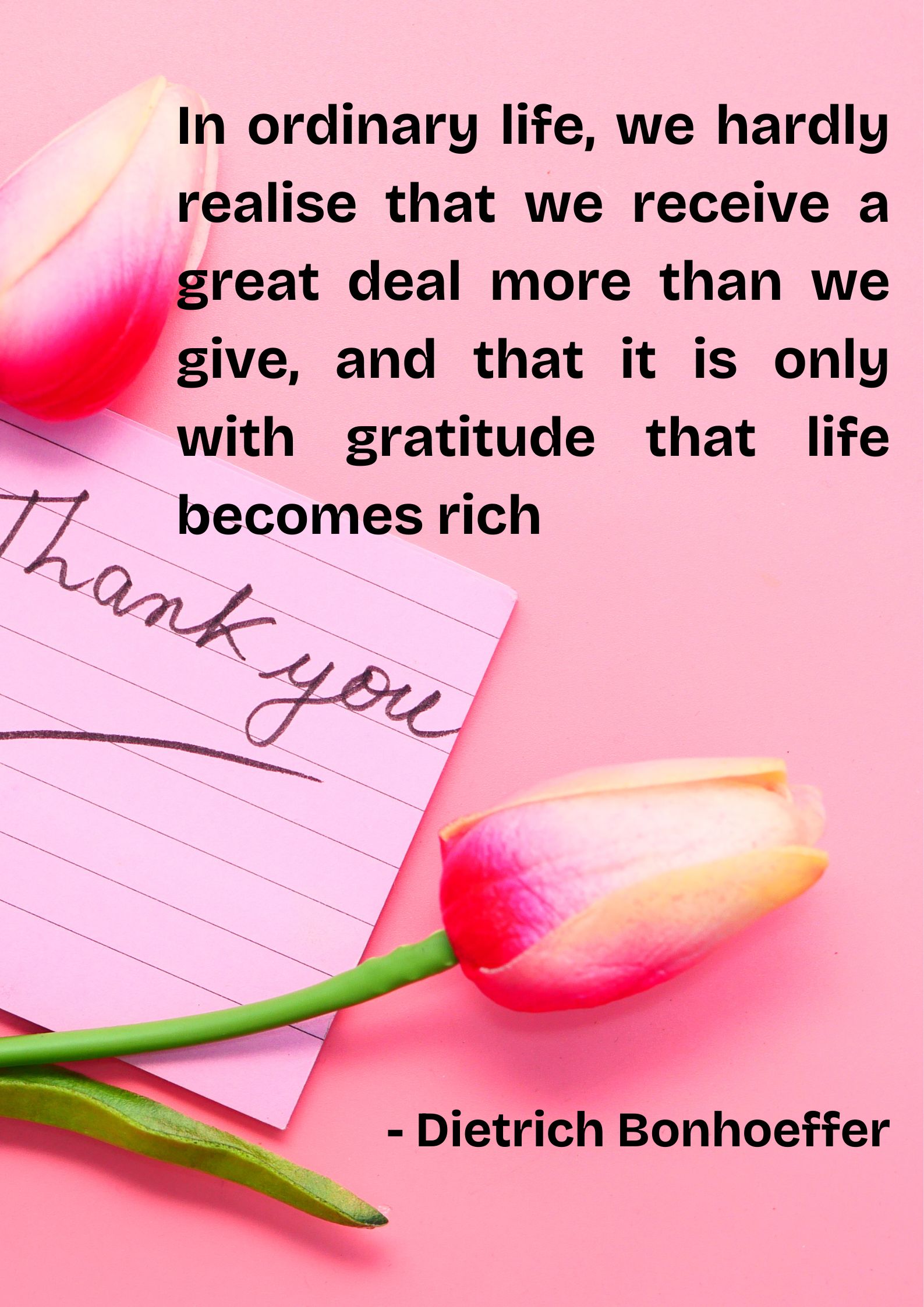
A German Lutheran pastor, theologian, and anti-Nazi dissident, Dietrich Bonhoeffer was known for his deep moral courage and spiritual insight. He was a vocal critic of Hitler’s regime and actively involved in resistance efforts, which led to his imprisonment and execution at the age of 39. Bonhoeffer’s quote reflects on the often-overlooked abundance present in everyday life. It reminds us that we are constantly receiving: be it through the kindness of others, the gifts of nature, or the unseen efforts that sustain our daily lives. Yet, in the busyness of routine, we tend to focus on what we lack or give, rather than acknowledging the quiet generosity that surrounds us.

He points out that gratitude is the key to true richness, not material wealth. When we become aware of all we receive: love, time, opportunities, even lessons, we begin to live more deeply and meaningfully. Gratitude shifts our perspective from scarcity to abundance, from complaint to appreciation. It enriches our emotional life, strengthens our relationships, and grounds us in humility. Ultimately, Bonhoeffer teaches that to live with awareness and thankfulness is to discover a richness that transcends possessions, one that fills the soul.

This week was a bit busy. I got my first freelance work, even though it was a very small amount, it gave me some hope that maybe I will be able to earn an income from here. Other than that, the week was spent writing, both for this space and for commissions, and I am happy because it means my creativity is back. BB & GG are busy with their work. GG’s internship will come to an end at the end of this month, and then she will start a new semester in August.

Life goes on, unbroken and constant, which can be simultaneously a blessing and a curse. While its a good thing that our lives are not in a constant state of uncertianty, but at the same time, it can get boring. So I don’t know if I should be happy or sad. I think I will choose happiness over sadness and look forward positively. That’s all from me this week, stay positive and keep smiling!

In My Hands Today…

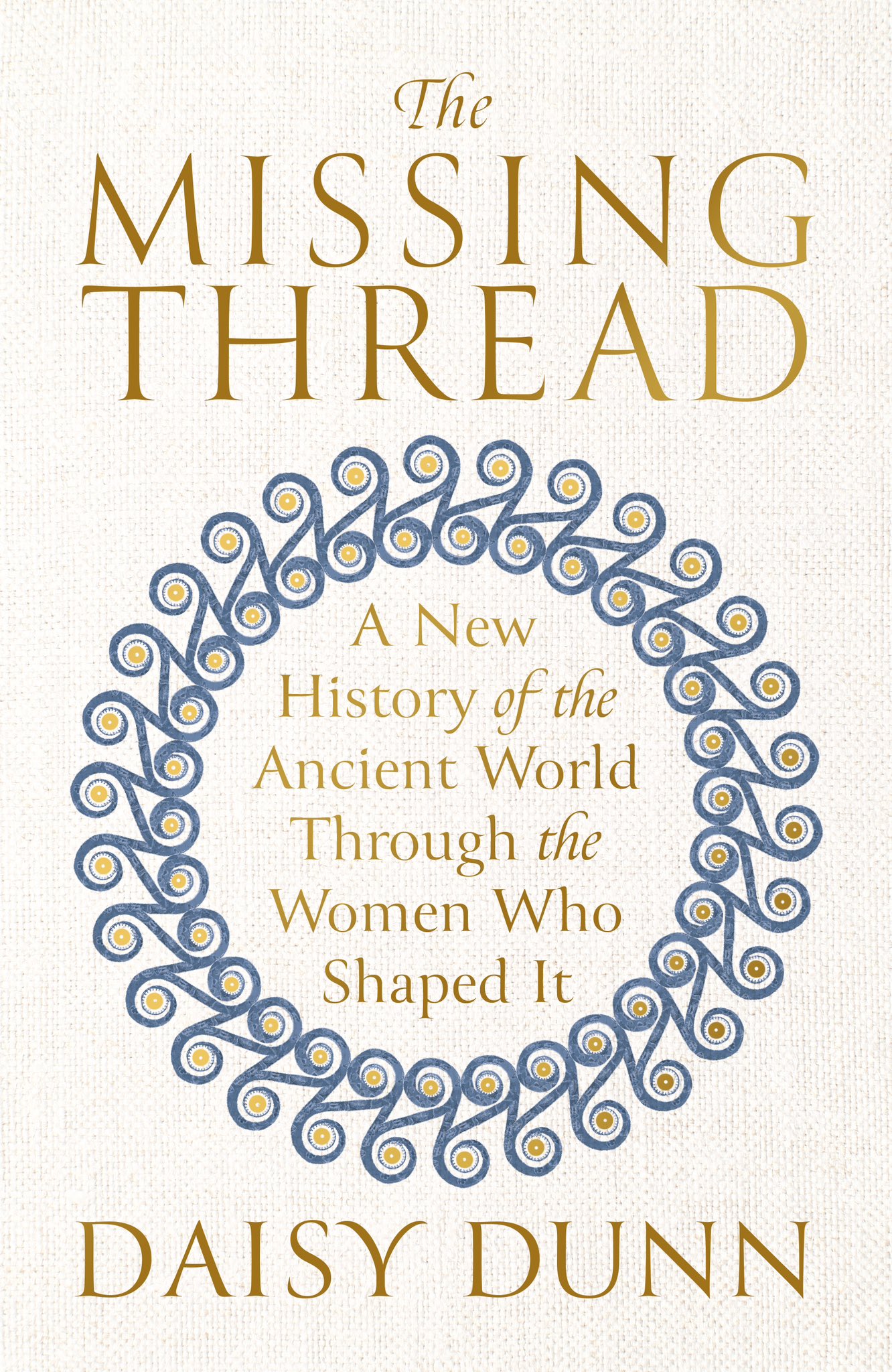
The Missing Thread: A Women’s History of the Ancient World – Daisy Dunn

Spanning 3,000 years, from the birth of Minoan Crete to the death of the Julio-Claudian dynasty in Rome, a magisterial new history of the ancient world told, for the very first time, through women.

For centuries, men have been writing histories of antiquity filled with warlords, emperors and kings. But when it comes to incorporating women aside from Cleopatra and Boudica, writers have been more comfortable describing mythical heroines than real ones.

While Penelope and Helen of Troy live on in the imagination, their real-life counterparts have been relegated to the margins. In The Missing Thread, Daisy Dunn inverts this tradition and puts the women of history at the centre of the narrative.

These pages present Enheduanna, the earliest named author, the poet Sappho and Telesilla, who defended her city from attack. Here is Artemisia, sole female commander in the Graeco-Persian Wars, and Cynisca, the first female victor at the Olympic Games. Cleopatra may be the more famous, but Fulvia, Mark Antony’s wife, fought a war on his behalf. Many other women remain nameless but integral.

Through new examination of the sources combined with vivid storytelling Daisy Dunn shows us the ancient world through fresh eyes, and introduces us to an incredible cast of ancient women, weavers of an entire world.