Life Lessons to GG & BB on their 17th Birthday

Today GG & BB turn 17! I can’t believe the tiny babies who were placed in my hands and were just about an arm’s length now tower over me. They are their own individuals who have their own ideas about life and who are now on the cusp of adulthood. I usually write a letter for them for their birthday and I have written one for their previous birthdays and while writing this post, I actually went back to read my old posts and I am amazed how much they have grown over the years. I do send them the link to my posts and ask them to read and even share if they want to with their friends.

Since they have now started tertiary education, I thought this could be the perfect time to share some life lessons. And since they are 17 today, I’ll do 17 such lessons grouped into different categories:

  1. Sleep: Sleep at least 7 hours a day, your body will thank you 40 or 50 years down the line. At this point in life, you may think you are invincible and can’t get by with the bare minimum of sleep, but your sleep debt is accumulating. Sleep plays a critical role in helping our bodies and minds recover and rejuvenate. Sleep promotes cognition and memory, facilitates learning, recharges our mental and physical batteries, and generally helps us make the most out of our days. With plentiful sleep, we improve our mental and physical health, reduce stress, and maintain the routine that is critical to healthy daily functioning. This habit, if healthly followed will stand in good stead in life, when you may not get the optimum level of sleep, but then you would not have accumulated so much sleep debt.
  2. Look after your health: You have only one body in this life, so look after it and keep it in optimal condition. Have healthy eating habits, eating more fresh produce and less junk food. Try to give up sugar if possible, it will do wonders for your health and also do not snack mindlessly. Make sure you do some exercise each day. It’s best if you do something you enjoy like dancing or running, but whatever you do, just do something! Not only will it mean having good health all through life, it also means when you present yourself in front of others, you are confident about your body and therefore about yourself. In the same vein, look after your external looks too. Take care of your skin and adopt a good skincare routine, irrespective of your gender. Makeup only conceals and covers, but with a good skin, makeup will enhance what you already have.
  3. Appreciate your family and close friends: Listen to what your parents and elders have to say. They know much more than you, especially at this point in life, and only have your best interests in mind when they give you advice. Most of the advice they give you is most probably from experience and they have gone through the exact same situation you are now in. At the same time, don’t listen to them blindly, your parents are after all human beings and can be wrong, so listen to them and then do some further research before you decide to take or not to take their advice.
  4. Learn life skills: These are skills you need to lead your life which include skills like cooking, cleaning, doing your laundry etc. Learn them now while you are still living at home and can get tutored from your parents on how best to do these chores. If you don’t learn them voluntarily now, you may be forced to learn them (maybe without someone teaching you) at a later stage.
  5. Learn to love IT: Artificial Intelligence is taking over the wold and with this many jobs will become redundant in the future. Learn to code and embrace AI so that your job becomes more secure. You will also have a plan B should the job you are in at any point be made redundant.
  6. Never stop learning: This is self evident. The day you stop learning is the day you start to stagnate. Learning stops the day you die and so never stop learning. Learning does not only come from a book or by going to school, every incident in life is a learning opportunity, so learn from all your successes and failures, learn from family, friends, coworkers and even the random stranger you meet may teach you something, so keep learning every second of the day.  
  7. Grab every opportunity that comes your way: In fact, I would say, go out of your way to find and look for opportunities. Look for internships and projects which will boost your resume and bring you front and centre of those who make hiring decisions. Many opportunities are never advertised mainly because these are filled because someone recommends a suitable person. Become that suitable person by showcasing what you can bring to the table by your work. Acknowledge your mistakes, own them and learn from them.
  8. Find a mentor: Search and find a good mentor who has the experience and knowledge to guide you. In fact, I would advise that you look for multiple mentors who can guide you in various aspects of life. Of course you don’t only take from a mentor, you should also give back to your mentor and help where you can. A mentor who is willing to help you does that because he or she sees that elusive spark in you. They have the connections and access to important people which you will not have at this point. A good mentor will lead you by pushing and encouraning you to get where you want to go and with their suppoer and encouragement, you should be able to succeed.
  9. Read: Reading is incredibly important and you should read widely and across a variety of genres. You access new worlds and learn so much from reading that you should set aside a dedicated time each day to read. Reading reduces stress, stimulates your mind, improves your vocabulary and memory and makes you know a lot about many many things that others are ignorant about. It also improves focus and concentration and hones your analytical and critical thinking skills and when you read more, you automatically become better in your own writing which will be an asset everywhere.
  10. Life’s passion: Try to find something you can be passionate about all your life. This will make life a bit easier when you spend half yor day or more at work. Of course, passions change and you need to refine your passion as you grow, both at work and in life and when passions change, try to make sure you are in the right position to take advantage of this change in passion.
  11. Learn to say No: This is another important life lesson. Most times, we are afraid to say No to the people in our lives – be it our family, friends, co-workers or managers. We take on more than we can do and afraid of confrontation, we end up saying Yes. If you find it difficult to say no, start practising with low stakes – like a stranger accosting you in the MRT station or someone trying to sell you something. Say Yes only when the opportunity aligns with your long-term goals. Another way to say no is to couch your refusal in very polite terms.
  12. Privacy Matters: Be aware of and ensure your privacy. There is no need to overshare on social networks, what is on the internet stays there forever, you never know when a post or a photo or a video can come back to haunt you. So be very circumspect in what you post online.
  13. Be financially literate: Financial literacy is important because it will equip you with an understanding of basic financial concepts so that you make sound real-world financial decisions. With this knowledge, you are in a better way to be able to manage your money, make sound decisions, and maintain healthy spending and budgeting habits, which over time can lead to financial wellness. Start a savings habit as early as possible and remember the power of compounding!
  14. Lead a purposeful life: What does this mean? It means not to go through the motions of life, the life you lead should be one in which life has some meaning, a life where you are connected and engaged with those around you. Do something for the less fortunate in society and learn to give back to those who need it, it need not be money, you can give your time, your skill-set and sometimes even a listening ear is enough. In this same vein, I would also recommend starting a meditation practice daily. Spending a few minutes each day with just yourself and your breathing will do wonders for your mental health and life equilibrium.
  15. Focus on what is important at this moment: Today it is school and tomorrow it will be your career. Focus fully on what is in front of you. Also at this point, you can and should take some calculated risks in life, specially since you are cushioned by your family and don’t have family and financial commitments as yet. Be competitive, but don’t make the competition a one-upmanship show. Be your own competitor and try to be a better version of yourself than what you were yesterday. Don’t indulge in petty politicking at work or school. Stay away from gossip and cheap talk and let your work speak for itself.
  16. Don’t be a sheep: Don’t accept instructions blindly or sign documents just because someone tells you to do so. Do your own research, ask questions before making a call and use caution before taking any decision. Also, it will help If you can talk to people close to you, especially your parents.
  17. Be Ambitious: Be ambitious and reach for the stars. In fact, aim for the stars and you will reach the moon. Aim for something slightly over your reach and go all out to achieve it, you will eventually get to it. You are also the average of the five people you spend the most time with, so choose friends wisely. Also remember that there is no shortcut to success. All those successful people you see, they had to hustle for years and work hard before they became ‘overnight sucesses’. Lastly be scrupulously honest, both with yourself and the people around you. Lies have a way of catching up and keeping up with the many falsehoods you may have said will definitely catchup one day!

So there you have it, 17 life lessons which I hope are useful to them.

Meditation – To open your eyes, close them

Wikipedia defines Meditation as a practice where an individual uses a technique – such as mindfulness, or focusing the mind on a particular object, thought, or activity – to train attention and awareness, and achieve a mentally clear and emotionally calm and stable state. Scholars have found meditation difficult to define, as practices vary both between traditions and within them.

Meditation has been practiced since 1500 BCE antiquity in numerous religious traditions, often as part of the path towards enlightenment and self realization. The earliest records of meditation or Dhanya as it is called in Sanskrit, come from the Hindu traditions of Vedantism. Since the 19th century, Asian meditative techniques have spread to other cultures where they have also found application in non-spiritual contexts, such as business and health.

Meditation may be used with the aim of reducing stress, anxiety, depression, and pain, and increasing peace, perception, self-concept, and well-being. Meditation is under research to define its possible health benefits which could be psychological, neurological, and cardiovascular as well as other effects.

Meditation has been associated with all the major religions of the world, be it Hindusim, Islam, Jainism,Buddhisim or Christianity. There have been many religious practices which has its roots in meditation, be it chanting the lord’s name with a rosary or sitting in one position and comtemplating the infinite.

I have written about meditation previously, but even though I have tried meditating in fits and bursts, after a few days, I usually find myself starting to slack. Earlier this year, I restarted meditating again. It started with someone asking if I was interested in being a part of a group for Deepak Chopra’s 21 day meditation course. Intrigued, I said yes and started the programme. During the programme, I also came across an app which was giving free access to all their meditation programmes for a year because of the current situation and I decided to take them up on their offer. Initially, I used to meditate at night before bed, but soon started falling back on old habits and trying to miss one day thinking it was no big deal. Then I switched it up. I started waking up about 30 minutes earlier daily to meditate and to my big surprise, this really worked for me. I found that I really liked being awake early enough when the house was in silence and the 15 minutes I spent on my practice started paying off. These days, I find myself waking up early even on weekends and public holidays, when I would normally sleep in, just because I want to meditate in silence and darkness (or with minimal light). I have now been consistent with my practice for more than two months and it has done wonders in my own behaviour. I feel that I have become less anxious and also feel more positive these days, with the cloud of negativity that usually hangs around me, lessened to a great degree. I am also trying to be more grateful to things around me, which is a positive thing.

Mediation is a practice and you only get better the longer you practice it. Every meditation practice is unique in its own way and even if you feel you did not have a good practice, incrementally you are getting better. Meditation is great for both physical, mental and spiritual well-being. It lowers your blood pressure, improves blood circulation, lowers heart rate, reduces anxiety, slows down your respitory rate, reduces anxiety, lowers blood cortisol levels, reduces stress, gives you feelings of well-being and improves and deepens your sense of relaxation.

Contemporary researchers are now exploring whether a consistent meditation practice yields long-term benefits, and noting positive effects on brain and immune function among meditators. Yet it’s worth repeating that the purpose of meditation is not to achieve benefits. To put it as an Eastern philosopher may say, the goal of meditation is no goal. It’s simply to be present.

Meditation is not as difficult as we think. All we need to do is sit in a quiet place with no distractions. Close your eyes and start focussing on the one thing we all have and do – our breathing. Just breathe naturally, there is no need to to changeyour breathing style and technique. If you mind wanders, and this is common and natural, just acknowledge it and go back to focussing on your breathing. You may also feel phantom itches and perhaps pain. When this happens, again acknowledge it and go back to your breath. When you start, you can start at 1-2 minutes and then once you become comfortable, slowly start increasing the time and you can go as long as 15-20 minutes. The longer you practice meditation, the more your focus becomes sharper and you can after some time, focus on your breathing without your mind wandering for the entire duration of the meditation.

During times like this, when we are anxious on so many levels and worry about our health, finances and scores of other things, a meditation practice will help you manage your anxieties and help you get a grip on things so that you don’t get overwhelmed.

Ikigai: Your Raison D’être in Life

A couple of months back, I came across this Japanese term, ‘Ikigai’ which essentially means finding your passion in life and leading your life according to that, in other words, your ‘raison d’être’ and the term really intrigued me. In other words, Ikigai is what makes you get up each morning and jeep going even when the going gets tough.

When I read more about this term, I thought that perhaps this was the missing link in our lives. If we lived a life worth living, if we did something which makes us jump out of bed each morning and looked forward to each new day, then wouldn’t that be the best thing ever? We would never have to work a day in our lives and life will be so much smoother without the usual angst work generates within us.

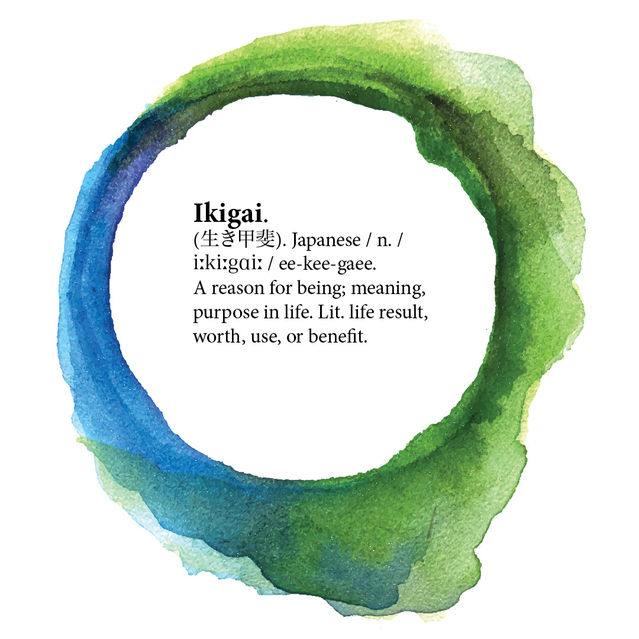
Ikigai which is pronounced as it is spelt, is a Japanese concept which means, “a reason for being”. The word “Ikigai” is usually used to indicate the source of value in one’s life or the things that make one’s life worthwhile. The word translated to English roughly means “thing that you live for” or “the reason for which you wake up in the morning.”

Each individual’s Ikigai is personal to them and specific to their lives, values and beliefs. It reflects the inner self of an individual and expresses that faithfully, while simultaneously creating a mental state in which the individual feels at ease. Activities that allow one to feel Ikigai are never forced on an individual; they are often spontaneous, and always undertaken willingly, giving the individual satisfaction and a sense of meaning to life.

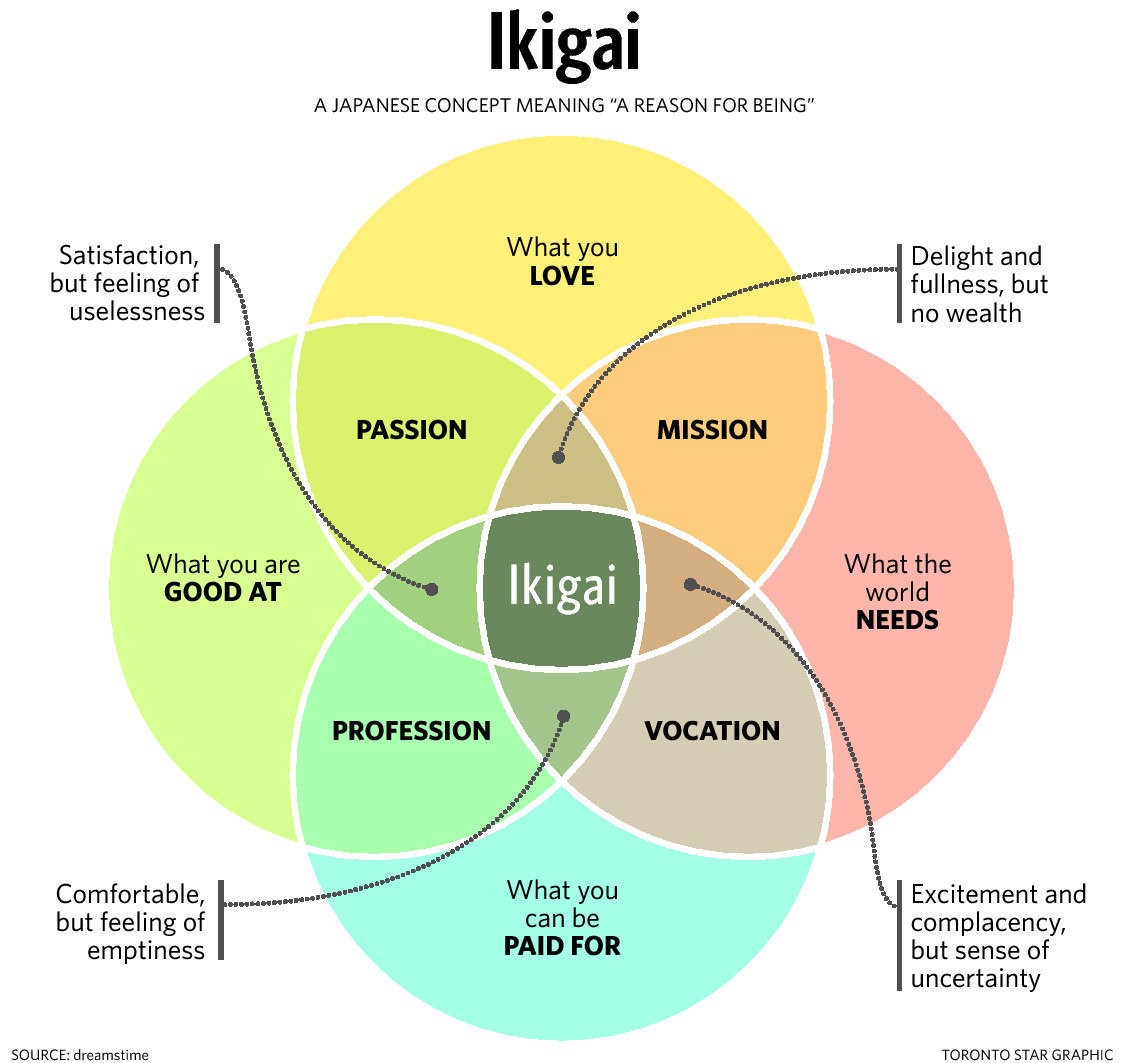
According to best seller author Dan Buettner, Ikigai lies at the cross section between your values, what you like to do and what you are good at. When you are able to figure that out, you have found your personal Ikigai.

So how do you find out your own personal Ikigai? Make four lists – the first one being your passion in life or what you love doing, the second being your mission in this world or what you feel this world needs, the third list being the able to figure what you are good at or your vocation in life and the last list being what you can get paid for doing your vocation which is essentially your profession. The intersection of these four lists will allow you to figure your personal and unique Ikigai.

In their book Ikigai: The Japanese Secret to a Long and Happy Life, Hector Garcia and Francesc Miralles break down the ten rules that can help anyone find their own Ikigai:

  1. Stay active and don’t retire
  2. Leave urgency behind and adopt a slower pace of life
  3. Only eat until you are 80 per cent full
  4. Surround yourself with good friends
  5. Get in shape through daily, gentle exercise
  6. Smile and acknowledge people around you
  7. Reconnect with nature
  8. Give thanks to anything that brightens our day and makes us feel alive.
  9. Live in the moment
  10. Follow your Ikigai

While the concept has been around for centuries now (it originated in the Heian period, sometime during the period 794 to 1185 AD), the majority of us, including the Japanese people haven’t quite figured it out yet.

There have been studies which say that Ikigai promotes a sense of wellbeing which is probably why the Japanese and particularly Okinawians where this concept is said to have originated live the longest. It was statistically proven that presence of Ikigai is correlated with a lower level of stress and an overall feeling of being healthy. The feeling of Ikigai balances out the secretion of neurotransmitters such as dopamine, serotonin and β-endorphin. Some studies demonstrate that a sense of purpose or goal in life or Ikigai is negatively correlated with a need for approval from others and anxiety and studies also found that Ikigai is associated with longevity among Japanese people.

Human beings are born curious. Our insatiable drive to learn, invent, explore, and study deserves to have the same status as every other drive in our lives. So go and channel that curiosity and maybe you will be able to find that sweet spot in your life which is your Ikigai. Once you do, use it every day. Find things to do, simple or complex in your day to day lives which would be an expression of your Ikigai and once you have found and pursued it, you will realise that anything else is just compromise.

I am going to leave you with a Youtube video where Dan Buettner speaks in a Ted-Ed video on how to live to more than a 100 where he also speaks about Ikigai.

2018 Week 14 Update

Another week and this was a mixed bag of a week for me.

I have been super productive in finishing some chores which have been pending since the start of the year. I am almost done with the organisation of some documents and will start with something else later this week.

We’ve all been sick, starting with GG, then BB and me together. GG seems to have recovered, but BB and I are still not 100% fine.

That’s about it for me this week. I am also psyching myself to get myself to agree to a decision for which my self-imposed deadline will come in a couple of months and I really need to psych myself for it.

Have a lovely week folks!

2018 Week 4 Update

So how was your week?

This week I did something that I can tick off from my life bucket list; I watched a film alone in the theatre. It’s always been quite weird to think I could see a movie alone, but wanted to break free and do it anyway! The children wanted to watch Maze Runner Death Cure and when I checked, in the same theatre, there was a show for Padmavaat running around the same time. So I bought tickets for both movies and saw the movie. S could not make it as he had something on and anyway, he was not really interested in the movie.

I’ll post a more detailed movie review later in the week, but for now, after watching the movie, I just don’t get the hype and hullabaloo that had been and is continuing to happen in India over this film.

In another career related news, this week, I should hear back from two places I had gone for an interview earlier in the month. They had told me they will get back to me by the end of the month, so that’s now. Let’s see if something comes up from either of these.

Have a wonderful week, we’re within spitting distance to February!