In My Hands Today…

Never Have I Ever – Joshilyn Jackson

This image has an empty alt attribute; its file name is 36679186.jpg

In this game, even winning can be deadly…

Amy Whey is proud of her ordinary life and the simple pleasures that come with it—teaching diving lessons, baking cookies for new neighbors, helping her best friend, Charlotte, run their local book club. Her greatest joy is her family: her devoted professor husband, her spirited fifteen-year-old stepdaughter, her adorable infant son. And, of course, the steadfast and supportive Charlotte. But Amy’s sweet, uncomplicated life begins to unravel when the mysterious and alluring Angelica Roux arrives on her doorstep one book club night.

Sultry and magnetic, Roux beguiles the group with her feral charm. She keeps the wine flowing and lures them into a game of spilling secrets. Everyone thinks it’s naughty, harmless fun. Only Amy knows better. Something wicked has come her way—a she-devil in a pricey red sports car who seems to know the terrible truth about who she is and what she once did.

When they’re alone, Roux tells her that if she doesn’t give her what she asks for, what she deserves, she’s going to make Amy pay for her sins. One way or another.

To protect herself and her family and save the life she’s built, Amy must beat the devil at her own clever game, matching wits with Roux in an escalating war of hidden pasts and unearthed secrets. Amy knows the consequences if she can’t beat Roux. What terrifies her is everything she could lose if she wins.

World Youth Skills Day

Our youth make up a bulk of the world’s population today with many countries and continents having a younger population as compared to an ageing one. Today, there are about 1.2 billion young people aged 15 to 24 years, who account for 18 per cent of the global population.

Rising youth unemployment is one of the most significant problems facing economies and societies in today’s world, for developed and developing countries alike. At least 475 million new jobs need to be created over the next decade to absorb the 73 million youth currently unemployed and the 40 million new annual entrants to the labour market. At the same time, OECD surveys suggest that both employers and youth consider that many graduates are ill-prepared for the world of work.

Attaining decent work is a significant challenge. In many countries, the informal sector and traditional rural sector remains a major source of employment. The number of workers in vulnerable employment currently stands at 1.44 billion worldwide. Workers in Sub-Saharan Africa and South Asia account for more than half this number, with three out of four workers in these regions subject to vulnerable employment conditions.

In November 2014, the United Nations, at its General Assembly, declared 15 July as World Youth Skills Day or WYSD. The aim of WYSD is to recognize the strategic importance of equipping young people with skills for employment, decent work and entrepreneurship, and to highlight the crucial role of skilled youth in addressing current and future global challenges. Today’s WYSD takes places in a very challenging world. The COVID-19 pandemic and lockdown measures have led to the worldwide closure of technical and vocational education and training or TVET institutions, threatening the continuity of skills development. UNESCO currently estimates that nearly 70% of the world’s learners are affected by school closures across education levels. Respondents to a survey of TVET institutions, jointly collected by UNESCO, the International Labour Organization (ILO) and the World Bank, reported that distance training has become the most common way of imparting skills, with considerable difficulties regarding, among others, curricula adaptation, trainee and trainer preparedness, connectivity, or assessment and certification processes.

Even before the current panademic, young people were almost three times more likely to be unemployed than adults and continuously exposed to lower quality of jobs, greater labor market inequalities, and longer and more insecure school-to-work transitions. In addition, women are more likely to be underemployed and under-paid, and to undertake part-time jobs or work under temporary contracts.

The international community has set an ambitious 2030 Agenda for Sustainable Development which calls for an integrated approach to development which recognises that eradicating poverty in all its forms and dimensions; combating inequality within and among countries; preserving the planet; creating inclusive and sustainable economic growth; achieving full and productive employment and decent work for all women and men; and ensuring full gender equality and fostering social inclusion, are interdependent.

Education and training are central to the achievement of the 2030 Agenda. The vision of the Incheon Declaration: Education 2030 is fully captured by Sustainable Development Goal 4 which says, “Ensure inclusive and equitable quality education and promote lifelong learning opportunities for all”. Education 2030 devotes considerable attention to technical and vocational skills development, specifically regarding access to affordable quality Technical and Vocational Education and Training (TVET); the acquisition of technical and vocational skills for employment, decent work and entrepreneurship; the elimination of gender disparity and ensuring access for the vulnerable. In this context, TVET is expected to address the multiple demands of an economic, social and environmental nature by helping youth and adults develop the skills they need for employment, decent work and entrepreneurship, promoting equitable, inclusive and sustainable economic growth, and supporting transitions to green economies and environmental sustainability.

TVET can equip youth with the skills required to access the world of work, including skills for self-employment. TVET can also improve responsiveness to changing skill-demands by companies and communities, increase productivity and increase wage levels. TVET can reduce access barriers to the world of work, for example through work-based learning, and ensuring that skills gained are recognised and certified. TVET can also offer skills development opportunities for low-skilled people who are under- or unemployed, out of school youth and individuals not in education, employment and training (NEETs).

The active engagement of youth in sustainable development efforts is central to achieving sustainable, inclusive and stable societies by the target date, and to averting the worst threats and challenges to sustainable development, including the impacts of climate change, unemployment, poverty, gender inequality, conflict, and migration.

The theme of the 2020 World Youth Skills Day is ‘Learning to Learn for Life and Work’ because, in an ever-evolving world, today’s young people will need to learn new skills throughout their lifetime. Some estimates suggest 85 per cent of jobs that will exist in 2030 haven’t been invented yet, meaning the single most important skill a young person can have is knowing how to acquire new skills.

Today, nurture the skills your child has, make them curious and eager to learn. It is only when they become a lifelong learner, will they learn the skills to learn new skills. Many of the skills needed to do a job or profession in the next decade are not yet invented today, so making a child a curious and eager learner is the best skill you can impart to them, one that will stand in good stead their whole life!

In My Hands Today…

The Egyptian Years – Elizabeth Harris

This image has an empty alt attribute; its file name is 28720766._SY475_.jpg

In 1892, the newly married and vivacious Genevieve Montsorrel disappeared into the Egyptian desert. Only her parasol was ever found — the circumstances surrounding her disappearance, and assumed death, were never explained.

A century later, Willa Jamieson comes into the possession of a trunk of Genevieve’s possessions. Hidden in a secret compartment she finds Genevieve’s diary…which holds the key to her secret life and her sadistic husband, her strength and her ability to survive everything life threw at her.

As she’s drawn further and further into the diary, Willa realises that it might just hold the answers to what really happened to Genevieve Montsorrel…

Recipes: Arachavitta Vellai Pooshnikkai Sambar or Ground White Pumpkin Sambar

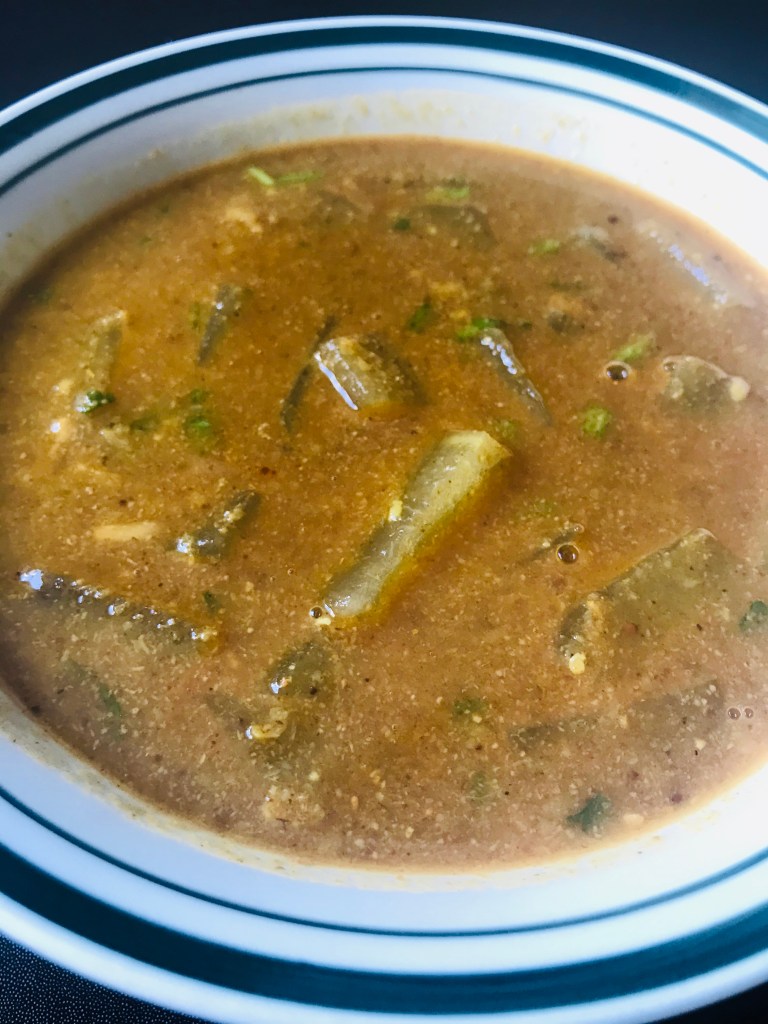
This recipe initially started its life as an experiment, but it was quite successful and the resulting sambar was so tasty, I was pleasantly surprised. While any arachavitta or ground sambar is yummy, the addition of the white pumpkin or Winter Melon or Ash Gourd as its called in English and Vellai Pooshnikkai in Tamil elevated this recipe. This recipe is perfect for the days you can’t use onions in your recipe. I have blogged about both Arachivitta Sambar and White Pumpkin Rasavangi and this is a lovely marriage between the two. So let’s go to the recipe.

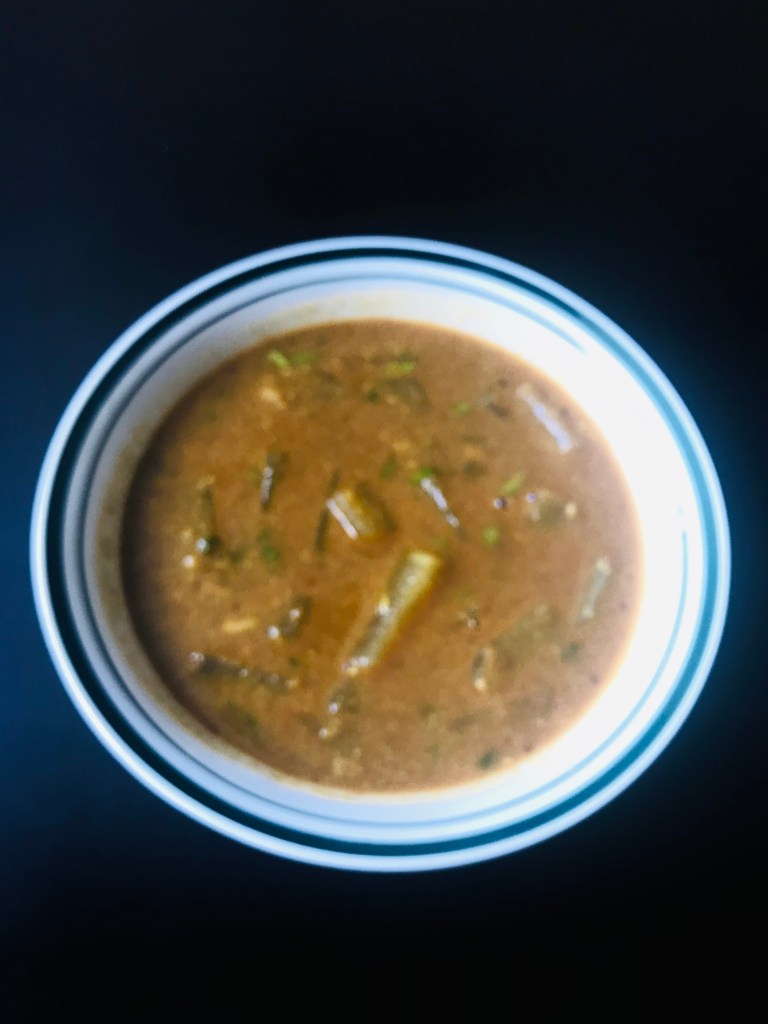
Arachavitta Vellai Pooshnikkai Sambar or Ground White Pumpkin/Ash Groud/Winter Melon Sambar

Ingredients:

  • 2 cups white pumpkin, peeled, the seeds removed and cut into 1 inch cubes
  • 1 lemon sized piece of tamarind, soaked in hot water for 30-40 minutes
  • 1 cup toor dal
  • 2 tbsp oil
  • 1 tsp mustard seeds
  • 1 tbsp chana dal
  • 2 tbsps coriander seeds
  • 6-8 dried red chillies
  • ¼ cup fresh grated coconut
  • 1 tbsp sambar powder (optional)
  • 1-2 tbsp jaggery (optional)
  • Salt to taste
  • 2 tbsp finely chopped coriander leaves to garnish

Method:

  • In a small pressure cooker, pressure cook the toor dal with ¼ tsp turmeric powder till it is soft and the dal has broken down complety. This usually will take around 3 whistles in the cooker. When the pressure reduces, open the cover of the cooker and then whisk the dal well. Keep aside.
  • Mash the tamarind when it becomes cool to touch and then squeeze tamarind and drain the water so the fibres get separated and you have the water. Alternatively use 3-4 tbsp tamarind paste which you can get at any Indian store.
  • Heat 1 tbsp oil in a small pan and put the chana dal, coriander seeds and dried red chillies and stir a while till the chana dal starts to brown. At this point add the fresh grated coconut and constantly stir until all the water from the coconut dries up and you have a crisp brown coconut with no water whatsoever. Note that if there is any water left in this, your sambar may spoil later in the day.
  • Once this coconut mixture is cool, grind it to a fine paste using some water in a blender. Make sure the paste is as fine as you can make it.
  • In a large pan, heat the balance 1 tbsp oil and when the oil is warm, add the mustard seeds and when the seeds pop, add the chopped white pumpkin and cook the cubes for about 5 minutes.
  • Then add the tamarind water which has been thinned to suit your taste and add salt to taste. You can also add sambar powder at this point if you want. Also add the jaggery if you are using here.
  • Let the white pumpkin cook until it is cooked, but still has a bite to it.
  • At this point, add the ground paste and the cooked dal and cook for another 5-10 minutes.
  • Check for seasoning at this point before switching off the gas.
  • Garnish with coriander leaves and serve hot with plain rice, white or brown and a curry of your choice.
  • This is also very tasty with any South Indian food like Upma, Idli or Dosai.

2020 Week 28 Update

Yesterday, after more than two decades, I exercised my political right and responsibility and voted in Singapore’s general elections. The results were not too surprising, but this is not a political blog, so I will not go in there. The whole process was quite fast and in my opinion, seamless. We were in and out of the polling centre in less than thirty minutes, including queueing up to enter which took some time as they only allowed a certain number of people inside at a time.

Singapore’s community cases have been increasing with the lifting of the circuit breaker, but I guess this was inevitable. Now we need to see what will happen. With a total of more than 45,000 cases, we don’t seem to see the light of the tunnel anytime soon. India’s cases seems to have surged and the country is now the third most affected country after the United States and Brazil.

Some countries which had successes have reported fresh cases which is cause for concern since they had opened up their economies and does not bode too well for the rest of the world which are considering doing the same.

I have been seriously meditating now for about a hundred days or about as long as since the beginning of the circuit breaker and it is now I really realise the benefits I derive from it. I used to meditate at night, but I started to see the the real benefits when I switched to meditating in the mornings. I like to wake up early, before everyone else and meditate in that silence, mostly in the darkness as well. So if there is anyone who is still on the fence about meditation, please go ahead and give it a try, you will not regret it. S also has started to meditate now, though not as consistent as me. But then it took me a few years of inconsistent meditation to start doing it consistently, so I have hopes for him too.

That’s all from my side this week. Stay home, stay safe and stay masked everyone!