Also known as the Shri Moreshwar Temple, the Shri Mayureshwar Mandir, situated in the tranquil village of Morgaon, approximately 65 km from the Pune district, marks the starting and ending point of the Ashtavinayak circuit.
Morgaon is the foremost centre of worship of the Ganapatya sect, which considers Ganesha as the Supreme Being. A Hindu legend relates the temple to the killing of the demon Sindhura by Ganesha. The exact date of the temple’s construction is unknown, although the Ganapatya saint Moraya Gosavi is known to have been associated with it. The temple flourished due to the patronage of the Peshwa rulers and descendants of Moraya Gosavi.
The village of Morgaon derives its name from the Marathi word for peacock, ‘mor,’ a nod to the region’s once-abundant population of these majestic birds. The temple itself is situated on the banks of the sacred Karha River, and the village is said to be laid out in the shape of a peacock, deepening the connection between the land and its presiding deity, Lord Ganesha in his Mayureshwar, or peacock-riding, form.
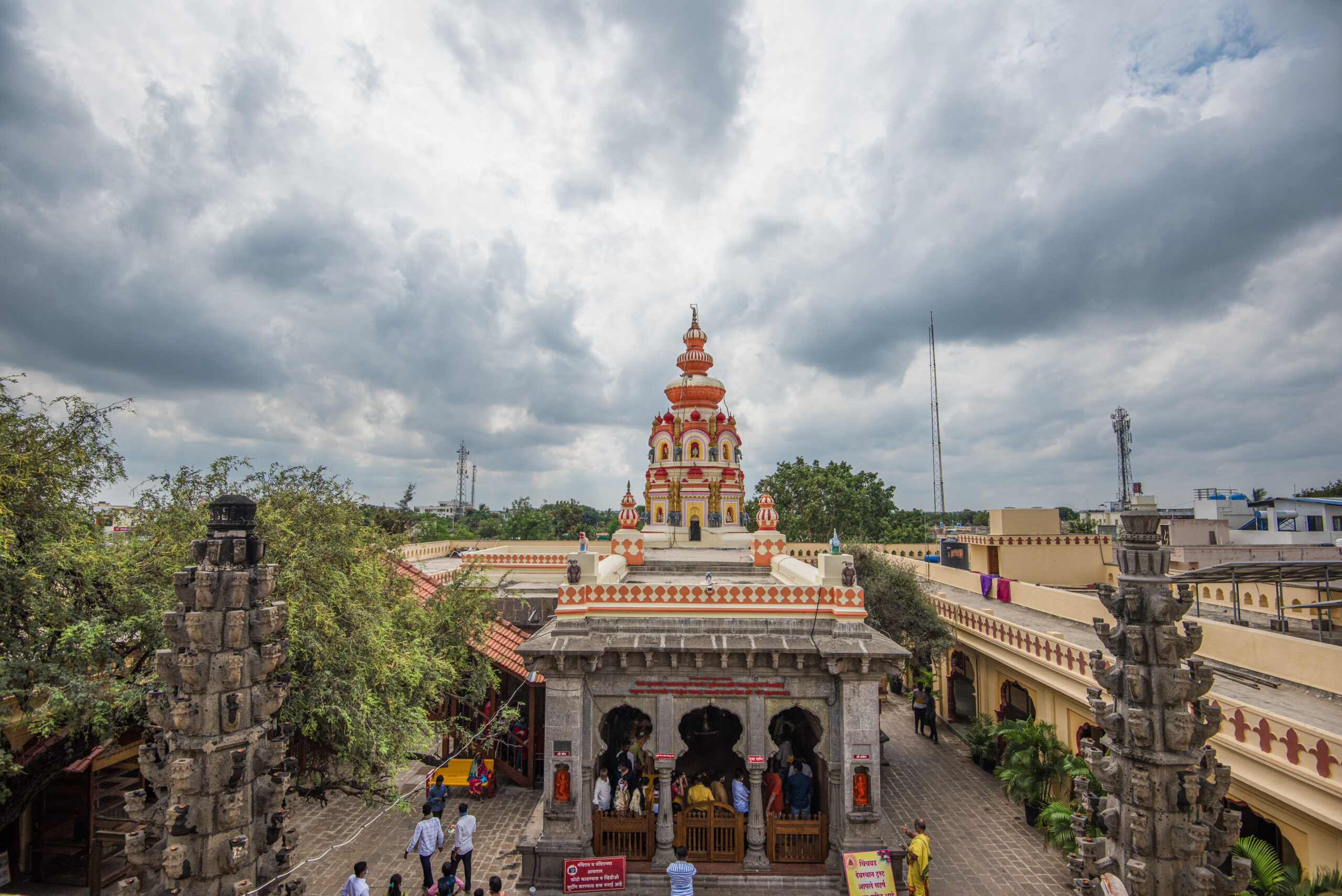
The origins of Shri Mayureshwar Mandir trace back to the Bahmani period, with construction believed to have occurred between the 14th and 17th centuries. The temple’s architecture is distinctive, featuring a high stone boundary wall and four minarets at each corner, giving it the appearance of a mosque from a distance, a strategic design choice to protect it during times of political upheaval. The temple flourished under the patronage of the Peshwa rulers, who considered Ganesha their family deity, and the spiritual influence of the Ganapatya saint Moraya Gosavi, who is closely associated with the temple’s history and legacy.
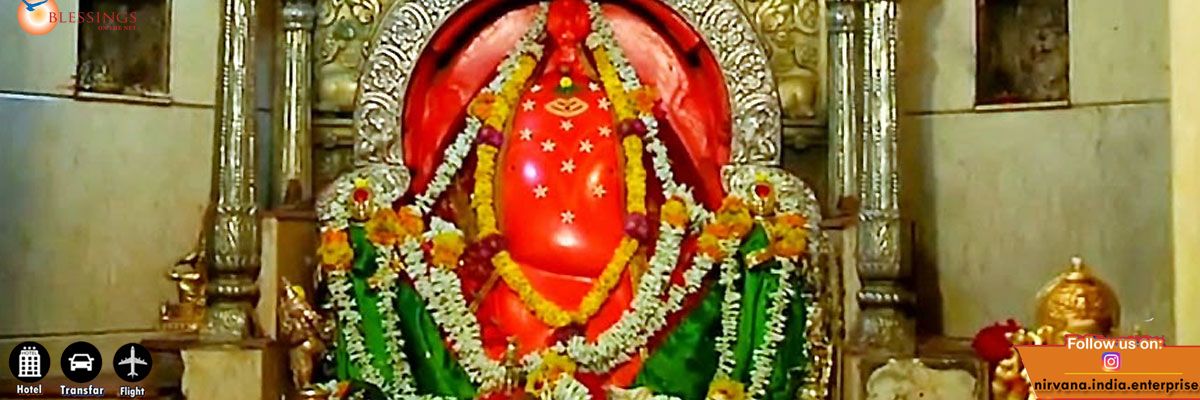
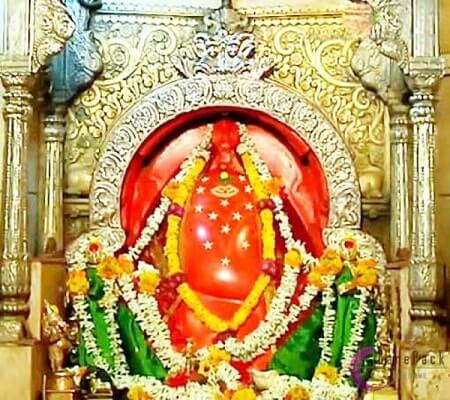
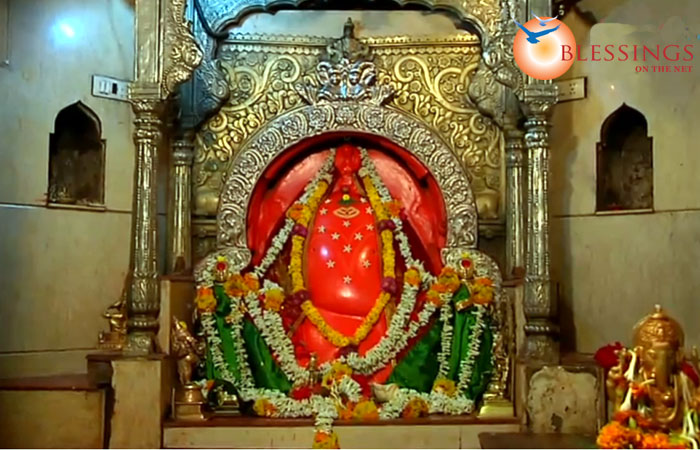
The Shri Moreshwar Temple is a striking blend of Hindu and Islamic architectural influences. There are our entrance gates, with each gate facing a cardinal direction and adorned with an image of Ganesha, representing his manifestations in the four Yugas or ages. The four minarets and 50-foot-tall stone walls were built to safeguard the temple from invaders. Unusually, a large statue of Nandi, Shiva’s sacred bull, stands before the temple entrance, a rare sight in Ganesha temples, explained by a local legend that the Nandi statue was left there after the vehicle transporting it broke down. The sabha-mandapa or assembly hall houses 23 different idols of Ganesha, each depicting a unique form, including the eight avatars described in the Mudgala Purana. The courtyard contains two sacred trees, Shami and Bilva, associated with penance and spiritual significance. Two lamp towers or Deepmalas and a six-foot-tall mouse, Ganesha’s vahana or mount, are prominent features in the courtyard. The sanctum sanctorum, the garbhagriha, enshrines the swayambhu or self-manifested idol Lord of Ganesha as Mayureshwar, depicted with four arms, three eyes, and a trunk turned to the left, seated on a peacock and flanked by his consorts, Siddhi and Buddhi.
The most celebrated legend associated with the temple is the tale of Ganesha’s incarnation as Mayureshwar to vanquish the demon Sindhu. According to the Ganesha Purana, Sindhu was born to Chakrapani and Ugra, and by the grace of the Sun-god, was granted a bowl of amrita, the elixir of immortality. To safeguard it, Sindhu swallowed the bowl, becoming invincible and unleashing terror across the three worlds. The gods, unable to withstand his tyranny, prayed to Ganesha, who incarnated as Mayureshwar, a six-armed, white-complexioned deity riding a peacock. In a fierce battle, Ganesha defeated Sindhu’s army, slew his general Kamalasura, and ultimately cut open Sindhu’s body to empty the amrita bowl, thus killing the demon and restoring cosmic order. After this victory, Ganesha gifted his peacock mount to his brother Kartikeya, cementing his epithet as Mayureshwar or Moreshwar, aka the “Lord of the Peacock.”
Another legend recounts how the creator-god Brahma, preserver-god Vishnu, dissolver-god Shiva, the Divine Mother Devi, and the Sun-god Surya meditated at Morgaon to understand their creator and purpose. Ganesha manifested before them as an Omkara flame, revealing his supremacy and blessing them with divine knowledge.
A further myth tells of Brahma’s penance to cleanse himself of the sin of desiring his daughter, Sarasvati. The sacred Turiya Tirtha river appeared, and Brahma carried its water in his pot to worship Ganesha at Morgaon. When he stumbled and spilt the water, it became the Karha River, which continues to flow by the temple today.
The Ganapatya saint Moraya Gosavi is deeply connected to the temple’s lore. He was a devout worshipper who travelled monthly from Chinchwad to Morgaon on foot to offer prayers. On one occasion, arriving after the temple had closed, the locks miraculously fell away, allowing him to worship Ganesha. His devotion inspired the construction of the Mangalmurti temple at Chinchwad and elevated the status of the Moreshwar temple as a premier centre of Ganapatya worship.
The temple’s daily worship schedule is meticulously observed, offering devotees multiple opportunities to participate in sacred rituals. The ritual bathing and purification of the deity, the Prakshal Puja, is conducted between 5 and 6 am, while the Shodashopachar Puja, the traditional sixteen-step ceremonial worship, happens between 7 am and 12 noon. The five-step worship, the Panchopachar Puja, takes place at 8 pm, while the Samudaik Evening Aarti, which is a communal ritual of lighting the lamp,p happens at 7:30 p,m and the nighttime aarti, the Shej Aarti, is done at 10 pm before the temple’s doors are shut for the day.
Devotees traditionally first worship Nagna Bhairava, then Mayureshwar, and finally Sakshi Vinayaka, who is believed to be the witness to prayers offered at the temple. The people of Morgaon collectively offer food or a thali lunch to visitors during Magh Shuddh Panchami, reflecting the temple’s role as a hub of community and hospitality.
The temple becomes the focal point of grand celebrations during Ganesh Chaturthi, the Bhadrapada Shukla Chaturthi, and Ganesh Jayanti or Magha Shukla Chaturthi. Devotees flock to Morgaon, and a procession arrives from the Mangalmurti temple in Chinchwad, carrying the palkhi or palanquin of Ganesha. Festivities continue for more than a month, culminating on Ashvin Shukla Dashami, with fairs, processions, and communal feasting. The temple also hosts celebrations on Vijayadashami, Shukla Chaturthi, Krishna Chaturthi, and Somavati Amavasya, the new moon coinciding with a Monday.
The main idol is believed to be swayambhu or self-manifested and is said to have been consecrated twice by Brahma, once before and once after being destroyed by the demon Sindhu. Each of the four gates represents a cardinal direction and a life goal: Dharma or righteousness, Artha or wealth, Kama or desire, and Moksha or liberation. The idol is covered with layers of saffron-colored vermillion, which naturally peels off every century, revealing the original image, a phenomenon regarded as miraculous by devotees. The sabha-mandapa houses 23 different forms of Ganesha, including the eight avatars from the Mudgala Purana, making it a living gallery of Ganesha iconography. The presence of the Shami and Bilva trees in the courtyard is tied to legends of penance and spiritual awakening. The juxtaposition of Nandi and the mouse at the temple entrance is unique, blending Shaiva and Ganapatya symbolism.
The Ashtavinayak Yatra, a pilgrimage to eight Ganesha temples around Pune, is considered incomplete unless the devotee both begins and ends the journey at Shri Mayureshwar Mandir. This cyclical pilgrimage reflects the Hindu understanding of spiritual journeys as both linear and circular, with every ending marking a new beginning.
Shri Mayureshwar Mandir in Morgaon is more than a temple; it is a living testament to the enduring power of faith, myth, and community. Its legends, rituals, and architecture encapsulate the essence of Maharashtra’s spiritual heritage, inviting devotees and seekers to embark on a journey that is as much about inner transformation as it is about external pilgrimage.









 Memories and Such