Grit: The Power of Passion and Perseverance – Angela Duckworth
Why do some people succeed and others fail? Sharing new insights from her landmark research on grit, Angela Duckworth explains why talent is hardly a guarantor of success. Rather, other factors can be even more crucial such as identifying our passions and following through on our commitments.
Drawing on her own powerful story as the daughter of a scientist who frequently bemoaned her lack of smarts, Duckworth describes her winding path through teaching, business consulting, and neuroscience, which led to the hypothesis that what really drives success is not genius, but a special blend of passion and long-term perseverance. As a professor at the University of Pennsylvania, Duckworth created her own character lab and set out to test her theory.
Here, she takes readers into the field to visit teachers working in some of the toughest schools, cadets struggling through their first days at West Point, and young finalists in the National Spelling Bee. She also mines fascinating insights from history and shows what can be gleaned from modern experiments in peak performance. Finally, she shares what she’s learned from interviewing dozens of high achievers; from JP Morgan CEO Jamie Dimon to the cartoon editor of The New Yorker to Seattle Seahawks Coach Pete Carroll.
Winningly personal, insightful, and even life-changing, Grit is a book about what goes through your head when you fall down, and how that not talent or luck makes all the difference.
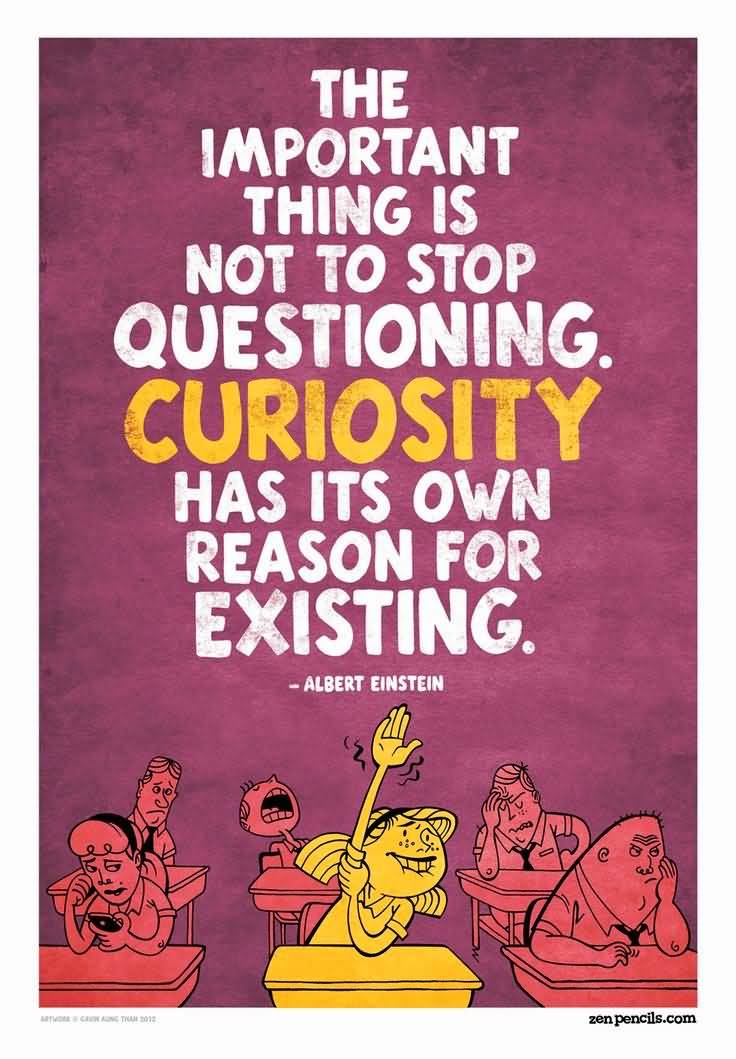
Merriam Webster defines curiosity as a desire to know, an inquisitive interest in others’ concerns, an interest leading to inquiry and intellectual curiosity.
Curiosity is the desire to learn, to understand new things, and to know how they work. As children, we are naturally curious, born with the impulse to seek new information and experiences. As we age and gain more experience, we become less reliant on curiosity for answers and more reliant on knowledge. Curiosity gives way to comfort and certainty. Curiosity can be seen manifesting itself in geniuses, because they are inherently always curious, leading to the discoveries attributed to them. Curiosity is not only important for those with high IQs, but successful people across all walks of life often display a good measure of curiosity. Curiosity is the expression of the urge to learn and acquire facts and knowledge. It widens the mind and opens it to different opinions, different lifestyles and different topics.
Curiosity can manifest in many ways, as the desire to read the gossip columns or watch reality shows on TV, or as the desire to know about people and their lives. It can also manifest as the desire to accumulate knowledge about science, geography or other topics, or as the urge to know how to fix things. Curious people ask questions, read and explore. They are active about seeking information or experience, and are willing to meet challenges and to broaden their horizons. They are not shy to ask questions and delve deeply into the topic that interests them.
Curiosity throughout adulthood requires approaching experiences with the open-mindedness and naivete of a child. Buddhists call this the Beginner’s Mind. Curiosity pushes people toward uncertainty and allows them to approach it with a positive attitude. Empathy, creativity, innovation, and the ability to learn quickly all spring from curiosity. Curiosity lacks an agenda or desire to drive a specific outcome, which means it can open you up to experiences you never thought were possible. This is how ground-breaking discoveries are made, markets are disrupted, and barriers are overcome.
While curiosity comes naturally to some, many adults must develop it, and just like any other skill or habit, it takes practice. According to experts, to live a curiosity-driven life, an individual must commit to being vigilant about looking for what’s piquing their curiosity and to follow what is interesting to a person, even if that interest is faint at first. Curiosity is not only linked to success because it leads to creativity and discoveries, it also helps to develop meaningful relationships that enrich personal and professional lives. When curiosity leads conversations, it opens up possibilities, letting people establish deeper, more meaningful relationships because the interactions then moves towards discovering others, rather than using them to fulfil an agenda.
But why is curiosity so important? Here are some reasons
Curiosity makes your mind active instead of passive. Curious people always ask questions and search for answers. Their minds are always active. Since the mind is like a muscle that becomes stronger through continual exercise, mental exercise caused by curiosity makes the mind stronger and stronger.
Curiosity makes the mind observant of new ideas. When an individual is curious about something, their mind expects and anticipates new ideas related to the subject. When the ideas come they will recognise them and without curiosity, the ideas may pass right in front of them and yet they miss them because their mind is not prepared to recognise them.
Curiosity opens up new worlds and possibilities. By being curious, an individual will be able to see new worlds and possibilities that are normally not visible, which are hidden behind the surface of normal life, and it takes a curious mind to look beneath the surface and discover them.
Curiosity brings excitement to life. The lives of curious people are far from boring and are neither dull nor routine with new things always on the horizon that attracts the curious person’s attention. Instead of being bored, curious people have an adventurous life. Curiosity is important for excelling in any job and doing it better because it allows an individual to ask questions, learn from others, and look for ways to do their job better. The minds of curious people are active, they want to know and to understand which puts them in a better position to learn a job and do it better and more creatively, unlike a person who lacks curiosity. When curious people fail, they analyse their failure, because they are keen on knowing the reasons, to do better the next time, increasing future successes.
Keep an open mind: An open mind is essential to have a curious mind. Be open to learn, unlearn, and relearn. Some things you know and believe might be wrong, and one should be prepared to accept this possibility and change their minds.
Don’t take things at face value: If one just accepts the world as it is without trying to dig deeper, they will certainly lose the holy curiosity. Never take things at face value and try to dig deeper beneath the surface of what is around them.
Ask questions relentlessly: A sure way to dig deeper beneath the surface is asking questions. The five Ws and one H of Who, Why, When, What, Where and How are the best friends of curious people.
Don’t label something as boring: Whenever one labels something as boring, they close one more door of possibilities. Curious people are unlikely to call something boring. Instead, they always see it as a door to an exciting new world. Even if they don’t yet have time to explore it, they will leave the door open to be visited another time.
See learning as something fun: If one sees learning as a burden, there’s no way they will want to dig deeper into anything, and will just make the burden heavier. But if they think of learning as something fun, they will naturally want to dig deeper. So the lesson here is to look at life through the glasses of fun and excitement and enjoy the learning process.
Have diversity in your reading: Don’t spend too much time in just one world; take a look at other worlds, it will introduce an individual to the possibilities and excitement of the other worlds which may spark their interest to explore them further. One easy way to do this is by reading diverse genres and topics. The easiest way to do this is to pick a book or magazine on a new subject and let it feed the mind with the excitement of a new world.
Be Present: Don’t enter a conversation with the mind somewhere else or be focused on where you want the conversation to go. Be aware of thoughts drifting, and bring them back to the present, staying fully engaged with the person in front of you. Look at each interaction as an opportunity to learn something fascinating.
Give: Give others your full attention, give them an authenticity and give them time. When one shifts their focus from what they can get from a person to what they can give them, their relationship shifts from transactional to genuine.
Check Your Ego: A person’s ego can destroy curiosity because it fears insecurity. Curiosity requires embracing and exploring the unknown, which triggers insecurity. Don’t worry about how others will react to a person. Curiosity drives one to discover, not impress.
I will leave you to search more about this immensely interesting subject and allow you to flex your curiosity muscle with these TED Talks.
12 Rules for Life: An Antidote to Chaos – Jordan B. Peterson, illustrated by Ethan Van Sciver
What does everyone in the modern world need to know? Renowned psychologist Jordan B. Peterson’s answer to this most difficult of questions uniquely combines the hard-won truths of ancient tradition with the stunning revelations of cutting-edge scientific research.
Humorous, surprising, and informative, Dr. Peterson tells us why skateboarding boys and girls must be left alone, what terrible fate awaits those who criticize too easily, and why you should always pet a cat when you meet one on the street.
What does the nervous system of the lowly lobster have to tell us about standing up straight (with our shoulders back) and about success in life? Why did ancient Egyptians worship the capacity to pay careful attention as the highest of gods? What dreadful paths do people tread when they become resentful, arrogant, and vengeful? Dr. Peterson journeys broadly, discussing discipline, freedom, adventure, and responsibility, distilling the world’s wisdom into 12 practical and profound rules for life. 12 Rules for Life shatters the modern commonplaces of science, faith, and human nature while transforming and ennobling the mind and spirit of its listeners.
I grew up in Mumbai, very close to what is the heart of the tambram community in the city, Matunga. Where we lived was a 15 minute walk to the heart of the community, to the market and the temples, to the flower shops and the vegetable vendors, some of whom though they came from the northern states of Bihar and Uttar Pradesh, but could banter with the mamas and manis in Tamil. Before COVID-19 stuck and life changed, my mother used to make the thrice weekly trip every week to Matunga to get her fix of all of the above.
The other day while I was thinking about this, I realised that I actually grew up in an urban agraharam. So what is an agraharam you may ask? An Agraharam or Agrahara was a grant of land and royal income from it, typically by a king or a noble family in India, for religious purposes, particularly to Brahmins to maintain temples in that land or a pilgrimage site and to sustain their families. Agraharams were also known as Chaturvedimangalams in ancient times as well as known as ghatoka, and boyas. Agraharams were built and maintained by dynasties such as the Cholas and Pallavas. The name originates from the fact that the agraharams have lines of houses on either side of the road and the temple to the village god at the centre, thus resembling a garland around the temple. According to the traditional Hindu practice of architecture and town-planning, an agraharam is held to be two rows of houses running north–south on either side of a road at one end of which would be a temple to Shiva and at the other end, a temple to Vishnu. An example is Vadiveeswaram in Tamil Nadu.
Where we grew up was a collection of about 50-60 two to three storey buildings set in a sort of square with roads intersecting them. We were framed by educational institutes on three sides and a main road on the fourth. While our small community comprised of people from different communities across the various states of India, if I look back, I can see the Tamil Brahmin community most predominant here, with most of them from Kerala or the Palakkad Iyers. Most buildings, with some exceptions which only had people from a certain community as residents, had a few tambram families in residence. Everyone was a mama or mami and not uncle or aunty and everyone knew everyone, or at the very least knew our parents and grandparents, many of whom they were either together at school, in the same class or from the same village in Tamil Nadu or Kerala.
In my own building, the bulk of our neighbours were from my own community and this is why I call my small slice of area an urban agraharam. Everyone was solidly middle class and if you probed enough, you found some connection with them, either through family or friends and once the connection was made, you were part of them. I know now that even living in a secular and multi-community city like Mumbai made us quite insular when it came to Tamil culture. The only Tamil culture I knew was the Tambram one and coming to Singapore, to a culture similar to my own was actually a culture shock to me.
But, growing up in a community made mostly of people who had the same values, the same traditions as us was just as charming. Festivals which are unique to my community was commonplace here and I never questioned why the rest didn’t celebrate it. For example, the annual Avani avittam festival which is the only festival for the men who on this day would change their sacred threads used to be held in a nearby school with a few priests from one of the temples in Matunga coming over to conduct the rituals. Since there were enough men who wore the sacred thread, it probably made sense for the organizers to hold a mini session in our area. Since the day was not a public holiday, they used to do the session fairly early so the men and boys could then go on to work and school. And in all the years my grandfather and then father went here instead of to our temple in Matunga, I never questioned why. It all seemed normal to me. We loved going to each other’s homes for festivals like Diwali, Navratri and Ganesh Chaturti in our pavadais and sing songs and gorge on the delicacies.
That was a lovely time growing up. Everyone looked out for each other and mamas and mamis didn’t heaitate to scold or tell on a child they knew if the said child did something wrong. We thought nothing of going into anyone’s house for a drink of water or to use the bathroom. We were also quite safe in our little enclave and most of us pretty much lived our whole lives there till we moved out.
Life in our small community has changed now. Many buildings are being knocked down to make way for high rises, especially since this area is now a prime area, within what is considered the original Bombay and close, but not too close to the city. A lot of people from the community moved to suburbs like Chembur, Thane and Dombivili when the real estate prices here started picking up in the nineties. I think my grandparents and parents even explored the idea of moving to Chembur, but thankfully dropped the idea very soon. Life goes on, but in our area, the percentage of tambrams has reduced tremendously, so much so it can’t be called an agraharam anymore. I mourn for this loss, but c’est la vie and life must go on. The chakra of life never stops and I am sure in some of the suburbs I mentioned newer urban agraharams have been created.
Austerlitz, Borodino, Waterloo: his battles are among the greatest in history, but Napoleon Bonaparte was far more than a military genius and astute leader of men. Like George Washington and his own hero Julius Caesar, he was one of the greatest soldier-statesmen of all times.
Andrew Roberts’s Napoleon is the first one-volume biography to take advantage of the recent publication of Napoleon’s thirty-three thousand letters, which radically transform our understanding of his character and motivation. At last we see him as he was: protean multitasker, decisive, surprisingly willing to forgive his enemies and his errant wife Josephine. Like Churchill, he understood the strategic importance of telling his own story, and his memoirs, dictated from exile on St. Helena, became the single bestselling book of the nineteenth century.
An award-winning historian, Roberts traveled to fifty-three of Napoleon’s sixty battle sites, discovered crucial new documents in archives, and even made the long trip by boat to St. Helena. He is as acute in his understanding of politics as he is of military history. Here at last is a biography worthy of its subject: magisterial, insightful, beautifully written, by one of our foremost historians.









 Memories and Such