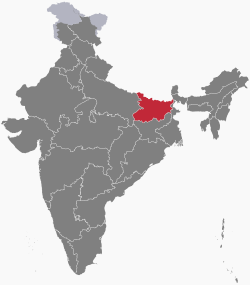
A state in the eastern part of India, Bihar is the third-largest state by population and the twelfth-largest by territory. It is bordered by Uttar Pradesh to its west, Nepal to the north, the northern part of West Bengal to the east, and Jharkhand to the south. The Bihar plain is split by the river Ganges, which flows from west to east and three main cultural regions converge in the state: Magadh, Mithila, and Bhojpur and is also the world’s third-most populous sub-national entity. On 15 November 2000, southern Bihar was ceded to form the new state of Jharkhand. The state is mostly rural with only 11.3% of the population living in urban areas, the lowest in India after Himachal Pradesh. Bihar is also a very young state with almost 58% of Biharis below the age of 25, giving it the highest proportion of young people of any Indian state.
The name Bihar has been derived from the Sanskrit and Pali word vihara, meaning Abode. The region roughly encompassing the present state had many Buddhist viharas, which were the abodes of Buddhist monks in the ancient and medieval periods.
In ancient and classical India, the area that is now Bihar was considered a centre of power, learning, and culture. From Magadha arose India’s first empire, the Maurya empire, as well as one of the world’s most widely adhered-to religions, Buddhism. The Magadha empires, notably under the Maurya and Gupta dynasties, unified large parts of South Asia under a central rule. Another region of Bihar is Mithila which was an early centre of learning and the centre of the Videha kingdom.
The history of Bihar is one of the most varied in India. Each of Bihar’s three distinct regions of Magadh, Mithila and Bhojpur have their distinct history and culture. Chirand, on the northern bank of the Ganga River, in the Saran district, has an archaeological record from the Neolithic age, about 2500–1345 BC. Regions such as Magadha, Mithila and Anga are mentioned in religious texts and epics of ancient India with Mithila believed to be the centre of Indian power in the Later Vedic period which occurs between 1100 to 500 BCE. Mithila first gained prominence after the establishment of the Videha kingdom. The Kings of the Videha Kingdom were called the Janakas. A daughter of one of the Janaks of Mithila, Sita, is mentioned as the consort of Lord Rama in the Hindu epic Ramayana, written by Valmiki. The Videha Kingdom later became incorporated into the Vajji confederacy which had its capital in the city of Vaishali, also in Mithila. Magadha, another region of Bihar was the centre of Indian power, learning and culture for about a thousand years. Based on the information found in texts about Jainism and Buddhism, Vajji was established as a republic by the 6th century BC, before the birth of Gautama Buddha in 563 BC, making it the first known republic in India. The Haryanka dynasty, founded in 684 BC, ruled Magadha from the city of Rajgriha also known as Rajgir today. The two well-known kings from this dynasty were Bimbisara and his son Ajatashatru, who imprisoned his father to ascend the throne and who founded the city of Pataliputra which later became the capital of Magadha. The Haryanka dynasty was followed by the Shishunaga dynasty and then the Nanda Dynasty who ruled a vast tract stretching from Bengal to Punjab. The Nanda dynasty was replaced by the Maurya Empire, India’s first empire. Modern Bihar was also the birthplace of Buddhism and Jainism. The Mauryan Empire, which originated from Magadha in 325 BC, was founded by Chandragupta Maurya, who was born in Magadh and had its capital at Pataliputra which is modern Patna. Pataliputra, adjacent to modern-day Patna, was an important political, military and economic centre of Indian civilisation during the ancient and classical periods of Indian history. Many ancient Indian texts, aside from religious epics, were written in ancient Bihar with the play Abhijñānaśākuntala the most prominent. Emperor Ashoka, born in Pataliputra, is often considered to be among the most accomplished rulers in world history. The Gupta Empire, which originated in Magadha in 240 AD, is referred to as the Golden Age of India in science, mathematics, astronomy, commerce, religion, and Indian philosophy. Bihar and Bengal were invaded by Rajendra Chola I of the Chola dynasty in the 11th century.
Buddhism in Magadha went into decline due to the invasion of Muhammad bin Bakhtiyar Khalji, during which many of the viharas were destroyed along with the universities of Nalanda and Vikramashila. Some historians believe that thousands of Buddhist monks were massacred during the 12th century. After the fall of the Pala Empire, the Chero dynasty ruled some parts of Bihar from the 12th century until the Mughal rule in the 16th century. In 1540, Sher Shah Suri took northern India from the Mughals and declared Delhi his capital. From the 11th century to the 20th century, Mithila was ruled by various indigenous dynasties. The first of these was the Karnatas, followed by the Oiniwar dynasty and Raj Darbhanga and during this period the capital of Mithila was shifted to Darbhanga. The tenth and the last guru of Sikhism, Guru Gobind Singh, was born in Patna in 1666. With political instability in the Mughal Empire following Aurangzeb’s death in 1707, Murshid Quli Khan declared Bengal’s independence and named himself Nawab of Bengal.
After the Battle of Buxar in 1764, the British East India Company obtained the rights to administer and collect tax revenue for Bihar, Bengal and Odisha and the rich resources of the land attracted the Dutch and the British. Bihar remained a part of the Bengal Presidency of British India until 1912 when Bihar and Orissa were carved out as separate provinces. In the northern and central regions of Bihar, the Kisan Sabha or the peasant movement was an important consequence of the independence movement which began in 1929.
After the Pala period, Bihar played a very small role in Indian history until the emergence of the Suri dynasty during the Medieval period in the 1540s. After the fall of the Suri dynasty in 1556, Bihar again became a marginal player in India and was the staging post for the British colonial Bengal Presidency from the 1750s and up to the war of 1857–58. Since the late 1970s, Bihar has lagged far behind other Indian states in terms of social and economic development.
Bihar has the fastest-growing state economy in terms of GSDP, and the state’s economy was projected to grow at a compound annual growth rate or CAGR of 13.4% during the 12th Five-Year Plan from 2012 to 2017. Bihar is the fourth-largest producer of vegetables and the eighth-largest producer of fruits with about 80% of the state’s population employed in agriculture.
The culture and heritage of Bihar can be observed from the large number of ancient monuments spread throughout the state which is visited by many tourists from around the world. In the past, tourism in the region was purely based on educational tourism, as Bihar was home of some prominent ancient universities like Nalanda and Vikramashila. This can easily be seen that one of my most popular posts in recent times was about the Chhath Pooja of Bihar!
In the next part we shall see what the capital city of Patna has to offer visitors.







 Memories and Such