As another difficult week unfolds in the Middle East, I find myself thinking of all those whose daily lives have been upended by conflict, fear, and loss. There are moments when words feel small, but silence feels incomplete, too. Perhaps all one can really say is this: may peace return, may suffering lessen, and may those living through uncertainty find strength, safety, and hope.
This week’s quote is by Sir Isaac Newton, the English mathematician, physicist, and astronomer, widely regarded as one of the most influential scientists in history. He formulated the laws of motion and universal gravitation, laying the foundation for classical physics. His work in mathematics, optics, and natural philosophy transformed how humanity understood the universe. Despite the complexity of his discoveries, Newton deeply valued order, logic, and elegant simplicity in explaining how the world works.
Newton’s quote speaks to the power of clarity, suggesting that truth is often far more straightforward than we imagine. Human beings have a habit of overcomplicating matters, layering ideas with noise, confusion, and unnecessary detail. But beneath that clutter, truth usually has a cleaner, more elegant form. This idea is especially meaningful because it applies far beyond science. In relationships, work, decision-making, and even self-understanding, confusion often grows when we add too many assumptions, excuses, or distractions. Simplicity cuts through that. It helps us ask: What is really happening here? What is essential? Truth tends to reveal itself when we strip away what is excessive and return to first principles.
Newton’s quote also reflects a deeper intellectual discipline. Simplicity is not the same as shallowness. In fact, arriving at simplicity often requires great insight. It takes real understanding to reduce something complex to its essence without losing its meaning. That is why the clearest explanations are often the strongest ones. There is also a quiet warning in the quote. Multiplicity and confusion can be seductive. They can make something sound more impressive or feel more profound than it really is. But confusion is not depth. Complexity is not always wisdom. Sometimes the truest answer is the plainest one.
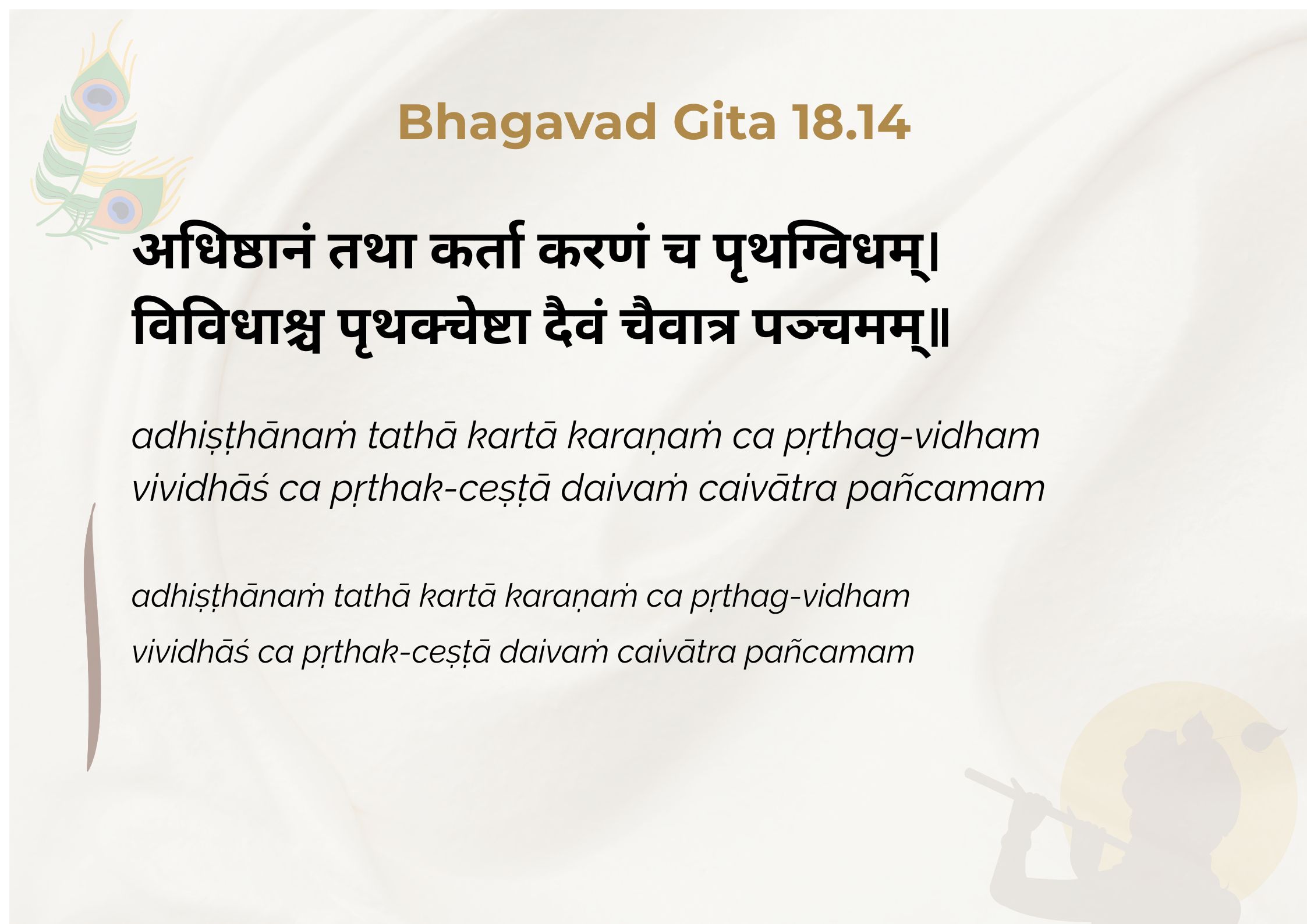
This verse from the Bhagavad Gita softens something important. We like to believe we are entirely responsible for everything that happens. Success becomes personal triumph; failure becomes personal shame. Krishna introduces nuance. Every action, he says, has five contributing factors. You. Your body. The tools available to you. The effort applied. And something beyond your control. This does not remove accountability. It removes excessive burden. You are responsible for effort and intention. But you are not the sole architect of outcomes. Context matters. Timing matters. Support matters. Circumstances matter. Understanding this changes how we move. We still act. We still strive. But we do not collapse under results. Discipline becomes steadier when it is not fuelled by ego. Courage becomes sustainable when it is not driven by fear of failure. You are part of the equation. Not the entire equation. A gentler way to measure effort.
Today’s motivation is about honouring your inner strength. It takes courage to keep your heart open despite everything it has been through. Your intentions are pure. The way you pour love into everything you do, the way you radiate kindness and demonstrate calm confidence, even in the most challenging moments, is a source of inspiration for many. You are brave enough to rebuild yourself with even more compassion and tenderness. Embrace all that you are and all that you are becoming. Do not allow anything to dim your spirit. Greater things are coming your way.
To those who are in the eye of the storm, we’re all rooting and praying for you. To everyone else, here’s wishing a beautiful second half of March!
The Mesopotamian Riddle: An Archaeologist, a Soldier, a Clergyman, and the Race to Decipher the World’s Oldest Writing – Joshua Hammer
It was one of history’s great vanishing acts.
Around 3,400 BCE—as humans were gathering in complex urban settlements—a scribe in the mud-walled city-state of Uruk picked up a reed stylus to press tiny symbols into clay. For three millennia, wedge shape cuneiform script would record the military conquests, scientific discoveries, and epic literature of the great Mesopotamian kingdoms of Sumer, Assyria, and Babylon and of Persia’s mighty Achaemenid Empire, along with precious minutiae about everyday life in the cradle of civilization. And then…the meaning of the characters was lost.
London, 1857. In an era obsessed with human progress, mysterious palaces emerging from the desert sands had captured the Victorian public’s imagination. Yet Europe’s best philologists struggled to decipher the bizarre inscriptions excavators were digging up.
Enter a swashbuckling archaeologist, a suave British military officer turned diplomat, and a cloistered Irish rector, all vying for glory in a race to decipher this script that would enable them to peek farther back into human history than ever before.
From the ruins of Persepolis to lawless outposts of the crumbling Ottoman Empire, The Mesopotamian Riddle whisks you on a wild adventure through the golden age of archaeology in an epic quest to understand our past.
Situated near the ancient coastal city of Dwarka in Gujarat, the Nageshwar Temple stands as one of the revered twelve Jyotirlingas dedicated to Lord Shiva. Known as Nageshwar or Naganath, meaning Lord of the Serpents, this temple combines powerful spiritual symbolism with mythological richness. The temple has special significance as a protector from snakebites and poisons, both literal and metaphorical, offering devotees liberation from earthly and spiritual toxins. Nestled in a region steeped in Krishna lore and early Hindu civilisation, Nageshwar Temple reflects both timeless faith and regional cultural vibrancy, drawing countless seekers seeking solace, protection, and the light of Shiva.
Nageshwar Temple’s deep mythology intertwines Shiva’s cosmic power with tales of demons, devotion, and divine protection. According to the Shiva Purana, a treacherous demon named Daruka lived in a forest area called Darukavana, along with his wife Daruki. Daruka and Daruki were empowered by Parvati through severe penance, becoming ruthless obstructors of spirituality. They imprisoned the sage and great devotee of Shiva, Supriya, along with many others.
Supriya continued worshiping Shiva with unwavering devotion, performing daily rituals, chanting the sacred Maha Mrityunjaya mantra, and adorning himself with sacred ash or bhasma and rudraksha beads. Moved by this steadfast faith, Shiva manifested in the form of a Jyotirlinga to defeat Daruka and liberate the devotees. The cosmic battle resulted in Shiva’s victory and the establishment of the Nageshwar Jyotirlinga at the site.
Nageshwar is closely associated with serpents; Lord Shiva is often pictured wearing a cobra around his neck, symbolising his power over deadly forces and his role as protector against poisons in the body and mind. It is believed that worshipping at Nageshwar grants liberation from snakebites and spiritual toxins like sin and illusion, or maya.
Local legend also ties Nageshwar to the Pandavas of the Mahabharata. It is said that during their exile, Bhima discovered a self-manifested Shiva lingam beneath the sea (or river) waters, which became the basis for this temple, fortifying its sanctity as part of the cosmic cycle of dharma and divine protection.
Nageshwar Temple’s history spans ancient lore and royal patronage across centuries. The temple’s ancient significance is mentioned in the Shiva Purana and other scriptures, identifying Darukavana near Dwarka as its legendary location. Archaeological artefacts and inscriptions confirm the temple’s existence since early medieval times.
The temple was constructed in its present form in the 16th century, with notable renovations under regional rulers who patronised Hindu temples to affirm cultural identity during times of political change. The temple’s upkeep was continuous, surviving sometimes harsh coastal weather and occasional political turmoil.
The proximity of Nageshwar to the Krishna-centric city of Dwarka adds to its importance. Dwarka, one of the sacred Char Dham, shares a deep theological and pilgrimage link with Nageshwar, highlighting the unity of Shiva and Krishna worship.
The Nageshwar Temple shows a blend of traditional Gujarati and Somnath temple architectural styles, expressive yet solemn. The temple is made primarily of sandstone and adorned with intricately carved pillars and arches. Its towering shikhara rises prominently over the sanctuary, adorned with intricate carvings depicting Shiva, snakes, and Hindu motifs. The temple courtyard allows pilgrims to circumambulate and participate in collective worship with ease. The main sanctum contains the self-manifested Jyotirlinga, decorated with a silver serpent symbolising Shiva’s protective power. Exquisite relief carvings on the temple walls portray mythological scenes relating to Shiva, the demon Daruka, and the cosmic dance of destruction and creation. The sanctum also features a statue of Goddess Parvati, reinforcing the divine union central to Shaiva tradition.
Daily rituals imbue the temple with sacred energy and community connection. The lingam is bathed with holy water, milk, and honey, accompanied by chanting of mantras and Rudra stotras. Morning, noon, and evening aarti ceremonies fill the temple with the sound of bells, conch shells, and devotional music. Devotees present bilva leaves, flowers, metal snakes, and sacred ash to receive blessings. Unique rituals to remove Sarpa Dosha (snake-related afflictions in horoscopes) are prominent here. The temple is a centre for Nag Panchami celebrations, dedicated to serpent worship. Other festivals include Mahashivaratri, when massive crowds attend a night of continuous worship, and regional fairs drawing thousands. Local priests, artisans, and residents actively participate in temple upkeep and festival organisation, blending devotional fervour with cultural tradition.
Nageshwar Temple is integral to pilgrimages in the coastal and western Gujarat region. Located about 17 km from Dwarka city, it is connected by road and served by Dwarka Airport and railway stations. Pilgrims often combine visits here with Somnath and other nearby spiritual sites for an enriching pilgrimage experience. Accommodations range from basic dharamshalas to guest houses. Local cuisine reflects Gujarati coastal flavours. The temple’s peaceful surroundings, near the Arabian Sea coast, enrich the pilgrim’s spiritual and sensory experience. Devotees recount stories of protection from snakebites, fulfilment of vows, and divine appearances. The temple’s potent energy is frequently described as calming, protective, and transformative.
Nageshwar Temple has deep roots in regional tradition and broader Hindu spirituality. The temple and its legends appear in Gujarati and Sanskrit devotional literature. Folk songs and bhajans composed in praise of Nageshwar are performed during festivals, permeating the local cultural soundscape. Temples in the region incorporate serpent motifs, inspired by Nageshwar’s emblematic snake. Regional artisans produce religious icons and crafts influenced by the temple’s themes. Nageshwar is integral to the spiritual and cultural identity of the Saurashtra region and coastal Gujarat.
Today, Nageshwar Temple thrives as a spiritual centre, adapting to contemporary needs. The temple is managed by local temple trusts and Gujarat’s tourism department, ensuring smooth religious ceremonies and visitor services. There are increasing numbers of national and international visitors, particularly during Nag Panchami and Mahashivaratri, which boosts the local economy while preserving heritage. Conservation and upgrades are ongoing while restoration maintains temple structures and art. Infrastructure improvements accommodate growing pilgrim flows while respecting temple sanctity.
Nageshwar Temple in Dwarka embodies the potent divine power of Shiva as Lord of Serpents, protector from hidden dangers, and bestower of spiritual liberation. Rooted in ancient mythology and resilient history, it stands as a vital pillar among the twelve Jyotirlingas. For devotees and travellers alike, Nageshwar offers a unique blend of faith, myth, culture, and nature—an eternal sanctuary where the cosmic and earthly intertwine in timeless worship.
No More Tears: The Dark Secrets of Johnson & Johnson – Gardiner Harris
One day in 2004, Gardiner Harris, early for a flight, sat down at an airport bar and started talking to the woman on the bar stool beside him. She was a drug sales rep for Johnson & Johnson, and her horrific story about unethical sales practices and the devastating impact they’d had on her family fundamentally changed the nature of how Harris covered the company—and the entire pharmaceutical industry—for The New York Times. His subsequent investigations and ongoing research since that conversation led to new federal laws and ultimately to No More Tears, a blistering exposé of a trusted American institution and the largest healthcare conglomerate in the world.
Harris takes us light years away from the company’s image as the child-friendly “baby company” as he uncovers reams of evidence showing decades of deceitful and dangerous corporate practices that have threatened the lives of millions. He covers multiple disasters: lies and cover-ups regarding baby powder’s link to cancer; the surprising dangers of Tylenol; a criminal campaign to sell dangerous anti-psychotics to children; a popular drug for cancer patients that increases the risk of tumor growth. Deceptive marketing efforts that accelerated opioid addictions rival even those of the Sacklers and Purdue Pharma. All told, Johnson & Johnson’s products have helped cause drug crises that have contributed to the deaths of as many as two million people and counting.
Filled with shocking, infuriating, but utterly necessary revelations, No More Tears is a landmark work of investigative journalism that lays bare the deeply rooted corruption behind the image of babies bathing with a smile.
Conflict doesn’t wait for a convenient time. It cuts across life: friendships, families, roommates, work. And there’s no magic script or one-size-fits-all solution. Most young adults spend years avoiding conflict or handling it poorly, which makes simple disagreements complicated and wounds that should’ve healed linger for years. So let’s dive deeper, strip away the myths, and get practical.
Why Conflict Feels So Personal Most guides downplay just how exposed and uncomfortable conflict makes people feel. No one grew up learning “Here’s a safe way to disagree with your boss” or “Here’s how you defend yourself when a roommate crosses a line.” Schools often teach conflict avoidance rather than assertiveness. Families teach their own style: yelling, silence, sarcasm, guilt-tripping, that sticks into adulthood. By the time you’re living on your own or starting a job, confusion about conflict is the norm, not the exception.
The first thing to learn is that conflict, by itself, isn’t bad or dangerous. Often, it’s a sign that people care enough to try. What people fear isn’t conflict; it’s what conflict might do: wreck a relationship, get them fired, humiliate them, or put a target on their back. Recognising this helps lower the temperature in any argument. When someone reacts badly, it’s usually fear, not hate. Remember that when tension flares.
Practical Ground Rules for Starting Any Conflict Conversation Set some basic rules for yourself: no matter where, when, or who you’re dealing with.
Start by saying you want to resolve things, not attack anyone. People drop their guard when they hear you want to fix, not fight.
Commit to honesty and respect: no name-calling, no shouting, never bringing up every past problem at once.
Use “I” statements: “I felt hurt when you…” instead of “You always…” or “You never…”. It’s old advice, but it works because it shifts blame to sharing.
Tackle one problem at a time. Stacking up old arguments only clouds the issue and makes solutions impossible.
Concrete Tips for Personal Relationship Conflicts Conflicts in your private life aren’t just about logistics; they’re mostly about emotions. Here’s how to make arguments healthier and less draining.
Express What You Actually Feel, Fast Don’t wait for frustration to turn into resentment before you speak. If a friend flakes on you again, don’t keep score in silence. In the moment, say, “I felt let down when you cancelled.” Be specific. “I feel ignored when my messages get no response for days.” Clarity isn’t harsh, it’s necessary.
No Blame Games It’s tempting to use “you always” or “you never,” but that just puts the other person on the defensive. State your feelings about what happened, then describe the change you want. “Next time, can we just text if plans change?” It’s direct, not personal.
Don’t Argue by Text Phone screens make conflict worse. You can’t see faces or hear tone. Don’t start or finish arguments through messages—it only escalates things by misunderstanding. If possible, say, “Let’s talk in person (or at least on the phone)”.
Make Space for Emotions Sometimes the argument isn’t even about the thing being discussed. Don’t be embarrassed if you feel angry or sad. Name it. “I get mad when I feel dismissed.” When all else fails, taking a break is smart, not a sign of weakness. “I need to cool off before we finish this” helps stop explosions before they happen.
Listen, and Check You might think you’re listening, but usually you’re preparing your comeback. Try repeating what you think the other person said. “So, you’re saying you felt shut out when I didn’t ask your opinion?” Wait for a response. This solves half the misunderstandings right away.
Accept There’s No Winning You’re not going to “win” an argument with someone you care about. If someone has to lose, the relationship always suffers. Focus on figuring out what both of you need, not who’s right.
Roommates, Families, and Unavoidable Relationships Unlike with friends or partners, you can’t always just walk away from these conflicts. Living together or being related means repeated friction. Here’s how to survive and maybe even improve things:
Set clear house rules. If noise, cleaning, or guests are constant problems, write down what’s expected, and agree on it together. Having these in writing cuts down on future “but I thought…” arguments.
If things break down, get help. Sometimes you need a neutral mediator—someone both sides trust or even a professional, especially if fights keep repeating.
Don’t expect total harmony. Focus on cutting stress, not on everyone suddenly being best friends.
Handling Conflict at Work: More Strategies, More Risks Professional conflicts come with higher stakes. Reputations can take a hit, and you might feel trapped by hierarchies or office politics. Still, ignoring problems at work only builds pressure.
Don’t Wait; Address Issues Early If a colleague interrupts constantly, or a boss claims your ideas, don’t let it slide too long. Say something early, calmly, and in private. “I noticed in meetings, my ideas sometimes get overlooked. I’d like to contribute more actively. How can we build space for that?” The longer problems go unmentioned, the harder they are to fix.
Separate Person from Problem If work styles clash, one person loves planning, another thrives on last-minute energy, don’t make it personal. Discuss task approaches, not personalities. “I prefer schedules so I’m not scrambling at the deadline. How can we balance our methods for this project?” Sometimes the solution is splitting responsibilities so each works their own way.
Clarify Roles When Power Struggles Emerge If resentment bubbles because of promotions or authority issues, ask for a clear conversation about roles and responsibilities. “Can we clarify who handles what, so we avoid stepping on each other’s toes?” This reduces rivalry and signals you want a fair system.
Use Mediation When Needed Sometimes teams get stuck, or emotions run high after repeated clashes. Asking for a mediator, like an HR professional or senior staffer, doesn’t mean you failed. Often, it’s the only way people actually feel heard, and compromises are made.
Learn to Let Minor Stuff Go Some differences aren’t worth a fight. If it’s just an annoying habit that doesn’t impact your work, sometimes the healthiest move is to ignore it. Don’t pick unnecessary battles; save your energy for what actually matters.
When Conflict Turns Unhealthy: Drawing the Line Sometimes, you’re not at fault. Not all conflict should be “resolved,” especially in cases of bullying, discrimination, or abuse. Walking away, even quitting a job or ending a relationship, isn’t weak. It’s survival. If someone disrespects your boundaries repeatedly or uses power to control or harm, the right move is to protect yourself, not to negotiate.
Step-By-Step: How to Actually Navigate Conflict Here’s a barebones step-by-step to keep you anchored when conflict erupts:
Pause. Don’t react immediately. Take a breath. If emotions run high, take a break.
Set the Stage. Tell the other person you want to solve the problem, not win. If you need to, set ground rules: no yelling, no interruptions.
Share Perspectives. Each side takes turns describing how they feel and what they want. Don’t interrupt. Listen, even if it’s hard.
Acknowledge What You Hear. Reflect back. “So, you felt X when I did Y?”
Identify the Real Issue. Sometimes, what people argue over isn’t the actual problem. Look for needs beneath the surface—respect, recognition, independence.
Brainstorm Solutions Together. Focus on creating options. Be open to ideas that neither person suggested first.
Make an Agreement. Nail down what will change, then check in later to see if it’s working.
Practical Examples in Real Life Sometimes, tips are too vague. Here are real situations and how the steps look in daily life:
Example 1: The Flaky Friend You’re tired of a friend cancelling plans. You bring it up: “I noticed when we make plans, they often fall through. I feel like my time isn’t respected.” Pause for their side. Maybe they’re overbooked or anxious. You listen, then say: “Going forward, can we only make plans when you’re sure you can keep them?” You agree: If cancellation is necessary, give as much notice as possible.
Example 2: Work Style Clash You hate last-minute work. Your teammate thrives on it. The project keeps slipping deadlines. You meet and each explains their method. With a manager’s help, you decide: planning phases use your structure, brainstorming sessions are more open. Regular check-ins mean there are fewer surprises.
Example 3: Roommate War Over Chores Dishes keep piling up. Arguments get more hostile. A calm conversation reveals you both hate cleaning, but for different reasons. You agree: make a schedule, split the chores, check in weekly to tweak as needed. You write it down so the system doesn’t rely on anyone’s memory or “good mood.”
Write it down. If you’re anxious or easily overwhelmed, jot down what you’re feeling and what you’d like before the conversation.
Use neutral spaces. If things are tense, talk in a public place—a coffee shop or park—where both sides are less likely to raise voices.
Practice asking questions. Instead of stating, “You never listen,” ask, “How did you see the situation?” or “What’s most important to you here?” It encourages honesty without blame.
Notice your own patterns. Are you usually quick to defend? Do you shut down? Recognising your own habits is the only way to change them.
Focus on respect, not agreement. You don’t have to see eye-to-eye on everything. But both sides can agree to treat each other fairly.
Don’t forget self-care. Sometimes the fallout from conflict isn’t solved in a single chat. Cook a meal, talk to another friend, get fresh air. Processing takes time.
When to Let Go You won’t solve every conflict. Sometimes, people won’t meet you halfway. You’ll grow out of friendships, hit walls at work, or need to move out. Don’t see this as a failure. Not all relationships are meant to last. If fighting for resolution only hurts you, it’s valid to step back or let go entirely.















 Memories and Such