

Photo by Gabriela Palai on Pexels.com
The older I get, the more solo travelling has started to appeal to me. S and I are completely different when it comes to travel goals and so as the children get older and I am not bound by their schedules.
But there seems to be a big societal deterrent to travelling alone, especially in Asian cultures. Solo travels these days, also seems to the domain of the young millennial. As a middle-aged woman, I have certain standards and so don’t fall into the same category. I like my luxuries and don’t think I can rough it out like the young set, and since if I travel alone, I will have the money to finance it, I don’t see it too much of an issue.

Photo by Porapak Apichodilok on Pexels.com
So why is solo travel good for your soul?
It gives you the complete freedom to do what you want without having any regard for other people in your group. You feel like exploring a certain place in depth, go ahead and do that. On the other hand, if you just want to be a sloth on a particular day, that’s your prerogative.
You gain confidence in yourself. Since you have to depend only on yourself to do all the grunt work for and during your travels and this makes you get out of your comfort zone and forces you to interact with people of different strata. You may make friends with them, some of whom become life-long friends, but again, it’s your call how much further you want to take this.
You become comfortable in your own skin. When you travel alone, you are forced to eat and sightsee alone. I remember the first time I had to eat alone in a restaurant. It was very intimidating (I was travelling on business, not pleasure), but soon realised how much I enjoyed eating alone. I was free to read or watch what I wanted while I ate, without making small talk with people I barely knew and somehow since then, I would not mind eating slightly early or later just so I can eat alone. I am also more comfortable with myself than I was in my twenties. I recently even watched a movie alone in the theatre and found that I actually liked doing things alone.

Photo by Ali Naderi on Pexels.com
You step outside your comfort zone. You are responsible for yourself when you travel alone and any hiccups along the way are yours to solve. This helps you develop problem-solving skills as well as the ability to think on your feet. This will stand you in good stead irrespective of what stage of life you are in.
Solo travelling strengthens your creativity. When you have the time to chill and be with yourself, you have the time and more importantly, the bursts of creativity to start on the book you’ve always been meaning to write or start any of the projects you wanted to do like knitting, needlework, embroidery etc.
One other benefit of travelling alone, for a reader like me, is to have the unlimited time to read. You don’t have others impinging on your reading time, while in the hotel room or even while moving from one attraction to the other. Actually, this is not just true of reading, but also of watching movies or anything you wanted to watch but didn’t have the time for.
It may make you happier in the long run. Research suggests that getting into vacation mode has the potential to increase our happiness levels. And spending time alone has also been shown to stave off depression.

Photo by Polina Sirotina on Pexels.com
However, travelling alone makes you more vulnerable to attacks as you don’t have the safety of numbers and seeing a woman alone may make you the target of potential attackers and molesters. So you have to be very careful and have all eyes and ears open all the time. Make sure you guard all your belongings and dress with respect to local cultures and norms. In addition, always do your homework: find out the do’s and don’ts of an area prior to arrival.
Travel, in general, is one of the most beneficial life experiences you can have but there are even more benefits if you decide to do it alone. So what are you waiting for? As for me, I still have one more year before I am free to start to travel alone. Till then, I am going to make my solo travel bucket list.
 I’ve always loved travelling by train. I love the feel of the wind against my face and seeing the landscape rush past me!
 Around the time I turned 9/10 years old, my paternal grandparents moved to Bangalore for their retirement years and we started travelling there every year on a train that was introduced then: Udyan Express. The first few years, the train left Mumbai around 8 pm and reached Bangalore 24 hours later with the return journey leaving Bangalore at 8 am in the morning and reaching Mumbai at 8 am the next day. After that, they switched the train timings with the train leaving Mumbai in the morning and leaving Bangalore in the evening.

 Because it has no milk or water solids, people with lactose intolerance can use this as a very good substitute for butter in cooking. It’s been part of the ancient medical system of Ayurveda for thousands of years, stretching back to at least 800 BC; Ayurvedic medicine claims that ghee is good for everything from sleep quality to semen health, joint suppleness, intelligence, memory and wrinkles.
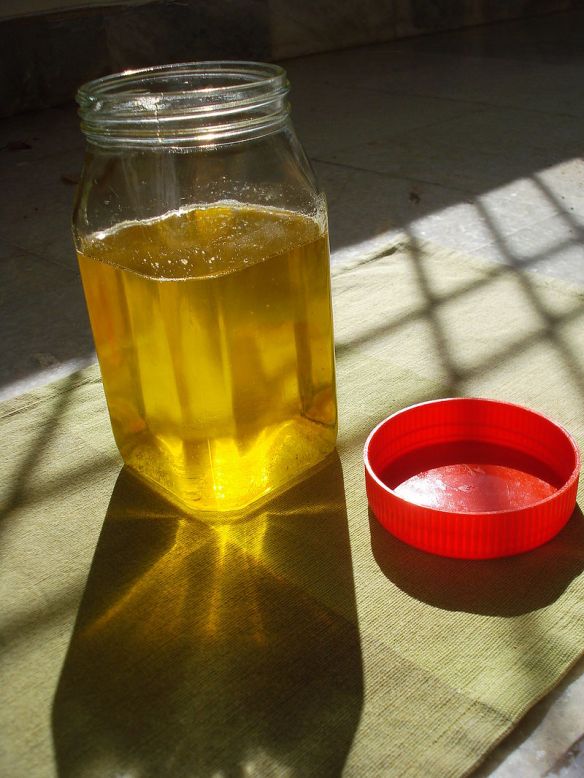 A 2010 review of ghee science in the International Quarterly Journal of Research In Ayurveda by scientists from Ohio State noted that animal studies of ghee have found a series of possible benefits, including decreases in cholesterol, low-density lipoproteins and triglycerides (which are associated with cardiovascular disease), and a potential link between ghee and lower coronary heart disease risk. One study in 2016 found that ghee was better for cooking than sunflower oil when looking at antioxidants and liver protection, while another in 2013 found that it helped to protect against the development of fatty deposits in arteries. Multiple studies in 2015 found that ghee, particularly low-cholesterol ghee, seemed to improve general cholesterol levels. It’s worth noting that virtually all of these studies were done on rats, not humans. But the qualities of ghee have attracted medical attention for other reasons; it was suggested in early 2017 that ghee might be a good way to administer chemotherapy, as it may help the chemo get into the body more efficiently.
 Memories and Such