The state of Malacca or Melaka is the next state we will explore. Located in the southern region of the Malay Peninsula, facing the Strait of Malacca, it has Malacca City, also known as the Historic City, which has been listed as a UNESCO World Heritage Site since 2008. The state is bordered by Negeri Sembilan to the north and west and Johor to the south. The exclave of Tanjung Tuan also borders Negeri Sembilan to the north.
Although it was the location of one of the earliest Malay sultanates, namely the Malacca Sultanate, the local monarchy was abolished when the Portuguese conquered it in 1511. The head of state is the Yang di-Pertua Negeri or Governor, rather than a Sultan. Malacca is noted for its unique history and it is one of the major tourist destinations in Malaysia. With a highly strategic state position for international trade routes, Malacca was once a well-known international trade centre in the East. Many traders anchored in Malacca, especially traders from Arabia, China and India, traded at the port of Malacca and from there were born many of the descendants and tribes that exist in Malacca to this day. Malacca is filled with a great diversity of races and ethnicities reflecting its history. Malays, Chinese, Indians, Baba Nyonya, Kristang, Chitty and Eurasians are significant ethnic groups living in the state today.
The state’s name dates to a popular legend surrounding the founding of the sultanate preceding it by Parameswara who sought to find a new spot to establish his new kingdom after fleeing Singapura which fell to the Majapahit army. As the story goes, Parameswara was resting under a tree near a river during a hunt, when one of his dogs cornered a mouse deer. In self-defence, the mouse deer pushed the dog into the river. Impressed by the courage of the deer, and taking it as a propitious omen of the weak overcoming the powerful, Parameswara decided then and there to found an empire on that very spot. He named it Malacca after the tree where he had just taken shelter, the Malacca tree or Pokok Melaka in Malay. However, some historians argue that the story shows remarkable similarities with and was probably adapted from folk tales from Kandy, Sri Lanka, and Pasai, Sumatra, both of which pre-date Malacca.
Another account about the origin of Malacca’s name says that during the reign of Muhammad Shah who ruled between 1424 and 1444, the Arab merchants called the kingdom Malakat which is Arabic for a congregation of merchants because it was home to many trading communities. One theory suggests, as mentioned in Suma Oriental by Tomé Pires, that it is derived from the Javanese terms melayu or mlayu which means to steadily accelerate or to run, to describe the strong current of a river in Sumatra that today bears the name Sungai Melayu or the Melayu River, which was later possibly adopted as Melaka denoting a place for the fleeing prince.
Before the arrival of the first Sultan, Malacca was a fishing village. The kingdom was founded by Parameswara, also known as Iskandar Shah. He found his way to Malacca around 1402 where he found a good port, one that was accessible in all seasons and on the strategically located narrowest point of the Malacca Straits. In collaboration with allies from wandering proto-Malay privateers of the Straits called the orang laut or the sea-people, he established Malacca as an international port by compelling passing ships to call there, and establishing fair and reliable facilities for warehousing and trade. In 1403, the first official Chinese trade envoy led by Admiral Yin Qing arrived in Malacca. Malacca’s relationships with Ming China granted it protection from attacks by Siam and Majapahit and the kingdom submitted to Ming China as a protectorate. This encouraged the development of Malacca into a major trade settlement on the trade route between China and India, the Middle East, Africa and Europe.
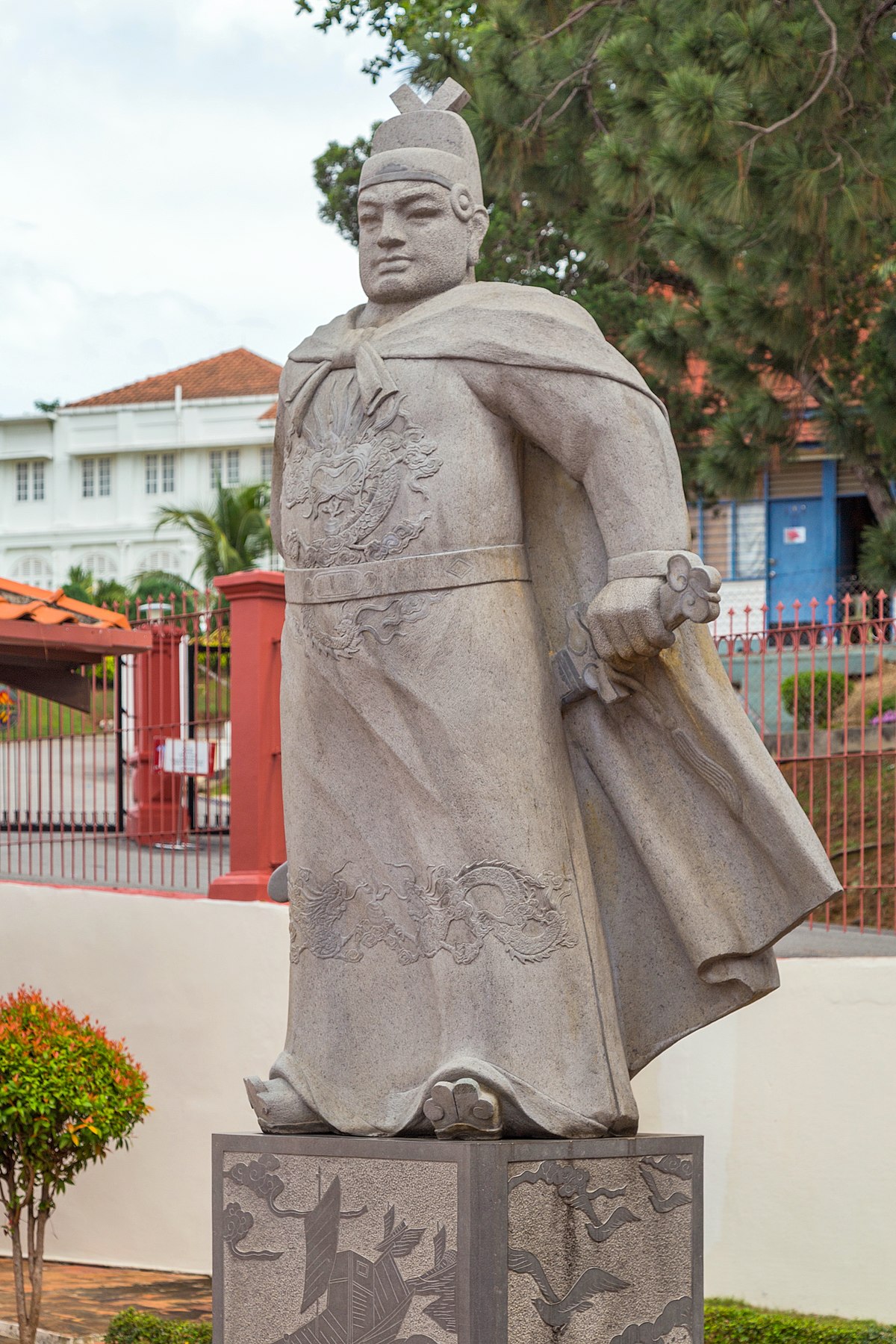
During the early 15th century, Ming China actively sought to develop a commercial hub and a base of operation for their treasure voyages into the Indian Ocean. In 1405, the Ming court dispatched Admiral Zheng He with an imperial order elevating the status of the port to a country. The Chinese also established a government depot as a fortified cantonment for their soldiers. The rulers of Malacca would pay tribute to the Chinese emperor in person. The early kings of Malacca understood that they could gain Ming China’s protection through skilful diplomacy and thereby could establish a strong foundation for their kingdom against Siam and other potential enemies. The Chinese involvement was crucial for Malacca to grow into a key alternative to other important and established ports. Hang Li Po, according to local folklore, a daughter of the Ming Emperor of China, arrived in Malacca, accompanied by 500 attendants, to marry Sultan Mansur Shah who reigned from 1456 until 1477. Her attendants married locals and settled mostly in Bukit Cina.
In April 1511, Alfonso de Albuquerque set sail from Goa to Malacca with a force of about 1200 men and 18 ships and conquered the city on 24 August 1511. After seizing the city, Afonso de Albuquerque spared the Hindu, Chinese and Burmese inhabitants but had the Muslim inhabitants massacred or sold into slavery. It soon became clear that Portuguese control of Malacca did not also mean that they controlled the Asian trade centred there. The Malaccan rule was severely hampered by administrative and economic difficulties. Rather than achieving their ambition of dominating Asian trade, the Portuguese disrupted the organisation of the network. The centralised port of exchange of Asian wealth had now gone, as was a Malay state to police the Straits of Malacca that made it safe for commercial traffic. Trade was now scattered over several ports among bitter warfare in the Straits.
The Jesuit missionary Francis Xavier spent several months in Malacca in 1545, 1546, and 1549. The Dutch launched several attacks on the Portuguese colony during the first four decades of the 17th century with the first attack taking place in 1606. On 14 January 1641, the Dutch defeated the Portuguese and captured Malacca, with the help of the Sultan of Johor and ruled Malacca from 1641 to 1798. But they were not interested in developing it as a trading centre, placing greater importance on Batavia or Jakarta and Java as their administrative centre. However, they still built their landmark, better known as the Stadthuys. In the Dutch era the building was white, today’s red paint is of a later date.
Malacca was ceded to the British in the Anglo-Dutch Treaty of 1824 in exchange for Bencoolen on Sumatra. From 1824 to 1942, Malacca was under the British East India Company and then a crown colony. It formed part of the Straits Settlements, together with Singapore and Penang. Malacca went briefly under the rule of the Empire of Japan between 1942 and 1945 during World War II.
After the dissolution of the crown colony, Malacca and Penang became part of the Malayan Union on 1 April 1946, which later became the Federation of Malaya on 1 February 1948. On 16 September 1963, Malaysia was formed with the merger of Malaya with Sabah, Sarawak and Singapore, and Malacca became part of the new country. On 15 April 1989, Malacca was declared a historical city and listed as UNESCO World Heritage Site on 7 July 2008.
Malacca sits upon the southwestern coast of the Malay Peninsula opposite Sumatra, with Negeri Sembilan to the north and west and Johor to the east. Malacca is located roughly two-thirds of the way down the west coast and commands a central position on the Straits of Malacca. Except for some small hills, Malacca is generally a lowland area with an average elevation below 50 meters above sea level. The peninsula of Tanjung Tuan, formerly known as Cape Rachado is an exclave of the state, situated on the coast of Negeri Sembilan. The Malacca River or Sungai Melaka roughly runs through the centre line of the state from north to south, while the Linggi River acts as the western border of Malacca with Negeri Sembilan, and the Kesang River acts as the eastern border of Malacca with Johor. Malacca has thirteen islands off its coast, with Besar Island being the biggest of all.
Malacca is one of only four Malaysian states without hereditary monarchies, despite being the location of one of the earliest Malay sultanates, as the local monarchy was abolished when the Portuguese conquered it in 1511. The head of the state is the Governor, appointed by the King of Malaysia. In practice, the Governor is a figurehead whose functions are chiefly symbolic and ceremonial. Despite being located in a land without any significant natural resources, the economy of Malacca dates back more than 500 years, due to its strategic location. Located at the centre of the all-important spice trade, Malacca attracted many colonial powers to engage in wars to control it.
The Malay community in Malacca is generally divided into two, one of which follows the Temenggong custom and the other follows the Perpatih custom. The remaining traditional Malay village in Malacca City is the Morten Village. Indians in Malacca are predominantly Tamils, many of whom used to work at the rubber plantation. There is also Chitty Village for the minority Chitty people which houses the Chitty Museum. Among the unique Malacca culture is Dondang Sayang recognised by UNESCO. Dondang Sayang is a traditional Malay art still practised in Malacca by four communities: the Malay, Baba Nyonya, Chitty and Portuguese communities. The practice combines elements of music like violins, gongs and tambourines or the tambour, songs and chants, and features melodious strains of poetry. Also known as love ballads, the songs are used by communities to convey feelings of love and give advice on special topics.
Tourism is a booming industry in Malacca as it is a popular travel destination for Singaporeans during the weekends. In 2017, the state recorded 16.79 million tourist arrivals, the highest number to date. It has also been listed by many publications as one of Asia’s and the world’s top travel destinations. Malacca’s River Art Project which began in 2012 has street art in the buildings beside the port. Nine artists came together to paint on the walls of historical shophouses along the river in Jalan Kampung Hulu. Known as ProjectARM, these murals depict the artist’s representation of Malacca and include a colourful mosaic painted on the walls of Kiehl’s store.
Now that we have learned a bit about Melaka’s history, let’s learn a bit more about the state capital, also known as Malacca or Malacca City.
Malacca City
Malacca City or Bandaraya Melaka or Kota Melaka as it is known in Malay is the capital city of the state. It is one of the cleanest cities in South East Asia, being awarded the National Winner of the ASEAN Clean Tourist City Standard Award for 2018 to 2020. It is the oldest Malaysian city on the Straits of Malacca, having become a successful entrepot during the Malacca Sultanate. The present-day city was founded by Parameswara, a Sumatran prince who escaped to the Malay Peninsula when Srivijaya fell to the Majapahit. Following the establishment of the Malacca Sultanate, the city drew the attention of traders from the Middle East, South Asia, and East Asia, as well as the Portuguese, who intended to dominate the trade route in Asia. After Malacca was conquered by Portugal, the city became an area of conflict when the sultanates of Aceh and Johor attempted to take control from the Portuguese.
When the British succeeded in extending their influence over the Malay Peninsula, the city came under the Straits Settlements as part of the British Empire and the city soon prospered. The development and burgeoning prosperity were, however, halted when the Japanese arrived in World War II and occupied the area from 1942 to 1945. During the occupation, many of the city’s residents were taken and forced to construct the Death Railway in Burma, today’s Myanmar. After the war, the city was returned to the British and remained the capital of Malacca. The status as a capital remained until the formation of Malaysia in 1963, and in 2008 it was listed, together with George Town of Penang, as a UNESCO World Heritage Site. Malacca City’s economy is largely based on tourism. As the economic centre of the state, it also hosts several international conferences and trade fairs. The city is located along the Maritime Silk Road, proposed by China in 2013.
Due to the large influence of Arab, Persian, and Indian traders, Malacca soon turned into an Islamic sultanate, and Parameswara converted to Islam when he married a princess from Pasai, changing his name to Sultan Iskandar Shah. Malacca continued to prosper until the eighth Sultanate of Malacca, Mahmud Shah, with the various races who came to trade becoming associated with particular trade specialities. Like other traders, the Chinese established their area in the city, occupying the southeast side of the port around a hill called Bukit Cina, where they constructed temples and a well called Hang Li Poh’s Well, named after Hang Li Po, the fifth wife of the sixth Sultan of Malacca, Mansur Shah, who was a Chinese princess from the Ming dynasty.
During the first stage of World War II, the city’s residents continued to live normally until the news of the Sinking of Prince of Wales and Repulse on 10 December 1941 reached the city and struck panic. British colonial officials began to flee and thousands of the city’s residents hid in rubber estates and jungles. The Japanese Army arrived in the city on 14 January 1942 in a convoy of bicycles, but as they focused on ensuring the retreat of the British to the south of the Malay Peninsula and Singapore, there was no major battle in the city or other parts of Malacca. During their occupation, a kempeitai headquarters was established in the formerly British Government Rest House which served as a place for arrests, torture and executions. Those who still lived in the city were given low rice rations with a tapioca supplement and a number of them were taken to Thailand and forced to construct the Burma–Siam Railway. After Malaya achieved its independence on 31 August 1957, the Malacca Club was built by the British in the city as the social centre. The building was then turned into a memorial after 38 years to commemorate the Malayan independence. After the Federation of Malaya, together with North Borneo, Sarawak and Singapore formed the Federation of Malaysia in 1963, Malacca was extensively developed and in 2003 it was granted city status. On 7 July 2008, Malacca City was listed as one of the historical cities in Malaysia, together with George Town in the northern Malay Peninsula.
The city is located on both sides of the Malacca River near its mouth on the Straits of Malacca. Due to large-scale land reclamation, it has grown in size, especially in the south and its physical features are characterised by flat and gently undulating land stretching from its coast. The historic central area of the city is located near the old coastline and includes St Paul’s Hill with the ruins of the Portuguese fortress and the Dutch Square on the right or eastern bank of the river, and the old Chinatown on the left or western bank. The Chinese Hill or Bukit Cina, where a large old Chinese cemetery is located, was formerly located to the northeast of the city but is now surrounded by new buildings on all sides.







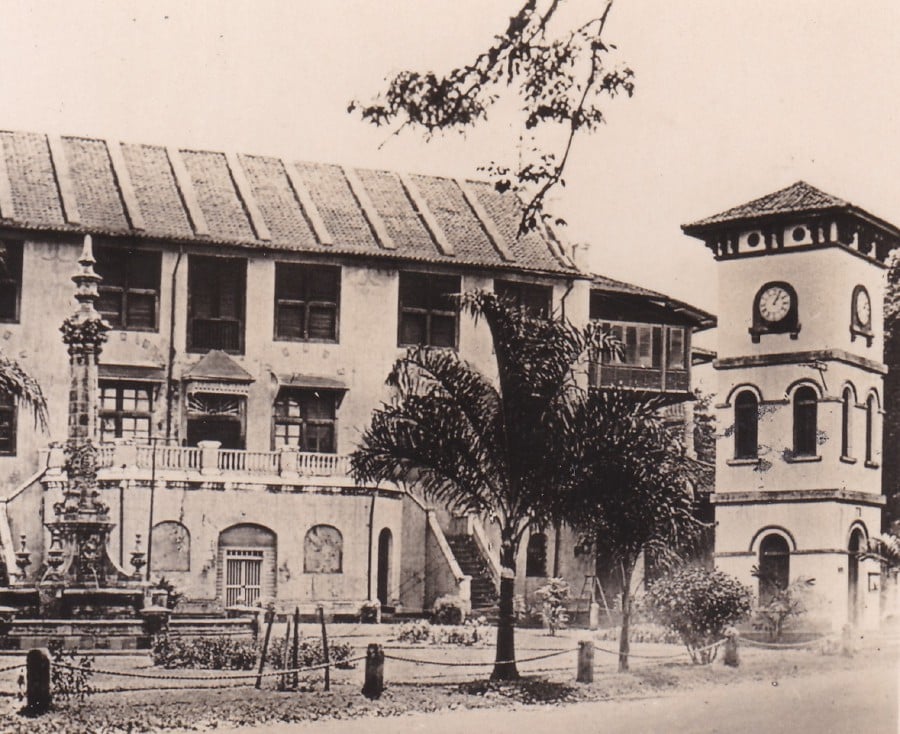
 Memories and Such