2025 Week 36 Update

American author, editor, and journalist Will Schwalbe’s quote emphasises that mindfulness is simple presence, not a complicated practice or performance. He explains that mindfulness doesn’t require elaborate techniques; it’s about giving your full attention to the current moment and to the person or activity in front of you.

By saying “When I’m with you, I’m with you,” he highlights the importance of genuine presence in relationships. Too often, we divide our attention: thinking about the past, worrying about the future, or being distracted by devices. True mindfulness is about dropping distractions and fully engaging with what’s happening now. The quote reminds us that mindfulness is not about adding something extra to life; it’s about stripping away the noise so that we can experience connection, clarity, and peace as they naturally are in the present moment.

BB left for Australia yesterday early morning, and I am already missing him. He will be gone until the end of the month, and my only hope for him during this trip is that he is safe, enjoys himself, and learns something that will serve him for the rest of his life. GG is busy with school and is giving interviews for her six-month internship, which is a graduation requirement.

This week, I read something interesting about reclaiming your power. What it said was that your peace and happiness should never depend on someone else’s actions. Don’t sacrifice your calm over a missed call or a message left unanswered. You don’t need anyone’s validation to recognise your worth. Stand firm in who you are and honour your values. Stop investing energy in those who don’t give it back. Let people enhance your joy, but don’t make them the source of it. Root your happiness and peace within yourself, and stay aligned with your truest, most authentic self. Does it make sense?

At the end of August, I am almost done with my epic walk of more than 14,000 km from Singapore to my home in Mumbai, then a detour to Bengaluru and back to Singapore. By my estimation, sometime in the third week of September, I should finally reach home. Now, where should I walk next?

That’s all from me this week. Here’s to a fantastic September (albeit a week late)…

In My Hands Today…

How to Be Enough: Self-Acceptance for Self-Critics and Perfectionists – Ellen Hendriksen

Are you your own toughest critic? Learn to be good to yourself with this clear and compassionate guide.

Do you set demanding standards for yourself? If so, a lot likely goes well in your life: You might earn compliments, admiration, or accomplishments. Your high standards and hard work pay off.

But privately, you may feel like you’re falling behind, faking it, or different from everybody else. Your eagle-eyed inner quality control inspector highlights every mistake. You try hard to avoid criticism, but criticize yourself. Trying to get it right is your guiding light, but it has lit the way to a place of dissatisfaction, loneliness, or disconnection. In short, you may look like you’re hitting it out of the park, but you feel like you’re striking out.

This is perfectionism. And for everyone who struggles with it, it’s a misnomer: perfectionism isn’t about striving to be perfect. It’s about never feeling good enough.

Dr. Ellen Hendriksen—clinical psychologist, anxiety specialist, and author of How to Be Yourself—is on the same journey as you. In How to Be Enough, Hendriksen charts a flexible, forgiving, and freeing path, all without giving up the excellence your high standards and hard work have gotten you. She delivers seven shifts—including from self-criticism to kindness, control to authenticity, procrastination to productivity, comparison to contentment—to find self-acceptance, rewrite the Inner Rulebook, and most of all, cultivate the authentic human connections we’re all craving.

With compassion and humor, Hendriksen lays out a clear, effective, and empowering guide. To enjoy rather than improve, be real rather than impressive, and be good to yourself when you’re wired to be hard on yourself.

Sacred Stones, Spaces and Stories: Shakthipeeta Part 18

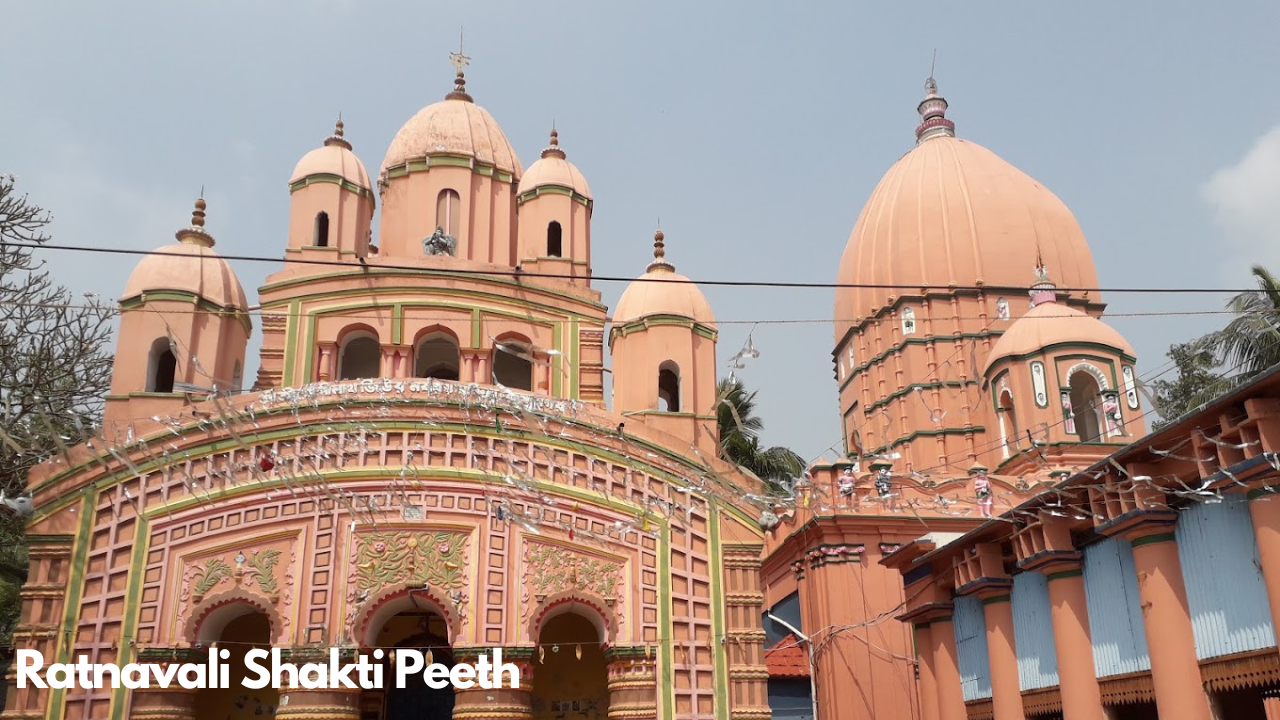
Ratnavali, Khanakul I, West Bengal
Also known as the Anandamayee Shakti Peeth, the Ratnavali Shakti Peeth is a sacred temple located in Khanakul-Krishnanagar, Hooghly district. Nestled on the banks of the Ratnakar River, this ancient shrine is dedicated to Maa Kumari, and Lord Shiva is worshipped as Bhairava.

It is believed that Sati’s right shoulder fell at this location in Khanakul-Krishnanagar. The temple has been a centre of devotion for centuries and is known locally as the Anandamayee Shakti Peeth. The name Ratnavali translates to a string of gems, symbolising the divine radiance and spiritual wealth associated with this sacred site. The current structure reflects traditional Bengali temple architecture and has undergone renovations over time to preserve its sanctity.

Goddess Sati is worshipped here as Maa Kumari, symbolising purity and divine energy. Lord Shiva is revered as Bhairava, representing his protective aspect. The right shoulder or dakshina skandha of Sati fell at this site.

The temple is situated on the tranquil banks of the Ratnakar River, adding to its serene ambiance. Devotees believe that the river’s waters carry divine blessings and often perform purification rituals before entering the temple. The sanctum sanctorum houses an intricately carved idol of Maa Kumari adorned with ornaments and flowers. Adjacent to her shrine is a smaller shrine dedicated to Bhairava, symbolizing Lord Shiva’s presence as her protector. The temple features traditional Bengali architecture with a curved roof or chala and terracotta designs on its walls. Its simplicity emphasizes spiritual connection over material grandeur. During Navratri, the temple becomes a hub of religious activity with grand decorations, cultural performances, and community feasts. Despite being located in a relatively remote area, the temple is well-connected by road and rail. Pilgrims often travel from Howrah or Kolkata to visit this sacred site.

Daily worship includes the morning and evening aartis and devotees offer flowers, especially hibiscus, fruits, sweets, incense sticks, and coconuts to Maa Kumari while chanting hymns like Durga Saptashati. Navratri is celebrated twice a year in March-April and September-October with great fervor. Special pujas are performed over nine days to honor Maa Kumari’s nurturing aspect. Devotees observe fasting during these nine days as an act of devotion. Durga Puja is one of the most vibrant festivals celebrated at Ratnavali Shakti Peeth. Elaborate rituals are conducted to honor Mahishamardini Durga’s victory over evil forces. The deity is adorned with new clothes and jewelry donated by devotees during this time.

Dedicated to Bhairava or Lord Shiva, Maha Shivratri involves night-long prayers and abhishekam with milk, honey, ghee, curd, and holy water. Devotees light oil lamps around the temple premises as part of their offerings. Havan ceremonies are conducted during auspicious occasions like Navratri and Shivratri to invoke divine blessings for prosperity and protection.

According to legend, when Sati’s right shoulder fell at this site after being dismembered by Vishnu’s Sudarshan Chakra, it radiated immense divine energy that sanctified the surrounding area. Devotees believe that this energy still permeates the temple premises, making it a powerful center for spiritual awakening. Local lore suggests that Bhairava appeared in his fierce form to protect this sacred site from negative energies after Sati’s right shoulder fell here. His presence ensures balance and harmony at Ratnavali Shakti Peeth. It is believed that devotees who pray earnestly at Ratnavali Shakti Peeth experience miraculous healing from ailments. Many pilgrims visit the temple seeking relief from physical and emotional hardships through Maa Kumari’s blessings.

The Ratnavali Shakti Peeth offers visitors a unique spiritual experience rooted in mythology, devotion, and natural beauty. Whether you seek spiritual solace or wish to explore India’s rich cultural heritage, visiting this ancient shrine will leave you feeling connected to the divine feminine energy.

Trishrota/Bhramari Devi, Jalpaiguri, West Bengal
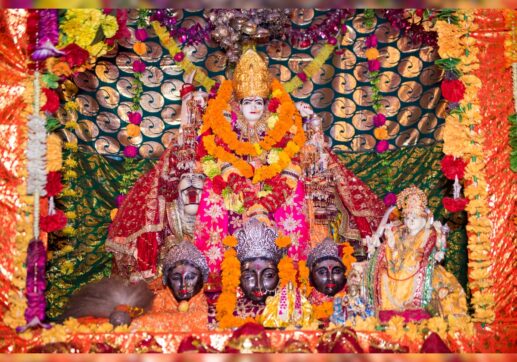
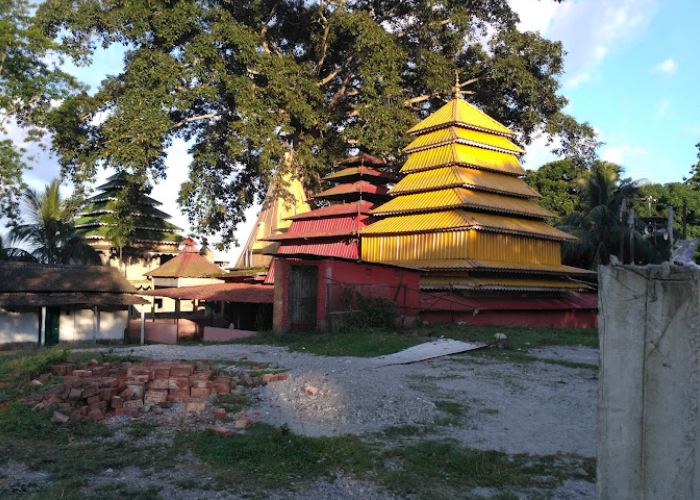
The Bhramari Devi Temple, also known as the Trisrota Shakti Peetha, is a revered Hindu shrine located in Bodaganj village, Jalpaiguri district. Nestled on the banks of the Tista River, this temple is one of the 51 sacred Shakti Peethas, where it is believed that the thumb of Sati’s left leg fell.

The temple is named after Maa Bhramari, an incarnation of Goddess Durga who is associated with bees or bhramara in Sanskrit. According to legend, Maa Bhramari transformed into a swarm of bees to defeat a demon named Arun Asura who had terrorised heaven and earth. Her fierce yet protective nature earned her the title Goddess of Bees. Lord Shiva, worshipped here as Ambar Bhairava.

While the exact date of the temple’s construction remains unknown, it has been a center of devotion for centuries. The temple’s serene location on the banks of the Tista River adds to its spiritual ambiance and makes it an ideal destination for meditation and worship.

Maa Bhramari is known as the Goddess of Bees. Devotees believe that her divine energy manifests through bees that protect her temple. Honey, associated with bees, is offered as a sacred item during rituals. The temple is located on the banks of the Tista River, also known as Trisrota, meaning three streams. The river’s tranquil flow creates a serene environment that enhances meditation and spiritual practices. Unlike many temples that house stone or metal idols, Maa Bhramari is represented by a symbolic stone structure adorned with flowers and sacred cloths. The temple features traditional Bengali architectural elements with minimal ornamentation. Its natural setting amidst greenery adds to its charm. Devotees believe that Maa Bhramari possesses miraculous powers to heal ailments, bless couples with children, and protect devotees from evil forces.

The rituals at Trisrota Shakti Peetha reflect ancient Hindu traditions combined with local customs. Daily pujas are performed by priests who offer flowers, especially hibiscus, fruits, honey, incense sticks, and coconuts to Maa Bhramari. Morning Aarti begins at sunrise with chanting of hymns like Durga Saptashati. Evening Aarti concludes with lighting oil lamps around the temple premises. Bhramari Puja, a special 10-day festival dedicated to Maa Bhramari takes place annually in July-August. During this time the temple is decorated with flowers and lights, devotees offer honey as a sacred item, and cultural performances and community feasts are organised.

Navratri is celebrated twice a year in March-April and September-October with grand rituals honoring Maa Bhramari’s protective aspect. Devotees observe fasting during these nine days to seek blessings for prosperity and protection. Honey or madhu is considered sacred due to its association with bees and is offered daily at Maa Bhramari’s altar. Yagnas are conducted during auspicious occasions like Navratri to invoke divine blessings for health, wealth, and spiritual growth.

According to legend, Arun Asura was a cruel demon who terrorised heaven and earth after gaining immense power through penance. He drove out gods from their celestial abodes and harassed their families. In desperation, they sought help from Maa Parmeshwari, another form of Goddess Durga, who transformed into Maa Bhramari—a giant bee surrounded by swarms of bees. Maa Bhramari attacked Arun Asura with her swarm, piercing his chest repeatedly until he was defeated. This victory symbolises triumph over evil forces and establishes Maa Bhramari as a fierce protector.

Devotees believe that Maa Bhramari possesses miraculous healing powers. Many pilgrims visit the temple seeking relief from physical ailments or emotional distress after hearing stories of miraculous recoveries attributed to her blessings. It is said that those who offer honey at Maa Bhramari’s altar with sincere devotion often see their wishes fulfilled—whether related to financial stability, fertility, or personal growth.

The Trisrota Shakti Peetha with its unique rituals like honey offerings emphasise simplicity in worship while preserving ancient traditions. Whether you seek spiritual solace or wish to explore India’s rich cultural heritage, visiting this ancient shrine will leave you feeling connected to the divine feminine energy embodied by Maa Bhramari.

Nandikeshwari Temple, Sainthia, West Bengal
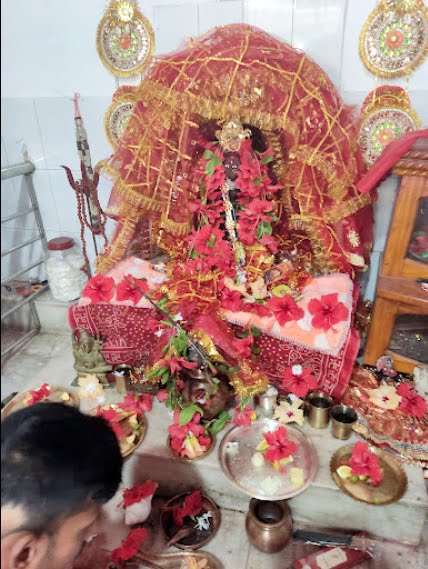
Believed to be where the necklace of Sati fell, the Nandikeshwari Temple, located in Sainthia, Birbhum district is dedicated to Maa Nandikeshwari, an incarnation of Goddess Durga. The origins of the Nandikeshwari Temple are deeply rooted in Hindu mythology. After Sati’s self-immolation during Daksha Yajna, Lord Vishnu dismembered her body with his Sudarshan Chakra to pacify Lord Shiva’s grief-stricken Tandava. It is believed that Sati’s necklace fell at this site in what was once known as Nandipur village, now part of Sainthia town. This event sanctified the location as one of the 51 Shakti Peethas.

The temple was constructed in 1913 CE, the year 1320 according to the Bengali calendar on an elevated platform. Over time, it has undergone renovations but retains its ancient charm. The name Nandikeshwari derives from Nandi, the sacred bull and follower of Lord Shiva, and Ishwari, meaning goddess. This etymology reflects the temple’s association with both Shiva and Shakti. Sainthia itself is derived from the Bengali term Sain, meaning Islamic priest, symbolising the region’s history of cultural coexistence. The temple stands on the banks of the Mayurakshi River.

Goddess Sati is worshipped here as Maa Nandikeshwari, symbolising divine protection and nurturing energy. Lord Shiva is revered here as Nandikeshwar Bhairava, representing his role as a guardian and protector. The necklace or mala of Sati is believed to have fallen at this site. The combination of Maa Nandikeshwari and Nandikeshwar Bhairava represents the union of nurturing feminine energy with protective masculine power, making this Shakti Peetha a site of immense spiritual significance.

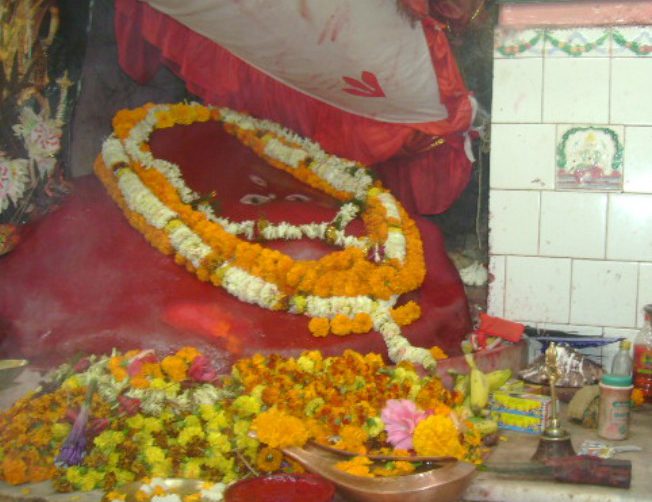
The Nandikeshwari Temple stands out for its distinctive characteristics. The main idol in the temple is a black stone that has turned red over time due to the continuous application of vermilion by devotees. This stone is adorned with a silver crown and three golden eyes symbolizing divine vision. Devotees believe that touching or praying before this sacred stone brings blessings and fulfils wishes.

Adjacent to the temple is an ancient banyan tree where devotees tie red or yellow threads with prayers for wish fulfilment. This practice symbolises their faith in Maa Nandikeshwari’s divine grace. The temple features a pyramidal dome marking Maa Nandikeshwari’s sanctum. Surrounding it are smaller shrines dedicated to other deities like Lord Shiva, Ram-Sita, Radha-Krishna, Saraswati, Lakshmi-Narayana, and Hanuman. The walls overlooking the main temple feature carvings of the Dasa Mahavidya, the ten forms of Goddess Durga, symbolising her diverse manifestations.

The rituals at Nandikeshwari Temple reflect deep-rooted traditions combined with local customs. Daily pujas are performed by priests who offer flowers, fruits, coconuts, rice, incense sticks, and sweets to Maa Nandikeshwari. Morning Aarti begins at sunrise with chanting of hymns like Durga Saptashati, while evening Aarti concludes with lighting oil lamps around the temple premises.

The 10-day Nandikeshwari Utsav is a festival held annually in October-November is one of the most important events at the temple. During this time, the temple is adorned with flowers and lights, special yagnas are conducted to invoke divine blessings, and devotees from across India participate in cultural programs and community feasts. Celebrated on Buddha Purnima, the full moon day commemorating the birth of the Buddha, the festival of Baishakhi Purnima, involves special prayers and offerings at Maa Nandikeshwari’s altar. Devotees light lamps under the banyan tree to seek blessings for prosperity and happiness.

Kali Puja is celebrated with grand rituals honoring Maa Durga’s fierce aspect as Kali. Devotees offer red hibiscus flowers symbolic of power and victory over evil forces. On new moon nights or Amavasya, special Tantric rituals are conducted by priests to invoke Maa Nandikeshwari’s protective energy.

It is believed that when Sati’s necklace fell at this site, it radiated immense divine energy that sanctified not only Sainthia but also its surrounding regions. Devotees claim that this energy can still be felt within the temple premises during meditation or prayer. According to legend, tying threads around the banyan tree adjacent to the temple fulfills devotees’ wishes—whether related to health, prosperity, or personal relationships. Many pilgrims return annually to untie their threads as a gesture of gratitude after their wishes are fulfilled. Devotees believe that Maa Nandikeshwari possesses miraculous healing powers. Many visit the temple seeking relief from physical ailments or emotional distress after hearing stories of miraculous recoveries attributed to her blessings.

The Nandikeshwari Temple, on the banks of the Mayurakshi River provides an ideal setting for meditation and introspection. If one is seeking spiritual solace, visiting this ancient shrine will leave one connected to the divine feminine energy.

In My Hands Today…

The Position of Spoons: And Other Intimacies – Deborah Levy

Deborah Levy’s vital literary voice speaks about many things.

On footwear: “It has always been very clear to me that people who wear shoes without socks are destined to become my friends and lovers.”

On public parks: “A civic garden square gentles the pace of the city that surrounds it, holding a thought before it scrambles.”

On Elizabeth Hardwick: “She understands what is at stake in literature.”

On the conclusion of a marriage: “It doesn’t take an alien to tell us that when love dies we have to find another way of being alive.”

Levy shares with us her most tender thoughts as she traces and measures her life against the backdrop of different literary imaginations; each page is a beautiful, questioning composition of the self. The Position of Spoons is full of wisdom and astonishments and brings us into intimate conversation with one of our most insightful, intellectually curious writers.

Family Footprints: An Unforgettable Italian Adventure – Part 3

View from the train on the way to Florence

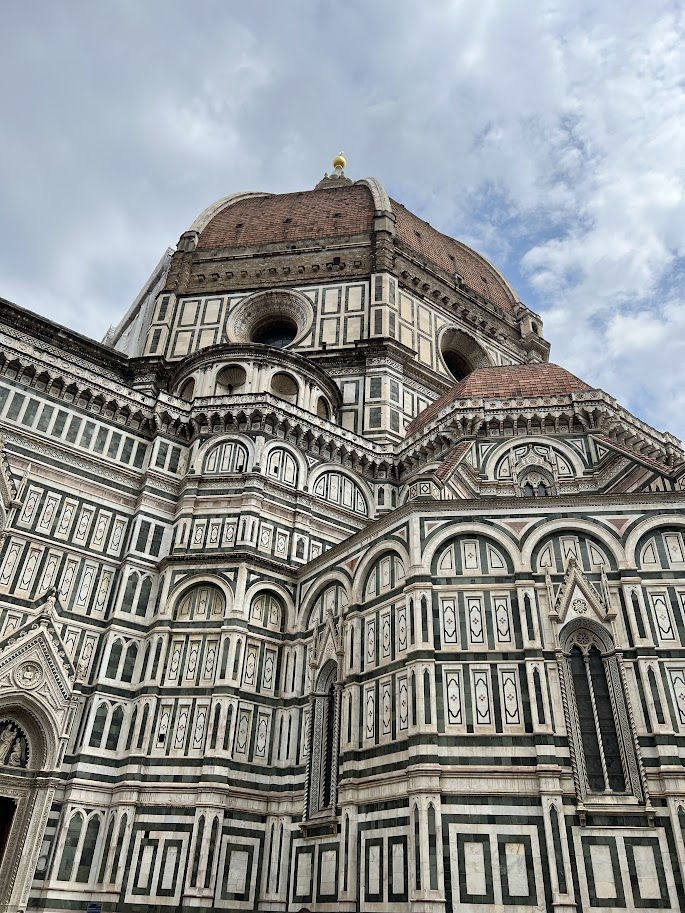
Early the next day, we checked out of our Airbnb and made our way to the Roma Termini station for our Frecciarossa train to Florence. We had booked business class tickets, and other than two other people in the carriage, we had the carriage to ourselves. We reached Florence around 10:30 am and took a taxi to our next Airbnb. Our Florence host had graciously allowed us to leave our luggage in the Airbnb while it was being cleaned. So after dropping our luggage, we started our short Florence trip. We walked to the Duomo, and I had a jaw-dropping moment there. It dominates the landscape and made me think of St. Paul’s Cathedral in London.

The Duomo

Construction of Florence’s Duomo complex began in 1296 under Arnolfo di Cambio; Filippo Brunelleschi crowned it with his revolutionary double-shell dome in 1436, still the world’s largest in masonry at 43 m wide. We did not go inside and climb the dome, but the next time, I will climb all 463 steps in Brunelleschi’s Dome and brush past Vasari’s Last Judgment fresco before stepping onto a 91 m-high lantern terrace for city-wide views. One can also climb the 414 steps up Giotto’s Campanile for a front-row view of the dome’s herringbone brickwork. At the Museo dell’Opera del Duomo, one can stand inches from Ghiberti’s original Gates of Paradise and Michelangelo’s Pietà Bandini before they return outdoors.

Piazza della Signoria, Time Unfolding

After lunch in the shadow of Brunelleschi’s Dome, we walked to Piazza della Signoria, which has anchored Florentine civic life since 1330. Its irregular “w-shaped” stones still front the crenellated Palazzo Vecchio, the seat of government from the medieval Republic to today’s city council. Under the tower’s shadow, the square doubles as an open-air sculpture gallery. A copy of Michelangelo’s David guards the palace door; the neighbouring Loggia dei Lanzi frames masterpieces from Cellini’s Perseus to Giambologna’s Sabine Women. Ammannati’s marble-and-bronze Fountain of Neptune returned to full sparkle in 2019 after a €1.5 million Ferragamo-funded overhaul that replaced long-silent pumps and cleaned centuries of grime. I loved the sculpture of the young woman holding a smartphone. Apparently, it is a four-metre contemporary bronze by Thomas J. Price called Time Unfolding, which will remain until 14 September 2025. Beyond statuary, one can climb the Arnolfo Tower for 360° city views or follow the freshly reopened Vasari Corridor from Palazzo Vecchio toward the Uffizi and Ponte Vecchio, walking the same secret Medici passage first built in 1565.

While we were relaxing amidst the statues, we were told our Airbnb was ready for us. So we quickly gathered our things and checked in. After resting for a while, we decided to head out, this time just walking and taking in Florence. We split up initially and then met up and did some shopping before heading out for dinner. After dinner, it was time for some gelato and then bed before our Tuscan road trip the next day.

The beautiful Tuscan countryside

We woke up early, and two of us went out to get the car we had reserved. Here is where we hit the first of the many snags of the day. Our plan was to be out of Florence by 8:30 am, but when we reached the car rental place by 8 am, it was still shut, and there was a queue of about 10ish people ahead of us. By the time we collected the car, it was almost 10 am, and our ticket at Pisa was for 10:30 am. The distance between Florence and Pisa is between 60 and 90 minutes, and so we were late even before we started the drive.

Leaning Tower of Pisa

The Leaning Tower of Pisa looms improbably over the Campo dei Miracoli, tilting 3.97° off-plumb because the alluvial clay beneath its foundations started to give way soon after work began in 1173; the bell tower was finally completed in 1372. A decade-long engineering rescue from 1990 to 2001 removed 70 tonnes of soil, nudged the structure upright by 45 cm, and reopened it to visitors; a web of fibre-optic sensors now feeds live data to engineers who forecast at least 200 years of stability. Climbing the 251 spiral steps is a disorienting thrill; the gradient alternately steepens and eases as the tilt shifts underfoot before one steps onto the belfry terrace for wide-angle views of Tuscany and a close-up of the seven medieval bells. Back on the lawn, look for the delicate reliefs at ground level and indulge in the obligatory “holding-up-the-tower” photo.

We reached Pisa and the Leaning Tower around noon, and after parking the rented car close to the complex, we walked over. We tried going inside but were not allowed and were told to purchase new tickets. Since we were getting late, we left the Leaning Tower complex and had a quick meal before making our way to the next stop on our itinerary.

The beautiful Tuscan countryside

Perched on a ridge of Tuscan vineyards, San Gimignano still thrusts 14 medieval tower-houses skyward, remnants of more than 70 that once broadcast family pride and rivalries. Their unmistakable skyline, intact walls, and 14th-century fresco cycles earned the town UNESCO World Heritage status in 1990. At the Piazza del Duomo, you begin at the Torre Grossa, where one can climb 218 wooden steps for sweeping views of the Apuan Alps and Siena’s dome. Inside the adjoining Palazzo Comunale, Benozzo Gozzoli’s pastoral frescoes frame a camera-ready civic courtyard. Steps away, the Romanesque Collegiata cathedral dazzles with a near-complete Old and New Testament cycle by the 14th-century Sienese school. But we didn’t make it into the town. By the time we reached the town’s car park, we realised we had to leave if we were to make it to our wine tasting session at the Castello di Brolio on time. Reluctantly, we left and took the route passing through Siena, which we wanted to come back to.

Castello di Brolio

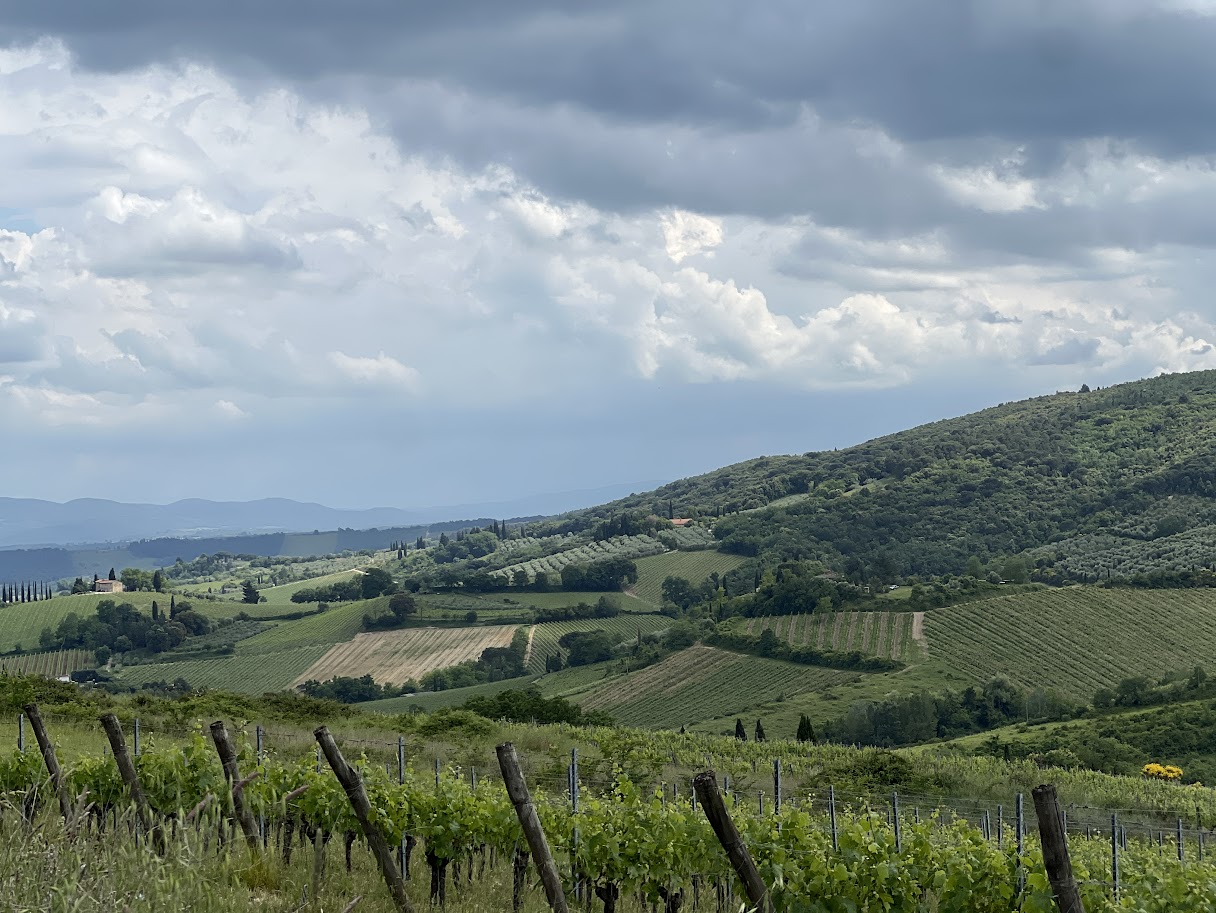
Driving through the Tuscan countryside is amazing! We took the long route and stopped frequently to take in the views and photos. And we finally made it to the Castello di Brolio just in time for the wine tasting session. Castello di Brolio has belonged to the Ricasoli family since 1141, making it Italy’s oldest continuously run wine estate. The brick-red battlements you see today are a 19th-century neo-Gothic rebuild commissioned by Baron Bettino Ricasoli, the statesman who also penned the original Chianti Classico formula. We circled the ramparts for postcard vistas that sweep across 240 hectares of vineyards to Siena and distant Monte Amiata, then wandered Renaissance box gardens and the family chapel. We had the Classic wine tasting with three wines, and after the session, some of my sisters brought bottles of wine to take home. I am not a drinker, but even I loved the wines we tasted.

After the wine tasting, it was time for dinner. As I mentioned, some of my sisters are big foodies, and one of them found a Michelin-starred vegetarian restaurant in Siena, so we decided to go there because they were not picking up the phone to make a reservation. Another sister wanted to visit Siena, so this worked for everyone.

Siena

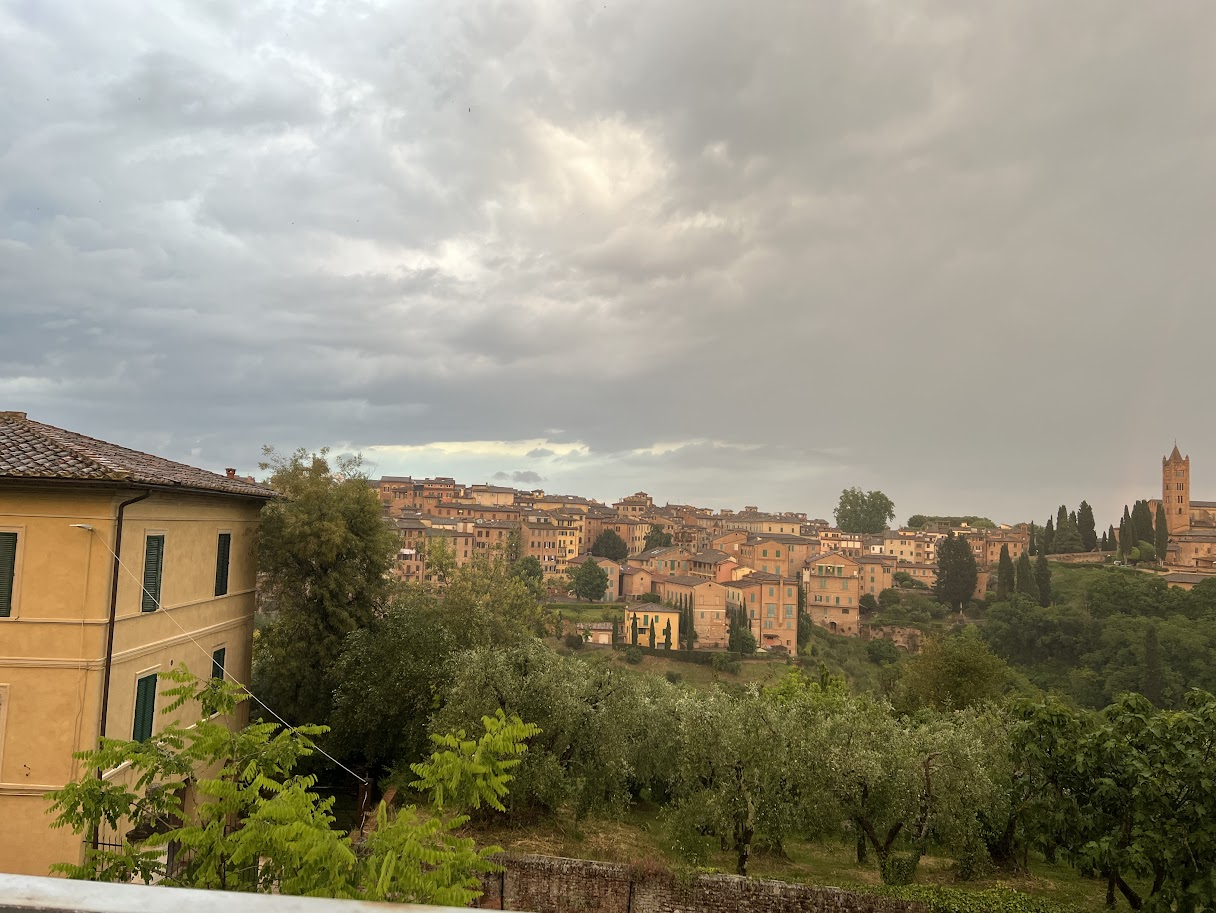
We reached Siena around 7 pm. Set atop three converging ridges in southern Tuscany, Siena preserves one of Europe’s purest Gothic cityscapes; UNESCO inscribed the entire historic centre in 1995 for the way its 13th- and 14th-century street plan and ochre-brick facades survive almost intact. The fan-shaped Piazza del Campo is still the civic stage: twice a year it morphs into the thundering Palio horse race. Just above the square, the zebra-striped Cathedral of Santa Maria Assunta dazzles. Climb the 102-m Torre del Mangia for vineyard-striped horizons.

The restaurant was completely booked, and they turned us away. So we frantically googled alternatives. And then it started raining. We went back to the car park and tried alternatives. But it was decided unanimously that we would walk to Piazza del Campo for dinner. The streets of this part of Siena are extremely hilly and winding. But after walking to the Piazza, the views were worth it. We had dinner at one of the restaurants in the Piazza before making our way back to the car park and then the drive back to Florence.

Piazza del Campo

Piazza del Campo is the red-brick heart of Siena. Its distinctive shell unfurls in nine cream-travertine wedges, a permanent tribute to the “Nine” oligarchs who guided the city’s 14th-century heyday, and a key reason UNESCO protected the entire historic centre in 1995. On the square’s lower rim rises the Palazzo Pubblico with its soaring Torre del Mangia. While the belfry’s 400-step climb rewards you with views over Chianti hills, the palace itself offers a rarer thrill: scaffold-level tours of Ambrogio Lorenzetti’s Allegory of Good and Bad Government frescoes. Opposite, Jacopo della Quercia’s marble Fonte Gaia gleams again after a laser cleaning completed in February 2024; its wolves and Genesis reliefs now sparkle against the Sienese brick.

We left Siena around 10 pm for the 1-hour-plus drive back to Florence. I had a headache because of the rain, and so I pretty much slept the drive. I think in the entire trip, this road trip would stand out as a highlight because of all the fun we had. We stored the car in a local garage to be returned the next day.

David at the Galleria dell’Accademia

The next day was our last in Florence, and we had tickets to see David at the Academia. Our original plan was to take a 2 pm train to Venice, but because we wanted to spend more time in the city, we moved our ticket to about 6 pm. Our slot to the Academia was at noon, so after a good breakfast, a couple of us went to return the car while the rest of us worked on clearing the house and getting ready to leave. Our host very graciously offered to let us keep our luggage at a restaurant they co-owned close by, so after checking out and leaving the luggage, we walked to the Academia. We had to wait in a queue for about 15-20 minutes before we could enter.

The Galleria dell’Accademia was founded in 1784 as a teaching museum; today its seven rooms orbit Michelangelo’s David: the five-metre marble hero carved 1501-1504 and installed here in 1873 to shield him from the elements. Every two months, restorers vacuum dust from his curls and scan for micro-cracks, a ritual that keeps the icon in “remarkable health” despite drawing more than two million visitors a year.

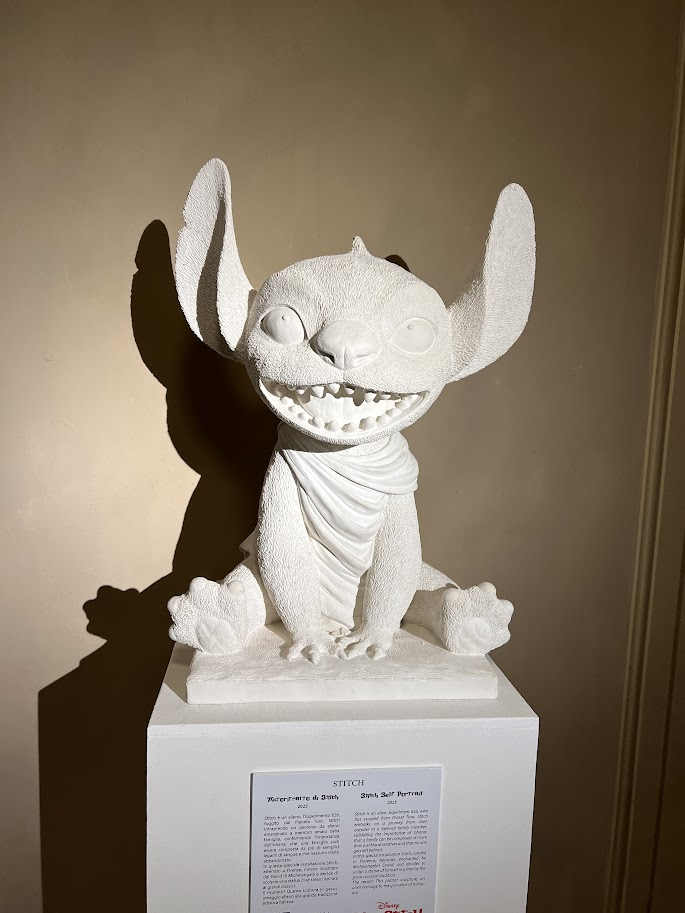
Sculpture of Stitch at the Galleria dell’Accademia

The Hall of the Prisoners, where four unfinished slaves wrestle with their marble bonds, comes first before a long hallway with David at the very end. It was not very crowded, and we could walk around the statue, taking in the sculpture’s beauty. Then we walked into the Hall of the Colossus to see Giambologna’s life-size plaster for The Rape of the Sabines flanked by early-Renaissance altarpieces. The luminous Gipsoteca Bartolini showcases 19th-century plaster casts under skylights restored in 2021, while the adjoining Museum of Musical Instruments, home to a Stradivari “Medici” violin and one of Cristofori’s earliest pianos, was amazing. Towards the exit, unexpectedly, I came across a sculpture of Stitch from the film, Lilo and Stitch, draped in a toga. The project is a three-way partnership between Disney Italy, the Italian Ministry of Culture and the museum, timed to promote the live-action Lilo & Stitch remake and to pull new, younger audiences into Florence’s most visited art space. I enjoyed this ode to modern art amidst all the classical and Renaissance art and sculptures.

After visiting the Academia, we decided to have Indian for lunch and walked to one about 10 minutes away. After lunch, we each wandered away, to do our own thing before agreeing to meet at the place where we had stored our luggage around 4 pm. Then it was time to go back to the station to catch another high-speed train to the last stop of our holiday.

Our last stop, Venice, comes up next, along with lessons learned and some tips.