The Truths We Hold: An American Journey – Kamala Harris
Vice President-elect Kamala Harris’s commitment to speaking truth is informed by her upbringing. The daughter of immigrants, she was raised in an Oakland, California community that cared deeply about social justice; her parents–an esteemed economist from Jamaica and an admired cancer researcher from India–met as activists in the civil rights movement when they were graduate students at Berkeley. Growing up, Harris herself never hid her passion for justice, and when she became a prosecutor out of law school, a deputy district attorney, she quickly established herself as one of the most innovative change agents in American law enforcement. She progressed rapidly to become the elected District Attorney for San Francisco, and then the chief law enforcement officer of the state of California as a whole. Known for bringing a voice to the voiceless, she took on the big banks during the foreclosure crisis, winning a historic settlement for California’s working families. Her hallmarks were applying a holistic, data-driven approach to many of California’s thorniest issues, always eschewing stale “tough on crime” rhetoric as presenting a series of false choices. Neither “tough” nor “soft” but smart on crime became her mantra. Being smart means learning the truths that can make us better as a community, and supporting those truths with all our might. That has been the pole star that guided Harris to a transformational career as the top law enforcement official in California, and it is guiding her now as a transformational United States Senator, grappling with an array of complex issues that affect her state, our country, and the world, from health care and the new economy to immigration, national security, the opioid crisis, and accelerating inequality.
By reckoning with the big challenges we face together, drawing on the hard-won wisdom and insight from her own career and the work of those who have most inspired her, Kamala Harris offers in The Truths We Hold a master class in problem-solving, in crisis management, and leadership in challenging times. Through the arc of her own life, on into the great work of our day, she communicates a vision of shared struggle, shared purpose, and shared values. In a book rich in many home truths, not least is that a relatively small number of people work very hard to convince a great many of us that we have less in common than we actually do, but it falls to us to look past them and get on with the good work of living our common truth. When we do, our shared effort will continue to sustain us and this great nation, now and in the years to come.
Rome We reached the airport about 2.5 hours before our flight because we had heard all sorts of horror stories about the airport. But we were pleasantly surprised and checked in and were sent on our way in less than 10 minutes. After breakfast at the airport, we started our journey. We landed in Rome in the afternoon, and there was a bit of a rush in Italian immigration. We could have taken the train to Roma Termini, but because there were six of us, a taxi was cheaper. Though Italy has Uber, only the premium taxis can be hired. Instead, the FreeNow app is more widely used, from which we got our taxi. We used Airbnb all through the trip, and our Airbnb in Rome was close to the Colosseum.
After checking in and freshening up, we headed out to go to the Vatican. We had a 5:30 slot at the Vatican Museum and a slightly earlier slot at St. Peter’s Basilica. We missed the basilica slot but made it to the Vatican Museum. Because it is a Jubilee year and a new Pope has just been selected, the crowds were crazy in all the Italian cities we visited. The Vatican Museum was no exception. But what a museum!
Courtyard of Vatican Museum
Founded in 1506 by Pope Julius II and expanded by successive pontiffs, the Vatican Museums form a 7-km labyrinth of galleries that chart 3,000 years of human creativity. The Sistine Chapel is the last but probably the most visited part of the museum, where Michelangelo’s ceiling and Last Judgment remain the undisputed stars of the collection. The recently restored four Raphael Rooms are gorgeous, their luminous frescoes now glowing as they did for Leo X’s court. In the Pio-Clementine Museum, the newly restored Apollo of the Belvedere once again commands the Octagonal Courtyard, its marble surface revealing subtle details lost for generations. At the Anima Mundi, the reimagined ethnographic wing, the freshly installed Africa and Americas galleries place sacred masks, bark-cloths, and Inuit carvings on equal footing with the Western canon. I loved the Gallery of Maps with its intricate illustrative maps, the jewel-like Pinacoteca, and the vertiginous modern Bramante/Momo spiral ramp. When you are finally exhausted, you reach the Sistine Chapel, where photography is prohibited, and just find space in the benches in the perimeter of the room to sit and take in the beauty of the room and the ceiling!
After this assault on the senses, it was time for dinner. Our group was comprised of foodies, so we ate really well during this trip. The first evening, we had a fancy dinner at the Raphael hotel. We could not get the rooftop dining experience, but the food was so, so good. I was practically falling asleep at my plate, so around 10 pm, we finally called it a day.
Colosseum
The next day was for the Colosseum. Our timed entry was for 9:30 am, but since we were less than 10 minutes away on foot, we took our time in the morning. Carved into the heart of ancient Rome, the Colosseum and neighbouring Palatine Hill form a single archaeological park that distils two millennia of power, spectacle, and imperial luxury into a walkable circuit. We began with the Colosseum, inaugurated in AD 80 by Emperor Titus. We only had the normal ticket, so we only went to the main area. But if you purchase the full experience ticket, you cam go onto the partly reconstructed arena floor, gaze down into the fully accessible hypogeum with its maze of lifts, cages, and service corridors reopened to visitors after a recent restoration campaign, and then climb to the upper ring for skyline views stretching from the Capitoline to the distant dome of St. Peter’s. We spent quite a bit of time at the Colosseum, marvelling at its grandeur. After a quick lunch nearby, we walked back to tackle Palatine Hill, mythical birthplace of Romulus and later the postcode of choice for Rome’s emperors. We walked around and caught the vividly painted private rooms of Augustus and Livia that survive in remarkable condition. We last headed to the Farnese Gardens, Europe’s first botanical garden, which offers fragrant terraces with postcard views over the Circus Maximus. After spending a couple of hours here, we headed back to our Airbnb to freshen up before dinner near Piazza del Popolo.
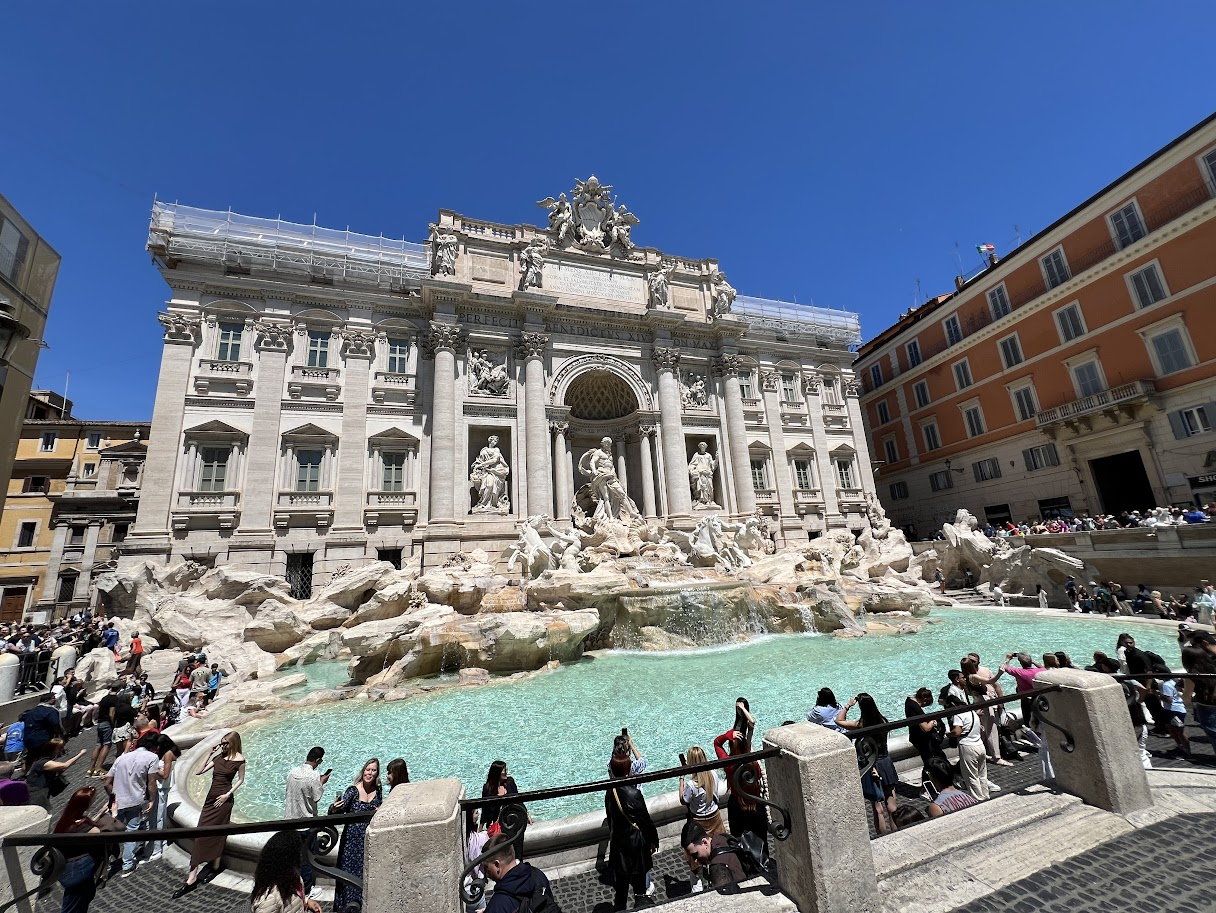
Trevi Fountain
On our last full day in Rome, we decided to head to the Trevi Fountain first. The Trevi Fountain is carved into a palace façade at the junction of “tre vie,” channels the 1st-century BCE Aqua Virgo aqueduct, and crowns Rome’s Baroque age. Pope Clement XII commissioned Nicola Salvi in 1732; after Salvi’s death, Giuseppe Pannini finished the marble theatrics in 1762, centring Oceanus in a shell chariot that surges from craggy rocks toward the city’s ancient heart. A 16-month restoration funded by Fendi in 2014-15 scrubbed the travertine, replaced hidden pumps, and relit the basin, ensuring its moonlit shimmer endures.
We walked about 25-30 minutes from our Airbnb to get to the fountain. It was so crowded, but we managed to get up close in front to take photos and do the coin toss. It is believed that if you stand facing away from the fountain and toss a coin over your left shoulder, you will return to Rome. And for those who are seeking love, it is believed that tossing three coins will get you the love of an Italian!
Source
From the Trevi Fountain, we walked to the Pantheon, but not before a gelato. As with every other attraction in Rome, the Pantheon was also crowded, and so we just saw it from the outside before making our way to Piazza Navona.
Rebuilt by Emperor Hadrian around AD 118–125 atop Agrippa’s earlier temple, the Pantheon still boasts the world’s largest unreinforced concrete dome and an oculus that rains sunlight, and, each Pentecost, rose petals into the marble rotunda. Converted to the church of Santa Maria ad Martyres in 609, it shelters the tombs of Raphael and Italy’s first kings. A €5 timed-entry system introduced in July 2023 now funds ongoing conservation, including 2025 dome reinforcement and portico cleaning backed by Tod’s. One should not miss the noon sunbeam illuminating the floor, the original bronze door leaves, and the Latin portico inscription (“M·AGRIPPA·L·F·COS TERTIVM·FECIT”) linking two Roman ages.
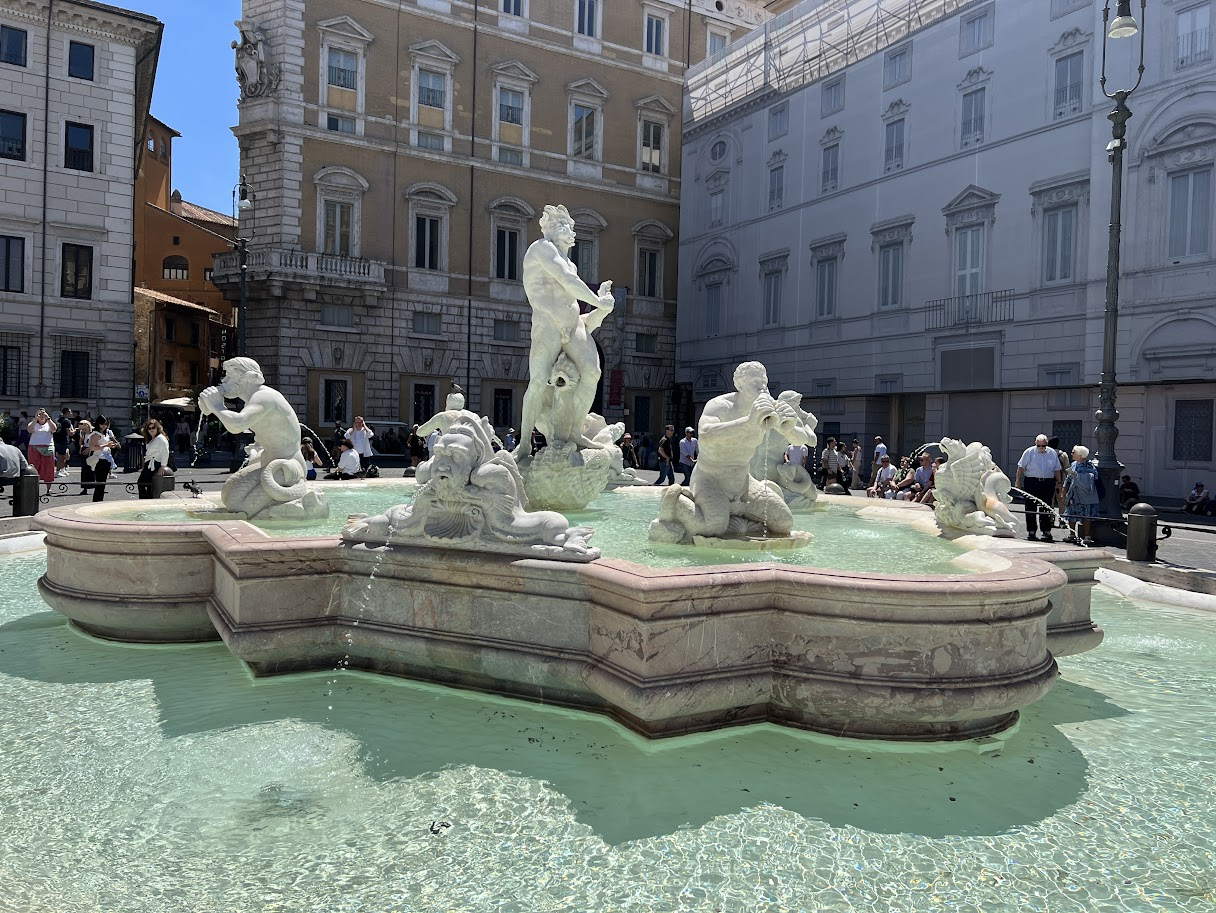
Piazza Navona
Occupying the footprint of Domitian’s first-century athletics stadium, Piazza Navona is an elongated “living room” and is Rome’s Baroque set piece. At its heart lies Bernini’s Fontana dei Quattro Fiumi, personifying the Nile, Danube, Ganges, and Río de la Plata. Framing it are Giacomo della Porta’s Neptune and Moor fountains and Borromini’s undulating façade of Sant’Agnese in Agone.
After spending some time admiring the gorgeous sculptures, we made our way for lunch, after which we did a spot of shopping, and then two of my sisters decided they wanted a break. The rest of us decided to walk to the Spanish Steps, which took us about 20 minutes of walking. We also stopped for coffee on the way.
Spanish Steps
One of Rome’s iconic sights, the Spanish Steps, is fashioned from creamy travertine and was built between 1723 and 1726. With 138 steps, it was financed by France to link its embassy-church above with Spanish diplomatic territory below. A €1.5 million Bulgari-backed restoration scrubbed the balustrades in 2016, and since 2019, anyone who sits or rolls a suitcase on the monument risks fines of €250-€400, preserving the marble for posterity. Crowning the staircase is the Church of Trinità dei Monti, a French-Gothic twin-tower basilica whose nave shelters delicate 16th-century frescoes and an 1864 Cavaillé-Coll organ. While we didn’t go inside the church, we were impressed with the views from the porch of the church.
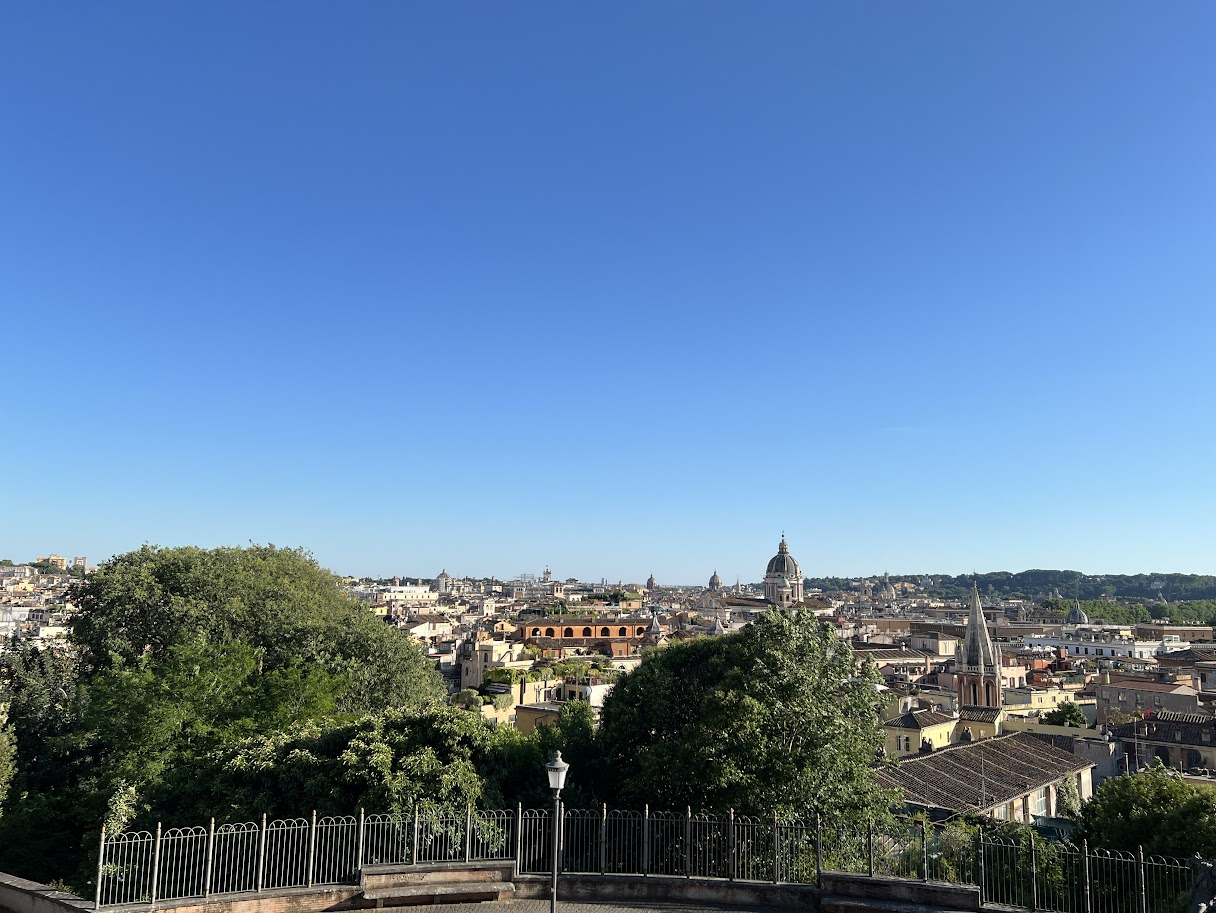
View from outside the Pincio Terrace
A few minutes’ stroll farther up Viale Trinità dei Monti leads to the pine-fringed Pincio Terrace, the southern gateway to Villa Borghese’s gardens. We walked to the gardens and took in the atmosphere. Then, tired, we sat down at a lake in the garden to chit-chat for a while and take a break. While there, I was entranced by a young Roman family with their toddler. All this while, my bag had been strapped crossbody with my phone on a strap around my neck. I was so engrossed with the toddler’s antics that when it was time to leave, I forgot that I had removed my bag from my shoulder and kept it aside. So, I just got up and started walking. We left the garden and walked across the street, and were contemplating whether we should take a taxi or the metro to get back to our Airbnb. It was then I realised that I didn’t have my bag with me! I immediately started running back to where we were sitting, and during those five minutes, my mind was frantically cataloguing the contents of my bag and wondering which cards I should cancel and how. It was one of the longest five minutes of my life. I reached the lake where we were sitting, and in a huge miracle, my bag was exactly where I had left it. With all that I had read about Rome, this was my Roman miracle, and I thanked all the gods, Indian and Roman, for my good fortune! We then walked to the nearest metro station, which happened to be in Piazza Poppolo. Our time in Rome had come to an end as we were going to have a quiet night with a cheese board, wine, and gossip.
Our next destination, Florence, is coming up soon.
What Are You Looking At?: 150 Years of Modern Art in a Nutshell – Will Gompertz
Every year, millions of museum and gallery visitors ponder the modern art on display and secretly ask themselves, “Is this art?”
A former director at London’s Tate Gallery and now the BBC arts editor, Will Gompertz made it his mission to bring modern art’s exciting history alive for everyone, explaining why an unmade bed or a pickled shark can be art—and why a five-year-old couldn’t really do it.
Rich with extraordinary tales and anecdotes, What Are You Looking At? entertains as it arms readers with the knowledge to truly understand and enjoy what it is they’re looking at.
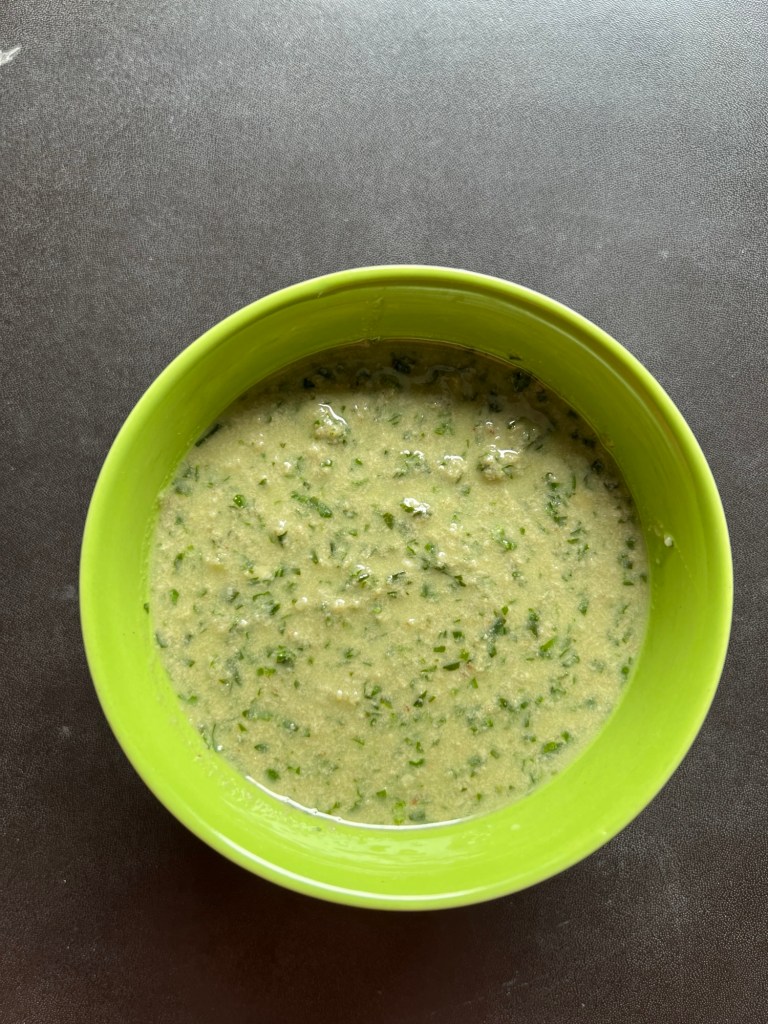
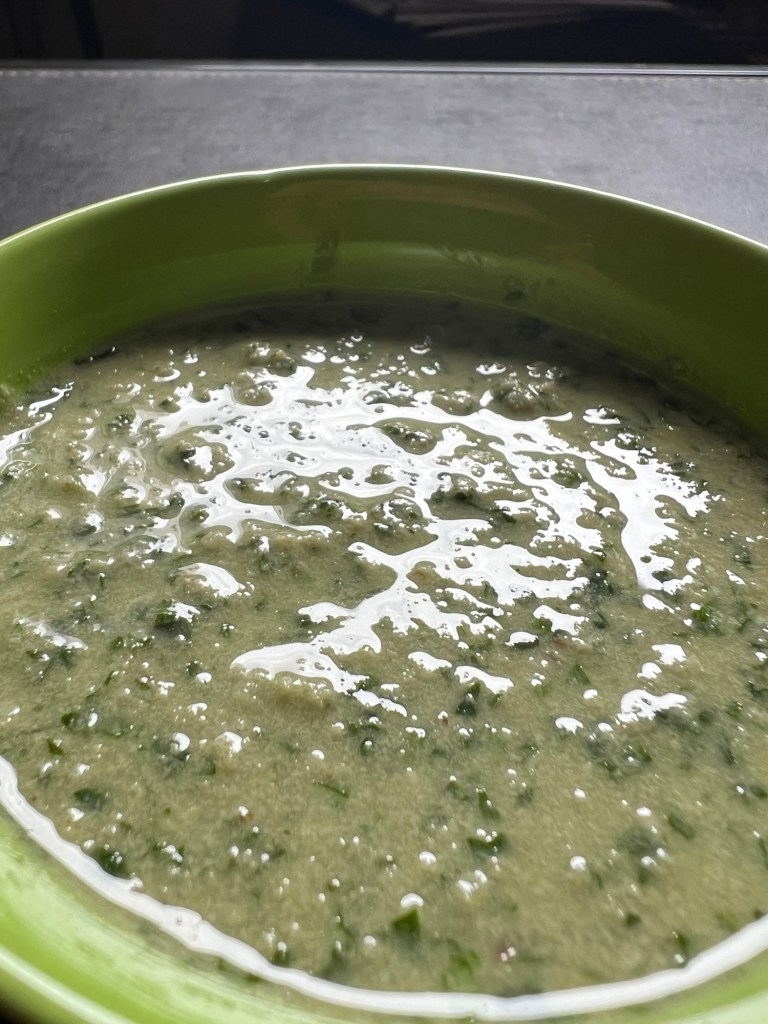
Over the past few years, I have been slowly getting GG & BB into the kitchen and teaching them simple recipes. This is so they can whip up something if there is a need. BB loves pasta, and so that has become his thing. He is the official pasta maker in our home, and recently he has started exploring making pesto from scratch. The below recipe is the result of his kitchen experiments. Quick to make, this vibrant pesto combines the aromatic flavours of basil and coriander, creating a versatile sauce perfect for pasta, sandwiches, marinades, or dressings. It’s quick to make and packed with nutrients.
Basil and Coriander Pesto
Ingredients:
1 cup fresh basil leaves
1 cup fresh coriander leaves
3-4 garlic cloves
½ cup cashewnuts and walnuts, lightly toasted
2 tbsp (or to taste) lemon juice
½ cup Parmesan cheese
Salt to taste
2-3 tbsp Olive oil
2-3 tbsp (or more) water
Method:
Wash and dry the basil and coriander leaves thoroughly.
Lightly toast the nuts in a dry pan over medium heat for 2–3 minutes until fragrant.
Add basil, coriander, garlic, toasted nuts, lemon juice, salt, and black pepper to a food processor. Blend while slowly drizzling in olive oil until the mixture is smooth. Add water gradually to achieve your desired consistency.
Taste the pesto and adjust salt, lemon juice, or olive oil as needed.
Transfer to an airtight container and refrigerate for up to one week or freeze for up to one month.
Spanish writer, poet, and motivational thinker known for her uplifting reflections on life, love, and personal growth, Foka Gómez’s quote emphasises the power of self-belief as the foundation for achieving goals and creating change. It suggests that what may seem like “magic” in life—success, transformation, or overcoming obstacles—doesn’t come from luck or outside forces, but from the confidence we hold within ourselves. When you truly believe in your abilities, you activate resilience, creativity, and determination, which allow you to turn possibilities into realities. The message is simple yet profound: self-belief unlocks potential. Without it, doubts hold us back; with it, even the impossible starts to feel within reach. In essence, the “magic” is not external; it lives inside us, waiting to be tapped. This quote reminds us that the real magic lies in self-belief. When you trust in your own abilities, you unlock the strength and confidence to overcome challenges and achieve your dreams. Believing in yourself is the first step to making anything possible.
I once again spent the week working on my content calendar for the rest of 2025 and beyond. Some posts were easy, some took time, and some have still not come to me. But hopefully, what I write is interesting and makes you want to continue to read.
BB is busy with the final touches to his big trip next month, and he and his platoon are doing all they can to make their mission a success. GG is busy with school, assignments, projects, and tests.
I read something recently that I thought I should share: There are many times when we feel that we can’t go lower than where we currently are. But we should never let the dark moments make us forget how powerful we truly are; we will always rise above. We should not let the temporary thoughts and emotions fool us into thinking we are weak, because when we’re vulnerable, it is easy to fall into the trap of assuming we can’t handle this. Remember, no matter how many times life has been hard, we have always found our way to the light. We’ve always shown up with resilience, strength, and grace and have it in us to overcome adversity and rediscover joy in our lives.
That’s all I have for you this week. Stay positive, keep smiling, and remember, it is always darkest before dawn!







 Memories and Such