In the year 1780, Harriet Westerman, the willful mistress of a country manor in Sussex, finds a dead man on her grounds with a ring bearing the crest of Thornleigh Hall in his pocket.
Not one to be bound by convention or to shy away from adventure, she recruits a reclusive local anatomist named Gabriel Crowther to help her find the murderer, and historical suspense’s newest investigative duo is born.
For years, Mrs. Westerman has sensed the menace of neighboring Thornleigh Hall, seat of the Earl of Sussex. It is the home of a once- great family that has been reduced to an ailing invalid, his whorish wife, and his alcoholic second son, a man haunted by his years spent as a redcoat in the Revolutionary War. The same day, Alexander Adams is slain by an unknown killer in his London music shop, leaving his children orphaned.
His death will lead back to Sussex, and to an explosive secret that has already destroyed one family and threatens many others.
Yesterday Mother’s Day was celebrated across most of the world, including Singapore. Given what is currently happening worldwide, you may or may not have been able to celebrate it with your own mother since many countries worldwide are still under a lockdown. But this day is not just to celebrate a mother, it can also be used to celebrate maternal bonds and this can be any woman who has had a strong influence in your life.
Today, what we celebrate as Mother’s Day began in the United States, at the initiative of Anna Jarvis in the early 20th century. In 1908, Anna Jarvis held a memorial for her mother at St Andrew’s Methodist Church in Grafton, West Virginia. But she had begun campaigning for the day to be recognised since 1905 when her mother Ann Reeves Jarivis passed away. Ann Jarvis had been a peace activist who cared for wounded soldiers on both sides of the American Civil War, and created Mother’s Day Work Clubs to address public health issues. So Anna Jarvis wanted to honor her mother by continuing the work she started and to set aside a day to honor all mothers because she believed a mother is “the person who has done more for you than anyone in the world”.
In 1908, the U.S. Congress rejected a proposal to make Mother’s Day an official holiday, but because of Anna Jarvis’s efforts, by 1911 all the US states observed the holiday, with some of them officially recognizing Mother’s Day as a local holiday. In 1914, the then US President, Woodrow Wilson signed a proclamation designating Mother’s Day, held on the second Sunday in May, as a national holiday to honor mothers. By the 1920s, the day had become quite commercialised with Hallmark and other companies selling Mother’s Day cards and gifts. Jarvis became resentful with this development and believed that these companies had misinterpreted and exploited her idea of the day and that the day should emphasise on the sentiment and not on profit. As a result, she started to organise boycotts of Mother’s Day, and threatened to issue lawsuits against the companies involved. She believed that people should appreciate and honor their mothers through handwritten letters expressing their love and gratitude, instead of buying gifts and pre-made cards. She protested at a candy makers’ convention in Philadelphia in 1923, and again at a meeting of American War Mothers in 1925. By this time, carnations had become associated with Mother’s Day, and the selling of carnations by the American War Mothers to raise money angered Jarvis, who was arrested for disturbing the peace.
Even though today Mother’s Day is celebrated as a result of Anna Jarvis’ efforts, there have been many traditional celebrations of mothers and motherhood that have existed throughout the world over thousands of years, such as the Greek cult to Cybele, Rhea the Great Mother of the Gods, the Roman festival of Hilaria. And even today, in some countries, Mother’s Day is still synonymous with these older traditions.
The ancient Greeks used to celebrate their annual spring festival to honor Rhea, wife of Cronus and the mother of many deities of Greek mythology. Ancient Romans also celebrated a spring festival by the name of Hilaria in honor of Cybele, a mother goddess, some 250 years before Christ was born.
The ancient Egyptians held an annual festival to honor Isis, one of the most popular and enduring goddesses of ancient Egypt who represented the ideal mother and wife and was the patroness of nature and magic. According to ancient Egyptian mythology, Isis was the wife of Osiris, who was also her brother. When Osiris was murdered by their envious brother Set, Isis gathered Osiris’s body parts that had been scattered around Egypt and used them to impregnate herself. She then gave birth to Horus, who avenged his father’s death and killed Set, becoming the first ruler of Egypt. As a result, Isis was regarded as the mother of all pharaohs and became symbolic of motherhood, and an annual festival was held in her honor.
In the United Kingdom, Mother’s Day is linked to Easter and is typically falls on the fourth Sunday during the period of Lent and is called Mothering Sunday. This day is celebrated to honour mothers and maternal figures and an occasion for children to honour and give presents to their hardworking mums. Originally linked to religion, this day has now lost most of its connections to the church and is mainly a family day. In the past, domestic servants were given the day off to return to their hometown and worship with their families. On their way home, these youths would pick wild flowers to place in the church – or give to their mums.
So what have you done to celebrate this day for your mum? And if you have children, have they done something special for you?
Singapore is about six weeks into the circuit breaker and the government is now looking to start easing up on our lockdown starting next week. Some businesses will re-open, but our new normal will be to wear face masks outside our homes and social distancing enforced when outside. Students, especially those from graduating cohorts like those taking their national exams like the PSLE, O levels and A levels will be called back to schools in small groups for face-to-face lessons, but I understand if the students don’t want to come back to school, they will not be penalised.
Our new positive case totals have crossed the 22,000 mark with a majority of cases coming from workers residing in dormitories. With over 3 million workers in Singapore, I expect this to not reduce anytime soon, but I am hoping and praying that the healthcare frontliners are able to catch and contain positive cases and so things go back to a semblance of normalcy for everyone.
In other news, our helper of seven years has decided that since she is not really needed at our home, she will be moving on to help another family. We are sending her off with our blessings as I have been telling her that we don’t really need help now since the children are grown up now. This is a good time for her to move on so that both GG & BB start to do more household chores. As it stands now, they do the bare minimum and I don’t want a situation where, if they go out of Singapore to either study or work, they are one of those you see ridiculed on social media about having no concept of what constitutes household chores. So once things start to get better, she will move on to her new home and hopefully, we will still meet her during the days she is off from work or during any special celebrations. If she is still in Singapore, I definitely want her to be part of any celebrations in our family.
Healthwise, I just had a scare – I had some bloodwork done last week and my white blood cells were more than it is normal. After probing me, my primary care physican decided to have new blood taken, so she can get another reading. Apparently when you are sick, the white blood cells increase, but I am as healthy as I can be and if this second reading is also high, there is a chance that I may have to be tested to check if everything is ok with me. So I am keeping fingers crossed for the reports to be better this time around and this is also a wake-up call for me to start taking more self-care. I have been quite lax about my diet and exercise this last month or so and this is my wake-up call to start treating myself well.
Well, that’s all from me this week. Stay home, stay safe and let’s all work together so things go back to business as usual as soon as possible!
Western Pakistan, the winter of 1971, and 9 year old Laila has a secret.
Ignored by the adults around her yet desperate to know their world, Laila takes comfort in being the confidant of teenager Rani – privy to details of the older girl’s forbidden love affair.
But when that affair bears unwelcome fruit, a floundering Rani leans on Laila for solace and support. Yet Laila – still a child – neither comprehends the danger nor is able to help; and thus unwittingly leads Rani towards catastrophe …
A peninsular region of Gujarat covering about a third of the state, some parts of Saurashtra are also known as Sorath or Kathiawar. The Saurashtra peninsula is bound on the south and south-west by the Arabian sea, on the north-west by the Gulf of Kutch and on the east by the Gulf of Khambhat. From the apex of these two gulfs, the Little Rann of Kutch and Khambhat, waste tracts half salt morass half sandy desert, stretch inland towards each other and complete the isolation of Kathiawar, except one narrow neck which connects it on the north-east with the mainland of Gujarat. The name Kathiawar is after the Kathi Darbar, which once ruled most of the region. However, Saurashtra is not entirely synonymous with Kathiawar, since a small portion of the historical Saurashtra region extends beyond the Kathiawar peninsula. Sorath forms the southern portion of the peninsula.
Referred to as Saurashtra and as some other names as well over a period of time, since the Mahabharata and Vedic period, this region is mentioned again as Surastrene, or Saraostus in the 1st century. Saurashtra and its Prakrit name Sorath, literally means “Good Country”. The name finds mentions in the Junagadh Rock inscription dating to 150, attributed to Rudradaman I. From the 8th to the 11th centuries, Brahmin merchants from the Saurashtra region started migrating towards Southern India due to the frequent Muslim invasions. On the invitation of the Chola, Pandya, Vijayanagara, Nayak and Thanjavur Maratha Kings, they set up mercantile silk-weaving guilds throughout Southern India and were involved in the trade of silk clothes and diamonds to the royal families of ancient South India, as the silk became the attire of royal families after the period of Gupta dynasty. These Brahmins who trace their ancestry to the historical region of Saurashtra are now known as the Saurashtra people. For a long time, the name Sorath referred to the region around Gir. From the 9th to the 14th centuries, Chudasama Rajputs ruled Sorath from their capitals of Vanthali and Junagadh alternativelyuntil the area came under Muslim rule. Sorath, a Muslim name of Saurashtra, was initially one of ten prants or historical disricts, but by the colonial era, it was one of only four surviving ones, the others being absorbed. The princely state of Junagadh was founded during British rule. In 1947, during partition, Junagadh’s Muslim ruler desired to accede his territory to Pakistan, but the predominantly Hindu population rebelled. After India’s independence, 217 princely states of Kathiawar, including the former Junagadh State, were merged to form the state of Saurashtra on 15 February 1948 with Rajkot as its capital. On 1 November 1956, Saurashtra was merged into Bombay state and when the Bombay state split along linguistic lines in 1960, Saurashtra, including Junagadh and all of Sorath, became part of the state of Gujarat.
Important cities and places in Suarashtra include Rajkot, Jamnagar, Dwaraka, Porbandar, Junagadh, Gir Somnath, Morbi, Bhavnagar, Amreli, Botad and Surendranagar
Rajkot The fourth-largest city in Gujarat, Rajkot lies in the centre of the Saurashtra region and is located on the banks of the Aji and Nyari rivers. The city has been under different rulers since it was founded with a long history and has had significant influence on the Indian independence movement.
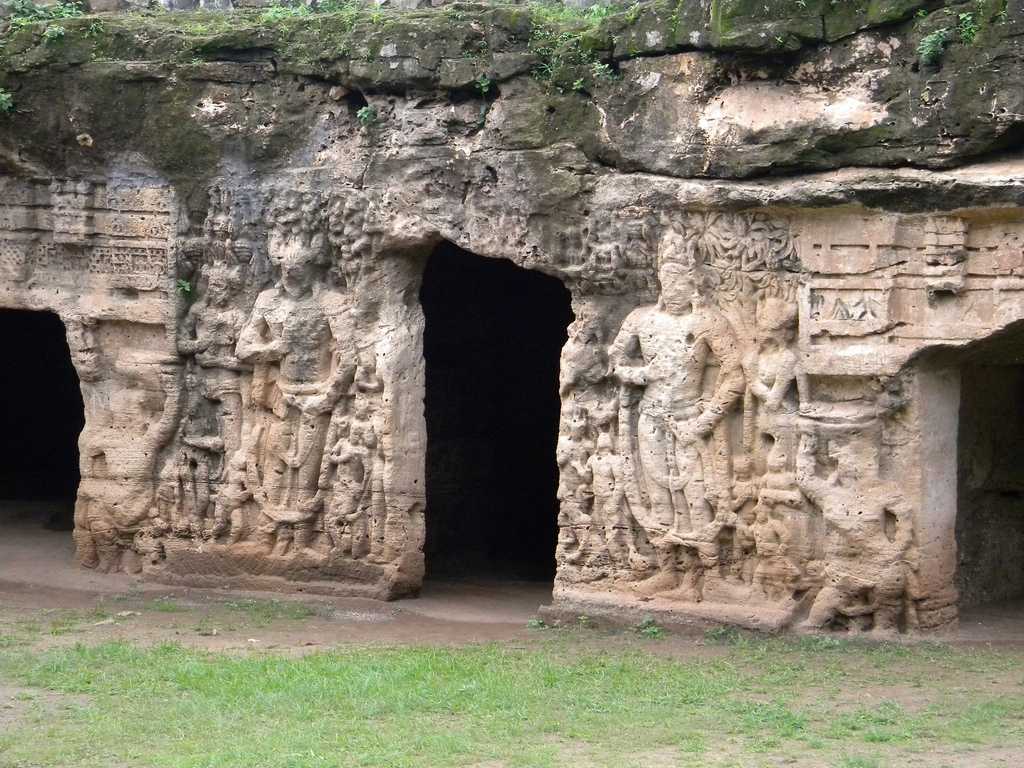
The Khambhalida Caves, also known as Rajkot Caves, are a set of three Buddhist caves cut out of limestone dating back to the 4th and 5th centuries. They are located near Gondal about 65 km south of Rajkot . Out of the three caves, the centre cave is named Chaitya and is a worn out stupa. Two sentinel statues, the left one being the stone of Bodhisattva and the right one being that of Vajrapani also stand guard atop a nearby cliff face which looks down on the caves. These caves are believed to be the oldest caves in Rajkot and are currently maintained by the Archaeology Department of Gujarat. Entry is free to the caves.
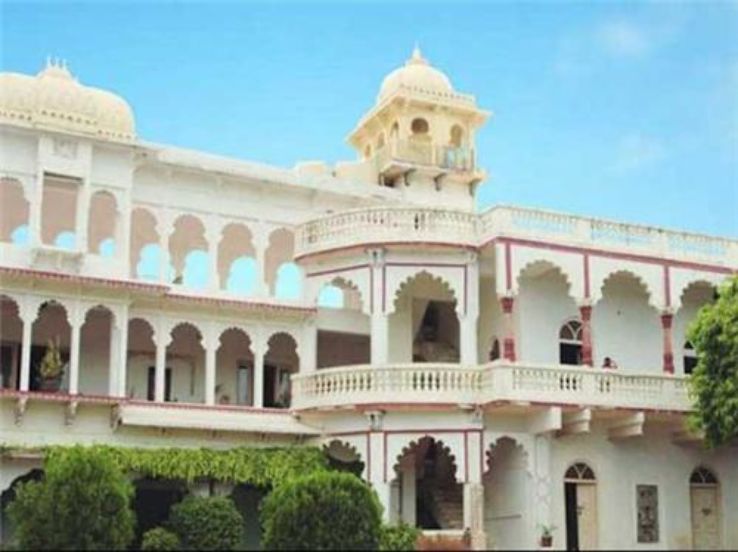
Around 35 km south of Rajkot lies the quaint city of Gondal once ruled by a royal family whose passion for cars was well known as well as its efficient road network dating from pre-independence times. That passion resulted in a wonderful collection of automobiles which are today exhibited in the museum located inside the palace premises. The city retains its grandeur and sense of royalty with the help of the Riverside Palace and the Darbargadh. The Riverside Palace which was built in 1875 by Batwat Singhji is now a heritage hotel whose enormous grounds double into a private forest reserve where individuals can occasionally spot deer and rare bird species. The Darbargadh also known as ‘Navlakha Palace’, on the other hand, is a 17th-century palace whose main feature are the excellent arches that are scattered across the grounds. Exploring its interiors provides a glimpse of the opulent living style of the Maharajas. You can enter the Darbargadh by paying a small fee. This place is also home to the Shri Bhuvaneshwari Pith, a very famous temple with the presiding diety of Goddess Bhuvaneshwari, considered as the creator of the universe.
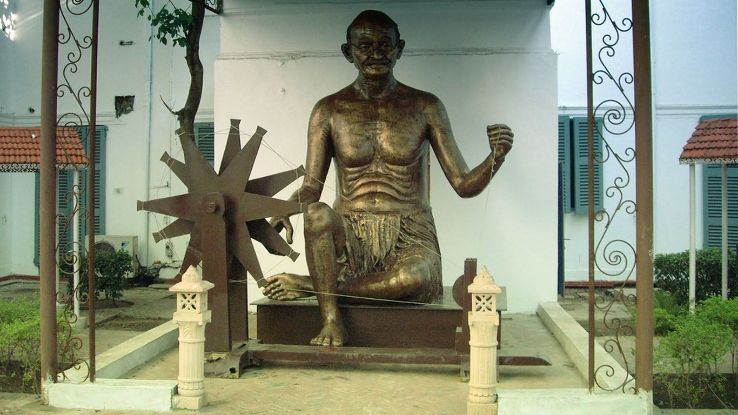
Mahatma Gandhi spent his early years in Rajkot and the Kaba Gandhi no Delo is the house where he lived when studying here while his father was the Diwan of Rajkot. This place is now a museum of historical importance with preserved artefacts and a pictorial tour which depicts the life of Mahatma Gandhi. An NGO also holds classes in the grounds which are primarily based on sewing and embroidery work for anyone who wishes to learn. This museum is open from 9 am to 12 noon and then again from 3 pm to 6 pm from Mondays to Saturdays and from 10 am on Sundays.
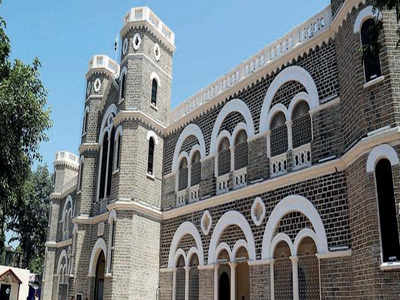
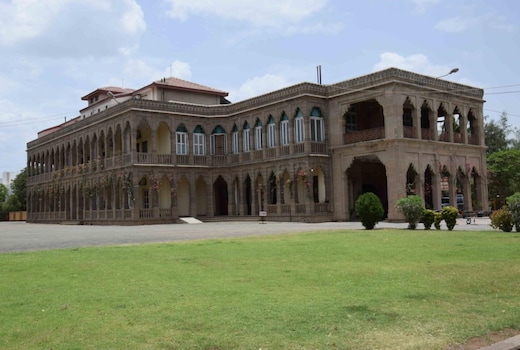
The Gandhi Museum, commonly referred to as the Mahatma Gandhi Museum documents and exhibits the life and work of Mohandas Karamchand Gandhi. This museum has 39 galleries which provide the visitor an enriching and comprehensive information about Gandhi and his ideologies. The museum is located in what was formerly the Alfred High School, which was where Mahatma Gandhi attended school in 1887. The museum also features a Light & Sound show based on Gandhiji’s life which is around 20 minutes daily at 7 pm. Fee paying visitors have this show included in the cost of their tickets. The museum is open from 10 am to 7 pm on all days except Mondays when it is closed. You will need around 2 hours to see the entire museum and ticket prices are INR 10 for Indians between the ages of 3-12, INR 25 for Indians above the age of 12 and INR 400 for foreigners.
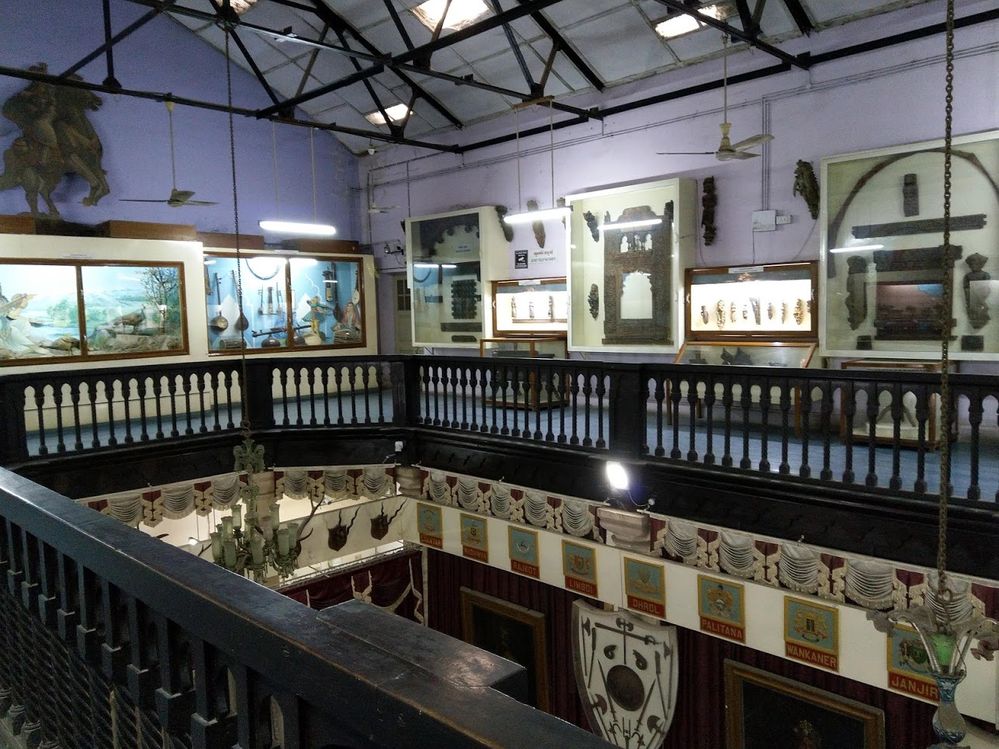
One of the largest and oldest museums in Gujarat, the Watson Museum contains many artefacts and belongings of the Jadeja Rajput dynasty, who were also the founder of the princely state of Rajkot. The Gujarat State Government manages this museum and has preserved this as a part of the state’s long and rich cultural heritage. Other than the collections, the museum also has an extensive library. The museum has various sections containing scriptures, inscriptions, manuscripts, painting, coins, embroidery and textile works, handicraft items, different wood carving, musical instruments, etcetera. Several royal families from different parts of India have donated many paintings, artefacts, and manuscripts to the museum which it now houses.It also has on display examples of the colonial style of textile and jewellery design. One of the fascinating sections in the museum is the one on the Indus Valley Civilisation, which contains several artefacts collected during the excavations located around Saurashtra. These artefacts include many statues, coins, carvings, and costumes of the inhabitants of Mohenjo Daro. The museum is open every day except Wednesdays, the second and fourth Saturdays of each month, and all government holidays, from 9 am to 12:45 pm and then again from 3 pm to 6 pm. Entry fees are very nominal with students paying INR 2, Indians paying INR 5 and foreigners paying INR 50.
A very interesting and unique museum in Rajkot is the Rotary Dolls Museum with its array of dolls from all around the world. Each doll in the museum unique as they tell tales of different traditions and cultures around the world. There are more than 1600 dolls in the museum wearing apparel representing over 102 countries, their cultures and traditions. The dolls have been donated to the museum by various rotary clubs throughout the world. The museum also maintains brief records of history about the dolls for knowledge as well as entertainment. The museum is open from 9:30 am to 1 pm and then again from 3:30 to 7:30 pm every day except Mondays. Adults pay INR 25 while children above the age of 5 pay INR 15 and if you want to use a camera inside, you need to pay INR 35 for that.
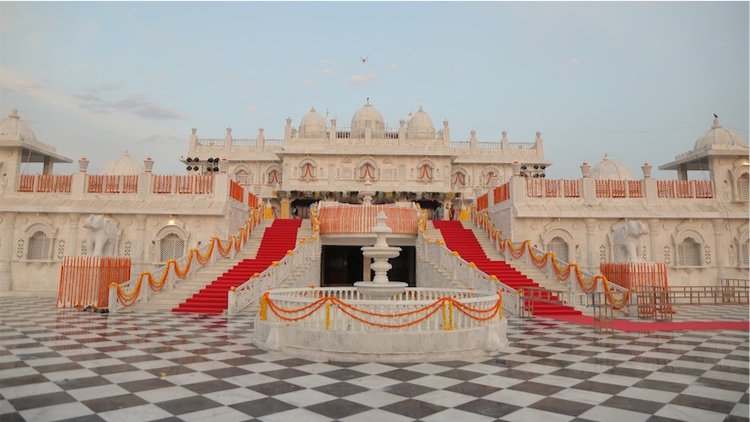
The Jagat Mandir is a universal temple which holds the idols of several deities and takes into account religions like Hindism, Christianity, Islam and Buddhism. However, the chief deity to which the temple is devoted to is Shri Ramakrishna Paramahamsa. The statue of Paramahamsa is made entirely out of white marble which contrasts the temple walls, and the idol is depicted sitting on a lotus flower. Aside from its religious uniqueness, the temple is also known for its architecture. The temple is entirely made of red stone which contrasts with its natural surroundings and stands out during the day as well as night. The temple is supported by 60 pillars which are made of granite and sandstone and are unique in their own right.
The Jubilee Garden is situated in the heart of the city and is an open garden with an expanse of lush green grass, ideal for a family picnic or a day out with friends. Within the garden area, there is a museum, an auditorium, a library which is known as Lang Library and a few fairground rides. The pathways in Jubilee Garden are adorned with small plants and bushes. The avenue of shady trees and the occasional sight of uncommon birds are the reasons why nature lovers love to spend their leisure time in the Garden.
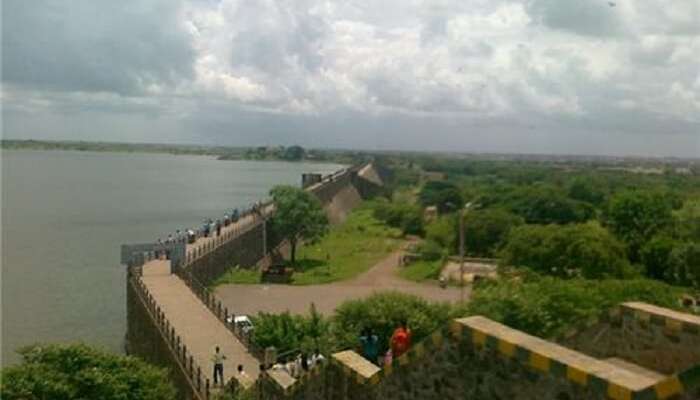
The Lalpari Lake located at the outskirts of Rajkot has a captivating landscape that entices its audience. The glimmering lake along with the lush green surroundings makes an excellent picnic spot as well. Another exciting aspect of the lake which brings forth a lot of nature enthusiasts is the fact that it attracts several migratory birds which can be easily spotted from the lakes shore and which add to the mystic beauty of the place. Located at a distance of 5 km from Rajkot, Nyari Dam is a scenic picnic spot that is frequented by locals and tourists. This dam also draws a lot of birdwatchers as the area is visited by several migratory birds especially during the winter season. Recently, a children’s area has also been constructed here to let kids have a good time. In addition to that, there are a few eateries and food stalls at the spot to provide you with refreshments and beverages.
Dividing the city of Rajkot along its east-west line, the Aji river is one of the most important rivers of the region. It supplies considerable water for drinking as well as for agricultural purposes, and is also often referred to as the ‘lifeline of Rajkot’. There are four dams across the Aji river, which was completed in the year of 1954; the garden and the zoo were inaugurated later in June 2017, by the then Prime Minister. The Aji dam, on the downstream area of the river, is the most important one among them and is located in the outskirts of Rajkot, around 8 km from the central city. This dam, along with the Nyari Dam, makes for an essential source of water for Rajkot. The Aji dam also has a garden and a zoo next to it, which makes it an even more attractive tourist destination.
Located in a tranquil setting the Rampara Wildlife Sanctuary has sprawling acres of land boasting of a rich wildlife, both in terms of flora and fauna. Considered to be a haven for bird lovers, the sanctuary attracts a lot of migratory birds like the ring dove, large gray blabber, yellow-throated sparrow, purple sunbird, common peafowl and partridges etc., it is also not unusual to find several deer and antelopes flocking the place. Among other common animals that can be found here are blue bull, hyena, foxes, jackals, and wolves etc. Established in 1988, Rampara Wildlife Sanctuary is spread over 15 square km of land area and boasts of over 280 species of flora and 130 species of birds, and over 30 species of reptiles and mammals. The land area is divided into patches with shrubs, trees and there is a watchtower constructed in the centre, from where you can enjoy a bird’s eye view of the place. The sanctuary is open from 7 am to 7 pm on all days except Sundays.
Jamnagar Jamnagar is the largest city on the westernmost part of India and is the fifth largest city in Gujarat. H.H. Jam Ranjitsinhji was instrumental in building the modern infrastructure of the city during his reign in the 1920s. Thereafter, the city was substantially developed by Jam Saheb Shri Digvijaysinhji Ranjitsinhji in the 1940s, when it was part of the Princely state of Nawanagar. The city lies just to the south of the Gulf of Kutch.
Nawanagar was founded by Jam Rawal in 1540 as the capital of the eponymous princely state. Jamnagar, historically known as Nawanagar or the new town, was one of the most important and the largest Princely states of the Jadejas in the Saurashtra region. According to mythology, Lord Krishna established his kingdom at Dwarka town in Jamnagar district, after migrating from Mathura, and accordingly, it is to the Yadava race that the Jams of Nawanagar trace their ancestry. Once on a hunting trip in present-day Jamnagar, a hare was found to be brave enough to turn on the hunting dogs and put them to flight. Deeply impressed by this, Jam Sri Rawalji thought that if this land could breed such hares, the men born here would be superior to other men, and accordingly he made this place his capital. In August 1540 on the banks of the rivers Rangmati and Nagmati, he laid the foundation of his new capital and named it Nawanagar or new town, which after few centuries came to be known as Jamnagar, meaning the town of the Jam’s.
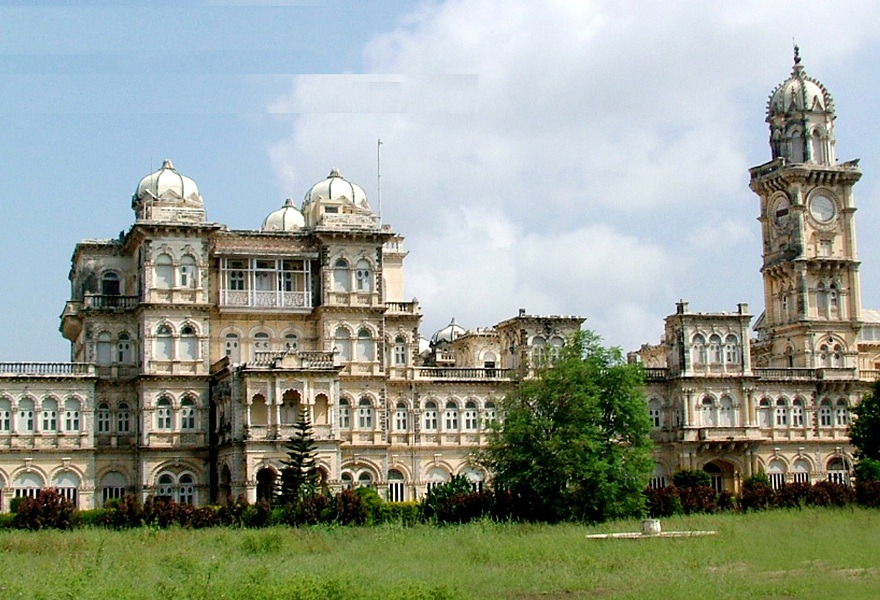
The Pratap Vilas Palace is a beautiful royal palace built by Jam Ranjit Singhji between 1907 and 1915. The palace is constructed in the Indo-Saracenic architecture style overlaid with European architecture inspirations, reminiscent of the Victoria Memorial Building in Kolkata. The three glass domes are the chief attraction here. The carvings of flowers, leaves, creepers, birds and animals on the pillars enhance the appeal of the palace. The walls of the magnificent halls of the building are adorned with hung portraits and paintings by artists of that period. There are swords and armor and other period pieces. Mainly built to serve as a guest house for royal guests, the palace sits in the middle of spacious grounds and a park that was converted in to a Natural Park in 1968 by Maharaja Kumar Ranjit Singhji. The Gujarat earthquake of 2001 has caused loss of a few parapets and furthermore the partition of some upper dividers at the rooftop level of the royal residence. Though not open to the public, permission can be obtained from the Darbargarh Palace to visit this palace, but note that even with permission, you may not have access to all areas inside the Palace. The Palace is open on all days from 11 am to 5 pm and you need to pay INR 100 per person to get inside.
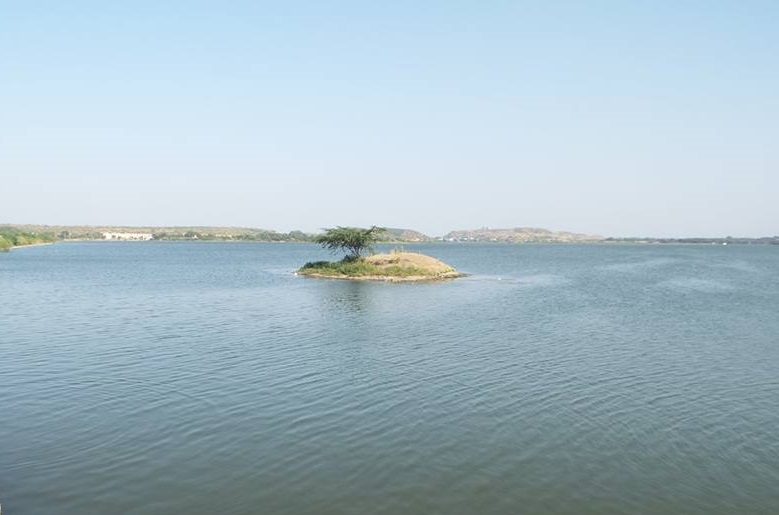
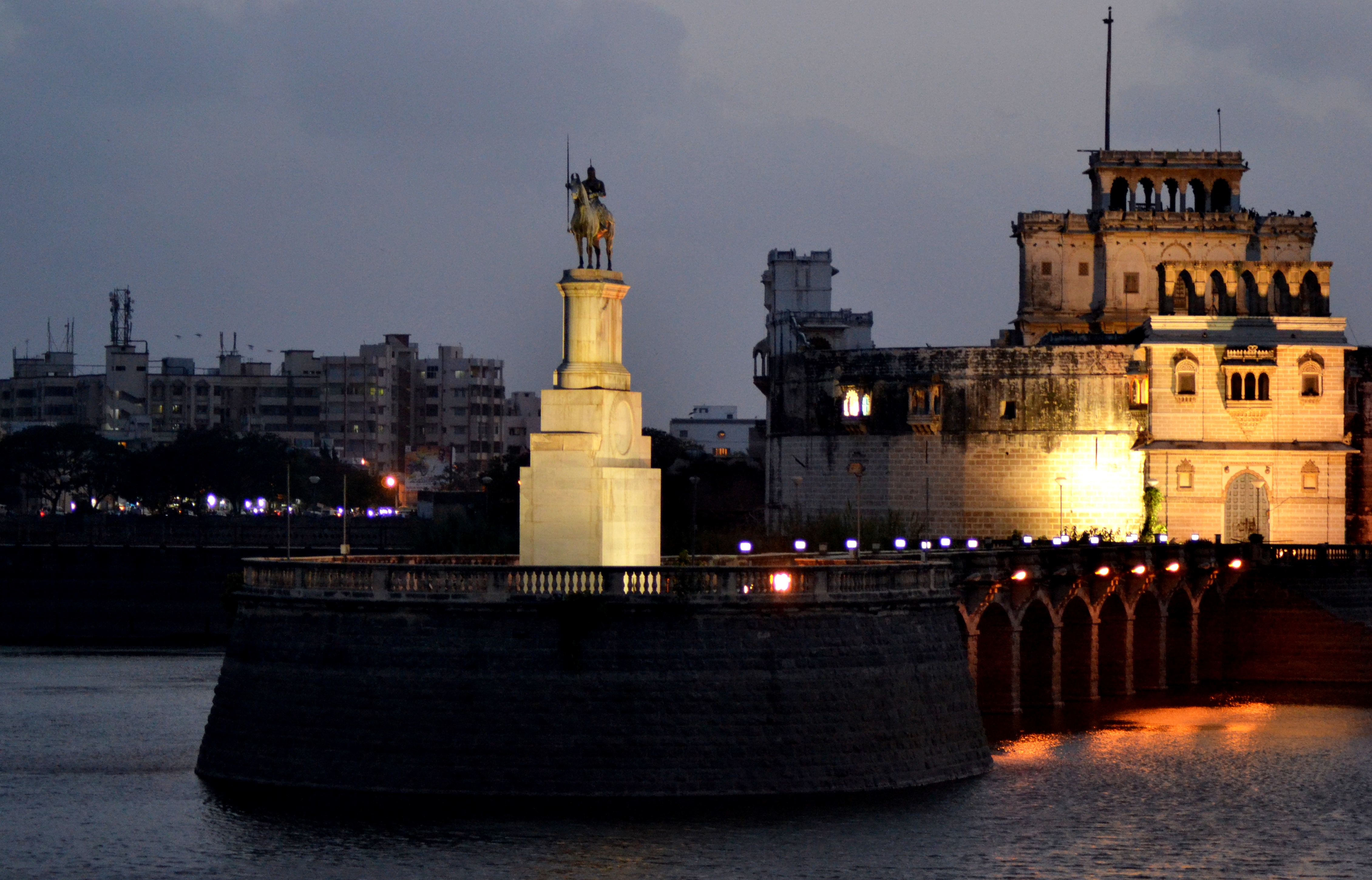
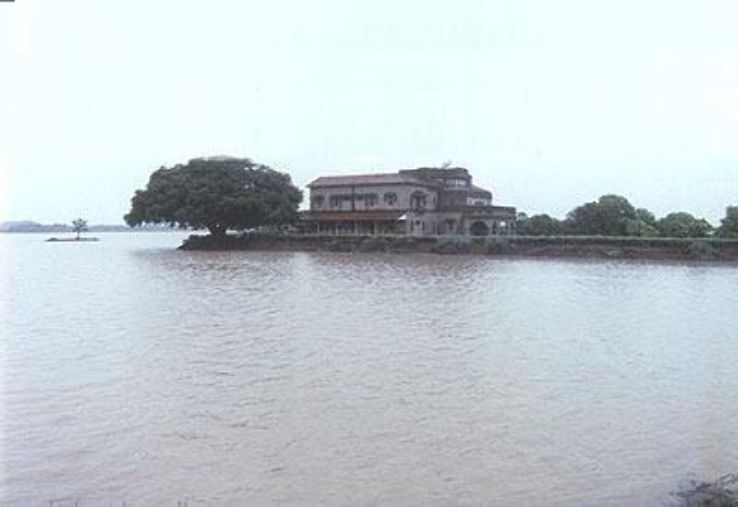
Also known as Lakhota Lake, the Ranmal Lake is one of the largest water bodies in the city. The lake was constructed in the mid-19th century by Jam Ranmal II, the king of Nawanagar. The lake was intended to act as a water reservoir in times of need. The lake is home to one of the oldest man-made structures in Jamnagar, the famous Lakhota Palace. The Lakhota Palace is situated on an island in the middle of the Ranmal Lake in the shape of a large bastion. This palace was constructed as a famine relief work in 1839-45 AD by the then Maharaja of Nawanagar. An arched stone bridge connects the Lakhota Palace with the town. The entire palace was designed as a fort with the Ranmal Lake serving as a natural moat. The palace contains a circular tower, a pavilion and rooms for the royal guards. The tower and turrets surrounding the structure was also used by soldiers to store their arsenal. This palace now houses a museum which possesses sculptures dating from 9th to 18th century, arms and firearms, medieval age pottery from surrounding villages and so on. The walls of the museum are adorned with frescos depicting scenes of battle fought by Jadeja Rajputs. The lake is lit at night which makes the whole place more attractive and there is also a musical fountain show at night. The lake is open from 5 am to 10 pm while the palace and museum are open from 19:30 am to 2 pm and then again from 2:30 pm to 5:30 pm. The musical fountain show runs between 8:30 – 9 pm on all days except Wednesdays. The entry fee for the lake is INR 10 per person and INR 25 is charged for the musical fountain show.
Darbargadh is an old royal palace which served as the first royal residence of the Jam Sahib. The construction of the palace was initially started in 1540 AD along with the construction of Jamnagar city but it went on intermittently leading to an exquisite mix of Rajput and European architectural styles. It is in the form of a rectangular palace surrounded by walls, having gates in each direction to enter. The palace complex consists of a number of buildings with very fine architectural features and detailing with some fine examples of stone carvings, jali-screens, ornate pillars, decorated mirrors and sculptures. The rooms of the palace are full of paintings portraying armies bearing images of men and women in the setting of battlefields and palaces. In one of the hall, the ceiling is covered with the map of Jamnagar and is believed that the map was engraved in 1912. The outer walls of the palace are featured with carved jharokha balconies designed in the Indian tradition. A section of the palace called the Tilamedi is said to be the place where the crowning ceremony of kings used to take place. The wooden throne of Jam Rawal, his sword, dagger and spear are still preserved in Tilamedi. Jam Ranjitsingh built two important urban projects in front of Darbargadh Palace namely Willington Crescent and Chelmsford Market. There is a statue of Jam Ranjitsinghji in the middle of the crescent. The Chelmsford Market is located in front of the Willington Crescent which is a two storied semicircular arcade. At this semicircular arcade outside the palace, the former Maharajas of Nawanagar once used to gather and hold his public meetings. The earthquake of 2001 caused significant damage to the Darbargadh Palace. You can visit this palace between 9 am to 9 pm and entry is free.
The Bala Hanuman Temple also known as the Shri Bala Hanuman Sankirtan Mandir is a Hindu temple situated on the southeast corner of Ranmal Lake. The temple is dedicated to Lord Hanuman and was established in 1964 by Shri Prembhikshuji Maharaj. The temple houses the idols of Lord Ram, Lakshman, Goddess Sita and Hanuman and is very popular as it has been recorded in the Guinness Book of World Record for its continuous 24 – hours chanting of the mantra, ‘Sri Ram, Jai Ram, Jai Jai Ram’ since 1964. The temple has intricate architecture that consists of ethnically designed pillars and amazing carvings. The temple is open from 6 pm to 12 noon and then again from 4:30 to 10 pm though the chanting is constantly going on and visitors can join in this chanting.
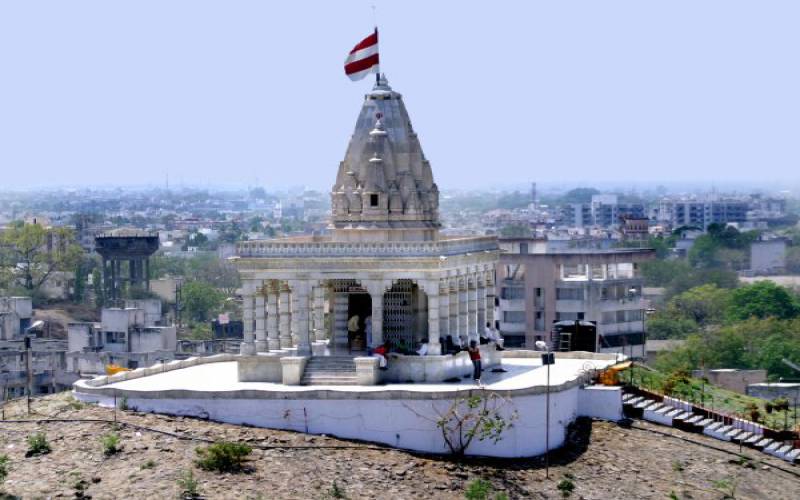
The Jain Temple complex is a cluster of four Jain temples dedicated to various thirthankaras of the Jain sect. These temples form the centerpiece of the old city with its lovely buildings of wood and stone, adorned with pastel colored shutters and wooden balconies. Built between 1574 and 1622, the most intricate of the temples in the complex is the Raisi Shah Temple dedicated to the 16th tirthankar, Shantinath. Also known as Shantinath Temple, the temple has mirrored domes, coloured columns, and intricate carving. The walls of Shantinath Mandir are richly decorated with fine frescos as well as other wall paintings (murals), which depict the lives of various Tirthankaras. The floor is made of marble and is decorated with distinctive Jain patterns in yellow, black, white and red. Next is the Vardhman Shah temple, dedicated to Adinath, the 1st thirthankar of Jainism. Also known as Adinath Jain Temple, it is a simple structure compared to Shantinath Temple, but more vibrant in color. The foundation stone of this shrine was laid in 1612, during the reign of Jam Jasaji I, and it was completed in the year 1620. The temple is surrounded by 52 small temples or Deri, which were built in the year 1622. The third temple is Sheth’s Temple which was built by Bhansali Abji in the year 1594 AD. The last temple in the complex is Vasupujya Swami Temple and is believed to be built by Aaskaran Shah in the 17th century. The complex is open from 5:30 am to 1 pm and then again from 3:30 pm to 9 pm.
The Bhidbhanjan Temple is dedicated to Lord Shiva, and this beautiful temple was constructed during the rule of Jam Rawal, the founder of city. The temple is best known for its Hindu-Rajput style of architecture. The temple walls and pillars are adorned with exquisite carvings and the intricate silver work on the doors is a testament to the craftsmanship that is found in Jamnagar even today. The shikhara of the temple is inspired from the architecture of the shikhara of South Indian temples. There are also 10 small shrines dedicated to various Hindu gods including Goddess Parvati and Lord Ganapati. People believe that chanting of Mrutyunjay Mahadev mantra here is quite beneficial. The best time to visit the temple is during the aarti, which is usually performs at 7 pm while the temple is open from 8 am to 8 pm.
The Bohra Hajira, a beautiful mausoleum, also known as Mazar E Badri, it is one of the holiest of its kind in Gujarat. The resting place of Mota Bawa, a Muslim saint, the dargah of the Dawoodi Bohra community was built by Jam Rawal in 1540 on the banks of the Rangmati and Nagmati Rivers. Made out of white marble, the mausoleum that represents the Saracenic style of architecture has intricate carvings. When this mausoleum was being constructed, it used to be the boarding place for those who wanted to cross the Nagmati or Rangmati rivers by boat. Today, the rivers have almost dried up now and the dried river banks close to the Hajira play host to Hindu fairs during the holy month of Shravan. One can also visit Saifee Tower situated nearby. Please not that you need to take prior permission from the manager to visit the mausoleum which is open from 8 am to 8 pm daily.
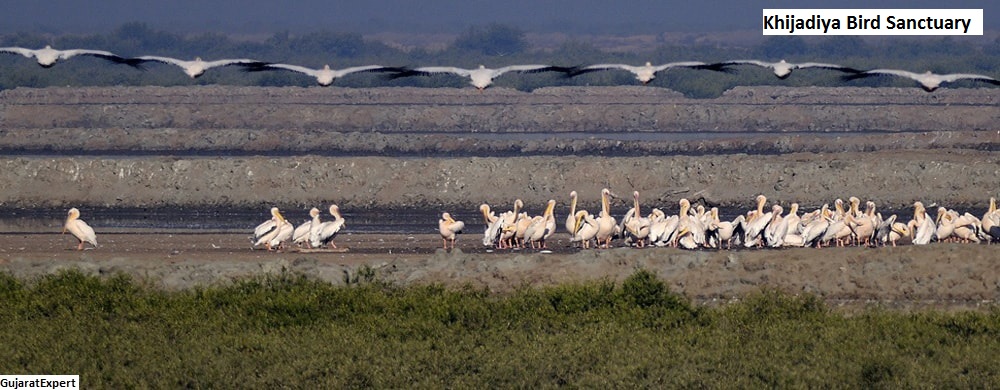
Located 16 km from Jamnagar the Khijadiya Bird Sanctuary is situated off the coast of Kutch and covers an area of about 6 sq km. This bird sanctuary is unique in having fresh water lakes as well as salt and freshwater marshlands. Though it was officially declared as a sanctuary in 1982, it had already become a natural habitat for local and migratory birds before India’s independence when the then rulers constructed a small check dam on the Ruparel river for storing water. This dam created a unique ecosphere with the freshwater lakes on one side and the salty water of the sea forming marshes on the other to support not only a variety of fauna but also flora. The main sanctuary covers the area around the Ruparel and Kalindi rivers towards the north-east of Jamnagar. The sanctuary is home to more than 250 species of resident and migratory birds, including globally threatened species such as Dalmatian pelican, Asian open bill stork, Black-necked stork, Darter, Black-headed ibis, Eurasian spoonbill, and the Indian skimmer. It is more recognized as the breeding ground for the great crested grebe. One can also find jackals, cats, snakes, wolves, bluebells, mongoose and reptiles here. The site is also considered remarkable for ecological research and education. There are also facilities like nature trails, watchtowers, and reclamation bunds to watch these winged visitors. One can climb up any of the three watch towers, opt for paddle boats, or walk along any of the trails to check out the wild in all its grandeur. The best season to visit the sanctuary is between September to February and the best time is either early in the morning or in the evening. However, note that entry to the sanctuary has to be registered with the Forest Office in Jamnagar which closes at 2 pm. The sanctuary is open from 6:30 am to 6 pm. The entry fee for Indians is INR 40 and for foreigners it is USD 10. You also need to pay for any camera or video equipment you take inside as well as for your vehicle.
The Narara Marine National Park is a marine wildlife sanctuary in the Gulf of Kutch located 56 km from Jamnagar and is the first Marine National Park in India. This place is among the few where one can look at corals without having to dive down into the water. An area of about 458 sq km between Okha and Jodiya was declared as a marine sanctuary in 1980 and later in 1982, about 163 sq km of the core area was declared as a Marine National Park. There are 42 tropical islands on the Jamnagar coast in the Marine National Park, most of them surrounded by reefs out of which 33 islands have coral reefs. Some of the best known islands are Pirotan, Karubhar, Narara, and Poshitra. There are islands with sandy beaches and mangrove swamps. The major ecosystem available are coral reefs, mangroves, mudflats, creeks, sea grass, & sea weeds, estuaries, sandy strands to saline grasslands, marshy areas and rocky shores. All of the ecosystems support the rich marine life & bird life in the marine park. The sanctuary lies in the intertidal zone, so during low tide, visitors can get to observe the rich diversity of marine life here. If you just walk in the water during low tide till about 1-2 feet of water, you can see this fascinating underwater world of corals. It is a 2 km walk and takes 1.5 – 2 hours to complete and during the walk, you can spot a variety of marine life. Since it is protected area, visitors cant pick up anything from the marine national park and ca’t touch, catch or disturn any marine creature. Here again, you need permission from the forest department to access the park and foreign tourists need additional permission from the police department.
The park can be accessible only during low tide and in a day there are four tides; two high and two low. The High tide occurs every 12 hours, and the Coral walk is done between the two high tides. Generally, it takes 3.5 hours for the tide to reach its highest point at Narara, so make sure you start your visit when low tide starts, as you cannot enter the park during high tide. If you are planning to visit this marine park, make sure you call the forest office at Jamnagar or check online for the details of tidal times before you visit. The park is open from 9 am onwards and entry fee is INR 100 for Indiams and INR 650 for foreigners. A guide will cost you INR 300 and you need to pay INR 200 for any camera you will take inside.
Pirotan Island which is spread across 3 sq km, is one of the 42 islands which comprise the Narara Marine National Park. It is one of the two islands in the marine national park, the other being Narara Island. Pirotan was originally known as ‘Pir jo Thaan’ which means the sacred place of a saint, in this case of Saint Khwaja Khizer Rahmatullahialaih. The holy shrine of the saint is located on the island which also houses a lighthouse. The island is uninhabited except for the workers at Pirotan Island’s lighthouse, the forest guard, and the Mujhavars or servers at the shrine. Because there is no regular ferry service to the island, one has to hire boats from the Bedi or Rozi Ports and it takes about 1.5 to 2 hours to reach the island. Since the beach is very shallow, the boats can only reach the island during high tide and leave the island during high tide. The tide timings need to be checked with the forest department or locals as they tend to change with the change in the position of moon. Bring your own food and water as there is nothing on the island and you will need to stay for approximately 12 hours on the island as the high tide cycle is a 12 hour one. As with Narara, you need the permission of the forest department and in this case permission from the customs and port authorties as well. Foreigners need additional permission from the police.
Dwarka Dwarka or Devbhoomi Dwarka as it’s also known, is an ancient city located on the western shore of the Okhamandal Peninsula on the right bank of the Gomti River. One of the Chardhams or the four sacred Hindu pilgrimage sites, Dwarka is one of the Sapta Puri or the seven most ancient religious cities in the country. The city is also often identified with the Dwarka Kingdom, the ancient kingdom of Krishna, and is believed to have been the first capital of Gujarat. The city’s name literally means gateway and has been referred to throughout its history as “Mokshapuri”, “Dwarkamati”, and “Dwarkavati”. It is mentioned in the ancient prehistoric epic period of the Mahabharata and according to legend, Krishna settled here after he defeated and killed his uncle Kansa at Mathura. This mythological account of Krishna’s migration to Dwarka from Mathura is closely associated with the culture of Gujarat. Krishna is also said to have reclaimed 12 yojanas or 96 square kilometres of land from the sea to create Dwarka. Dwarka was established as the capital in Saurashtra by the Vedic Indians during the Puranaic period. The Yadavas, who had migrated from Mathura, established their kingdom here when the city was known as “Kaushathali” and during this period, the city underwent rebuilding and was named Dwarka. The city’s Dwarkadhish Temple dedicated to Krishna was originally built around 2,500 years ago, but was destroyed by the Mahmud Begada rulers and subsequently rebuilt in the 16th century. The temple is also the location of Dwaraka matha, also called Sharada Matha or Sharada Peeth and the “western peeth”, one of the four peeths or religious centres established by Adi Shankaracharya.
Archaeological investigations at Dwarka, both on shore and offshore in the Arabian Sea, have been performed by the Archaeological Survey of India. The first investigations carried out on land in 1963 revealed many artifacts. Excavations done at two sites on the seaward side of Dwarka brought to light submerged settlements, a large stone-built jetty, and triangular stone anchors with three holes. The settlements are in the form of exterior and interior walls, and fort bastions. From the typological classification of the anchors it is inferred that Dwarka had flourished as a port during the period of the Middle kingdoms of India. Coastal erosion was probably the cause of the destruction of what was an ancient port. Dwarka is mentioned in the copper inscription dated 574 of Simhaditya, the Maitraka dynasty minister of Vallabhi. He was the son of Varahdas, the king of Dwarka. The nearby Bet Dwarka island is a religious pilgrimage site and an important archaeological site of the Late Harappan period, with one thermoluminescence date of 1570.
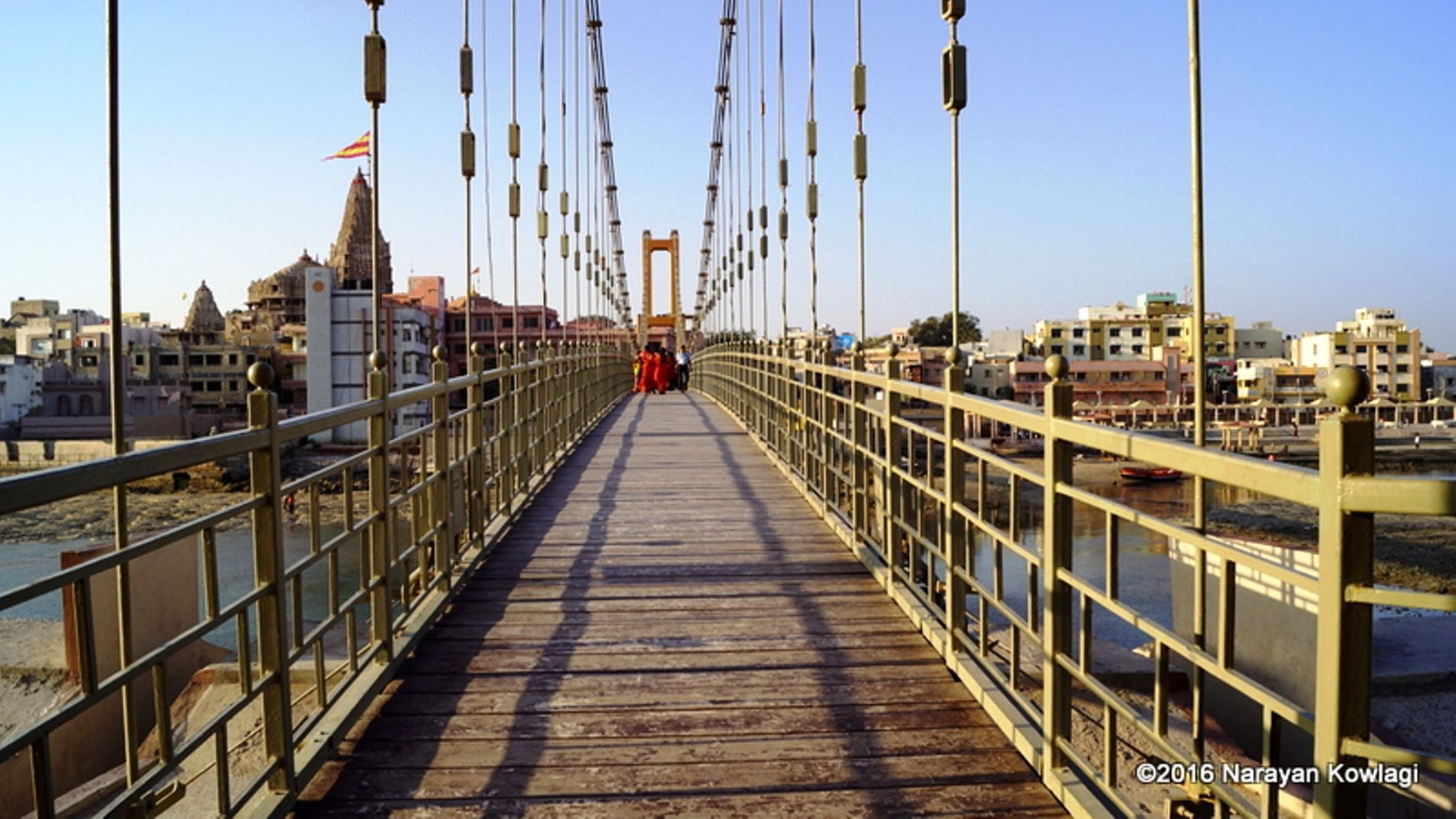
The Greek writer of the Periplus of the Erythraean Sea referred to a place called Baraca, which has been interpreted as present-day Dwarka. A reference made in Ptolemy’s Geography identified Barake as an island in the Gulf of Kanthils, which has also been inferred to mean Dwarka. In 1241, Mohammad Shah invaded Dwarka and damaged the temple. In 1473 the Gujarat Sultan Mahmud Begada sacked the city and destroyed the temple of Dwarka. The Jagat Mandir or the Dwarakadhisa temple was later rebuilt. Vallabha Acharya retrieved an idol of Dwarkadhish, which was revered by Rukmini. He hid it in a stepwell, known as Savitri vav, during the Muslim invasion, before moving it to Ladva village. In 1551, when Turk Aziz invaded Dwarka, the idol was shifted to the island of Bet Dwarka. Dwarka, along with the Okhamandal region, was under the rule of Gaekwad of Baroda state during the Indian rebellion of 1857. In 1861, the Dwarakadheesh Temple was renovated by Maharaja Khanderao and the British, who refurbished the shikara. Maharaja Gaikwad of Baroda added a golden pinnacle to the shikara in 1958 during a refurbishment by Shankaracharya of Dwarka. Since 1960, the temple has been maintained by the Government of India. Dwarka is one of 12 heritage cities across the country selected to develop civic infrastructure. The Sudama Setu, a bridge over the Gomti River connecting mainland Dwarka with Panchkui island was opened in 2016.
Dwarka is a temple city, given it’s ancient lineage and most visitors to the city are pilgrims, visiting the city for its most famous temple, the Dwarkadish Temple. Also known as the Jagat Mandir, the temple is styled in the Chalukya style of architecture and dedicated to Lord Krishna. The five storied main shrine is grand and marvelous in itself constructed of limestone and sand and supported by 72 pillars and an intricately carved spire that is 78.3 meters high. The spire has an exquisitely carved Shikhar or pinnacle that soars 42 m high with a flag made of 52 yards of cloth. The flag consists of the sun and moon symbols, personifying Lord Krishna’s reign over the temple as long as the sun and moon exists on this earth. There are two two gateways to the temple, the Swarg Dwar or Heaven’s Gate where pilgrims enter and the Moksha Dwar or the Liberation Door where pilgrims exit and comprises of a vestibule, sanctum and a rectangular hall with porches on its either sides. Outside the south doorway of the edifice, 56 steps lead to the banks of the Gomti river.
The 2,200-year-old architecture, is believed to be built by Vajranabha, Lord Krishna’s grandson over Hari-Griha, who constructed it over the land reclaimed from the sea by Lord Krishna. The temple’s name of Dwarakdish means Lord of Dwarka, referring to Lord Krishna. The temple showcases intricate sculptural detailing done by the ancestral dynasties that ruled the region and the black magnificent idol of Lord Krishna. There are other shrines within the temple which are devoted to Subhadra, Balarama and Revathy, Vasudeva, Rukmini and many others. Devotees are expected to take a dip in the Gomti river before proceeding into the temple through the Swarg Dwar. The eve of Janmashtmi is the most special occasion in any Krishna temple, the Dwarkadhish temple is adorned by thousands of devotees chanting prayers and rituals. The shrine is a hive of colours, voices and faith transforming itself into inner silence and sanctity. The best time to visit the temple between October to March when the weather is cooler. The Janmasthami festival which is the festival to celebrate Lord Krishna’s birth around August/September is also wonderful time to visit to take part in the festivities. The temple is open from 6 am to 1 pm and then again from 5 to 9 pm and should keep aside around 2 hours to walk around the temple and soak in the atmosphere. As with all religious places in India, there is no entry fee.
The Nageshwar Temple is one of the 12 Jyotirlingas in India and is situated on the route between Gomati Dwarka and the Bait Dwarka Island on the coast of Saurashtra in Gujarat. Also sometimes known as the Nagnath Temple, the main deity here is Lord Shiva, also known as Nageshwar Mahadev. According to the Shiva Purana, those who pray at the Nageshwar Jyotirlinga become free from all poisons, snake bites and worldly attractions. Unlike other Nageshwar Temples, the statue or the Linga here faces south. A major highlight of Nageshwar Temple is the massive 80 feet tall statue of Lord Shiva made up of stone, known as Dwarka Shila, having small chakras on it and in the shape of a three mukhi Rudraksha. The temple itself is characterised by typical Hindu architecture. The importance of Nageshwar Jyotirlinga stems from the fact that it is believed to be the first of the 12 Jyotirlingas in India. Designed on the principles of Vaastu Shastra, the temple is planned on the Sayanam or sleeping posture of the human body. On the festival of Maha Shivaratri, the Nageshwar Jyotirlinga Temple witnesses grand celebration, drawing flock of devotees from all across the globe. The temple is open from 6 pm to 12:30 pm and again between 5 to 9:30 pm every day. You can’t bring a camera inside the temple sanctum, though it is allowed inside the temple premises. If you plan on doing an offering or abhishegam which takes place when the temple is open in the mornings, please note that men have to wear dhotis which are also available in the temple free of cost while women have to wear sarees.
A small but important shrine dedicated to Krishna’s beloved consort, Rukmani Devi, the Rukmani Temple is not as majestic or gigantic as the Dwarakdeesh temple, but is an architectural masterpiece in itself. The temple is said to be 2,500 years old but in its present form it is inferred to belong to the 12th century. It is a richly carved temple decorated with sculptures of gods and goddesses on the exterior with the sanctum housing the main image of Rukmini. Carved naratharas (human figures) and carved gajatharas (elephants) are depicted in panels at the base of the tower. There is an interesting legend to justify separate dwelling temples, far away from each other, for Rukmini and her husband Krishna. It is said that at the request of sage Durvasa, who was renowned for his short temper and bestowing curses Krishna and Rukmini pulled a chariot taking sage Durvasa to their house for dinner. On the way, when Rukmini asked for water to quench her thirst, Krishna drew Ganges water, by prodding the ground with his toe, for her to drink. Rukmini quenched her thirst with the Ganges water. But Durvasa felt insulted as Rukmini did not have the courtesy to offer him water to drink. He, therefore, cursed her that she would live separately from her husband.
The Bhadkeshwar Mahadev Mandir, dedicated to Lord Shiva, is an ancient temple dating back some 5000 years old, which was built around a self-manifested Shivaling found in the Arabian Sea. The temple gets submerged in the sea every year during the monsoons, which devotees believe to be nature’s way of performing the religious process of Abhishekam. The presiding deity is known as Chandra-Moulishwar Shiva and the temple houses more than twelve hundred Shalgramshilas, thirteen hundred Shiva Lingas, and metal statuette forms of seventy-five Shankaracharyas. Shalgramshilas are priceless holy gemstones that are believed to be the earthly manifestations of Lord Vishnu and a single touch of a Shalgramshila is said to wipe away all mortal sins.
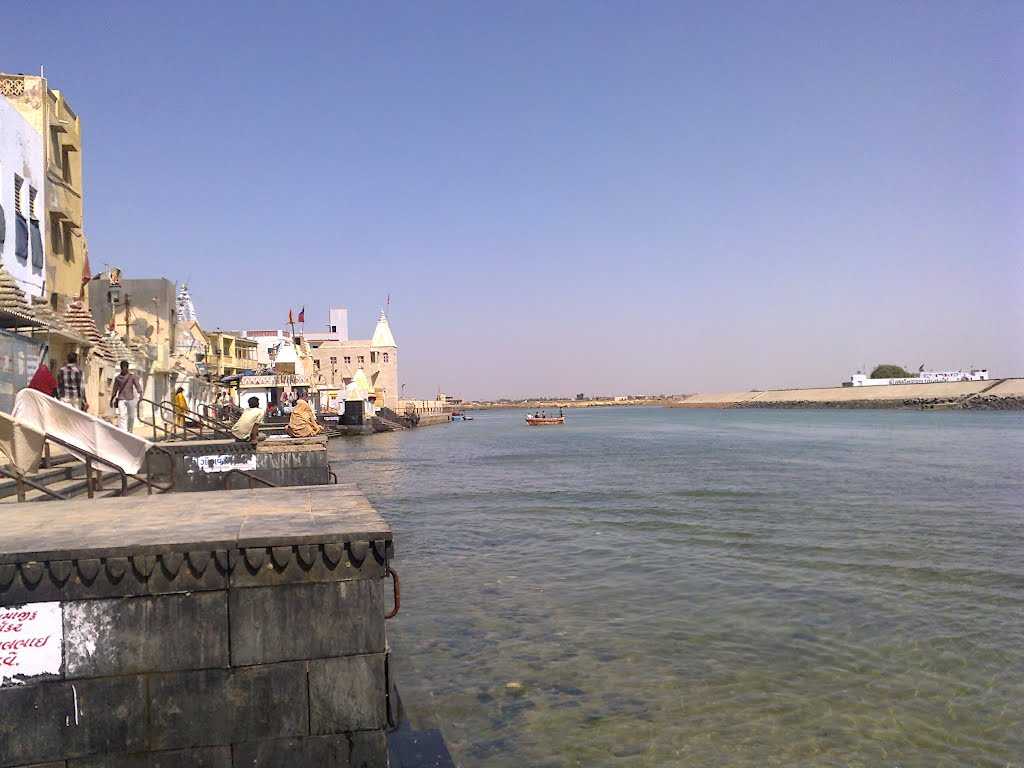
If the holy scriptures are to be believed, the Gomti River is none other than the Ganges, descended directly from the heavens. The Ghat is located at the mouth of River Gomati and you have go down a flight of 56 steps from the Dwarkadheesh temple’s Swarga Dwar in order to reach the ghat. According to myths the river Gomati is the daughter of Sage Vashishtha and her waters are powerful enough to purge one’s mortal sins. Thus pilgrims make it a point to bathe in River Gomti and they usually take their holy dip into the Gomati Kund, the point of confluence of River Gomti and the sea. Gomti Kund is located very close to the Gomati Sangam Ghat of Dwarka. Also, River Gomti is believed to be the ‘descending Ganges’, a river that descends straight down from heaven which is why it is a river that can wash away every sin as per Hindu mythology. You can also take a boat trip down the river which offers panoramic views of the holy city of Dwarka.
Named after the Lord Krishna’s childhood friend, Sudama, the Sudama Setu Bridge is a stunning suspension bridge built for pedestrians to cross the Gomti river. It connects the ancient Jagat Temple on mainland Dwarka to the sacred Panchad or Panchkui Tirth teerth on the island southeast to Dwarka and is associated with the legendary Pandava brothers. Other than mythology, the bridge is also famous for a breathtaking view of the river and the Arabian Sea. The bridge is open from 7 am to 1 pm and then again between 4 to 7:30 pm.
Situated around 30 km from the main town of Dwarka, Beyt Island, also called Bet Dwarka or Shankodhar, is a small island which was the main port in the region before the development of Okha. Located at the mouth of the Gulf of Kutch, the island is enclosed by a few temples, white sand beaches and coral reefs. Among the several activities available at the beach include dolphin spotting, marine excursions, beach camping and picnics. The name comes from ‘bet’ or ‘beyt’ which in Gujrati means a land surrounded by water on all sides. The island is also called Shankodhar because some people believed that the island is ‘shankh’ or conch shaped. And it is also a source of conch shells. The island also holds a significant mythological and religious significance as it is believed to be the home of Lord Krishna when he was the king of Dwarka. It was here where Lord Krishna exchanged the bags of rice with his friend Sudama – as the story goes. Therefore, this place is also visited by several devotees for a pilgrimage as well.
Popular among both tourists and locals, Dwarka beach and the lighthouse at the edge of the beach are the go-to places in the evenings. The beach is located quite close to the main temples in town and the lighthouse tower, which is 43m in height was panoramic views of the sunset.
Pordbandar Best known as the birthplace of Mahatma Gandhi, Porbandar was the former capital of the Porbandar princely state. Onshore explorations in and around Porbandar suggests the remains of a late Harappan settlement dating back to the 16th to 14th centuries BC. The discovery of ancient jetties along the Porbandar creek signifies the importance of Porbandar as an active center of maritime activities in the past. Indian theology also views Porbandar as the birthplace of Sudama, the friend Krishna. For this reason, it is also referred to as Sudaamapuri or Sudamapuri. Porbandar was the seat of the eponymous princely state in British India. In ancient times Porbandar was known to be Pao Bandar, due to its bread factories that used to export Pao ruti to Arab nations across Arabian sea. Colloquial changes in language results in name change to Pore Bandar. Later the state belonged to the Jethwa clan of Rajputs and had been established in the area since at least the mid-16th century. The state was subordinate to the Mughal governor of Gujarat until being overrun by the Marathas in the latter half of the 18th century. After, they came under the authority of the Gaekwad court at Baroda and eventually of the Peshwa. In common with the other states of Kathiawar, the state first came into the ambit of British influence in 1807, when the East India Company guaranteed security in the area in lieu of a fixed annual tribute to be paid to the Peshwa and the Gaekwad. In 1817, the Peshwa ceded his share to the EIC; in 1820, the Gaekwad agreed to have the IEC collect his due tributes in Kathiawar and remit the same to his treasury. Upon the Independence, the state acceded to the dominion of India and was merged with the ‘United State of Kathiawar’, and eventually came to form part of the present-day state of Gujarat. The last King of Porbandar was Natwarsinhji Bhavsinhji Maharaj.
The Kirti Mandir was built in the honour of Mahatma Gandhi and his wife Kasturba Gandhi. The ancestral house of Mahatma Gandhi is located right beside the temple and visitors can enter the ancestral home from the temple. The temple was built to mark the release of Mahatma Gandhi in 1944. The 73-year-old structure stands strong adorning the National Flag. The importance of this historic temple is such that even today political figures from all around the world often come to pay respect to the father of the nation, Mahatma Gandhi. The Maharaja of Porbandar, H.H. Maharana Shree Natavarsinhji, and Raj Ratna Shree Nanjibhai Kalidas Mehta and his wife, Sreemati Santokbehn Mehta undertook the project of building the temple. Before laying the foundation of the temple, the ancestral home was purchased from the Gandhi family and you can see the registration papers of the house, signed by Gandhi on display in the museum room of the Kirti Mandir complex. There is no entry fee for this complex which is open from 10 am to 12 noon and then again between 3 to 6 pm.
About 2km from the town, Bharat Mandir also Known as India Temple showcases many sculptures, pictures and other artifacts about the Indian tradition. Located opposite to Nehru Planetarium in a garden, the temple houses stone carvings and brass reliefs of heroes from Hindu mythology on the pillars. Entry fee to enter the temple is INR 3 and it is open from 9 am to 12 noon and then again between 3 to 6 pm.
The Krishna Sudama Mandir of Porbandar was built by Sri Ram Devji Jethwa of the Jethwa dynasty between 1902 and 1907, and is the only temple in India dedicated to Lord Krishna’s friend Sudama. The temple’s architecture is simple yet imposing. Open from all sides, the structure has been built in white marble and boasts intricately carved pillars. The arches are beautifully decorated with finely detailed carvings and the shikhara or temple spire has been designed with detailed carvings while the black and white chequered floors are in contrast with the marble structure of the temple. The temple complex is surrounded by a well-maintained garden and houses a small stepwell and a smaller temple dedicated to Lord Ganesha. A statue of Ram Devji Jethwa, the ruler of the Jethwa dynasty, under whose guidance the temple was constructed, is also present inside the temple. It is visited by thousands of devotees, especially newly married Rajasthani Kshatriya couples to receive blessings from the presiding deity. It is said that when the temple was being constructed, special plays were staged to collect funds for its construction and donations were taken from the rich traders of Porbandar.
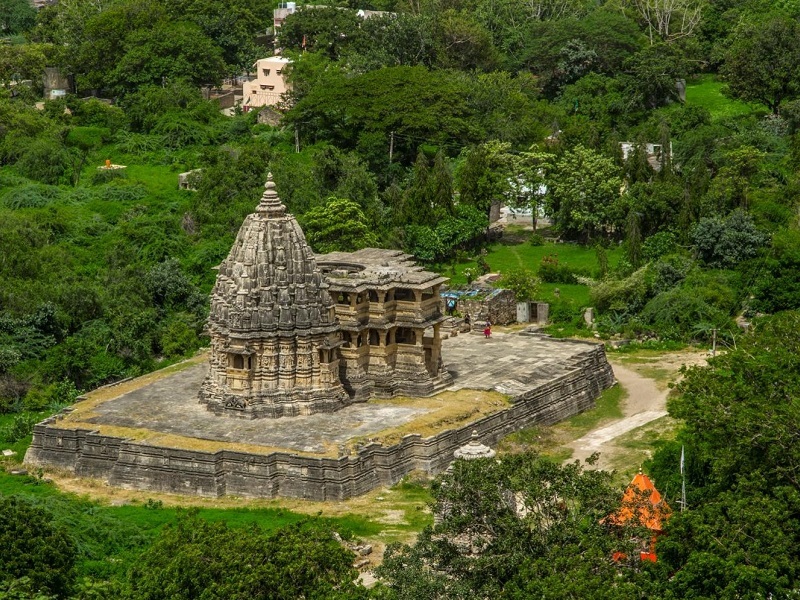
Dating back to as early as 550, the Gop temple which lies on the road between Porbandar and Jamnagar is a peculiar culmination of numerous faiths as well as architectural styles. It is believed to have been constructed by the rulers of the Maitraka dynasty who ruled this area between the 6th and 8th centuries. The temple, much of which is in ruins now is dedicated to Lord Shiva and has a shikhara or tower spire topped with a armalaka or circular disk. The skeleton of the temple has hints of Dravidian, Nagar, Kashmiri as well as slight influence of the Harappan style. Inside there are motifs and inscriptions related to Hinduism and also many unidentified ones.
Once the prosperous capital of Saindhava and then the Jethwa dynasty of Sourashtra back in the 12th and 13th centuries, Ghumli is now an important and preserved archaeological site. The village features a number of temples, historical gates and other structures built by the dynasties. The Navlakha temple and the Ashapura temples are a must-visit for the visitors. The Navlakha Temple, built by Jethwa rulers in the 12th century, is considered to be oldest Sun temple of Gujarat which is now in ruins. The temple is built in the Solanki style of architecture with entwining tusk of three elephants as a trade mark of temple. Close by, little easterly to Navlakha temple there are step wells called “Vikai Vav” the largest in Kathiawar and “Jetha vav”. Vikai or Vikia Vaav built by Jethwa ruler Vikiaji after whom it is named, is the oldest and one of the biggest step wells of Gujarat measuring almost 60 by 40.5 sq m. The well has numerous flights of steps leading up to it and string-coursed carvings. The entrance pavilions can still be seen standing intact at three places.
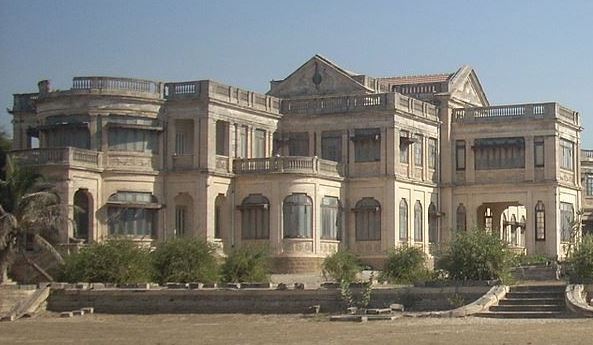
The Huzoor Palace is a grand, neoclassical structure of the early 20th century, touched with Anglican influences both in architecture and the administration. Featured with ornamental pillars and porticos, and flanked with gardens with fountains, the palace is a view to behold right at the shore of the sea. Visitors crowd in front of the palace during the Navratri festival to pay respects to the previous rulers, but are not allowed inside the palace.
The Darbargadh is an imperial fort constructed by Rana Sartanji during his regime. The whole palatial structure features authentic Rajput style of architecture. The outer walls are fortified with four giant arch gateways, and inside there are three more. One of them, called the Darbar Bari, is an ornate one with a traditional Rajasthani jharokha, supported by four elephant statues.
Also known as Willingdon Marina Beach, the Porbandar Beach is located close to the Huzur Palace and is an ideal place to sit and enjoy watching the waves and the fishing boats in the horizon. This beach is nestled between Veraval and Dwarka and is a favourite spot for morning and evening joggers.
The sandy stretch of the Chowpatty Beach is a perfect place for visitors to enjoy a lazy afternoon stroll or to sit and enjoy the blue expanse of the Arabian Sea. Flamingos, seagulls and other sea birds throng the beach throughout the day.
Located at about 15 km from Porbandar, the Barda Hills Wildlife Sanctuary is spread across the. Porbandar and Jamnagar districts. The Sanctuary exhibits great variety of fauna including varieties of butterflies, lion, chinkara, sambar, crocodile and chameleon, ratel, leopard, wolf, spotted eagle and the crested hawk eagle. It is still called as Rana Barda and Jam Barda by local people as the sanctuary was a private property of princely states of Ranavav or Porbandar and Jamnagar. The best time to visit the sanctuary is from November to March. Entry fees are INR 500 per adult and the sanctuary is open ever day from sunrise to sunset.
Junagadh Literally translated into “Old Fort”, Junagadh is the 7th largest city in the state. A different etymology derives the name from “Yonagadh” or “City of the Yona or the Greeks”, referring to the ancient inhabitants of the city under the Indo-Greek Kingdom. It is also known as “Sorath”, the name of the princely state of Junagadh. After a brief struggle between India and Pakistan, Junagadh joined India on 9 November 1947. It was a part of Saurashtra state and later Bombay state. In 1960, in consequence of the Maha Gujarat movement, it became part of the newly formed Gujarat state.
An early structure, Uparkot Fort, is located on a plateau in the middle of town. It was originally built in 319 BC during the Mauryan dynasty by Chandragupta. The fort remained in use until the 6th century, when it was abandoned for about 300 years, then rediscovered by the Chudasama ruler Graharipu in 976. The fort was subsequently besieged 16 times over an 1000-year period. One unsuccessful siege lasted twelve years. Within 2 km of Uparkot Fort is an inscription with fourteen Edicts of Ashoka on a large boulder. The Maitraka dynasty ruled Gujarat from 475 to 767. The early history of the Chudasama dynasty, which ruled Saurashtra from Junagadh, is almost lost. The bardic legends differ very much in the names, order, and numbers of early rulers; so they are not considered reliable. According to tradition, the dynasty is said to have been founded in the late 9th century by Chudachandra. Subsequent rulers were in conflict with the Chaulukya rulers and Saurashtra was briefly governed by Chaulukya governors during this period. These events are recorded in contemporary and later Jain chronicles. After the end of the rule of the Chaulukyas and their successors, the Vaghela dynasty, in Gujarat, the Chudasamas ruled independently, or as vassals of successor states, the Delhi Sultanate and the Gujarat Sultanate. The last king of the dynasty, Mandalika III, was defeated, and forcibly converted to Islam, in 1472 by Gujarat Sultan Mahmud Begada, who annexed the state and changed the name of Junagadh to Mustafabad and built the fortifications around the town and the mosque in Uparkot Fort. After the accession of Sultan Muzafar, and indeed during the latter part of Sultan Mahmud’s reign, the seat of government was removed from Junagadh to Diu owing to the importance of that island as a naval station and to check the ravages of the Portuguese. When the Portuguese took over the ports of Diu and Daman in the 16th century, a fifteen-foot cannon, made in Egypt in 1531, was abandoned by a Turkish admiral opposing the Portuguese forces at Diu, which is now at Uparkot Fort. In his time, Akbar conquered Gujarat, although Sorath yet remained independent under the Ghori rule. Around 1521-22, Junagadh became the seat of the imperial faujdars or garrison commanders of Sorath in subordination to the imperial viceroy at Ahmedabad. The last of the faujdars was Sherkhan Babi, who became independent and assumed the title of Nawab Bahadur Khan in 1730 after the invasion by the Maratha Gaekwad dynasty and founded the Babi dynasty.
In 1807, Junagadh State became a British protectorate, but the Saurashtra area was never directly administered by the British, who instead divided the territory into more than one hundred princely states, which remained in existence until 1947. The present old-town, developed during the 19th and 20th centuries, constituted one of those princely states. During the period just before the independence and partition of India and Pakistan in 1947, the 562 princely states that had existed outside British India, but under British suzerainty, were given the choice of acceding to either India or Pakistan, or to remaining apart. The Nawab of Junagadh, which, although located at the south-western end of Gujarat, had no common border with Pakistan, but chose to accede to Pakistan, arguing that Junagadh could access Pakistan by sea. India asserted that Junagadh was not contiguous to Pakistan and, believing that if Junagadh was permitted to accede to Pakistan communal tension already simmering in Gujarat would worsen, refused to accept the nawab’s accession to Pakistan. The Indian government pointed out that the state was 96% Hindu, and called for a plebiscite to decide the question of accession. On 26 October, the nawab and his family fled to Pakistan following clashes between Junagadhi and Indian troops. On 7 November, Junagadh’s court, facing collapse, invited the government of India to take over the state’s administration. Based on a plebiscite conducted in February 1948, which went almost unanimously in favour of accession to India, Junagadh became a part of the Indian state of Saurashtra until 1 November 1956, when Saurashtra became part of Bombay state and then a part of the Gujarat state in 1960 when the state was formed on linguistic lines.
Over 2300 years old, with walls up to 20m high in some places and with a 300 ft. deep moat inside the walls which reportedly used to be inhabited by crocodiles for the fort’s protection, the Uperkot Fort and a town was established at the foothills of Girnar hill during reign of the Maurya Empire and continued to be used during Gupta period, but it lost its importance when the capital of Saurashtra region was moved from Junagadh to Vallabhi by the Maitrakas. The Chudasamas settled around Junagadh from 875 according to bards when they acquired Vamansthali or Vanthli from the Chavda ruler. According to legends, after several Chudasamas of Vamansthali had ruled, a woodcutter one day managed to cut his way through the forest and came to a place where stone walls and a gate existed. Nearby sat a holy man in contemplation, and on being asked by the woodcutter the name of the place and its history, he replied that its name was “Juna” or old. The woodcutter returned by the way he had come to Vamansthali, and reported his discovery to the Chudasama ruler, who ordered the forest to be cleared away. This being done, the fort came into sight. But there was none who knew its history, or who could tell more than the holy man had told the woodcutter. So the place became known as “Junagadh” for want of a better title. If this story is to be believed, either Graharipu rediscovered an ancient stronghold or else after he had built the fort, it was abandoned and afterwards found again by a later ruler Navaghana who transferred Chudasama capital from Vamansthali to Junagadh. Neelam and Manek, forged in Cairo and brought by the Turks are the two major tourist attractions in the fort. Also make sure to see the stepwells and caves in the fort complex.
Located in the Uperkot Fort, the Jama Masjid is a yellow sandstone mosque boasting of a spacious courtyard covered in white marble and a huge ablution tank in the premises. The inner walls have intricate carvings and the central dome is carved in the shape of a lotus flower.
Adi-kadi Vav and Navghan Kuwo and two step wells inside the Uperkot Fort. Usually wells are dug into the ground through layers of soli, stones, etc. and the construction is like that done above the ground. But these two stepwells are different. Unlike most wells, this well isn’t dug. It is carved out of the stone in the ground. Technically the entire structure is carved out of a single stone!
Also known as Mausoleum of Bahaduddnbhai Hasainbhai, the Mohabbat Maqbara is a mausoleum built in the late 19th century, housing the tombs of Mohabbat khanji in the Mohabbat Maqabra and tomb of Bahaduddin Hasainbhai in the Bahaduddinhassainbhai Maqabra. This monument is a unique example of Indo-Islamic and Gothic architecture with finely designed arches, elaborate stone carvings on the walls and windows, silver-decorated portals, the winding staircases encircling its four tall minarters, the old step-well in the grounds and its onion shaped dome. The Jama Masjid is also located nearby.
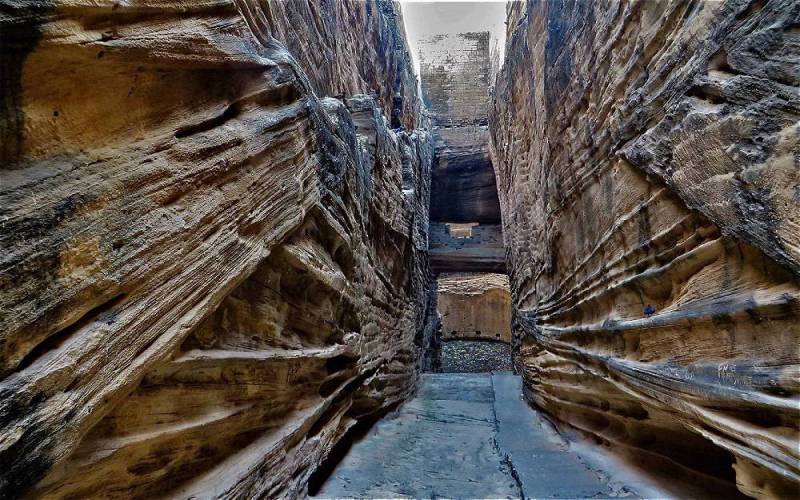
The Buddhist Caves aren’t exactly caves but rooms carved out of stones and were used as monk’s headquarters. The oldest, the Khapara Kodia caves belong to 3rd and 4th centuries and are plainest of all cave groups. They were carved into living rock during the reign of Emperor Ashoka and are considered the earliest monastic settlement in the area. Another set of caves, the Baba Pyara caves lie close to the Modhimath, which has four caves in its northern group.
Located 5 km east of Junagadh town, the Girnar hills are a collection of hills, whose origins can be traced back to the Vedas. It has been considered to be a religious place even during the Mohan-jo-Daro period. Flocked by Hindu and Jain pilgrims alike, this place is also nature’s paradise located in midst of the Gir Forest. Girnar offers its visitors some good trekking avenues, religious spots and pre-historic sites and mountains. Duing the 11th day of the Hindu calendar month of Kartik, Hindus in large numbers come to the mountain range for the Girnar Parikrama, a massive annual event which starts and ends at the Bhavanat Temple
The Girnar Parikrama is a massive annual event for Hindus. More than ten lakh pilgrims come to Girnar to carry out the procession. The procession of sadhus and pilgrims begins and ends, at the Bhavanat Temple. This festival takes place on the This procession is the backbone of the economy of Junagarh.
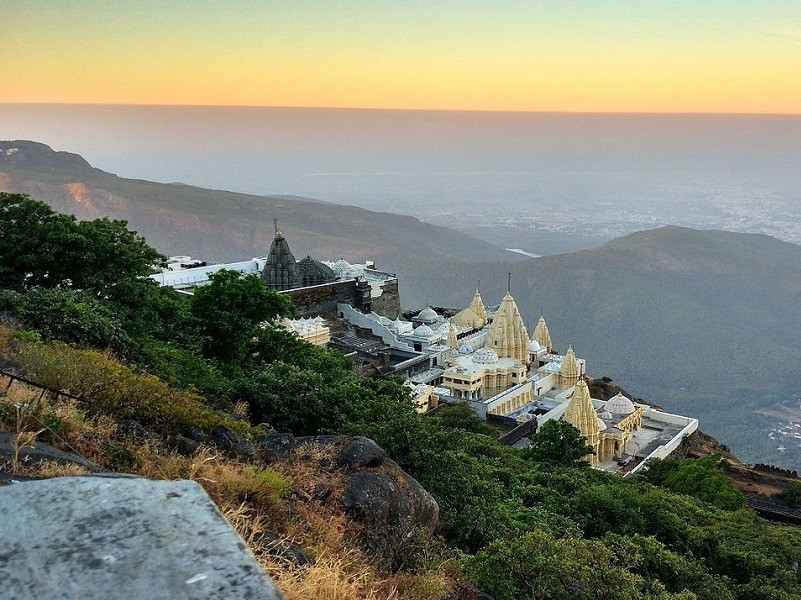
There is a group of Jain temples in Girnar near Junagadh, which are all unique yet similar in architecture and style. The Neminath Temple, built from 1128 to 1159, is one of the main attractions. The temple complex has quadrangle courtyards, corridors and other shrines as well, with pillars adorned with intricate carvings of Jain Tirthankars. The idol of Bhagwan Neminatha here is thought to be the oldest one in the world, approximately 84,785 years old. Innumerable monks come here to attain Moksha and for this reason Girnar is said to be an important religious place for the Jains.
Located on the top of the Girnar Mountain, the Dattatreya Temple is revered Hindu temple dedicated to the holy trinity of Brahma, Vishnu and Shiva collectively known as Dattatreya or Datta. However, the temple can only be reached by scaling the mountain height on foot which is a rather difficult trek.
Situated on the top of the Girnar Hill in Junagadh, Gujarat, Goddess Ambe Temple or Ambe Mata Temple is a revered Hindu temple and an important pilgrimage site for the Hindus. Dedicated to the Hindu Goddess Ambe Ma, the shrine is mostly visited by newly wed couples. The temple also provides a picturesque view of the town below.
The Jatashankar Mahadev Temple is a Hindu temple situated on the rear side of the Girnar mountain and is enshrined by Lord Shiva in the form of his shivalinga which is naturally bathed by a stream flowing along and water falling on the idol itself. The place is also the origin of river Sonrekh and is covered in ethereal beauty.
At the base of Ashwatthama Hill in the Girnar mountain range, is a sacred Hindu temple called Shri Damodar Haries Temple alongside a holy water pond called Damodar Kund. The temple is enshrined by Lord Krishna and is surrounded by natural beauty lush greenery. The premises also have a gaushala to tend to cows. The Damodar Kund Water Reserve is considered holy by the Hindus with regard to certain myths and legends. The ghat at the lake is used to cremate dead bodies and the water is believed to have properties to dissolve bones. The lake also has a temple and many poojas are performed at the site.
The Ashok Shilalekh is large rock inscription located around 3 kms from the Girnar Mountain. The massive boulder is 7 metres in circumference and 10 metres in height and makes a popular tourist site. The rock has 14 inscriptions carved in iron pen from the time of King Ashoka written in Brahmi script of Pali language.
Dataar Hills is a holy site located southwest of the Girnar range which is popular for housing the shrine of Jamiyal Shah Datar at the top of the mountain peak. The shrine is worshipped by Hindus and Muslims alike and also offers a spectacular panoramic view of the town below. The Urs festival is celebrated with great pomp and show here.
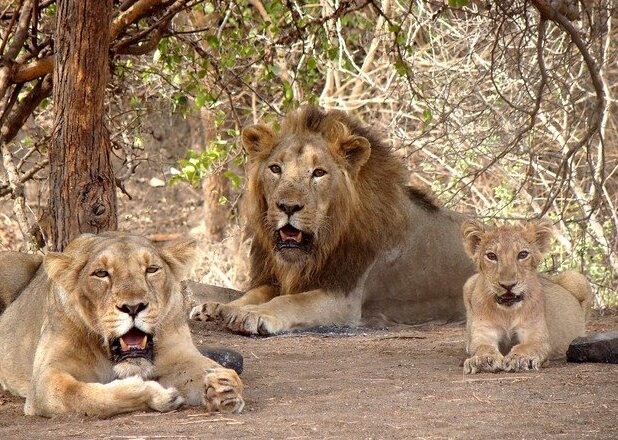
The Gir National Park, also known as Sasan Gir, is the only remaining home for the Asiatic lions other than Africa where the lions can be seen roaming free in the wild. This national park is situated approximately 65 kms south east of Junagadh. In 1965, the Indian government notified the large geographical extent of Sasan Gir as wildlife sanctuary to conserve the Asiatic Lion. It covers total area of 1412 sq km of which 258 km forms the core area of the National Park. Indiscriminate hunting by the people of Junagarh led to their decrease in population drastically, while they were completely wiped out from the other parts of Asia. From a population of approximately 20 lions in 1913, the lion population has risen to a comfortable 523 according to the 2015 census. Because the entire forest area is dry and decisous, providing the best habitat for the Asiatic Lion, as of 2015, there were 106 male, 201 female and 213 sub-adult lions in the wilderness of the national park. The park also is home to about 2375 differnet species of fauna here with 38 species of mammals, over 300 species of birds, 37 species of reptiles and over 2000 species of insects. There are also more than 300 leopards and the park is known for the Chowsingha – the world’s only four horned antelope. The sanctuary has been declared an important bird area by the Indian Bird Conservation Network and is a habitat of raptors like the critically endangered white-backed and long-billed vultures. Kamleshwar, a large reservoir in the sanctuary is the best spot where Marsh Crocodile can be seen in large numbers. The Devaliya Safari Park is an enclosed area of the sanctuary that offers a good opportunity for visitors to experience the rustic beauty and wilderness of the area. The safari tour is conducted in a mini bus that takes visitors to another cross section of the Gir. The park is closed from 16 June to 15 October every year with the months between December and March being the best months to visit. Although it is very hot in April and May, these are the best months for wildlife viewing and photography.
Located in the premises of Gir Forest National Park, Tulsi Shyam Springs is a group of three hot sulphur streams alongside a Lord Vishnu Temple. The first is warm, second is slightly hot and the third stream is boiling hot; it is believed to have curative powers. It is believed a dip in the springs can cure one of skin diseases.
The former residencial palace of the rulers of Junagadh was later converted into the magnificent Darbar Hall Museum exhibiting the splendid possessions of the 19th century Nawabs. The museum has several galleries exuding opulence and grandeur, decked with palatial rooms, goods, weapons, palanquins, pictures, photographs and artefacts. Open from 10 am to 1:15 pm and then again from 2:45 to 6 pm, the museum is closed on Wednesdays and the second and fourth Saturday of the month. Entry fee for Indians is INR 5 and for foreigners, it is INR 50.
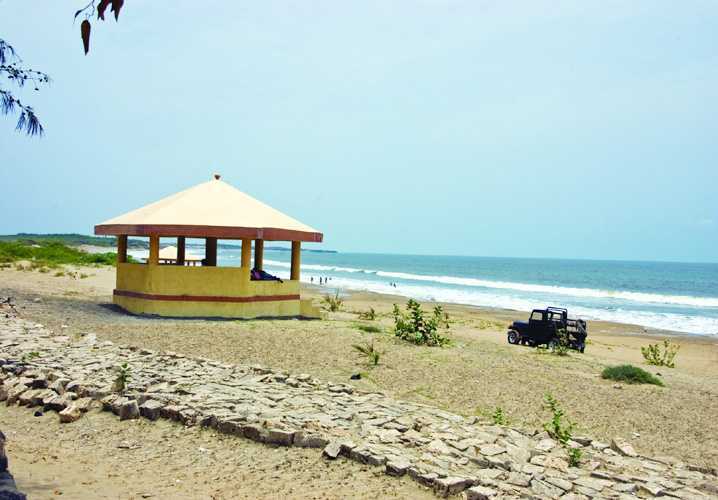
Madhavpur beach is a stunning beach lined with gorgeous coconut trees and boasting of an ethereal landscape. The other side of the beach, across the road has verdant green grass and vegetation which makes the area look even more pleasant. The beach is not considered ideal for swimming due to high tides; and is home to thousands of turtles.
The Ahmedpur Mandvi Beach is a 6 kms long pristine coastline kissed by the sparkling waters of the Arabian Sea situated on the junction of Diu and Gujarat and dotted with windmills and boasting of soft white sand. The beach is ideal of swimming, water sports and dolphin spotting and is visited by a large number of tourists throughout the year. The beach provides some stunning views of the Arabian Sea with a number of beautiful temples and palaces that can be visited as well as a fishing village surrounding it.
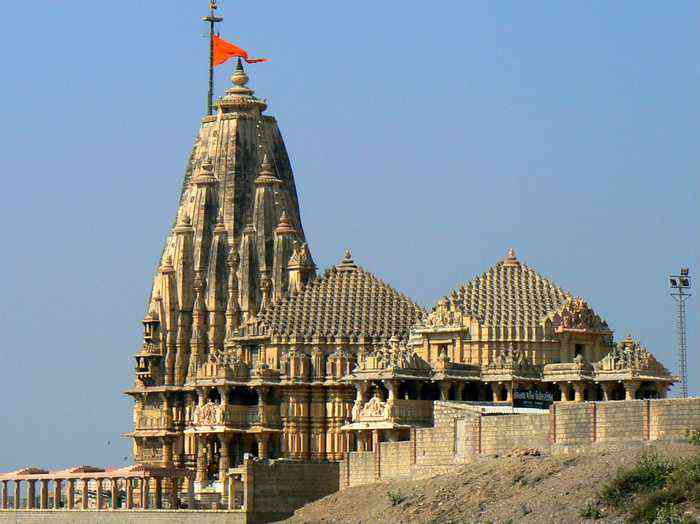
The famous Somnath temple located about 90 km southwest of Junagadh is believed to be the first among the twelve jyotirlinga shrines of Lord Shiva, which according to tradition, Shiva is believed to have appeared as a fiery column of light. The jyotirlingas are taken as the supreme, undivided reality out of which Shiva partly appears. Each of the 12 jyotirlinga sites take the name of a different manifestation of Shiva and in all these holy places, the primary image is a lingam representing the beginning-less and endless stambha or pillar, symbolizing the infinite nature of Shiva. Somnath has been a pilgrimage site from ancient times on account of it being a triveni sangam or the confluence of three rivers: Kapila, Hiran and the mythical Sarasvati. Soma, the Moon god, is believed to have lost his lustre due to a curse, and he bathed in the Sarasvati River at this site to regain it. The name of the town Prabhas, meaning lustre, as well as the alternative names Someshvar or the “Lord of the Moon” and Somnath or the Moon God” arise from this tradition.
The fabulous wealth of the temple attracted various invaders who attacked and plundered it ruthlessly. However, every invasion was followed by its reconstruction which restored it to its former glory. The present temple was reconstructed in the Chaulukya style of Hindu temple architecture and completed in May 1951. According to popular tradition, the first Shiva temple at Somnath is believed to have been built at some unknown time in the past. In 1024, during the reign of Bhima I, the prominent Turkic Muslim ruler Mahmud of Ghazni raided Gujarat, plundering the Somnath temple and breaking its jyotirlinga and taking away a booty of 20 million dinars. During its 1299 invasion of Gujarat, Alauddin Khalji’s army, defeated the Vaghela king Karna, and sacked the Somnath temple. As late as the 14th century, Gujarati Muslim pilgrims were noted by Amir Khusrow to stop at the temple to pay their respects before departing for the Hajj pilgrimage. In 1395, the temple was destroyed for the third time by Zafar Khan, the founder of Gujarat Sultanate and in 1451, was desecrated by Mahmud Begada, the Sultan of Gujarat. By 1665, the temple, one of many, was ordered to be destroyed by Mughal emperor Aurangzeb and in 1702, he ordered that if Hindus revived worship there, it should be demolished completely.
The temple’s Shikhar, or main spire, is 15 metres in height, and it has an 8.2-metre tall flag pole at the top. The temple is situated at such a place that there is no land in a straight line between the Somnath seashore until Antarctica as per an inscription in Sanskrit is found on the Baṇastambha or arrow pillar erected on the sea-protection wall. The Baṇastambha mentions that it stands at a point on the Indian landmass that is the first point on land in the north to the South Pole at that particular longitude.
Bhavnagar The town of Bhavnagar was founded in 1724 by Bhavsinhji Gohil and was the capital of the Bhavnagar State, which was a Princely state before it was merged into the Indian Union in 1948. The world’s largest ship-breaking yard, Alang located 50 km south of Bhavnagar.
The Gohil Rajputs of the Suryavanshi clan moved to the Gujarat coast in 1260 after facing severe competition in Marwar and established three capitals – Sejakpur, now Ranpur which was founded in 1194, Umrala, and Sihor. After a war in 1722-1723 on Sihor, Maharajah Bhavsinhji Gohil realised the reason for repeated attack was the location of Sihor and so in 1723, he established a new capital near Vadva village, 20 km away from Sihor, and named it Bhavnagar after himself. In 1807, Bhavnagar State became a British protectorate. The old town of Bhavnagar, a fortified town remained a major port for almost two centuries, trading commodities with Mozambique, Zanzibar, Singapore and the Persian Gulf. Bhavnagar benefited from the revenue that was brought in from maritime trade, which was monopolized by Surat and Cambay. Whilst Bhavsinhji was in power, Bhavnagar grew from a small chieftainship to a considerably important state. During the late 19th century, the Bhavnagar State Railway was constructed making Bhavnagar the first state that was able to construct its railway system without any aid from the central government. The former princely state of Bhavnagar was also known as Gohilwad or the “Land of the Gohils” which was the clan of the ruling family. Until Indian independence, Bhavnagar was an independent state ruled by the Rajput Gohil family. The last ruling Maharajah of Bhavnagar, Krishnakumar Sinhji handed over the administration of his state to to India in 1948. It is said the Bhavnagar state was the first princely kingdom to give up their state to join the Indian Union.
The Nilambag Palace is an ancient mansion initiated by the king of Bhavnagar of the time, Maharaja Saheb Takhatsinhji. He channelled the German architect Simms towards its construction in 1879. This palace which has an Anglo-Indian architectural style, was revamped as a heritage hotel in 1984. It is a part of the local heritage of the land as it has colonial historical significance.
The Gandhi Smriti stands in the centre of the city and commemorates the life and service of Mohandas Karamchand Gandhi. Constructed in 1955 and attached to a tower clock, the you can find rare photographs of Gandhi and a vast collection of books and memorabilia that Gandhi used at the Gandhi Museum. On the ground floor, you can find the oldest oldest library in the city, the Barton Library which has a huge collection of books as well as a range of archaeological remains of the surrounding areas. The Gandhi Smriti and the the Barton Library are closed on Sundays and the second and fourth Saturdays of the month and are open on other days from 9 am to 1 pm and then again between 2 to 6 pm. Entry fees are INR 3 per person.
Situated along the Takteshwar Tarheti Road, the Takhteshwar Temple is a hilltop temple and one of the oldest recorded holy sites in Gujarat. Established in 1893, the temple is named after its founder, Maharaja Takhatsinghji, the king of the time. The pathway to the temple is more a trek laid along a marble staircase that overlooks a breathtaking view of the lush green view that saddles the temple. This Shaivite temple has an idol of Lord Shiva, besides a smaller Nandi statue housed on a massive courtyard held by eighteen elaborately designed pillars. The temple attracts numerous devotees especially during Navratri. The temple is open from 5:30 am to 7 pm every day.
Bracketing the Victoria Park in Bor Talav, the Gaurishankar Lake is also known as the Bhavnagar Nagar. Merging along with its sister-stream, Balvatika, the Gaurishankar Lake was first created as a public reservoir in 1872. Alongside the Pil Garden, a dedicated space for children, the lake also has a Shiva temple. The lake is also a good place to view the sunset. On the edges of the lake, is a 2-sq-km protected forest known as Victoria Park. Here, one can spot vibrant flora, various species of birds and butterflies and a large fox population. It is one of the oldest human-made forests in India, made in 1888 by Mr Proctor Sins for Maharaja Takhtasinhji of Bhavnagar. The lake and park are open from 6 to 9 am and then again from 4 to 7 pm and the entry fee to the park is INR 20.
The Blackbuck National Park at Velavadar is located about 42 km north of Bhavnagar and was established in 1976 in the Bhal region. Hugging the coast of the Gulf of Khambhat on the south, it is spread over an area of 34.08 sq km, which was primarily a “vidi” or grassland of the Maharaja of Bhavnagar for hunting the blackbucks with his famous hunting cheetahs. On the northern side, it is surrounded by wastelands and agriculture fields. The national park has been classified as 4B Gujarat-Rajwada biotic province of semi-arid bio-geographical zone. Flat land, dry grasses and herds of antelope have always attracted visitors to this park which has a grassland ecosystem. Successful conservation programs for the blackbuck, wolf and lesser florican, a type of bustard which is considered an edemic Indian species, currently endangered, are ongoing.
A small town located about 50 km southwest of Bhavnagar, Palitana is noted as a popular pilgrimage spot for people of the Jain faith. This town follows strict vegetarianism which makes it the first town in the world to abide by the vegetarian diet legally. So the selling of any animal product is or activity which involve the killing of animals is illegal here. The town of Palitana has over 900 temples of which Shatrunjaya Hill which translates to the “Victory Ground” receives Jain pilgrims in large numbers because this is considered to be the most pious for them. This hill alone has more than 3000 temples. The Jain temples in Palitana worship Jain Tirthankars, and the foremost temple is dedicated to the first Tirthankara, Rishabhanatha, also known as Rishabhadeva. The temples on the Shatrunjaya Hills have been constructed by generations for almost 900 years. The first temple is believed to have been built in the 11th century. If you begin at the foot of the hill and go to the peak, the way to the temples have been carved out of more than 3,800 stone steps.
The temples flaunt exquisite craftsmanship with the intricate marble carving and the creative motifs. All the temples have been clubbed under nine different temple complexes or tunks; each of these housing several smaller temples which have been built around the central temple. The Chaumukh Temple is among the most important of all the temples here, characterised with the holy deity of Adinath who has four-faces, carved on marble and placed in a temple which is open on all sides. The architecture of the Chaumukh temple, built at the beginning of the 17th century, is unique and inspired by the five sacred hills worshipped by the followers of Jainism. The Adishwar temple is an architectural marvel with its beautifully carved pillars and roofs. Make sure you check out the brilliant dragon-shaped carving inside. There is also a Muslim shrine nearby, Angar Pir, which is visited by couples who are facing difficulties in getting pregnant.
There is no entrance fee to visit the temples, however, for those who can’t climb the steps, you can use a carriage or slig chair, called Doli which is chargeable. It will normally cost INR 2500 for two people for a doli without chairs and INR 500 for a doli with chairs for four people. During the peak season, the rates might often go up, however, in the offseason, it might be slashed to half.
The next post, the last post about this state, will be about the fascinating region of Kutch.