When I was a student, years back, my school had an ‘English Only’ policy. What this meant was that we could only speak English while in school. If teachers found students talking in any other language other than English, they would punish the student. However, this enforcement was possible only in kindergarten and primary schools. By the time we reached secondary school, we were effortlessly speaking multiple languages with each other – English when speaking to our teacher and a mixture of English, Hindi, Gujarati and even Parsi when speaking with each other. What we didn’t know then was that we were actually code-switching!
What is Code Switching? According to Wikipedia, “in linguistics, code-switching occurs when a speaker alternates between two or more languages, or language varieties, in the context of a single conversation. Multilingual speakers of more than one language, sometimes use elements of multiple languages when conversing with each other.”
Code Switching happens in societies which are multilingual in nature, so you see a lot of ode switching in places like Mumbai and Singapore which have people living in close contact who speak different languages. I guess it also happens when people who speak multiple languages live and work together. I’ve been known to speak in English, Hindi and Tamil all in the same sentence!
While working, when I have colleagues who speak Hindi or Tamil, I more often than not speak to them in those languages, especially when we want to speak things we do not want the others to know about, switching to English when another colleague joins us. I see this a lot here in offices here when ethnic Chinese people usually speak in Mandarin, but here, many do not speak English when others who don’t know the language join them.
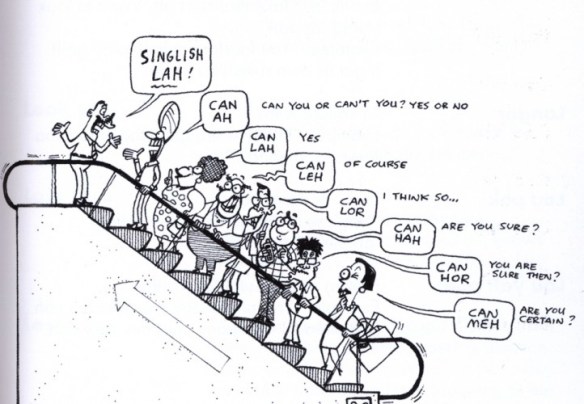
GG code switches more than BB moving between Mandarin, Singlish and Standard English. I am pretty particular about not using Singlish at home, but I am sure both GG & BB code switch between Standard English and Singlish when they are out with friends. This is actually fairly common in Singapore, where Singlish (or Singapore English), a colloquial version of English is the localised version spoken here. While English is the official language of business, Singlish is the language spoken between friends and while relaxing at home with words borrowed from Mandarin, Hokkien, Malay and Tamil.
When people are skilled Code Switchers, it allows them to connect culturally to people immediately. When you travel, when you hear Singlish or even Hinglish (the Indian version of Singlish), you immediately know you are among friends. It also allows you to make friends easily, especially when you and the person opposite you speaks a similar language. Code Switching also allows you to fit in immediately in a new environment.
I realise this when I go to Mumbai, I immediately start speaking in Hindi over English, even with friends with whom I’d text in English. I assume the reverse would happen if we go to a predominantly English speaking country – we’d automatically start speaking in English and also possibly start mimicking their accent.
I think back and realise we do this without realising it – one of my old bosses was a Brit and when I spoke to him, I realised my accent had become more crisp, almost copying the British accent.
So do you Code Switch? I’d love to hear your views on this interesting phenomena!

 Japan, 1709. The shogun is old and ailing. Amid the ever-treacherous intrigue in the court, Sano Ichiro has been demoted from chamberlain to a lowly patrol guard. His relationship with his wife Reiko is in tatters, and a bizarre new alliance between his two enemies Yanagisawa and Lord Ienobu has left him puzzled and wary. Sano’s onetime friend Hirata is a reluctant conspirator in a plot against the ruling regime. Yet, Sano’s dedication to the Way of the Warrior—the samurai code of honor—is undiminished.



 The Joffrey Ballet is a comprehensive history of the quintessential American dance troupe and a textured portrait of Robert Joffrey, the creative maverick who led and inspired it.


