Theory of Multiple Intelligence


The other day, while randomly clicking links, I came across an article which spoke about intelligence not as a single entity as we know but splitting it into nine different types. The more I read, the more it made sense to me. We all may not be intelligent in the traditional sense, which when you are in school means scoring more marks, but you could be street smart or even people smart which may actually stand you in better stead than being just book smart!

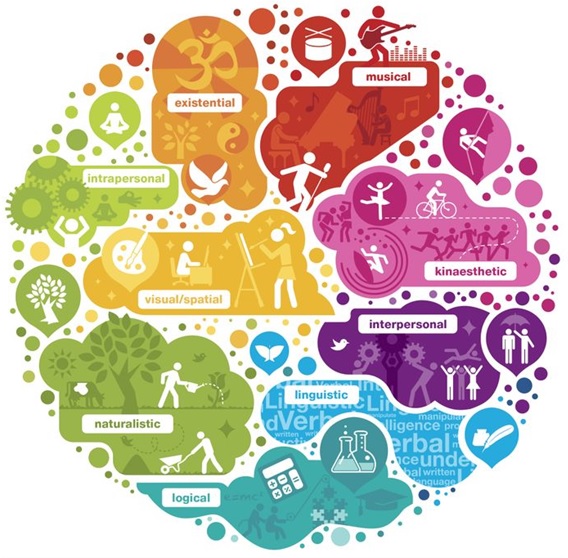
The theory of multiple intelligence was first coined by Howard Gardner who proposed this model in his 1983 book Frames of Mind: The Theory of Multiple Intelligences. According to Gardner, an intelligence must fulfil eight criteria: musical-rhythmic, visual-spatial, verbal-linguistic, logical-mathematical, bodily-kinesthetic, interpersonal, intrapersonal, and naturalistic.


Musical-rhythmic and harmonic or Sound Smart:
This area has to do with sensitivity to sounds, rhythms, tones, and music. People with a high musical intelligence normally have good pitch and may even have absolute pitch, and are able to sing, play musical instruments, and compose music. They have the sensitivity to rhythm, pitch, meter, tone, melody or timbre. Musical intelligence is the capacity to discern pitch, rhythm, timbre, and tone. This intelligence enables us to recognise, create, reproduce, and reflect on music, as demonstrated by composers, conductors, musicians, vocalist, and sensitive listeners. Interestingly, there is often an affective connection between music and the emotions; and mathematical and musical intelligence may share common thinking processes.


Visual-spatial or Picture Smart:
This area deals with spatial judgment and the ability to visualize with the mind’s eye. Spatial ability is one of the three factors beneath g in the hierarchical model of intelligence. Spatial intelligence is the ability to think in three dimensions. Core capacities include mental imagery, spatial reasoning, image manipulation, graphic and artistic skills, and an active imagination. Sailors, pilots, sculptors, painters, and architects all exhibit spatial intelligence.

Verbal-linguistic or Word Smart:
People with high verbal-linguistic intelligence display a facility with words and languages. They are typically good at reading, writing, telling stories and memorizing words along with dates. Linguistic intelligence is the ability to think in words and to use language to express and appreciate complex meanings. Linguistic intelligence allows us to understand the order and meaning of words and to apply meta-linguistic skills to reflect on our use of language. Linguistic intelligence is the most widely shared human competence and is evident in poets, novelists, journalists, and effective public speakers.

Logical-mathematical or Numbers or Reasoning Smart:
This area has to do with logic, abstractions, reasoning, numbers and critical thinking. This also has to do with having the capacity to understand the underlying principles of some kind of causal system. Logical reasoning is closely linked to fluid intelligence and to general intelligence. Logical-mathematical intelligence is the ability to calculate, quantify, consider propositions and hypotheses, and carry out complete mathematical operations. It enables us to perceive relationships and connections and to use abstract, symbolic thought; sequential reasoning skills; and inductive and deductive thinking patterns. Logical intelligence is usually well developed in mathematicians, scientists, and detectives.

Bodily-kinesthetic or Body Smart:
The core elements of the bodily-kinesthetic intelligence are control of one’s bodily motions and the capacity to handle objects skilfully.Gardner elaborates to say that this also includes a sense of timing, a clear sense of the goal of a physical action, along with the ability to train responses. People who have high bodily-kinesthetic intelligence should be generally good at physical activities such as sports, dance, acting, and making things. Bodily kinesthetic intelligence is the capacity to manipulate objects and use a variety of physical skills. This intelligence also involves a sense of timing and the perfection of skills through mind–body union. Athletes, dancers, surgeons, and crafts people exhibit well-developed bodily kinesthetic intelligence.

Interpersonal or Self Smart:
In theory, individuals who have high interpersonal intelligence are characterized by their sensitivity to others’ moods, feelings, temperaments, motivations, and their ability to cooperate in order to work as part of a group. Those with high interpersonal intelligence communicate effectively and empathize easily with others, and may be either leaders or followers. They often enjoy discussion and debate. Interpersonal intelligence is the ability to understand and interact effectively with others. It involves effective verbal and nonverbal communication, the ability to note distinctions among others, sensitivity to the moods and temperaments of others, and the ability to entertain multiple perspectives. Teachers, social workers, actors, and politicians all exhibit interpersonal intelligence.

Intrapersonal or People Smart:
This area has to do with introspective and self-reflective capacities. This refers to having a deep understanding of the self; what one’s strengths or weaknesses are, what makes one unique, being able to predict one’s own reactions or emotions. Intra-personal intelligence is the capacity to understand oneself and one’s thoughts and feelings, and to use such knowledge in planning and directioning one’s life. Intra-personal intelligence involves not only an appreciation of the self, but also of the human condition. It is evident in psychologist, spiritual leaders, and philosophers.

Naturalistic or Nature Smart:
Not part of Gardner’s original seven, naturalistic intelligence was proposed by him in 1995. This area has to do with nurturing and relating information to one’s natural surroundings.This sort of ecological receptiveness is deeply rooted in a “sensitive, ethical, and holistic understanding” of the world and its complexities – including the role of humanity within the greater ecosphere. Naturalist intelligence designates the human ability to discriminate among living things (plants, animals) as well as sensitivity to other features of the natural world (clouds, rock configurations). This ability was clearly of value in our evolutionary past as hunters, gatherers, and farmers; it continues to be central in such roles as botanist or chef. It is also speculated that much of our consumer society exploits the naturalist intelligences, which can be mobilized in the discrimination among cars, sneakers, kinds of makeup, and the like.

Existential or Life Smart:
Gardner did not want to commit to a spiritual intelligence, but suggested that an “existential” intelligence may be a useful construct, also proposed after the original 7 in his 1999 book. Sensitivity and capacity to tackle deep questions about human existence, such as the meaning of life, why we die, and how did we get here.

Gardner also opposed the idea of labeling learners to a specific intelligence and maintained that his theory of multiple intelligences should “empower learners”, not restrict them to one modality of learning. According to Gardner, an intelligence is “a biopsychological potential to process information that can be activated in a cultural setting to solve problems or create products that are of value in a culture.

Even after so many years of this theory being proposed, there is still controversy about it. I am not a psychologist, but this theory does make sense to me. I know that not everyone can be defined as ‘traditionally intelligent’ and this theory does put to rest why some people are widely successful in varied fields. Take music for example. Every years, hundreds of thousands of aspiring musicians audition for jobs and reality shows, but there are just a handful who are successful. That’s probably because they are blessed with musical intelligence, which a whole bunch of the others do not possess. This does make you think, right?

There are a couple of sites which allow you to take a test to determine which intelligence is your dominant one. I did one and no surprises there, at least for me – I got linguistic ability overwhelmingly which is right in my mind.

This is what the result said about me “Your dominant intelligence type is linguistic/verbal or in other words… you are word smart! You have an eloquent and sophisticated way of expressing yourself verbally as well as in writing.

You are passionate about literature, history and current events. You also have a knack for pursuing and learning new languages. You have a charismatic personality and because of you are talented in many areas of communicating, you also have strong interpersonal and intrapersonal skills. You are social, people smart and extremely self-aware.

If you want to do the same test, here’s the test link

Do you agree with Gardner’s theory of multiple intelligence? I’d love to hear what you got? Please do comment below….
Grandmother Tales

grandma09When I woke up this morning, the first thing I thought of today was my paternal grandmother. Somehow I kept thinking about her and thought I should dedicate this post to her.

My paternal grandmother, whom I called ammama was a remarkable lady. Ammama in some Tamil dialects and in Malayalam actually refers to your mum’s mum but I used to use it interchangeably for both my grandmothers!

3eeb889d8100ad16e6837259a7c58518Actually, there’s a story to why I called her ammama. Growing up, it seemed normal to me to call both my grandmothers by this name. I realised that it was different when I heard others call their grandmothers pati which in Tamil means grandmother. But I never really gave it a thought. Following my example, my sister and later other cousins from my maternal side also started calling our maternal grandmother as ammama and used to call their paternal grandma as pati. Years later, probably after I became a mother myself and my mother became a pati, I asked her why I used to call my grandmothers ammama? Her answer actually made me pause because apparently, it was my paternal grandmother who wished that I used this name to call her. I never had the chance to ask her this question, but I guess she must have been quite young when I was born and a streak of vanity in her didn’t want her to officially become a grandmother so young! So by making us call her ammama, she didn’t become a pati, yet we had a unique name to call her.


She was married to my grandfather when she was around 9 years old and came with him to Bombay (as it was then called) sometime in the early 40s. She was not very highly educated, she probably just finished high school, but was a very voracious reader. My dad always tells me that my love for books most likely came from her.

I was also named for her. In Tamil nomenclature, the first born child is usually named after the paternal grandparents (so paternal grandfather for the first born son and grandmother for the first born daughter) and the next child of the same sex is named after the maternal grandparents.  So, though the name I legally go by is not hers, I have her name on my birth certificate and can legally use anytime I want to do. This tradition is to keep family names alive and is probably the reason you see many south Indians with long and unpronounceable names!

In addition to being a reader, or perhaps because she was a reader, she was also very skilled in telling stories. I remember countless nights when I was very young when my sister and I would huddle against her and listen to stories before bedtime. She was the one who introduced mythology to us and would regale us with stories from the Hindu pantheon. She was also quite good at making up stories with the prompts we gave her and now I wish I had recorded those stories to share with BB & GG.

When I was around six years old, she moved away, first to a city in Western India and then to a city in Southern India because of my uncle, who was considerably younger than my father, and who was single then, moved for work. My grandfather had retired by then and so they decided to spend their last years away from the hustle and bustle that Bombay had by then become. They loved the southern city they finally moved to and when my uncle got married and moved away, they decided to stay there permanently. They first rented and then bought their own home there which my ammama lovely restored (the house was being used as student accommodation when they brought it so you can imagine the condition it was in).

We, especially I, waited impatiently for ammama to come to Bombay for their trips and when she was there, I probably forgot my parents completely. It was always ammama this and ammama that for me for the month or two that she was with us. I also used to wait for the summer holidays to come so that I could go to spend time with her. In case you wonder, it was not all a bed of roses with her too! She was very traditional and conservative and I used to chafe at the restrictions she used to put on us, especially some which I never understood since we were girls. For all her conservatism and traditions, she was also quite liberal in her outlook and encouraged my dad to give us far more freedom in terms of what we could do (within reason and boundaries) as compared to other girls around us. Perhaps this stemmed from what her daughter, my aunt went through in life which she didn’t want her grand-daughters to go through too.

3953b704373bafea3e5805627c34ec9f

The last time I spent time with her was when I was starting my class 12 year (equivalent to the A-levels in India). Since the exams would end much earlier, we had made plans before leaving that I would travel alone to be with her for a whole month before my mum and sister came. I was so excited going back to Bombay that I was making plans in the train, a whole year before the trip! She and my tatha were travelling on the same day to another city to attend a wedding and we had gone to the station together. Their train was before ours and so we said our goodbyes at the station. We reached Bombay late at night the next day and the day after that, around 5:30 am, we got a call from one of my dad’s relatives that she had passed away! She had a massive heart attack at the wedding venue and before she could get any medical attention, she passed away!

Writing this last sentence brought tears to my eyes, even now, more than a quarter of a century after the event! My parents rushed back to her town and left us back in Bombay. I never got a chance to say a last goodbye to my beloved ammama, which at some level, still rankles me, even today! When I first started writing this piece, I was happy sharing my memories about my ammama, but the last paragraph made me sad! I am still happy that I have these memories with me, I have friends who have no memory of their grandparents at all!

My maternal grandmother is still alive and healthy for her age and I am glad she is around. My children have and know their great-grandmother and she knows her brood of great-grandchildren!

Writing this post has been difficult, yet cathartic for me. Do you have memories about a favourite grandparent? Do share!

Parenting: Importance of Breakfast


We all know that breakfast is the most important meal of the day. We’ve also heard the adage “Breakfast like a king, Lunch like a common man and Dine like a pauper”. Breakfast which literally means breaking the fast between dinner and the morning is one meal which should not be missed.


There are reports from the Healthy Child website which say there are around 20 – 30% of teens who do not eat breakfast before going to school.


The first meal of the day is very important in providing energy to your teen for their activities in school. School work takes up a lot of mental energy and those who don’t fill up adequately before going to school may find their energy dwindling down before recess and a chance to eat food.


I am very particular that BB & GG eat something to fuel up before school and so far they’ve not disappointed me here. But somehow since school started this year, they both on different days would decide that they are full from the previous night’s dinner and so don’t want breakfast. Nothing I say would make them change their mind. It’s not because they sleep on and wake up late and so there’s time for breakfast. They are ready much earlier than S but would prefer to use their phones to eating, though on days when they do eat breakfast, they do both simultaneously.

I usually give BB & GG the analogy of a car with no fuel which can’t run for long on reserve fuel when they don’t want to eat breakfast before going to school. I also believe that without a healthy and hearty breakfast you will not be able to concentrate in class which will hamper performance in school. This is because those who miss breakfast lack the glucose which is needed for neurotransmitters to function properly in the body.

I sometimes suspect most teens (and BB & GG) skip breakfast as a way to reduce or control their weight. This tactic actually backfires on them as a study found that teens who ate breakfast daily had a lower Body Mass Index or BMI and gained less weight compared to those who skipped breakfast.


So this, in essence, is why breakfast is the most important meal in a day, not just for teens, but for everyone. Does your teen skip breakfast? What do you do to make him/her eat a good breakfast before school?


Parenting: Delayed Gratification

January is drawing to a close and so I wanted to share some thoughts on one of my words for 2017 which is ‘Delayed Gratification’


Delayed Gratification refers to the ability to resist the temptation for an immediate reward and wait for a later and maybe bigger reward.

So why Delayed Gratification? I have read research that say those people who perform delayed gratification on a regular basis are, perceived to be more successful in all walks of life, including success in school and work, better physical and psychological health as well as socially more active.


Someone who is able to delay gratification also is able to be more patient, have better impulse and self-control and also be able to control their willpower, basically anything that requires self-regulation.

I also came across a series of research conducted by Stanford University in the 1960s by a psychologist and Stanford professor named Walter Mischel who conducted a series of studies on delayed gratification on children aged 4-6 years old. In these studies, a child was offered a choice between one small reward provided immediately, or two small rewards (i.e., a larger later reward) if they waited for a short period, approximately 15 minutes, during which the tester left the room and then returned. The reward was sometimes a marshmallow, but often a cookie or a pretzel. The children were followed up for years, some as long as 40 years, and in follow-up studies, the researchers found that children who were able to wait longer for the preferred rewards tended to have better life outcomes, as measured by SAT scores, educational attainment, body mass index (BMI), and other life measures.


What the research essentially confirmed was that the ability to delay gratification is more often than not the measure by which you become successful later in life.

Another study took the Stanford study a bit further and saw that the ability to delay gratification was not an innate ability, it was not something which was genetic. What it was instead, a result of life experiences. When children were promised rewards for completing something (delaying gratification), but not given the reward, they tended not to delay gratification as their experience told them it was better to take the smaller reward first instead of waiting for a bigger, but later reward. Those whose life experiences did otherwise were able to delay gratification and so became more successful later in life.


As a parent to teens, I believe that this age is the perfect age to teach them the techniques with which to learn to delay gratification so that it stands in good stead in life for them later. So how would you go about creating a plan or strategy to delay gratification?


Avoid Distractions
When we don’t see it, we don’t need it. In the Stanford experiment, when the children closed their eyes and were not able to see the cookie, they were able to delay gratification. Similarly, make your children keep away distractions when you want them to say study or do something else. So keeping their smartphones or laptops away from their room may help them focus better on their studies.

Know what you want
Teens are (hopefully) more mature than young children and talking to them about their life goals may give them something to work on. Once they know what they need to aim for, they may be able to make the right choices to reach those goals. In our home, this is a crucial year for BB & GG as it is streaming year for them. I keep emphasising the subjects they need to choose now so that they can take the subjects they need to major in when they reach university so that they can become what they want to do. As teens, they should have at least a vague idea of what they want to do when they grow up. If you child has that idea, use that to help them make goals and try to stick to it.

Talk out of Temptation
Teach your teen to talk themselves out of temptation. When faced with a temptation they know they should not give in to, let them engage in self-talk that they can use to distract themselves. For example, when they know they need to finish their homework before playing games, they can tell themselves “I need to finish xyz and then I am free to play”

Reward Periodically
Some goals are far away in nature (like career goals for a teen, for example) and so will take some time to reach them. In such cases, break down the goals into smaller, attainable goals and when each smaller goal is reached, reward your teen with something they have been waiting for – another delayed gratification!

It’s important that parents consistently apply these tips to allow your child/teen to become competent in being able to delay gratification. I read an article where a psychologist who studies self-control has compared it to a muscle. This means that it can strengthen with exercise.

By helping our children apply their best self-control strategies to delay gratification in everyday situations, we can help them to develop better self-control overall, which should help them become better individuals when they grow up in life.

Code Switching

When I was a student, years back, my school had an ‘English Only’ policy. What this meant was that we could only speak English while in school. If teachers found students talking in any other language other than English, they would punish the student. However, this enforcement was possible only in kindergarten and primary schools. By the time we reached secondary school, we were effortlessly speaking multiple languages with each other – English when speaking to our teacher and a mixture of English, Hindi, Gujarati and even Parsi when speaking with each other. What we didn’t know then was that we were actually code-switching!


What is Code Switching? According to Wikipedia, “in linguistics, code-switching occurs when a speaker alternates between two or more languages, or language varieties, in the context of a single conversation. Multilingual speakers of more than one language, sometimes use elements of multiple languages when conversing with each other.”

Code Switching happens in societies which are multilingual in nature, so you see a lot of ode switching in places like Mumbai and Singapore which have people living in close contact who speak different languages. I guess it also happens when people who speak multiple languages live and work together. I’ve been known to speak in English, Hindi and Tamil all in the same sentence!

While working, when I have colleagues who speak Hindi or Tamil, I more often than not speak to them in those languages, especially when we want to speak things we do not want the others to know about, switching to English when another colleague joins us. I see this a lot here in offices here when ethnic Chinese people usually speak in Mandarin, but here, many do not speak English when others who don’t know the language join them.


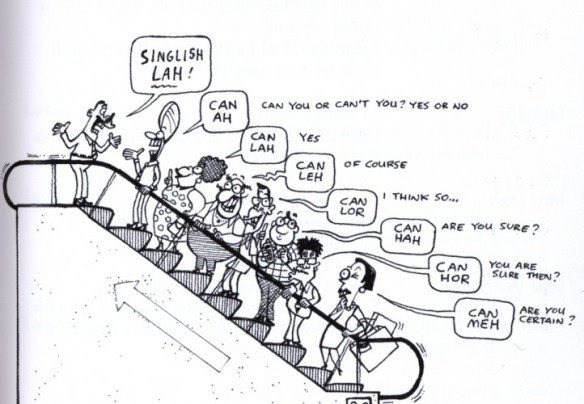
GG code switches more than BB moving between Mandarin, Singlish and Standard English. I am pretty particular about not using Singlish at home, but I am sure both GG & BB code switch between Standard English and Singlish when they are out with friends. This is actually fairly common in Singapore, where Singlish (or Singapore English), a colloquial version of English is the localised version spoken here. While English is the official language of business, Singlish is the language spoken between friends and while relaxing at home with words borrowed from Mandarin, Hokkien, Malay and Tamil.


When people are skilled Code Switchers, it allows them to connect culturally to people immediately. When you travel, when you hear Singlish or even Hinglish (the Indian version of Singlish), you immediately know you are among friends. It also allows you to make friends easily, especially when you and the person opposite you speaks a similar language. Code Switching also allows you to fit in immediately in a new environment.


I realise this when I go to Mumbai, I immediately start speaking in Hindi over English, even with friends with whom I’d text in English. I assume the reverse would happen if we go to a predominantly English speaking country – we’d automatically start speaking in English and also possibly start mimicking their accent.


I think back and realise we do this without realising it – one of my old bosses was a Brit and when I spoke to him, I realised my accent had become more crisp, almost copying the British accent.

So do you Code Switch? I’d love to hear your views on this interesting phenomena!