Sacred Stones, Spaces, and Stories: Divya Desams Part 12

Thiruthalaichanga Nanmadiyam Temple, Thalachangadu, Tamil Nadu
Thalachangadu is a small village near Sirkazhi in Tamil Nadu. It sits close to the seashore, where the Kaveri River meets the Bay of Bengal. In this quiet corner stands the Divya Desam known as Thiruthalaichanga Nanmadiyam, home to Chandrabagavan Perumal and Thirumangai Nachiyar. The temple is unusual because it connects Vishnu’s blessings with the Moon god, Chandra. Very few temples in South India carry this link. It is a temple tied to the idea of regaining brightness after a fall, of recovering dignity and peace after a period of decline. The stories and rituals here revolve around renewal.

The main legend at Thalachangadu centres on Chandra, the Moon god. Chandra was once cursed by his father-in-law, Daksha, for showing partiality toward one of his wives. The curse caused him to fade, losing his brightness day by day. Struggling under the weight of this curse, Chandra looked for a place where he could regain strength and clarity. He came to this spot, prayed to Vishnu with sincerity, and received relief. Vishnu restored his radiance and allowed him to grow bright again. Because of this story, Vishnu is worshipped here as Chandrabagavan Perumal, the one who brings back lost brilliance. Devotees who feel mentally drained or emotionally dim often come here for that reason.

Another legend states that this is the place where the Sudarsana Chakra, Vishnu’s discus, appeared in a gentle form, reflecting moonlike coolness rather than fiery power. This soft form is referred to as Chandra Sudarsana, again linking the temple with the Moon’s calm and reflective quality. Some local stories also connect the place with Indra, the king of the gods, who performed worship here to regain lost strength after a battle. These stories share a common thread: someone weakened or burdened finds renewal through Vishnu’s grace. The name Thalachangadu itself reflects this moon symbolism. Thalai refers to the head, changam/changam refers to the moon or brightness, and kadu means forest. Together, it paint an image of a sacred landscape where divine light was restored.

The region around Sirkazhi and Poompuhar is one of the oldest cultural belts in Tamil Nadu. Temples here often blend mythic stories with early Chola history. Thiruthalaichanga Nanmadiyam shows signs of early Chola workmanship in its stone foundations and structural layout. Inscriptions from this era refer to land donations, offerings of rice, oil for lamps and instructions for maintaining daily pujas. These small details capture what the temple meant to the community: a place of constant worship, even when kings changed. Later, during the Nayak period, the temple received maintenance and some architectural adjustments. The mandapam pillars likely date from this era, with their clean lines and modest decorations. The Divya Desam gained spiritual identity largely through Thirumangai Alvar, who sang about the deity here. His verses describe Vishnu as the one who restored Chandra’s lost brightness. Once the Alvar’s songs entered the Divya Prabandham, the temple became part of the broader Vaishnavite pilgrimage circuit. Villagers kept the temple alive through the centuries with small, steady contributions. Though not large or politically central, the temple survived through devotion rather than royal attention. Its endurance mirrors its own core message: light returns slowly but surely.

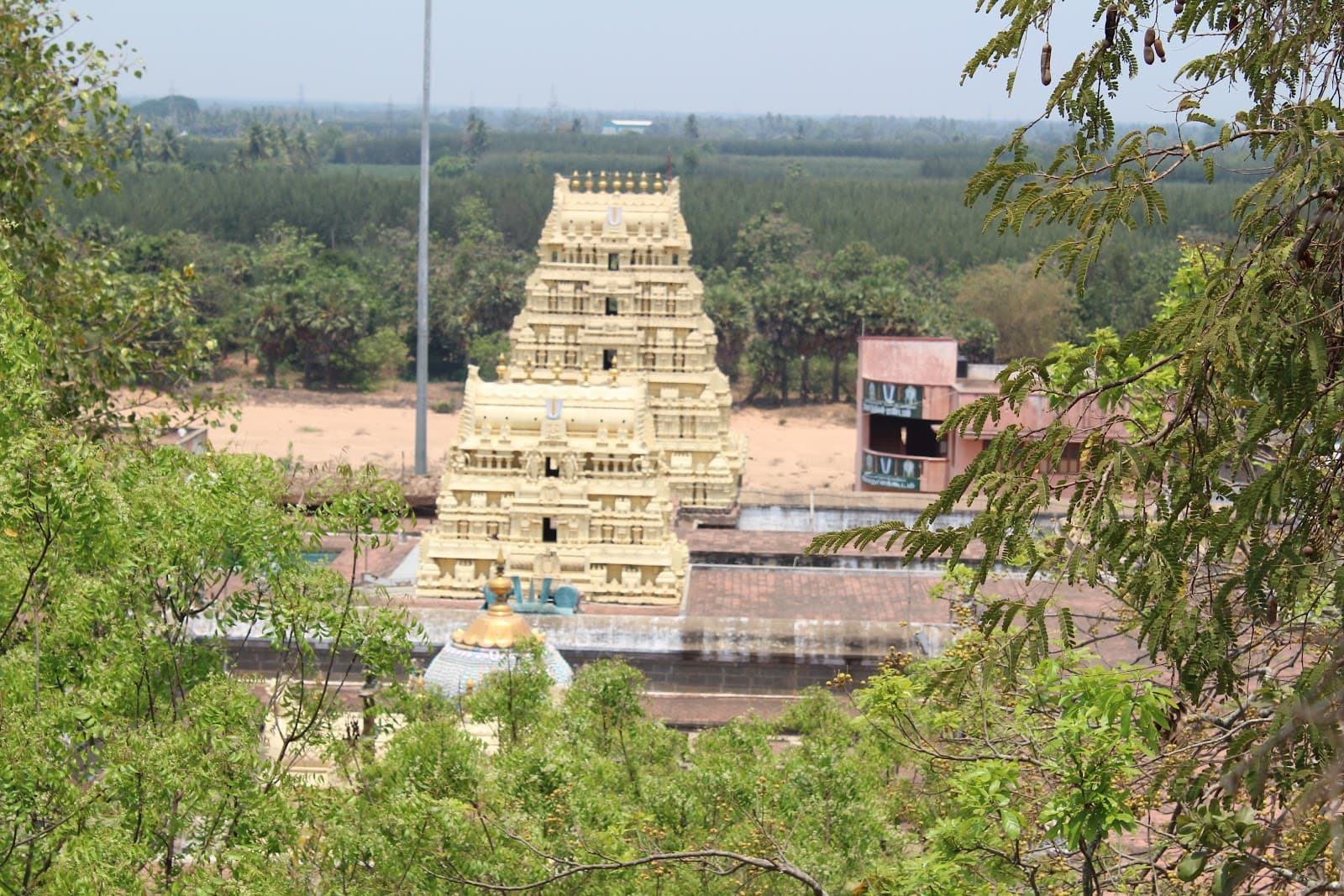
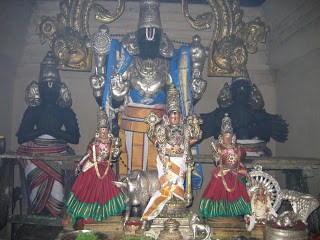
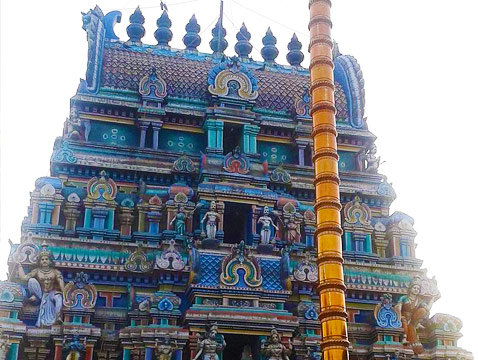
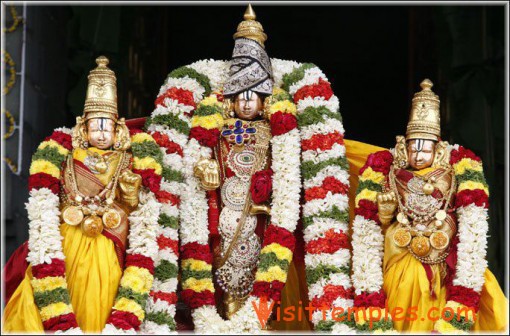
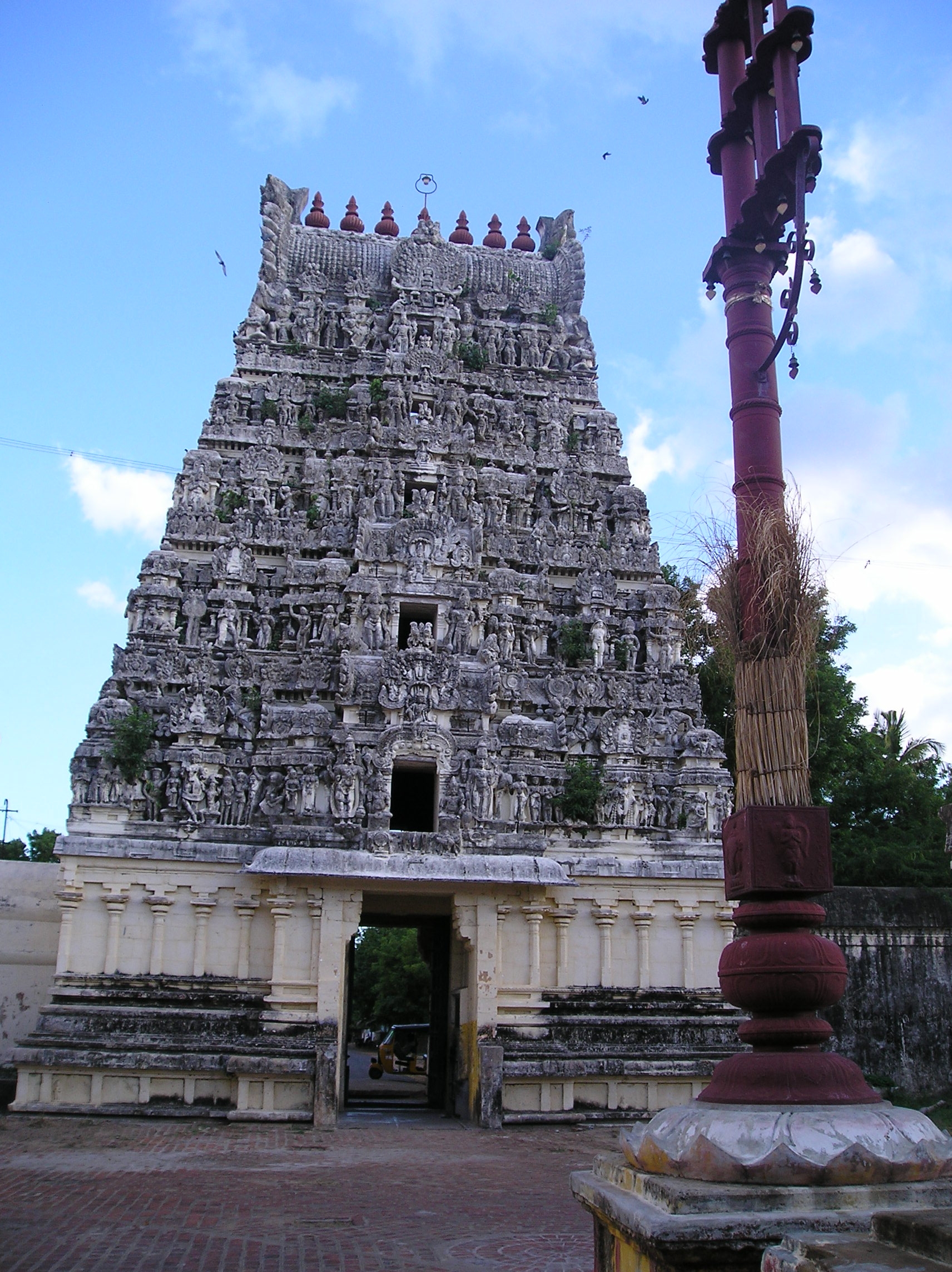
The temple layout follows the simple style of many coastal temples. It has a modest gopuram, a courtyard dotted with trees and a sanctum that feels quietly enclosed. The architecture doesn’t overwhelm; instead, it draws visitors inward. Inside the sanctum, Chandrabagavan Perumal stands facing east. The deity’s expression is gentle, often described as “cool,” reflecting the Moon’s mood. The idol is in a standing posture, holding the conch and discus. Unlike fiery representations of Vishnu, this one embodies calm strength. Thirumangai Nachiyar, the goddess here, has a separate shrine. Her space carries a soothing quality. Women often come here seeking peace in emotional matters or relief from periods of instability. The temple also houses a shrine for Chandra himself. This is rare in Vaishnavite temples. The link between Vishnu and Chandra is visually clear, the Moon god stands in a posture of gratitude.

Other architectural elements include a small mandapam with granite pillars, simple carvings of yali and lotus motifs, a narrow prakaram that allows a slow circumambulation, and a temple tank known as Chandra Pushkarini. The proximity to the coast gives the temple a different ambience. The air is slightly salty, the breeze constant, and the light softer. The granite walls carry marks of weathering from sea winds, adding to the temple’s character.

Daily worship here follows the standard Vaishnavite rhythm. Morning pujas begin early, followed by alankaram, neivedyam and darshan. Evening puja is calm and unhurried, with lamps casting gentle shadows across the temple. Major festivals include Vaikunta Ekadasi, when the temple sees its largest crowds, Panguni Brahmotsavam, which is celebrated with processions, Purattasi Saturdays, which draw families from nearby towns, and Chandra-related observances, especially for those seeking relief from emotional imbalances or mental strain. A unique practice at this temple involves offering prayers for mental clarity. Many devotees visit to mend periods of confusion, indecision or emotional heaviness. This practice stems from the legend of Chandra regaining stability here. Some families offer white flowers and ghee lamps at this temple, symbolic of coolness, purity and calm light. Women often visit Thirumangai Nachiyar’s shrine to seek balance at home, especially during times of stress or transition. Even during festivals, the temple retains a gentle atmosphere. Volunteers help with crowd movement, prasadam distribution and decoration. The community treats the temple as a shared space rather than a formal institution.

Reaching Thalachangadu usually involves travel through coastal villages near Sirkazhi and Poompuhar. The landscape shifts between fields, marshland and patches of trees. The sea breeze is ever-present, carrying a quietness that sets the tone even before you enter the temple. The village feels timeless. Houses stand close together. Children play in the lanes. The temple blends into this environment rather than rising dramatically out of it. Inside the temple, the light falls softly around the sanctum. The stone is cool underfoot. The air carries the smell of oil lamps and old granite warmed by the sun. Many visitors say the temple feels like a place where you naturally slow down. There is no rush. No pressure to move quickly. You can sit quietly near the mandapam or in the courtyard and absorb the silence. Pilgrims often include this temple in a longer Divya Desam route through the Nagapattinam–Sirkazhi belt. But Thalachangadu stands out for its coastal atmosphere and the calm, uplifting energy tied to the Moon. Because the temple is not heavily commercialised, you won’t find many shops outside. Tea stalls and small groceries serve basic needs. People usually bring water or eat before and after visiting.

In local culture, Thalachangadu is tied strongly to the idea of regaining brightness. Parents tell stories of Chandra’s fading and restoration to teach children about humility and second chances. The temple appears in oral traditions, folk songs and recitations of Alvar hymns. Village storytellers often remind listeners that even celestial beings make mistakes and seek forgiveness. Thirumangai Alvar’s verse anchors the temple in classical Vaishnavite literature. In his lines, he highlights Vishnu’s readiness to help those who feel diminished or lost. The nearby coastal history adds weight to the temple’s identity. Poompuhar, once a major port, has a long cultural lineage. The connection between the sea, the moon and the divine is felt naturally in this landscape. Artists sometimes depict Chandra worshipping Vishnu here. The imagery of the Moon bowing before the calm deity becomes symbolic of finding light again after a difficult period. Families in the region visit during key life transitions like work changes, family disputes, emotional uncertainty or anything that affects mental clarity. The temple has become part of their toolbox for healing.

Today, the temple functions smoothly, though on a modest scale. The administration handles daily pujas, while local devotees assist during festivals. Renovation work happens slowly, ensuring the original structure stays intact. The temple has gained quiet visibility online as travellers share photos of the Moon shrine, the small mandapam and the coastal surroundings. Younger devotees are discovering it through heritage blogs and Divya Desam guides. Tourism is not heavy, which helps maintain the temple’s peaceful feel. Many visitors come specifically for its connection to Chandra, often seeking clarity, stress relief or emotional balance. As interest in mental well-being grows, the temple’s message resonates more strongly today: light can return even after fading.

Thiruthalaichanga Nanmadiyam stands in the Divya Desam network as a temple of renewal. Its mythology speaks directly to anyone who has felt drained, confused or diminished. Chandra’s story reflects human experience of losing strength through mistakes or pressure, seeking help, and finding a path back to wholeness. Chandrabagavan Perumal represents calm guidance, not force. His presence supports rather than overwhelms. The temple’s architecture, rituals and atmosphere reinforce this message. It is a place where silence feels like company and worship feels like rest. In the vast spiritual geography of Tamil Nadu, Thalachangadu holds a steady, reflective place, one that reminds devotees that brightness can always return.

Thiruindalur Temple, Indalur, Tamil Nadu
Thiruindalur, located near Mayiladuthurai, is known for its close link to Indra, the king of the gods. The presiding deity here is Parimala Ranganatha Perumal, a reclining form of Vishnu. His consort is Parimala Valli Thayar. The temple is part of the sacred cluster of shrines along the Kaveri river, each carrying its own message and mood. Thiruindalur stands out for its theme of renewal after failure and reassurance during periods of instability. The atmosphere is peaceful. The temple sits in a residential pocket of the village, with houses close on both sides. When you enter the temple, the bustle of everyday life seems to fall away. The mood is gentle and steady.

The main legend tied to the temple centres around Indra. According to tradition, he faced a period of decline after losing a battle with demons. His strength, pride and authority were shaken. Seeking a way to regain his power and clarity, he came to this place and prayed to Vishnu. Pleased with Indra’s sincere repentance, Vishnu appeared as Parimala Ranganatha, lying in a peaceful reclining posture. From this form, Vishnu blessed Indra and restored his strength. This story shows how even powerful beings can fall, and how humility and prayer can restore balance. It’s a message that resonates with everyday life. People come here when they feel weakened, emotionally, professionally or spiritually, and seek a fresh start.

Another story explains the name Indalur. It says the village was once called Indiranthurai, meaning the place where Indra stayed and prayed. Over time, the name softened into the current Indalur. Some versions connect the temple with the concept of fragrance, parimalam, suggesting Vishnu here spreads a soothing divine presence similar to gentle perfume. This idea links the temple to healing and calmness rather than grand displays of power. The temple’s mythology is simple yet grounded in human experience: people lose their balance sometimes, but grace can restore what feels lost.
Thiruindalur sits in a region rich with early Chola history. Several temples along the Kaveri were built or supported during this period, and this one shows signs of that influence in its design and structural layout. Inscriptions found in and around the temple mention donations of land, rice, oil and funds to support daily worship. These records show the place wasn’t just a spiritual centre but also part of community life. Families and small landowners contributed to its maintenance, showing strong local involvement. During the Nayak era, the temple underwent some renovations, especially in the mandapam and outer structures. The stone pillars and corridor sections reflect this style—functional, clean and slightly more decorative than early Chola work.

The Divya Desam status comes from Thirumangai Alvar, who composed a verse praising the deity here. He described Parimala Ranganatha as a calm, reassuring god who responds to sincere prayer. This verse placed the temple firmly within the sacred Vaishnavite network, ensuring that pilgrims continued visiting it across centuries. Like many smaller temples, Thiruindalur survived through steady community effort rather than royal grandeur. It is a place shaped by continuity rather than spectacle.

The temple follows a classic South Indian layout but with a modest scale. The entrance is simple, marked by a small gopuram. When you step inside, the courtyard opens up quietly. The layout is clean, without unnecessary extensions. The main deity, Parimala Ranganatha, rests in a reclining posture facing east. The posture is peaceful. Vishnu appears resting on Adisesha, with a facial expression that suggests reassurance rather than grandeur. The idol’s proportions are balanced, and the sanctum carries a soft glow from small lamps. Parimala Valli Thayar has her own shrine. Her form brings warmth to the temple’s emotional tone. Women often visit her shrine seeking balance at home, guidance in family matters or inner strength during transitions.

Architectural elements include a mandapam with granite pillars, carvings of lions, lotus motifs and simple floral patterns, a narrow circumambulatory path around the sanctum, and a temple tank called Indra Theertham, associated with Indra’s worship. The tank is central to the temple’s identity. Its link to Indra adds symbolic weight; it represents clarity returning after confusion, much like water clearing after disturbance. One distinctive feature is the fragrance symbolism tied to the deity’s name. Though the structure itself is granite, the belief is that the divine presence here carries a subtle, soothing emotional fragrance. This sense is passed down through local lore.
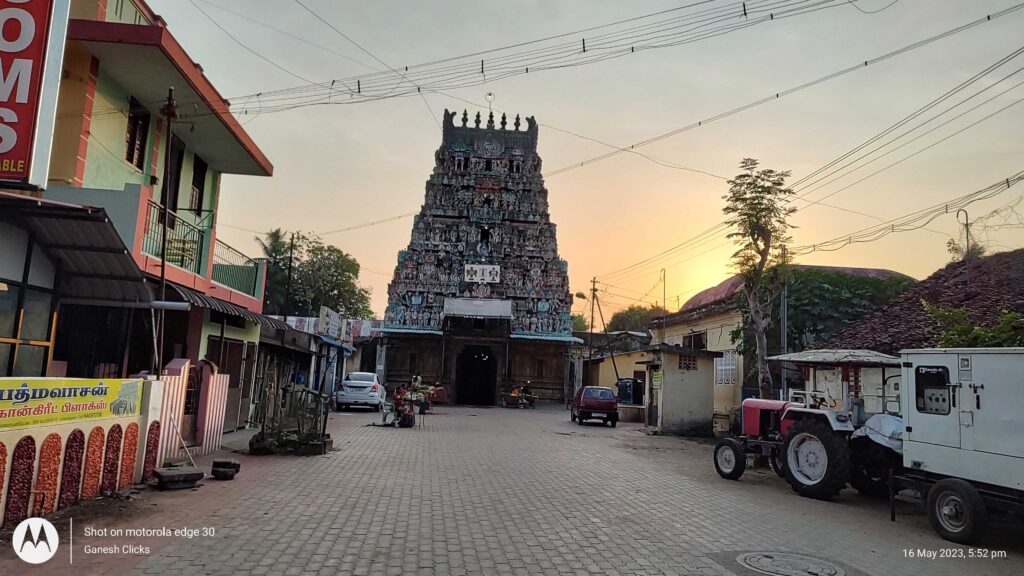
Daily puja here is calm and unhurried. Priests perform morning rituals that include suprabhatam, thirumanjanam, alankaram and darshan. The temple stays peaceful throughout the day. Major festivals include Vaikunta Ekadasi, which brings larger crowds, the temple Brahmotsavam, which is celebrated with processions through the village streets, Panguni Uthiram, which is significant for both Perumal and Thayar, Purattasi Saturdays, when devotees traditionally visit Vishnu temples, and special Indra-related worship, focused on renewal and clarity. A unique practice here involves devotees performing prayers for relief from confusion, indecision or prolonged periods of stagnation. Inspired by Indra’s story, people come when they feel stuck or unsettled in life. There is no elaborate ritual for this, just a simple prayer, lighting lamps and quiet reflection. Many women offer flowers at Thayar’s shrine for emotional stability and harmony at home. A sense of sincerity defines the worship practice here. Nothing feels rushed. During festival days, volunteers from the village take charge of decoration, crowd management and prasadam distribution. It is a community-led temple where responsibility is shared.

Reaching Thiruindalur is straightforward. Most pilgrims travel from Mayiladuthurai, which serves as a major access point. The road passes through a stretch of paddy fields before reaching the village. As you enter Indalur, the temple appears naturally among homes and narrow lanes. The village has an easy pace. You’ll find small shops selling tea, snacks and everyday groceries, but nothing commercial or loud. Inside the temple, the atmosphere settles into silence. The stone floor is cool even during warm afternoons. The sanctum often has a faint scent of incense, tulsi and oil lamps. Pilgrims say the temple feels grounding. It gives the sense of a pause rather than a busy religious stop. Many people sit quietly in the mandapam after darshan, taking a moment to collect their thoughts. The temple tank, Indra Theertham, adds to the setting. During certain times of the day, its still water reflects the sky and surrounding trees, giving a feeling of composure. Pilgrims often include this temple with others in the region like Thirunageswaram, Thiru Indhalur (Kaveri thir), Thiruvazhundur and others. But Thiruindalur stands out because of its message: strength returns quietly, not suddenly.

Thiruindalur has a strong place in the local cultural memory because of its connection to Indra. The story of Indra’s renewal is often retold by elders to younger generations as an example of humility and persistence. Thirumangai Alvar’s hymn gives the temple its prominence within Vaishnavism. His verse focuses on Vishnu’s gentle reassurance and the idea that divine help arrives when most needed. The temple finds mention in oral storytelling, festival songs and small religious gatherings in the village. Children grow up hearing about Indra losing his power and regaining it here, which becomes a moral story about learning from mistakes. Local calendar art sometimes depicts Indra praying before Vishnu in his reclining form. These images appear in homes, shops and small roadside shrines. Because the temple links to themes of mental clarity and emotional renewal, many families return here regularly during turning points, career decisions, children’s exams, marriage planning, or difficult phases at home. The temple has helped shape the emotional landscape of the area more quietly than historically grand temples. Its impact is subtle but long-lasting.

The temple today functions with a simple but steady routine. Daily pujas continue without disruption. The administration oversees maintenance, and villagers remain closely involved. Recent repairs include repainting the gopuram, reinforcing parts of the inner mandapam and clearing the temple tank. These updates are done with restraint so the temple’s original structure and atmosphere remain intact. The temple has slowly gained visibility through social media posts by travellers and Divya Desam enthusiasts. This has brought a newer wave of pilgrims, including younger people who are tracing all 108 temples. Despite modern attention, the temple has not become commercial. The mood remains authentic and calm. Worship is still simple, without layers of added rituals. Thiruindalur continues to be a place where people come to reset themselves. In a time when many seek grounding in the middle of uncertainty, the temple’s message feels more relevant than ever.

Thiruindalur is a Divya Desam that speaks to anyone who has lost confidence or direction. Its mythology of Indra’s renewal is relatable and steady. Parimala Ranganatha Perumal’s reclining form reinforces the idea that reassurance often comes in quiet ways. The temple’s architecture, rituals and atmosphere create a space for rest and clarity. It may not be large, but its emotional presence is strong. As part of the Divya Desam journey, it offers a moment of pause, a reminder that setbacks don’t have to define the story. Renewal is always possible. In the wider spiritual map of Tamil Nadu, Thiruindalur remains a gentle, reassuring presence, carrying forward the message of recovery and grace.

Festivals of India: Champakulam Boat Race

There are festivals you attend and festivals you enter, whether you intend to or not. The Champakulam Boat Race belongs firmly to the second category. Even before the first boat touches water, there is a sense of alignment taking place. People gather not around a stage, but along a river. They wait without distraction. They look in the same direction. Something older than scheduling takes over.

Held every year on the Pamba River near Champakulam, the race is often described as the oldest of Kerala’s snake boat races. That description is accurate but incomplete. The Champakulam Boat Race is not simply old. It is dense with meaning, habit, contradiction, and quiet negotiation. It is religious without being preachy, competitive without being slick, and traditional without being frozen in time.

The 2026 edition matters not because it promises spectacle on a grander scale, but because it unfolds in a Kerala that has changed in subtle but irreversible ways. Migration, climate anxiety, digital consumption, and shifting ideas of labour and gender all sit just beneath the surface of the river. The race continues, but it does not continue untouched.

The origins of the race are traced to a journey by Lord Krishna to the Sree Krishna Temple at Ambalappuzha. According to tradition, villagers raced their boats to welcome him, beginning a custom that would eventually turn into an annual event. This story is retold every year, often briefly, sometimes mechanically.

What is interesting in 2026 is not whether people believe the story literally, but how belief functions now. For many participants and observers, Krishna is not a presence expected to intervene. He is a reference point. The story gives the race a moral and temporal anchor, situating it within the Malayalam month of Chingam and within a ritual calendar that links water, harvest, and gratitude.

This distinction matters. Faith here is not spectacle. It is scaffolding. It holds the event steady without demanding uniform devotion. People row for different reasons: duty, pride, community loyalty, and memory. The religious narrative accommodates this plurality without insisting on explanation. In a time when religious festivals are often either aggressively commercialised or loudly politicised, Champakulam’s restraint feels deliberate. The sacred is present, but it does not shout.

The Pamba River is not a neutral backdrop. It is central to the race’s meaning and increasingly central to its unease. Kerala’s recent history of floods has altered how people relate to water. Rivers are no longer taken for granted. They are monitored, discussed, and worried over.

In 2026, this awareness sits quietly alongside celebration. The race is still held during the monsoon season, still shaped by the rhythms of rain and current. But the river is no longer simply a giver. It is fragile. It requires care. The race, intentionally or not, becomes a reminder of dependence.

This is one of the less spoken about aspects of the event. Environmental consciousness is not announced from loudspeakers, yet it is present in the way locals speak about water levels, safety, and timing. Tradition here is not blind to consequence. It absorbs it slowly.

The chundan vallams, the long snake boats that define the race, look unchanged from a distance. Their length, symmetry, and narrowness give them an almost mythical quality. Up close, they reveal a different story. Maintaining these boats in 2026 requires money, logistics and modern coordination. Sponsorships, diaspora funding, local business patronage and committee structures play a larger role than romantic accounts usually admit. This does not diminish the race. It explains its survival.

There is a persistent idea that tradition must remain economically untouched to remain authentic. Champakulam quietly disproves this. The form stays traditional. The systems supporting it evolve. What matters is not purity, but continuity. The boats are ancient in design, contemporary in upkeep. Both realities coexist without apology.

Each boat carries over a hundred rowers. The physical demand is immense, but what stands out more than strength is synchronisation. The race does not reward individual excellence. It punishes it. One person out of rhythm affects everyone. This produces a specific public masculinity, one that values restraint over bravado and coordination over dominance. In a culture increasingly shaped by individual visibility, this collective anonymity feels almost countercultural.

At the same time, the race remains overwhelmingly male. This is usually explained through tradition and physicality, but the explanation is incomplete. Women have always been present, just not on the boats. They organise, cook, fundraise, manage logistics, train younger participants, and preserve songs and stories. Their absence from the river is not a result of non-participation but of selective tradition.

In 2026, this selective flexibility is more noticeable. Younger observers, especially women, question why some traditions adapt easily while others are declared non-negotiable. The article does not need to resolve this tension. It needs to acknowledge it honestly. Champakulam’s strength lies in its ability to hold contradiction without collapsing.

Photographs of the race focus on boats slicing through water. Videos chase the finish line. Neither captures the heart of the experience. The race is built on sound. The vanchipattu, the rhythmic boat songs, regulate movement. Drumbeats set the pace. Calls ripple across the river. The crowd’s reaction rises and falls like breath.

In 2026, amplified sound systems sit uneasily alongside this organic acoustics, especially near designated viewing areas. The enhancement is understandable, but it risks flattening something that depends on nuance. The original soundscape does not need to be louder. It needs to remain layered. If the race ever loses its auditory complexity, it will lose more than atmosphere. It will lose its internal discipline.

Tourism is no longer peripheral. Curated viewpoints, travel packages, and social media coverage are part of the Champakulam experience in 2026. This creates friction but also funding. The issue is not whether visitors should be present. They already are. The real question is who sets the tempo. So far, Champakulam has resisted rearranging itself for convenience. The race still follows local timing. It still assumes patience. It does not apologise for discomfort or crowds. This refusal to become overly consumable is perhaps its quietest strength. Visitors are welcome, but not centred. The river does not bend to itineraries.

The Champakulam Boat Race in 2026 does not declare itself relevant. It simply continues, carrying with it layers of belief, labour, inequality, pride, and adaptation. It excludes and includes. It relies on unpaid effort. It resists simplification. And yet, it offers something increasingly rare: a collective act that cannot be digitised, outsourced or condensed into a highlight reel. You have to wait for it. You have to listen. You have to share space.

Perhaps that is why it endures. Not because it has perfected balance, but because it refuses closure. Each year, the race returns to the same river and asks the same question in slightly altered conditions: how do you move forward without losing your rhythm?

Champakulam does not answer this cleanly. It does something harder. It keeps rowing.

Listening to the Clock Within: A Clear-Eyed Look at Sleep Chronotypes

Sleep is often spoken about in absolutes. Eight hours. Early nights. No screens. Fixed routines. These rules circulate with the confidence of settled truth, yet they rarely account for the inconvenient reality that people are not built on identical internal clocks. What feels restorative for one person can feel punishing for another, even when both are following the same advice with equal sincerity.

Sleep chronotypes offer a more precise language for this mismatch. They describe the timing of our internal rhythms rather than the quantity of our sleep. They explain why some people think clearly at dawn while others only warm up after sunset, and why discipline alone cannot flatten these differences without cost.

This article does not argue for radical lifestyle redesign, nor does it romanticise any chronotype. Instead, it asks what the science reasonably supports, where popular narratives overreach, and how a better understanding of chronotypes can reduce friction between biological reality and daily expectation. The aim is not optimisation, but alignment.

What is a Chronotype?
A chronotype reflects how an individual’s circadian rhythm aligns with the 24-hour day. Circadian rhythms are internally generated cycles that regulate sleep and wakefulness, hormone release, body temperature, appetite, and aspects of mood and cognition. They are influenced by genetics, light exposure, age, and environment.

Chronotype is about timing, not virtue. It does not measure willpower, ambition, or seriousness. It does not predict success or failure. Nor does it remain fixed across a lifetime. Adolescents tend to shift later, older adults earlier. Illness, caregiving, travel, and work schedules can temporarily distort natural patterns.

What tends to remain stable is preference. Given freedom from alarms and obligations, most people gravitate back towards a familiar rhythm. That pull is the chronotype at work.

The persistent error is assuming that strong habits can permanently override this pull. Habits can compensate, sometimes impressively, but compensation is not the same as alignment. Over time, the body usually keeps score.

The Common Chronotypes
Popular writing often groups chronotypes into animal categories. These labels are simplifications, but they are useful as long as they are held lightly.

Morning Types
Morning-leaning individuals tend to wake easily, often before alarms. Mental clarity appears early, sometimes sharply. Energy declines steadily across the day, with evenings feeling quieter and less cognitively rewarding. Research often links morning preference with conscientiousness and emotional stability. This association is real but easily misinterpreted. When institutions reward early alertness, morning-oriented people receive positive feedback sooner and more consistently. Behaviour that is socially reinforced tends to consolidate. Morning types can underestimate the cost of this advantage. Because their rhythm aligns with dominant schedules, fatigue is often interpreted as a personal lapse rather than a biological limit. There is also a tendency to assume universality, to mistake one’s own rhythm for a reasonable baseline.

Evening Types
Evening-leaning individuals experience delayed alertness. Mornings are slow, sometimes cognitively dull, even after adequate sleep. Focus, creativity, and emotional fluency often peak later in the day. Later chronotypes are frequently associated with openness to experience and creative thinking. Again, correlation needs care. When peak functioning occurs outside standard hours, people often work alone or against the grain, which shapes thinking style and self-reliance. The structural disadvantage faced by evening types is well documented. Early school start times and fixed office hours create chronic sleep debt. This debt is often mistaken for poor self-management rather than misalignment. Over time, it can affect mood, metabolic health, and risk-taking behaviour, not because of personality, but because of sustained circadian strain.

Intermediate Types
Most people fall between the extremes. Their rhythms broadly track daylight, with alertness rising in the morning, peaking around midday, and declining in the evening. This apparent normality can obscure vulnerability. Because intermediate types can usually cope, they are less likely to interrogate sleep quality until something breaks. Their challenge is not misalignment but neglect.

Flexible or Variable Patterns
Some individuals show genuine adaptability. Their energy responds strongly to routine, light exposure, and context. Flexibility can be protective, but it can also mask gradual depletion. When internal signals are muted, external demands tend to fill the space.

Chronotype and Personality
Chronotypes do not create personality traits in isolation. They shape when traits are expressed and how they are perceived.

A person whose peak cognitive window occurs at 6 am is likely to appear decisive and organised in conventional settings. Another whose clarity emerges at 9 pm may appear disengaged in the morning and insightful in the evening. The same individual, placed in different temporal conditions, can be read in radically different ways.

Chronotype shapes exposure. Exposure shapes behaviour. Behaviour, repeated under reinforcement or constraint, begins to look like personality. This is not determinism, but adaptation.

The danger lies at both extremes. On one side is moral judgment, reading punctuality or lateness as character. On the other is identity rigidity, using chronotype as a fixed label that limits experimentation. Chronotype explains tendencies. It does not absolve effort, nor does it justify inflexibility.

Identifying your Chronotype without reducing it to a Quiz Result
Formal questionnaires exist, but careful observation is often more revealing. The most reliable approach begins with removing constraints rather than adding rules. Over a period of ten to fourteen days, prioritise sleep duration over sleep timing where possible. Go to bed when genuine sleepiness appears. Wake without an alarm if circumstances allow.

Track three elements daily:

  • Natural wake time
  • Periods of mental clarity and cognitive ease
  • Points of sharp or persistent fatigue

Patterns tend to surface quickly when the body is not being forced into compliance. The hours that consistently resist adjustment often reveal more than those that cooperate. It is important to distinguish chronotype from exhaustion. Chronic sleep deprivation flattens rhythms and distorts perception. Rest first, observe second. Context matters. Caregivers, shift workers, and those managing illness may be operating far from their natural rhythm. Chronotype still exists, but it may be partially obscured by necessity.

Working with Chronotype without turning it into another Discipline
The value of understanding chronotype lies in reducing unnecessary friction, not in perfect alignment. Few people can design their lives around sleep. Most can make small, strategic adjustments.

Morning-Leaning Patterns
Early clarity can be protected by reserving cognitively demanding work for the first part of the day. This does not require starting work at dawn. It requires recognising when the mind is most responsive. Evening fatigue should be interpreted as information, not failure. Consistently pushing past it often erodes the very clarity that mornings provide. Short afternoon rest periods, when culturally acceptable, can restore a narrow secondary window of alertness without undermining night sleep, provided they remain brief and early.

Evening-Leaning Patterns
For later chronotypes, sleep length matters more than sleep timing. A well-rested late sleeper is cognitively different from a sleep-deprived early riser. Where schedules are fixed, mornings can be reframed. Low-stakes tasks, movement, or administrative work can act as a warm-up rather than proof of inefficiency. High-stakes or creative work, when possible, can be batched into later windows instead of being spread thinly across the day. Stimulants deserve scrutiny. They can mask misalignment without correcting it, prolonging strain.

Intermediate and Flexible Patterns
Regularity is protective. Small daily shifts accumulate quietly. Seasonal changes often affect energy more than expected. Adjusting consciously to daylight changes tends to be gentler than reacting after fatigue sets in. Assumed resilience should be questioned periodically. Ease is not immunity.

Common Misuses of Chronotype Thinking
One misuse is avoidance. Biology explains limits, but it does not remove responsibility. Growth often requires temporary discomfort. Another is overcorrection. Forcing alignment where it creates conflict can be as damaging as ignoring chronotype entirely.

There is also a social dimension rarely addressed. The ability to adjust work hours, protect sleep, or nap assumes a degree of autonomy. Advice that ignores these risks sounds abstract. The most meaningful implication of chronotype research may not be personal optimisation, but structural empathy in how institutions are designed.

What Chronotypes Ask Us to Notice
Chronotypes do not ask for reverence. They ask for acknowledgement. They remind us that bodies are patterned, not programmable. That uniform schedules reward some rhythms while taxing others. That much of what we label as discipline or laziness is often timing.

The more useful question is not which chronotype one belongs to, but where daily life demands constant override, and whether that cost is being honestly counted. Sleep is not a tool for productivity. It is a biological negotiation. Paying attention to it is not indulgence. It is simply accurate.

Sacred Stones, Spaces, and Stories: Divya Desams Part 11

Thiruvazhundur Temple, Theranzhdur, Tamil Nadu
Thiruvazhundur, also known as Therazhundur, is a small village near Mayiladuthurai. At its centre stands the ancient Divya Desam dedicated to Amaruviyappan, a form of Vishnu known for protection, guidance, and the strength to restore order. His consort here is Senkamalavalli Thayar. The temple is one of the 108 Divya Desams sung by Thirumangai Alvar, whose verse gives the temple a permanent place on the spiritual map of Vaishnavism. The temple is quiet and steady, like many sacred spaces in the Kaveri region. But its story carries movement, tension and release. It tells of a chariot gone out of control, a god who steps in, and a lesson about power used with clarity and compassion.

The main legend of this temple revolves around Balarama, the elder brother of Krishna. The story says that Balarama once took a divine chariot belonging to Kubera, the god of wealth. For reasons that differ across versions, the chariot went out of control and dragged through this village. The name Therazhundur itself reflects this; ther means chariot, and azhundur suggests sinking or dragging. Seeing the trouble this caused, Vishnu appeared here as Amaruviyappan and stopped the chariot. His intervention brought calm, order, and protection for the people living in the village. This form of Vishnu shows the ability to step in where chaos grows, not with rage, but with grounded clarity. The temple’s identity rests on this idea that divine support can help freeze a situation before it spirals further.

Another story tied to the temple is about Uparicharavasan, an ancient king known for his devotion and strict moral code. He prayed here and received blessings for longevity and clarity of judgment. This adds another layer to the temple’s meaning: spiritual stability comes from both divine support and personal discipline. A third legend speaks of Vishnu appearing here to bless Agastya, the sage who brought balance to the world by moving to the south to counter the weight of rituals happening in the north. Agastya prayed here for strength and equilibrium, and Vishnu appeared before him. When taken together: Balarama’s chariot, the king’s devotion, and Agastya’s need for balance, the temple’s mythic identity becomes clear. Thiruvazhundur represents the moment when life slows down enough for the mind to find direction again.

The temple’s roots go deep into the Chola period. This region has always been part of the cultural heartland of Tamil Nadu, and many temples grew under Chola patronage. Inscriptions around the temple show land grants and donations made for maintaining lamps, feeding Brahmins, and supporting temple festivals. These inscriptions offer a glimpse into the quiet but continuous support the temple received from local rulers and families. Later, during the Nayak period, parts of the mandapam and outer walls were rebuilt or reinforced. The Nayaks often contributed decorative pillars and expanded worship spaces, and their influence can still be seen here. The Marathas of Thanjavur also left their mark in the form of renovations and festival support.

What makes Thiruvazhundur interesting is how securely it remained part of the Divya Desam network despite being located in a rural pocket. Thirumangai Alvar’s verse gave it prestige, and subsequent generations kept returning here, creating an unbroken line of devotion. Even when political power shifted away from the region, temples like this stayed active because of strong community roots. Today, it continues as an integral part of the Kaveri temple belt, visited by people who follow the Divya Desam trail, as well as those who come because the temple’s legends speak to them personally.

Thiruvazhundur Temple has a layout typical of South Indian Vishnu temples, but its scale is slightly larger than some of the smaller Divya Desams nearby. The Rajagopuram at the entrance is not massive, but it sets a clear frame for the temple. The temple tank, Darshana Pushkarini, sits close by and holds a place in several small rituals. Inside the complex, the first thing that stands out is the mandapam. The pillars show carvings that echo Chola and later Nayak styles: simple lines, yali motifs, lotus patterns, and scenes from everyday life. The stone is cool throughout most of the day, especially in the shaded areas.

The main deity, Amaruviyappan, stands in a graceful posture facing east. He holds the conch and discus, with a calm expression that reflects both strength and reassurance. Some versions of the legend describe him as stepping forward to stop the chariot, and the idol captures that sense of readiness. Senkkamalavalli Thayar sits in her own shrine. Her name refers to the red lotus, and her presence adds softness to the otherwise action-oriented mythology of the temple. Devotees often speak of how peaceful her shrine feels, especially during early morning puja.

Around the temple, you can find small shrines for Vishvaksena, Garuda, the Alvars, Rama and Krishna in smaller forms, and a shrine for the temple’s associated sages. The premises have several trees that provide shade, adding to the temple’s calm rhythm. The mix of granite, plaster, repainted sections, and weather-worn carvings tells the story of a temple that has been used, maintained, and lived in for centuries.

The temple follows the standard Vaishnavite pattern of daily pujas, each marking a shift in the day’s energy. Early morning begins with suprabhatam, followed by alankaram, neivedyam, and the first darshan. The priests move through the rituals slowly, without rush. Major festivals include Vaikunta Ekadasi, the most important day for Vishnu temples, Brahmotsavam, which involves processions through the village, Garuda Sevai, Panguni Uthiram, associated with divine union, and Purattasi Saturdays, popular for family visits. Because the temple is tied to legends of guidance and intervention, many devotees come here when facing confusion or crossroads. They offer prayers for clarity, direction, and support through uncertain phases of life.

The chariot festival held here has special meaning because of the temple’s mythology. Even though the modern chariot is symbolic, the act of pulling it through the streets connects the devotees to the original moment when Vishnu stopped the runaway chariot. This ritual reinforces the idea of regaining control over life. Thayar’s shrine attracts women who pray for stability in the home and a smooth path for their children.
The temple maintains a community-oriented identity. During festivals, local families volunteer, cook prasadam, and help decorate the temple. It feels more like a shared home than a formal institution.

Pilgrims usually reach Thiruvazhundur from Mayiladuthurai or Kumbakonam. The drive is easy, passing through paddy fields and quiet lanes. This region has many temples, but each stands in its own pocket of land, creating a rhythm of sacred spaces across the landscape. As you enter the village, the streets narrow, and houses get closer together. The temple doesn’t rise suddenly; it becomes visible slowly as you turn corners. Local people give directions without fuss. The village has a balanced pace—not too slow, not hurried. Inside the temple, the air feels still. The sound of bells and chanting filters through the corridors. The stone floor is cool even in the heat of the afternoon. Most pilgrims say that the temple gives a sense of grounding. Maybe it’s the story of Vishnu stopping the chariot. Maybe it’s the large mandapam or the open courtyard. Whatever the reason, people often linger longer than they planned. The tank near the temple adds to the setting. In the evenings, the reflection of the gopuram on the water creates a soft, tranquil mood. The temple visit is usually calm and unhurried, making it a good stop for those wanting a quieter Divya Desam experience.

Thiruvazhundur has a firm place in Vaishnavite tradition because of Thirumangai Alvar’s hymn. His words describe the beauty of the place and the protection offered by Amaruviyappan. The chariot legend influences local culture in subtle ways. Stories about regaining control, seeking guidance in turbulent moments, and trusting divine timing are passed down in households. Village plays and storytelling sessions during festivals often highlight Balarama’s role and Vishnu’s intervention. Local musicians sing verses from the Divya Prabandham here, keeping the oral tradition alive. Families in the region visit the temple during shifting phases of life: marriages, new jobs, family disagreements, or important decisions. The temple becomes a marker of transition. Even though it’s not one of the largest temples in Tamil Nadu, its stories show up in heritage writings, spiritual talks, and simple everyday advice that elders give to younger generations.

The temple today functions smoothly with daily pujas and regular festival schedules. Management is handled through temple authorities with support from local devotees. Renovation work happens slowly but steadily. Repainting, structural repairs, restoration of damaged carvings, and upkeep of the temple tank are ongoing. Thiruvazhundur has seen an increase in footfall due to Divya Desam tourism. Many visitors come in groups that cover several temples in one day. Yet the temple remains peaceful because the crowd comes in waves and rarely overwhelms the space. Younger people have started discovering the temple through social media posts, especially photos of the deity and the tank. This has brought new attention without changing the temple’s core identity. The temple maintains a balance between tradition and practical needs. Nothing feels forced or overly modernised. Worship remains simple, and visitors often comment on how natural the atmosphere feels.

Thiruvazhundur stands tall in the Divya Desam network not because of size or grandeur, but because of its story: the moment Vishnu brought a runaway chariot to a halt and restored calm. Amaruviyappan represents protection, steadiness, and clarity. His presence reassures people facing confusion or emotional turmoil. The temple’s history, architecture, rituals and community reflect this same message. Everything here moves at a measured pace. Nothing feels rushed. In the wider map of Indian spiritual heritage, Thiruvazhundur serves as a reminder that strength does not always roar. Sometimes it acts quietly, stepping in at the right moment to stop things from breaking apart. It remains one of the gentler stops on the Divya Desam trail and a temple that leaves visitors feeling steadier than when they entered.

Thiruchirupuliyur Temple, Thirusirupuliyur, Tamil Nadu
Thiruchirupuliyur, located near Nannilam, is one of the 108 Divya Desams and houses the deity Arulmaakadal Perumal, also known as Krupa Samudra Perumal, meaning “the ocean of compassion.” His consort here is Tirumagal Nachiyar. The temple is small, quiet and deeply woven into local life. Like many Divya Desams, it carries a legend that gives it emotional weight and a sense of purpose. In this case, the story centres on redemption, forgiveness and the chance to rise after a mistake. The temple stands in a compact village, surrounded by fields, narrow lanes and homes where devotion is part of daily rhythm. When you walk through the entrance, the space feels personal rather than overwhelming. The temple’s size reinforces its message: healing doesn’t need noise.

The mythology here revolves around a sage named Vyaghrapada. The name literally means “tiger-footed.” The story goes that Vyaghrapada prayed intensely at this place for inner clarity and freedom from past mistakes. He wanted physical strength and spiritual forgiveness. Moved by his devotion, Vishnu appeared here and blessed him. The Perumal took on the name Arulmaakadal, emphasising unlimited mercy. Because the sage had tiger-like feet, the village came to be known as Thirusirupuliyur, meaning the sacred place tied to a “small tiger” or a tiger-featured devotee. Another legend ties the temple to Markandeya, the devotee of Shiva who was destined to die at sixteen. While Markandeya’s main story belongs to the Shaivite tradition, some versions say he also received Vishnu’s blessing here. This strengthens the theme of grace crossing boundaries between different paths. A small but important myth explains why the temple is physically small. It says that when Vishnu appeared to Vyaghrapada, he did so in a compact form, out of gentleness. The deity wanted the sage to feel close and not overwhelmed. Because of this, the sanctum today is smaller than in most Divya Desams. Devotees sometimes kneel or bend low to see the main deity clearly. This act of lowering oneself becomes part of the experience, almost symbolic of humility and surrender.

Like many temples in the Kaveri region, Thiruchirupuliyur carries the imprint of the Cholas, who were known for building and supporting temples across Tamil Nadu. The structure we see today shows signs of early Chola influence, especially in the stone base and the compact layout of the sanctum. Later, during the Nayak period, some renovations were done, including smaller mandapams and support structures. The temple does not have grand inscriptions or heavy stone sculptures like some larger temples, but whatever inscriptions remain indicate land grants and donations for lamps, daily puja and festivals.

The temple’s claim to Divya Desam status comes through Thirumangai Alvar, who composed verses praising the deity here. His poetry describes the Perumal as a source of deep compassion, someone who responds quickly to sincere prayer. Because of this, the temple has stayed important despite its small size. Villagers continued to maintain the temple even during periods when larger shrines received more political attention. Its survival over the centuries reflects a theme common to many Divya Desams: a small place with a strong soul endures because people care. Families in this region have visited this temple across generations, and this continuity has kept the place active.

Thiruchirupuliyur is one of the smallest Divya Desams in Tamil Nadu. This is not a weakness; it is its character. The temple’s layout is simple, with a short gopuram at the entrance, a small courtyard, and a narrow path leading to the sanctum. Inside the main sanctum, Arulmaakadal Perumal stands in a calm posture facing east. The deity is small in scale, matching the legend of Vishnu appearing in a compact form to comfort Vyaghrapada. The shrine’s low entrance forces devotees to bow or bend before entering, adding a physical experience of humility to the act of worship. The goddess, Tirumagal Nachiyar, has her own shrine. Her presence adds balance to the temple’s energy. Her space feels gentle, and many women come here for guidance in family matters or emotional clarity. The temple tank, Punyakoti Theertham, sits nearby. It is small and used mostly during festivals and occasional rituals. The water reflects the gopuram and nearby trees, adding to the temple’s quiet mood. Carvings on the pillars and walls are modest, mostly floral patterns, lotus motifs, and a few yali figures. These are typical of smaller Chola-era shrines. Over time, patches of plaster and paint have been added, but the temple still carries the feel of an older structure. What stands out architecturally is not the detail but the proportions. Everything is smaller: sanctum, courtyard, mandapam, and corridors. This scale creates intimacy. It feels like walking into a temple that is close to the ground, close to people, close to emotion.

The worship schedule here is straightforward. Priests perform daily pujas with care but without extravagance. This temple does not rely on large-scale rituals. Its power comes from repetition, rhythm and sincerity. Morning puja begins early, followed by alankaram, neivedyam and darshan. Evening puja brings soft lamp light that fills the temple with a warm glow. Major festivals include Vaikunta Ekadasi, which draws the largest crowd, the temple Brahmotsavam, with processions in and around the temple, Purattasi Saturdays, when many families in Tamil Nadu visit Vishnu temples, and the Theerthavari, involving the temple tank. Even on festival days, the mood stays grounded. Devotees don’t rush. People chat quietly in the courtyard. Volunteers help distribute prasadam. Children run around without getting lost in massive crowds.

A notable local practice is performing prayers for relief from guilt, past mistakes and emotional heaviness. Because the temple is tied to Vyaghrapada’s redemption, people come here seeking a new start. The priests explain the story to visitors, sometimes adding simple advice or reassurance. The atmosphere is unpretentious. Worship here feels like a conversation rather than a performance.

Reaching Thiruchirupuliyur usually starts from Nannilam, Kumbakonam or Thiruvarur. The roads are quiet, passing through small villages and patches of farmland. By the time you reach the temple, your pace naturally slows down. The village itself is compact. Houses stand close together. Children play in the streets. The temple blends into the neighbourhood rather than standing apart from it. There are no large shops or tourist stalls. Instead, you find tea sellers, small groceries and a few homes where people sit outside chatting. Entering the temple, the space feels peaceful. You can see the sanctum almost immediately from the courtyard, a sign of the temple’s small scale. The air inside is cool and carries the smell of oil lamps and incense. Visitors often say that this temple feels like walking into someone’s ancestral home. The silence is soft, not heavy. You can hear the rustle of leaves, the sound of bells and nearby voices blending with prayer. This temple fits naturally into a Divya Desam trail. Many pilgrims cover nearby shrines like Thirukovilur, Thirukannankudi, or Thiruvazhundur on the same day. But Thiruchirupuliyur stands out because of its size and mood. People often come here when they want a break from crowded temples. It invites you to pause instead of pushing you along.

The temple may be small, but its presence in local culture is strong. Stories of Vyaghrapada are told by elders to children during festivals. The theme of redemption and inner strength shows up often in folk songs, small plays and temple narratives shared during gatherings. Thirumangai Alvar’s verse gives the temple its identity within the Divya Prabandham. The Alvar’s poetry describes Vishnu here as overflowing with kindness and ready to forgive. Locals see the deity as someone who listens quickly, not someone who makes devotees wait. This shapes their emotional connection to the temple. Artists occasionally depict Vyaghrapada with tiger-like limbs, praying before a small Vishnu. These images appear in calendar art, festival posters and devotional booklets sold in nearby towns. The temple also plays a quiet role in shaping values around humility. Because devotees must bend or kneel to see the deity, the physical act becomes part of local storytelling about surrender and gratitude. The temple is woven into community identity, less through grandeur and more through emotional meaning.

Today, the temple continues to function smoothly, supported by both the administration and the village community. Daily pujas run without interruption. Festival arrangements involve local volunteers. The temple is kept clean, and repairs are made as needed. Recent restoration efforts include repainting, structural strengthening of the sanctum, and improvements to pathways. These updates are done with restraint, preserving the original character of the temple. The temple has also started drawing attention from younger devotees through online posts. Photos of the small sanctum, the unique low entrance and the stories of Vyaghrapada circulate on social media and heritage pages. This has added a new layer of visitors while keeping the temple’s calm atmosphere intact. Tourism is modest but steady. Pilgrims visit throughout the year, especially those completing the Divya Desam circuit. Even with new attention, the temple has not become commercial. Worship remains simple, direct and sincere.

Thiruchirupuliyur stands as one of the most intimate Divya Desams. Its legend of Vyaghrapada and Vishnu’s mercy gives it emotional depth. Its small architecture reinforces its message, humility opens the heart. Arulmaakadal Perumal represents forgiveness without judgment. His presence comforts those who feel burdened by mistakes or uncertainty. In a landscape full of grand temples and large festivals, Thiruchirupuliyur offers something different: a gentle reset. The temple’s place in the Divya Desam network reminds us that spiritual strength doesn’t depend on size, scale or spectacle. It grows out of sincerity, simplicity and the quiet assurance that help is always available. This temple continues to welcome anyone seeking a new start. And in the long chain of South India’s sacred spaces, it remains a soft, steady voice.

Short Story: Incognito Heart

The scooter had been making that sound for weeks. Not a dramatic sound. Not even a complaint. More like a quiet, sulking wheeze. As if it had opinions about her choices and had decided to express them through the engine.

Nandini Rao patted the handlebars the way her mother used to pat her head when she couldn’t fix a problem but wanted it to behave anyway.

“Bas. Just get me there,” she murmured. “I’m not asking for much.”

The scooter responded by dying right outside the shuttered entrance of the old Bhandarkar Hall, where somebody had recently put up fresh hoardings with glossy visuals: REVIVAL. HERITAGE. A NEW CHAPTER.

Nandini stared at the hoarding and felt an unhelpful urge to laugh. Mumbai loved the idea of revival. It loved new chapters. It also loved forgetting the old ones.

She pushed the scooter to the side, wiped sweat from her forehead with the end of her dupatta, and checked her phone. One bar. Low battery. A bank balance that looked like a scolding.

Of course.

She stood there for a second, between the traffic and the hoarding and her own tiredness, and tried to decide which was worse: the scooter breaking down, or the fact that she’d started expecting breakdowns like they were part of the monthly budget.

A tap on her elbow made her flinch.

“Madam, scooter bandh?” a watchman asked, leaning on a metal railing like he’d been born there.

“It’s… taking a pause,” she said, as if she could negotiate with it using language.

The watchman grinned. “Pause toh theek hai, par yeh road pe pause mat karna.”

Behind him, a man stepped out from the construction site, wiping his hands on a rag. He wore a faded T-shirt and jeans that looked like they’d seen too many monsoons. There was dust in his hair. Not styled dust. Real dust. He had the kind of face that would disappear in a crowd until it didn’t.

“Need help?” he asked, and his voice was calm in a way that made her suspicious. Calm usually came with privilege. Calm usually meant people had options.

“It’s fine,” Nandini said automatically.

The man glanced at the scooter, then at her. Not in a dramatic up-and-down way. More like he was assessing the situation and doing the math quietly.

“You’re not from the It’s fine school,” he said.

“Excuse me?”

He smiled a little. “You said it’s fine, like you were trying to convince yourself. Not me.”

Nandini felt her cheeks heat. She hated being read. She made a living reading people, matching them to books. She did not enjoy the same attention coming back at her.

“I’m Nandini,” she said, mostly because she didn’t know how to end the conversation without being rude, and she was tired of being rude to strangers. It turned life into a long fight.

“Mihir,” he said. “I’m working there.” He tilted his head toward the building.

She followed the gesture. The place smelled of wet cement and old paint. Bhandarkar Hall had once hosted plays, debates, charity shows, and at least three weddings that had spilt onto the road. Now it was being reborn with a name that sounded like a bank.

“You can’t fix it?” she asked, half-hopeful, half-defensive.

“I can try.” He crouched near the scooter, peered under the side panel, and made a small sound of disapproval. “When was the last time you serviced it?”

Nandini made a face.

“That long, huh?”

“I’ve been… busy,” she said.

He looked up. “Everyone’s busy. The scooter doesn’t care.”

He opened the panel and nudged something with his thumb. “Battery connection is loose. Also, your plug cap looks like it wants to retire.”

Nandini blinked. “You… know what you’re doing.”

“Just enough to survive Mumbai,” he said.

The watchman chuckled. “Yeh Mumbai hai, madam. Sabko sab aata hai.”

Mihir tightened the connection, tapped the panel back into place, and gestured. “Try now.”

Nandini started the scooter. It coughed, complained, and then—like a child who didn’t want to be late to school but didn’t want to admit it—came alive.

Relief washed through her so hard she nearly closed her eyes.

“Thank you,” she said, and meant it in the way you mean things when your day was about to fall apart and then didn’t.

Mihir wiped his hands again, then glanced at her scooter basket. There was a cloth bag in it, bulging with what looked suspiciously like books.

“Where are you going?” he asked.

“Banyan & Paper,” she said, before she could stop herself.

He frowned. “That second-hand bookstore near the station?”

Nandini’s pride stirred, even though it was a small, exhausted pride. “Yes.”

“I’ve walked past it,” he said. “Always wanted to go in.”

“You haven’t?”

“I keep meaning to. I…” He paused, as if he was choosing words. “I haven’t had the habit in a while.”

Nandini didn’t ask what habit. She knew what he meant. Everyone knew what he meant. Reading had become something people claimed to love the way they claimed to love fitness. A virtue, not a practice.

“Well,” she said, surprising herself, “you should come in.”

“I will,” he said, and she got the sense that he actually meant it.

The watchman called out behind them, “Arre Mihir, kaam pe aa. Boss chillayega.”

Mihir lifted a hand in acknowledgement, then looked at Nandini again. “Don’t ignore the service, haan. Battery connection is a symptom. The scooter is basically you.”

“What’s that supposed to mean?”

He smiled. “Overworked. Still functioning. One bad day away from collapsing dramatically on a main road.”

Nandini stared at him, offended and amused at the same time. Before she could come up with a reply, he turned and walked back into the dusty half-reborn building.

She rode off with her scooter, behaving, and her mind mildly unsettled.


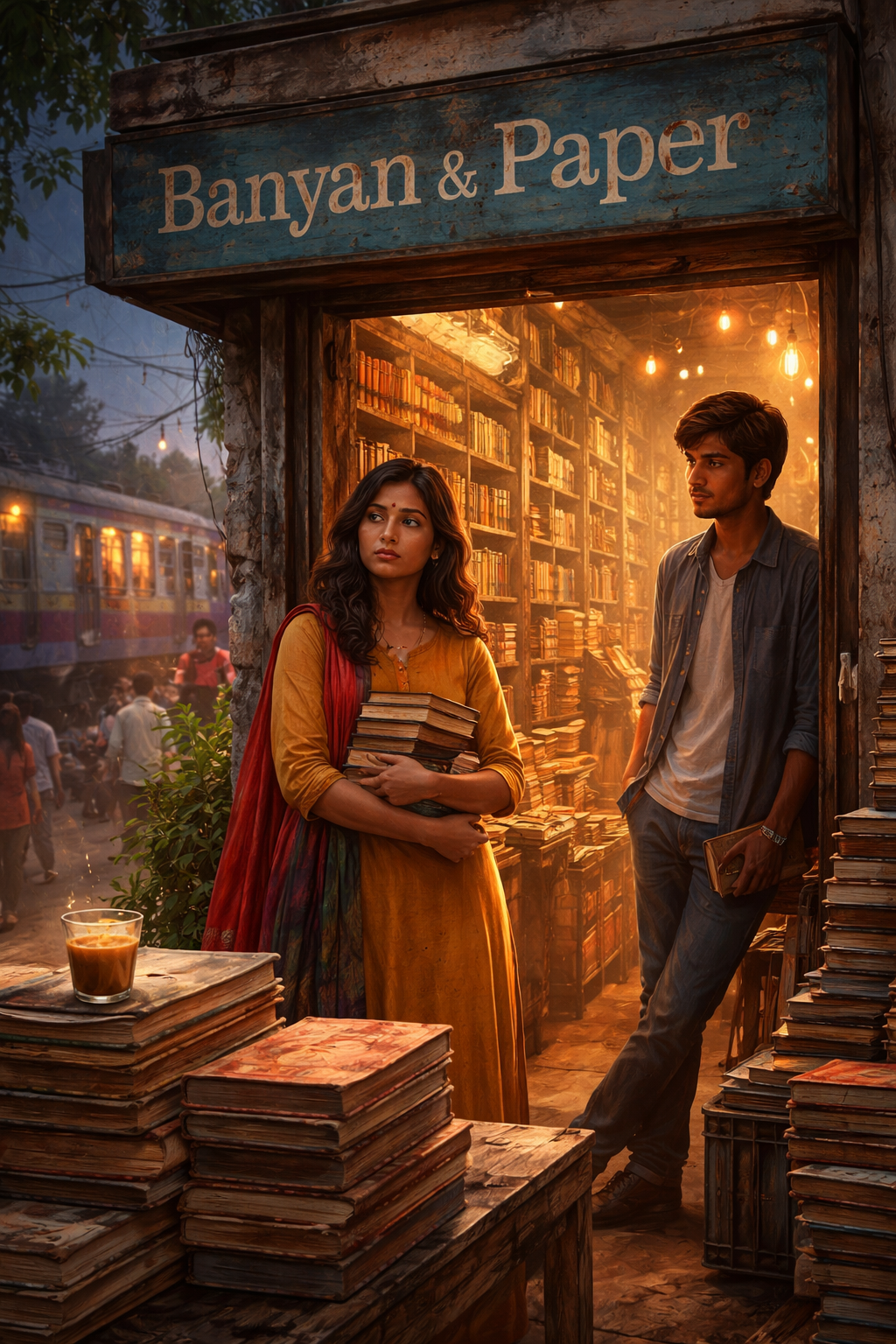
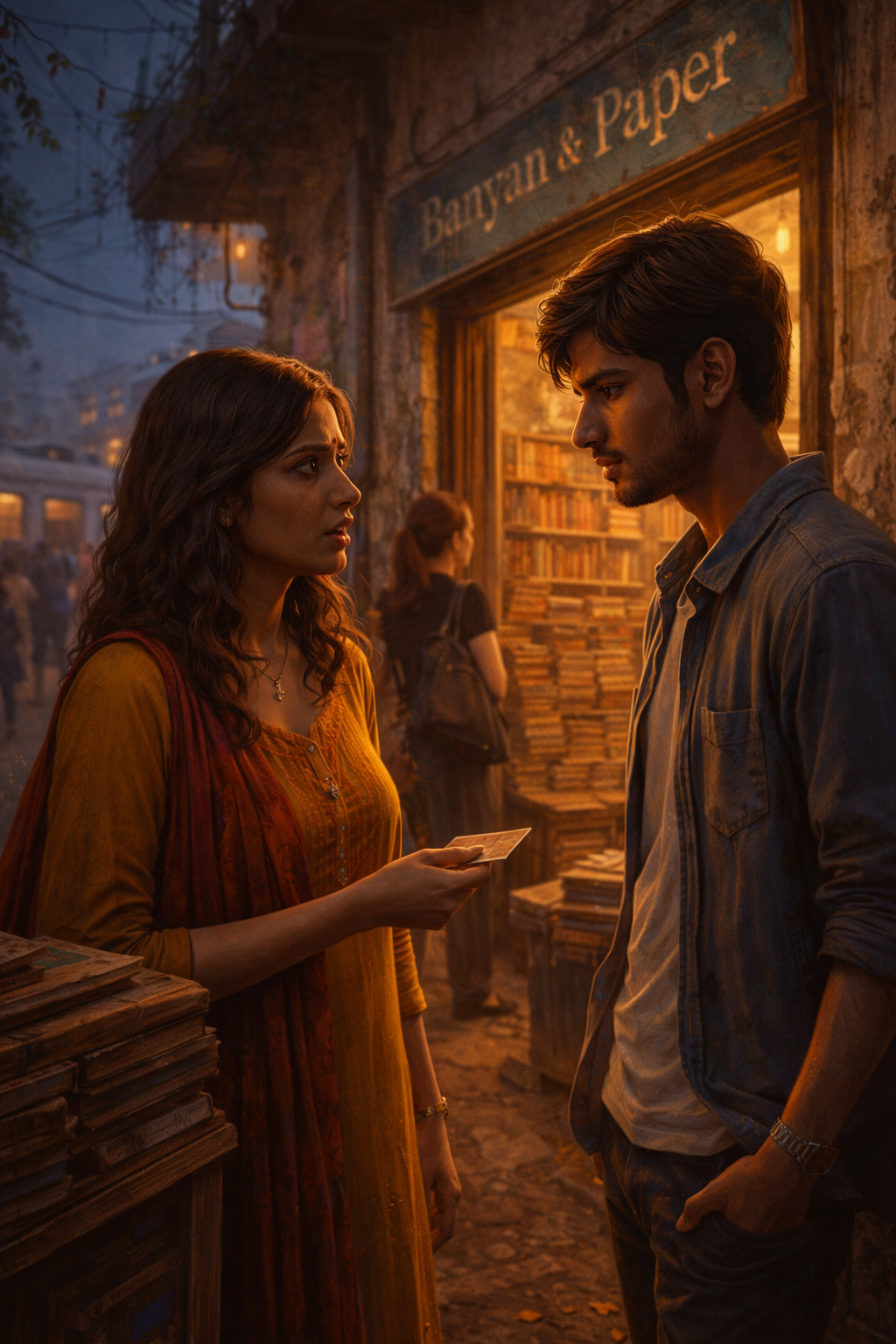
Banyan & Paper sat between a photocopy shop and a tiny snack stall that sold vada pav with alarming confidence. The bookstore didn’t have a glossy sign. Just painted letters that had faded unevenly, and a handwritten note taped near the entrance:

Yes, we buy old books. No, we can’t take your college textbooks from 2009. Please don’t argue.

Inside, the air was cooler than outside, not because of AC; she couldn’t afford to run it all day, but because books held a different kind of temperature. The place smelled like paper, dust, and the faint perfume of mothballs that Nandini kept in strategic corners like tiny guards.

Her mother had named the shop when Nandini was eight. Her father had wanted something sensible. Something like Rao Books & Stationery.

Her mother had insisted on a banyan tree.

“A banyan doesn’t look like it’s doing anything,” her mother had said. “But it holds everything together.”

Nandini unlocked the shutter, pulled it up with a grunt, and stepped inside.

Her phone buzzed. A text from her neighbour, Aarti:
Ma ate?

Nandini typed back quickly:
Yes. Dawa de diya. Sleeping.

Chronic but stable, her mother’s condition was a constant hum in the background of their lives: medication, BP checks, occasional dizzy spells, and a general fragility that made Nandini’s choices feel less like choices and more like a line drawn on a map.

She couldn’t move for work. She couldn’t “just try something else.” She couldn’t relocate, restart, reinvent herself in the way LinkedIn loved to suggest. Her life was tethered to this suburb, this shop, and the upstairs bedroom where her mother slept with a fan pointed directly at her face like it was a personal assistant.

Nandini flipped on the lights, dust motes rising like tiny spirits.

At ten thirty, the regulars drifted in.

A retired uncle who came to argue about politics and borrow old Marathi novels.

A teenage girl who pretended she was browsing but actually just wanted to sit in the corner and breathe for twenty minutes away from her tuition schedule.

A man who bought self-help books and looked disappointed every time a book failed to fix him.

The shop didn’t make money the way shops were supposed to. It made meaning. And meaning, unfortunately, didn’t pay rent.

At noon, the bell above the door rang.

Nandini looked up and saw Mihir standing there, freshly washed, wearing a clean shirt that looked surprisingly well-fitted. Not expensive exactly, but… deliberate.

He stepped in slowly, like someone entering a temple without knowing the rules.

“Hi,” he said.

“You came,” Nandini said, and immediately hated the warmth in her own voice.

He glanced around, taking in the shelves, the mismatched chairs, the handwritten category signs: Old Loves, Weird But Good, Marathi Classics, Women Who Don’t Apologise.

“It’s… exactly how I imagined it,” he said.

“What did you imagine?”

“A place where people come to feel less alone,” he said, like it was obvious.

Nandini’s throat tightened, annoyed at herself. She moved behind the counter and busied her hands with a stack of books.

“So,” she said, brisk, “what are you looking for?”

Mihir smiled at her tone. “Something that doesn’t make me feel like I’m doing homework.”

“Welcome to the club,” Nandini muttered.

He wandered into the aisles. He picked up a thin book of poetry, flipped through a few pages, put it back carefully.

“You read poetry?” Nandini asked before she could stop herself.

“I used to,” he said. “When I was younger.”

“And now?”

He shrugged. “Now I scroll.”

Nandini snorted. “You and the rest of the country.”

He looked at her then, properly. “Do you ever feel like everyone is tired but pretending they’re fine?”

Nandini paused. “Yes.”

“And do you ever feel like reading is the only thing that makes the tiredness… manageable?”

She swallowed. “Yes.”

He nodded, like something inside him settled. “Okay. Give me something.”

Nandini came out from behind the counter, walked to the shelves, and started pulling books without overthinking.

A slim novel in English that carried quiet grief like a second skin.

A book of essays by an Indian writer that made you laugh and then feel guilty for laughing.

A Marathi short story collection she’d grown up reading, translated on the facing page because she didn’t know what his Marathi was like and she didn’t want to ask.

She handed the stack to him. “Start here.”

He stared at the books as if she’d handed him a key.

“You’re good at this,” he said.

“I’ve been doing it forever,” she said, and then, because honesty slipped out sometimes when you weren’t watching, she added, “and because I can tell when someone is trying to remember themselves.”

Mihir’s mouth opened, then closed. For a second, he looked like he wanted to say something and didn’t trust it.

He paid in cash.

Nandini noticed because she always noticed. Cash was inconvenient. Cash was usually a habit, or a decision.

He took the bag and hesitated. “I’ll come back and tell you what I think.”

“You better,” she said. “Otherwise I’ll assume you didn’t like it and I’ll take it personally.”

He laughed. It was a full laugh. Not polite.

“Deal,” he said, and left.

Nandini watched the door for a second longer than she needed to, then turned back to the counter, annoyed with her own heart for being so easy to wake up.


Over the next two weeks, Mihir became a pattern in her day.

Not daily. That would have felt like too much too fast. But often enough that she started expecting him in the way you start expecting the train to arrive, even though it never arrives when you want.

He’d come in, buy one book, then talk about it like it mattered. Not like he was showing off. Like he was trying to understand why it hit him.

He brought her cutting chai once, and she nearly cried because nobody brought her chai unless they wanted something from her.

“Don’t make it weird,” she told him.

“You’re making it weird,” he said, grinning.

Sometimes he’d help her shift cartons. Sometimes he’d sit in the corner and read for twenty minutes without speaking. The shop accepted him the way old spaces accepted people who didn’t try to dominate them.

Even her mother, who noticed everything despite pretending she didn’t, asked one evening while Nandini was crushing tablets into curd:

“Who is this boy who keeps coming?”

“He’s not a boy,” Nandini said.

“Men are boys until they prove otherwise,” her mother replied, unbothered.

Nandini rolled her eyes. “He’s… a customer.”

Her mother made a soft sound. “Hmm.”

“Stop doing that.”

“Doing what?”

“That hmm. That I-know-more-than-you hmm.”

Her mother smiled. “I’m only saying, if he’s making you smile, don’t immediately find a reason to punish yourself for it.”

Nandini stared at the curd like it had answers.


One Thursday, after the shop had closed, Aarti stuck her head in with her usual lack of boundaries.

“You’re coming for the open mic, right?” she asked. “Don’t back out.”

Nandini groaned. “Aarti, I said maybe.”

Aarti widened her eyes theatrically. “Maybe is what cowards say when they want to sound brave.”

Behind Aarti, Mihir walked in, carrying a book under his arm.

“What open mic?” he asked.

Nandini shot Aarti a look that could have peeled paint. Aarti smiled innocently and disappeared.

Nandini exhaled. “There’s this small thing. At the community library. People read their writing.”

Mihir’s eyes lit up in a way that made her want to throw something at him. “You write?”

“Not like… professionally,” she said quickly. “Just. Sometimes.”

“I’d like to hear you,” he said.

The way he said it was not flirtatious. It was earnest. That made it worse. Earnestness didn’t give you room to be cynical.

“I don’t do public reading,” she said.

“Why?”

Because in public, people decided who you were and then told you. Because the moment you offered your words, they belonged to everyone.

Nandini shrugged instead. “I’m not that person.”

Mihir studied her for a second, then said quietly, “You already are. You just haven’t admitted it out loud.”

Nandini stared at him. “You’ve known me for two weeks.”

“And in two weeks,” he said, “I’ve seen you tell a teenager that her feelings aren’t a problem to solve. I’ve seen you put a book in an uncle’s hand and make him look less lonely. I’ve seen you run a shop that shouldn’t survive and keep it alive anyway. Don’t tell me you’re not that person.”

Nandini’s eyes stung, and she hated that too.

“You’re saying all this because you want me to read something,” she said, trying for sarcasm.

“I’m saying all this because you deserve to hear it,” he replied. “Reading is just… one way.”

Nandini looked away, pretending to straighten a pile of books.

Finally, she said, “Fine. I’ll go. But if I faint, I’m blaming you.”

Mihir’s grin returned. “Fair. I’ll bring water. And a chair.”


The community library in their suburb wasn’t fancy. It had plastic chairs, yellowing posters, and a librarian who treated overdue books like personal betrayal.

About thirty people showed up for the open mic. Mostly students. A few aunties. One man who read jokes like he was performing at a corporate event.

Nandini sat in the back, holding a sheet of paper so tightly it was beginning to crease.

Mihir sat one row ahead, turned halfway in his chair so he could see her, as if she might bolt.

When her name was called, her body moved before her brain agreed.

She walked up to the front, faced the microphone, and saw the room: not hostile, not kind, just waiting.

She took a breath.

“This is…” Her voice caught. She tried again. “This is called Banyan & Paper.”

And then the words came.

She spoke about the shop. About her mother’s hands pricing books with a pencil. About the way people came in looking for one thing and left with another. About the slow grief of watching reading become unfashionable. About holding a space together when the world told you it didn’t matter.

She didn’t mention her mother’s illness. She didn’t mention her bank balance. She didn’t perform pain.

She just told the truth.

When she finished, there was a beat of silence. Then applause. Real applause, not polite.

Nandini stepped down, slightly dizzy, and returned to her seat.

Mihir looked at her like she’d done something impossible.

“I told you,” he whispered.

“Don’t,” she whispered back. “Don’t make me cry in public.”

He smiled, but his eyes were damp. “Okay.”

Outside, later, under the streetlight near the paan shop, he said, “You were brilliant.”

Nandini exhaled shakily. “I feel like I ran a marathon without training.”

“That’s what it looks like when you do something you’ve been avoiding,” he said.

And then he kissed her.

Not dramatically. Not to prove a point. Just like it was the next honest thing.

Nandini kissed him back, and for a moment, the suburb felt suspended: the local train rumble in the distance, the smell of rain on concrete, the fact of tomorrow waiting.


After that, their closeness grew faster.

It always did once you crossed that line.

Mihir started coming over. Not often, because her mother was home, and Nandini had a complicated relationship with private life being witnessed. But sometimes he’d stand at the door with fruits or masala biscuits and say, “Aunty ke liye.”

Her mother would eye him with suspicious fondness.

“Tumhara kaam kya hai?” her mother asked one evening, not bothering with softness.

Mihir paused. “Consulting,” he said.

Nandini’s mother raised an eyebrow. “That word means nothing.”

Mihir smiled politely. “I help companies… fix problems.”

Her mother gave him the look only Indian mothers could give: the look that said I’m letting you speak, but don’t think I’m believing you.

Nandini watched Mihir carefully. He didn’t seem offended. He didn’t seem defensive. He seemed… careful.

Careful was okay. Careful was better than arrogant.

Still, there were things that didn’t add up.

He knew how to talk to people. Not just in a friendly way. In a practised way.

He was too comfortable in expensive spaces. Not showy, but unbothered.

He paid in cash, always.

And sometimes, when his phone rang, his entire face would change for a second. Like someone had called him by a name he wasn’t using.

Nandini told herself she was being dramatic. She told herself she was looking for problems because peace felt unfamiliar.

Then, one evening, she walked back to the shop after locking up, because she’d forgotten her keys.

She took the side lane behind the building, where the photocopy shop dumped paper scraps, and the snack stall stored gas cylinders.

She heard voices.

Low. Urgent.

A woman’s voice, sharp and controlled. “You can’t keep doing this.”

Mihir’s voice. Different. Cleaner. “I told you, I’m not available.”

“You’re not a college boy playing house in the suburbs,” the woman snapped. “You have responsibilities.”

Nandini froze behind a stack of cardboard, heart climbing into her throat.

“You can handle it,” Mihir said.

“I can handle it for a week,” the woman said. “Not indefinitely. And not when you’re ignoring calls. This is getting noticed.”

A pause.

Then the woman said, “Mihir Mehta, this isn’t romantic. It’s reckless.”

Nandini’s blood went cold.

Mehta.

Not an unusual surname. But the way she said it. Like it carried weight. Like it was a name that opened doors.

Mihir’s voice softened, but there was steel under it. “Don’t use my full name like you’re scolding a child.”

“You’re behaving like one,” she shot back. “The board meeting is tomorrow. The Pune acquisition is hanging. Your father is asking questions.”

Nandini felt dizzy. Father. Board. Acquisition.

This wasn’t just consulting. This was a life she hadn’t been invited into. A life that didn’t include second-hand bookstores and open mic nights.

“You’re going to get attached,” the woman said, and now there was something almost weary in her voice. “And then what? You think she’ll just… fit?”

“She doesn’t need to fit,” Mihir said.

“You’re not listening.” The woman lowered her voice. “She’ll pay the price for this long before you do. That’s how it works.”

Nandini pressed her hand to her mouth because something between a laugh and a sob threatened to come out.

Mihir said, very quietly, “I’m not lying to hurt her.”

“You’re lying to be loved safely,” the woman replied. “That’s still lying.”

Silence.

Then footsteps. The woman’s heels clicked away.

Mihir exhaled like someone who’d been holding his breath for days.

Nandini stumbled backwards, stepped on a plastic bottle, and the sound made Mihir turn.

Their eyes met across the lane.

For half a second, both of them looked like strangers.

“Nandu,” he said, and the nickname landed wrong. Like a stolen intimacy.

Nandini’s voice came out thin. “Who are you?”

Mihir opened his mouth, closed it, then said, “Can we talk inside?”

Nandini shook her head. “No. You don’t get inside. Not right now.”

His face tightened. He took one step toward her.

Nandini held up her hand. “Stop.”

He stopped.

“Tell me,” she said, voice steady now in a way that surprised her. “Don’t perform. Don’t manage my emotions. Just tell me.”

Mihir swallowed. “My name is Mihir Mehta,” he said. “That part is true. I… didn’t lie about my name. I lied by omission.”

Nandini laughed once, sharply. “That’s a fancy way to say you lied.”

He flinched. “Yes.”

“What are you?” she asked. “Consultant? Business heir? What? Because the lane behind my shop is not where ‘board meetings’ happen.”

Mihir looked down for a second, then back up. “My family… has businesses,” he said. “I work in them. I run a part of it.”

“And you thought saying ‘consulting’ was… what? Charming?”

“It was cowardly,” he said, and at least he didn’t deny it.

Nandini felt something inside her go very quiet, the way a room goes quiet when someone says something true and ugly.

“Why?” she asked.

Mihir’s voice broke slightly. “Because when people know, they don’t see me. They see the name. They see what I can offer. They see access. And with you—” He stopped, as if the sentence scared him.

“With me?” Nandini prompted, even though she already knew she’d regret it.

“With you,” he said, “I felt like I could be… a person.”

Nandini stared at him. She wanted to be moved. She wanted to soften. But something harder rose in her chest.

“You didn’t trust me,” she said.

Mihir’s face tightened. “I did—”

“No,” she cut in. “You trusted your own fear. You trusted your own script. You didn’t trust me to choose.”

He went still.

Nandini continued, words coming now like they’d been waiting. “Do you understand what you did? You let me imagine a future. You let me… step into something. And you knew, somewhere in your head, you knew that if this went wrong, it would cost me more than it would ever cost you.”

Mihir’s eyes shone. “I wasn’t trying to…”

“I know you weren’t trying,” Nandini said, and the fact that she believed that made her angrier. “That’s the problem. You didn’t even see the imbalance. Or you saw it and didn’t want to look at it.”

He whispered, “I did see it.”

Nandini held his gaze. “And?”

“And I still wanted to be with you,” he said, voice raw. “I still do.”

For a moment, the lane felt too small for the truth sitting between them.

Nandini looked away because if she looked too long, she’d remember the other version of him: the one who held her hand in the library, the one who listened to her words like they mattered, the one who sat on the shop floor and read quietly like he belonged there.

Her voice came out tired. “I don’t know what to do with this.”

“I’ll tell you everything,” Mihir said quickly, like he’d been waiting for permission. “Not managed. Not filtered. Everything.”

Nandini stared at the broken plastic bottle on the ground. Then she said, softly, “You should have done that before.”

“I know,” he said, and it sounded like it hurt.

Nandini felt tears rise, annoying and hot. She wiped them away with the heel of her hand, angry at her own body for being loyal to feelings.

Mihir took a cautious step closer. “Nandini…”

She stepped back. “Not today.”

He stopped, visibly restraining himself. “Okay.”

Nandini swallowed. “Tell me one thing. And don’t answer like a man in a boardroom.”

He nodded.

She asked, “Was any of it real?”

His voice turned quiet, almost rough. “All of it.”

“The books?” she demanded.

“Yes.”

“The way you looked at me?”

“Yes.”

“The kiss?”

He didn’t hesitate. “Yes.”

Nandini’s chest tightened painfully. “Then why ruin it with a lie?”

Mihir’s laugh was small and bitter. “Because I didn’t know how to be loved without one.”

That sentence landed hard. Not romantic. Not redeeming. Just honest in a way that made the skin on her arms prickle.

Nandini reached into her bag, pulled out her keys, and stared at them as if they were instructions.

Mihir stood there in the lane, not reaching for her, not touching her, as if he’d finally understood that touching was not the same as staying.

He took out his wallet, hesitated, then pulled out a card and held it out to her.

Nandini didn’t take it.

“It’s my number,” he said. “My real number. Not the one I’ve been using.”

“Why are you giving it to me?” she asked.

“Because I’m done hiding,” he said. “And because I’m not going to chase you. I don’t have the right. But I also don’t want to disappear and let you think you did something wrong.”

Nandini’s throat tightened. She hated that he was saying the right thing now. She hated that she still wanted to believe him.

She reached out and took the card, not because she forgave him, but because she wanted the truth to remain available if she chose it later.

Mihir watched her fingers close around it as if it were a fragile thing.

“I’m sorry,” he said again. Not dramatic. Not pleading. Just plain.

Nandini nodded once. She didn’t trust her voice.

She unlocked the shop door, stepped inside, and turned on the light. The shelves stood there, patient and familiar, like they’d seen everything and survived anyway.

Mihir stayed outside. She could feel him, even without looking.

After a minute, she heard his footsteps retreat.

When she finally turned back toward the glass door, the lane was empty.


That night, Nandini sat on the balcony of their flat, listening to the local train rattle past in the distance.

Her mother slept inside, the fan still aimed at her face like a stubborn guardian.

Aarti had texted twice. Kya hua? and then Don’t be stupid, ya. Nandini didn’t reply.

She held Mihir’s card between two fingers, turning it over and over like a coin.

On the other hand, her phone glowed with an unsent message.

I don’t know what to do with you.

She didn’t send it.

Below, someone argued with a delivery boy. Somewhere, a dog barked. The city continued, indifferent and intimate at once.

Nandini thought about the shop. About her mother. About the years she’d spent making peace with staying.

She thought about Mihir’s face when she read at the open mic, like he’d seen her become someone she’d been hiding from.

She thought about the lane behind the shop, about that one sentence that had cut clean:

You’re lying to be loved safely.

Nandini didn’t know what tomorrow would hold. She didn’t know whether love could survive the kind of truth that arrived late and messy.

But she knew this: she was done being treated like an afterthought in someone else’s escape plan.

The phone screen dimmed. She tapped it awake again.

The message still sat there, unsent.

She stared at it a long time, then deleted the text entirely.

And then, because she was not a saint and because she was human, she didn’t delete the number.