The Tiara Syndrome: Something that will never happen unless you ask for it

A term coined by Carol Frohlinger and Deborah Kolb, the founders of Negotiating Women, Inc, the Tiara Syndrome or the Tiara Effect is used to describe how many women approach salary and raise negotiations.

As Carol Frohlinger says, “Women expect that if they keep doing their job well someone will notice them and place a tiara on their head. That never happens.”

The fact is, most women don’t negotiate. That tiara is the recognition in the form of increased salary or pay. Women believe that they will be recognised for their value and automatically be paid what they are worth but the reality is, you have to ask for what you want. And if you don’t ask, the answer is always no.

In her bestselling book, Lean-In, Sheryl Sandberg says, “Women are also more reluctant to apply for promotions even when deserved, often believing that good job performance will naturally lead to rewards.”
Many women feel that working hard and doing a good job will be enough and the reality is that women are often extremely conscientious at delivering against their objectives. Just as at school where girls’ conscientiousness often leads to higher academic results than achieved by boys, many women believe that this same strategy will lead to success at work. However, sometimes this very diligence gets in the way of fast-tracking their careers. Many women are so so focused on doing the operational aspects of their job well that they don’t have time to step back and focus on strategic priorities and they often feel they do not have space in their busy working weeks to fit in networking which is seen as an unnecessary, and often uncomfortable, use of their precious time. In the same vein, they do not seek mentors to guide them or get the support of sponsors to give them the invaluable exposure and opportunities needed to step up to senior leadership positions.

Academic psychologist Cordelia Fine says such behaviour stems from socialisation, not innate differences between the sexes. And, of course, some men are sufferers, just as many women aren’t. But how do those who have been schooled not to boast learn to champion their cause and get over tiara syndrome?

A 2003 study of thirty-eight business students conducted University of California at Irvine discovered that 85% of the men believed that it was up to them to make sure their company paid them what they were worth. Only 17% of the women in the study believed this to be the case. The remaining 15% of the men and 83% of women assumed their worth would be determined by what their company paid them. The Tiara Syndrome only adds to the pay disparity between men and women. If we don’t ask for more pay based on our contributions, the answer is always no.

As women, we don’t negotiate. Most of us don’t negotiate our first job offer, which has been calculated to equal $500,000 over the length of her career. And all because we don’t speak up for ourselves and our worth.

So why do we women avoid negotiating? This is to a large extent because of the social conditioning females are brought up in where we are always told to be polite and quiet. Asking for money seems, greedy and rude and it is also uncomfortable. Frohlinger advises women to keep a work journal by month detailing the projects and accomplishments achieved, client kudos, amounts in new business created, or savings generated. This compelling evidence of their value to the company can be persuasively presented during a salary negotiation. Even if one gets an automatic raise annually, this substantiation of the corporate value could pay off in a larger increase. If you are stepping into a new role or moving to a new organization, don’t settle for the first offer.

Tory Johnson, the CEO of Women for Hire and Good Morning America’s career expert recommends the following for negotiating that initial offer. Start positive and get the whole compensation package in writing if it has been verbal so far. Be firm. If you have been offered a package lower than your expectations, then let them know politely with an emphasis on the skills and experience you bring to the role and ask them how much wriggle room is available. Every organisation will have a wriggle room, especially for someone they deem the best fit. Follow up especially if the hiring manager is firm on their offer. Work towards reaching an agreement, on paper, for a salary negotiation or review within a pre-determined period. Also try and negotiate on non-money aspects like vacation time, flexible working arrangements, medical benefits, etc.

What are the blocks that don’t allow extremely able women from progressing? These include insufficient impact and presence and lack of a strong personal brand, a lowered productivity and overwhelm through being pulled in too many directions at once as well as poor work-life balance, a belief that doing a good job will be enough and not seeking sponsors, discomfort with networking both internally and externally, being insufficiently strategic and too stuck in the detail, a lack of strategic career planning and reduced confidence and lack of self-belief as a leader.

If you suffer from this syndrome, here’s what you can do to overcome it:

Own your career, acknowledge that you suffer from the syndrome and come up with an action plan. If you don’t like talking about it, use technology instead. Copy your boss into relevant emails and share them on your professional social media accounts. Keep a career journal to keep a record of your accomplishments. This is great for building evidence required for negotiations, it can be confidence boosting and be useful for CVs, appraisals, and other career development opportunities. Stop comparing yourself to others and plan for and maximise the formal opportunities for negotiation, whether for a pay rise or a promotion. Build your brand and internal network. Your brand also includes managing your energetic presence, personal image and communication, including body language. Harness Your Potential which includes identifying and capitalising on strengths as well as being clear about which weaker areas are mission-critical and maximising time and energy. Creating a balance between work and other aspects of life is also vital for sustainable career success. Cultivate supportive relationships within your current work setting as well as the wider professional network, including sponsors and mentors. It is important to be able to initiate these relationships, enhance your influence and also handle difficult relationships. Focus on strategy and volunteer for strategic or extra credit projects so that you can develop an idea of the big picture. Thinking like a leader is necessary to develop a leadership mindset and this includes handling the little voice of doubt that we all have in our heads and also learning to let go of some of what we have excelled at to take on even higher level leadership tasks.

It’s naive to think that delivering excellent results is all that it takes to succeed in the workplace. The playing field is not yet equal for women; the fact is that women have to negotiate for things their male colleagues can often take for granted. In addition to the obvious issue regarding compensation, women should negotiate for high visibility assignments, the resources they need to get the job done, support from those senior in the organization and buy-in from colleagues. They should also negotiate in their personal lives for the things that will enable them to be successful in the workplace. Effective negotiation is a prerequisite to “leaning in”. As Sheryl Sandberg says, “Do not wait for power to be offered. Like that tiara, it might never materialise.” So to all the women reading this post, if you have the Tiara Syndrome, shrug it off and know that you too are worth it!

In My Hands Today…

Cassandra Speaks: When Women Are the Storytellers, the Human Story Changes – Elizabeth Lesser

What story would Eve have told about picking the apple? Why is Pandora blamed for opening the box? And what about the fate of Cassandra who was blessed with knowing the future but cursed so that no one believed her? What if women had been the storytellers?

Elizabeth Lesser believes that if women’s voices had been equally heard and respected throughout history, humankind would have followed different hero myths and guiding stories—stories that value caretaking, champion compassion, and elevate communication over vengeance and violence.

Cassandra Speaks is about the stories we tell and how those stories become the culture. It’s about the stories we still blindly cling to, and the ones that cling to us: the origin tales, the guiding myths, the religious parables, the literature and films and fairy tales passed down through the centuries about women and men, power and war, sex and love, and the values we live by. Stories written mostly by men with lessons and laws for all of humanity. We have outgrown so many of them, and still they endure. This book is about what happens when women are the storytellers too—when we speak from our authentic voices, when we flex our values, when we become protagonists in the tales we tell about what it means to be human.

Lesser has walked two main paths in her life—the spiritual path and the feminist one—paths that sometimes cross but sometimes feel at cross-purposes. Cassandra Speaks is her extraordinary merging of the two. The bestselling author of Broken Open and Marrow, Lesser is a beloved spiritual writer, as well as a leading feminist thinker. In this book she gives equal voice to the cool water of her meditative self and the fire of her feminist self. With her trademark gifts of both humor and insight, she offers a vision that transcends the either/or ideologies on both sides of the gender debate.

Brilliantly structured into three distinct parts, Part One explores how history is carried forward through the stories a culture tells and values, and what we can do to balance the scales. Part Two looks at women and power and expands what it means to be courageous, daring, and strong. And Part Three offers “A Toolbox for Inner Strength.” Lesser argues that change in the culture starts with inner change, and that no one—woman or man—is immune to the corrupting influence of power. She provides inner tools to help us be both strong-willed and kind-hearted.

The Importance of Sleep

Where sleep is concerned, our household is divided cleanly down the middle. GG and I prefer a decent bedtime while BB and S can go on for a long time. While GG and I can stay up late, our energies are noticeably depleted and we prefer to sleep early so we are awake early. On the other hand, BB and S can go on past midnight working, playing games or watching television with no difference to their energy and wake up the next day, not as early, but not very late too. BB especially has the best of both worlds according to GG. He can sleep late like S and wake up early, bright as a button the moment he opens his eyes like me.

The past few months, BB and I have been having this ongoing discussion on why he should sleep early, especially if it’s a weekday and so I thought I should share my findings with you. Read on to find out why sleep is so important and that by burning the midnight oil, how we set ourselves up for failure.

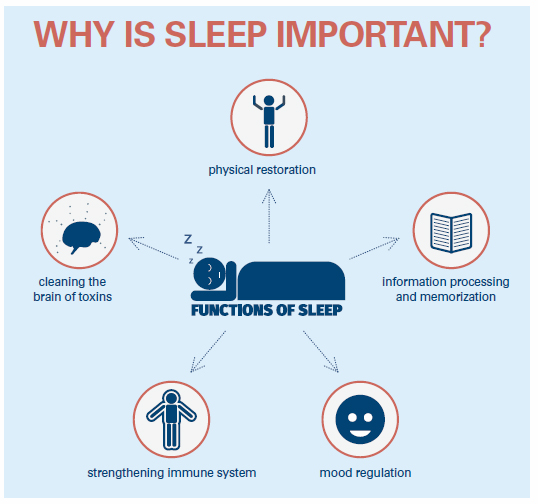
A vital, often neglected, component of every person’s overall health and well-being, Sleep is an essential function that allows the body and mind to recharge, leaving one refreshed and alert when they wake up. Sleep is important because it enables the body to repair and be fit and ready for another day. Healthy sleep also helps the body remain healthy and stave off diseases. Without enough sleep, the brain cannot function properly and getting adequate rest may help prevent excess weight gain, heart disease, and increased illness duration which can impair the ability to concentrate, think clearly, and process memories.

An internal body clock regulates one’s sleep cycle, controlling when they feel tired and ready for bed or refreshed and alert. This clock operates on a 24-hour cycle known as the circadian rhythm. After waking up from sleep, one will become increasingly tired throughout the day with the feelings peaking in the evening leading up to bedtime. This sleep drive, also known as sleep-wake homeostasis, may be linked to adenosine, an organic compound produced in the brain. Adenosine levels increase throughout the day as one becomes more tired, and then the body breaks down this compound during sleep.

Light also influences the circadian rhythm. The brain contains a special region of nerve cells known as the hypothalamus, and a cluster of cells in the hypothalamus called the suprachiasmatic nucleus, which processes signals when the eyes are exposed to natural or artificial light. These signals help the brain determine whether it is day or night. As natural light disappears in the evening, the body will release melatonin, a hormone that induces drowsiness. When the sun rises in the morning, the body will release the hormone known as cortisol that promotes energy and alertness.

Once a person falls asleep, the bodies follow a sleep cycle divided into four stages. The first three stages are known as non-rapid eye movement (NREM) sleep, and the final stage is known as rapid eye movement (REM) sleep. The first stage marks the transition between wakefulness and sleep and consists of light sleep. Muscles relax and the heart rate, breathing, and eye movements begin to slow down, as do brain waves, which are more active when one is awake. Stage 1 typically lasts several minutes. The second NREM sleep stage is characterised by deeper sleep as the heart rate and breathing rates continue slowing down and the muscles become more relaxed. Eye movements will cease and the body temperature will decrease. Apart from some brief moments of higher frequency electrical activity, brain waves also remain slow. Stage 2 is typically the longest of the four sleep stages. The third stage of NREM plays an important role in making one feel refreshed and alert the next day. Heartbeat, breathing, and brain wave activity all reach their lowest levels, and the muscles are as relaxed as they will be. This stage will be longer at first and decrease in duration throughout the night. The first REM stage will occur about 90 minutes after one falls asleep. As the name suggests, the eyes will move back and forth rather quickly under the eyelids. Breathing rate, heart rate, and blood pressure will begin to increase. Dreaming will typically occur during REM sleep, and the arms and legs will become paralysed, it’s believed this is intended to prevent one from physically acting out on their dreams. The duration of each REM sleep cycle increases as the night progresses with numerous studies that have also linked REM sleep to memory consolidation, the process of converting recently learned experiences into long-term memories. The duration of the REM stage will decrease as one ages, causing one to spend more time in the NREM stages.

These four stages will repeat cyclically throughout the night until one wakes up. For most people, the duration of each cycle will last between 90 to 120 minutes and NREM sleep constitutes about 75% to 80% of each cycle. One may also wake up briefly during the night but not remember the next day and these episodes are known as W stages.

For most adults, at least seven hours of sleep each night is needed for proper cognitive and behavioural functions with children and teenagers needing substantially more sleep, particularly if they are younger than five years of age. An insufficient amount of sleep can lead to serious repercussions. Some studies have shown sleep deprivation leaves people vulnerable to attention lapses, reduced cognition, delayed reactions, and mood shifts. It has also been suggested that people can develop a sort of tolerance to chronic sleep deprivation. Even though their brains and bodies struggle due to lack of sleep, they may not be aware of their deficiencies because less sleep feels normal to them. Additionally, lack of sleep has been linked to a higher risk for certain diseases and medical conditions including obesity, type 2 diabetes, high blood pressure, heart disease, stroke, poor mental health, and early death.

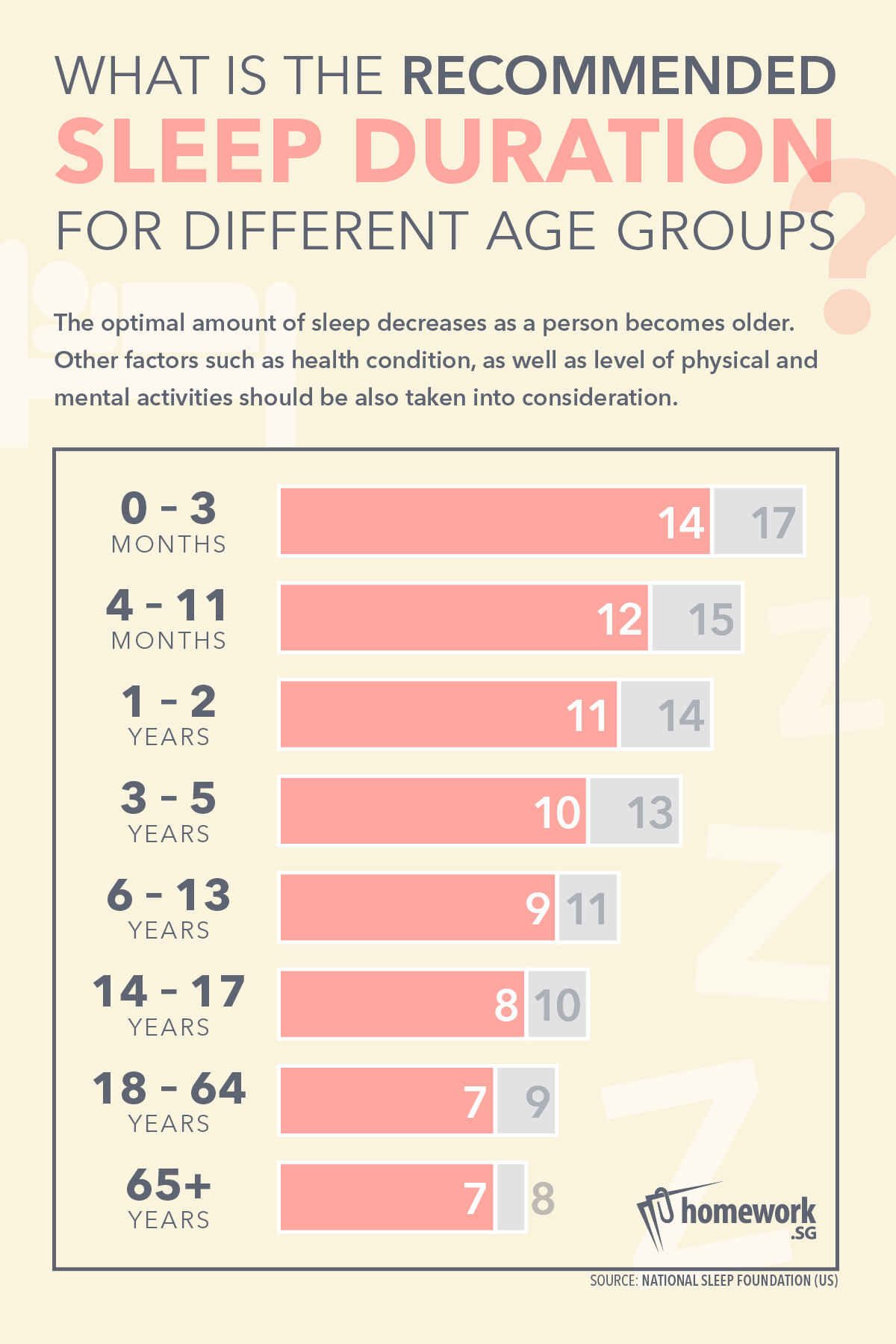
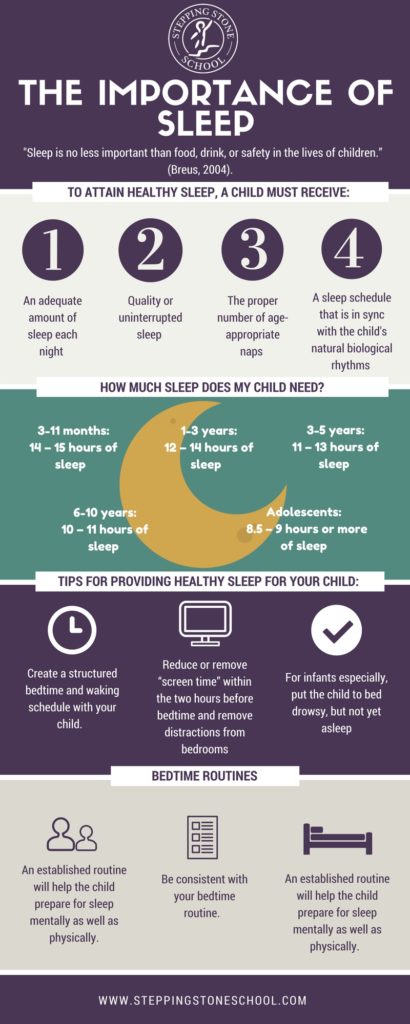
Sleep needs vary from person to person, depending on their age. As a person ages, they typically require less sleep to function properly. According to the CDC, newborns until three months of age need 14 to 17 hours of sleep, infants between 2 to 12 months need 12 to 16 hours and toddlers from one to two need 11 to 14 hours of sleep. Preschool children between 3 to 5 need 10 to 13 hours while children between 6 to 12 years old need around 9 to 12 hours of sleep a day. Teens between 13 and 18 need to clock in 8 to 10 hours of rest while adults until the age of 60 need to maintain an average of 7 hours of sleep daily. As one grows older, sleep schedules change with adults between 61 and 64 needing 7 to 9 hours and those older than 65 need between 7 to 8 hours of sleep daily.

Work schedules, day-to-day stressors, a disruptive bedroom environment, and medical conditions can all prevent one from receiving enough sleep. A healthy diet and positive lifestyle habits can help ensure an adequate amount of sleep each night, but for some, chronic lack of sleep may be the first sign of a sleep disorder.

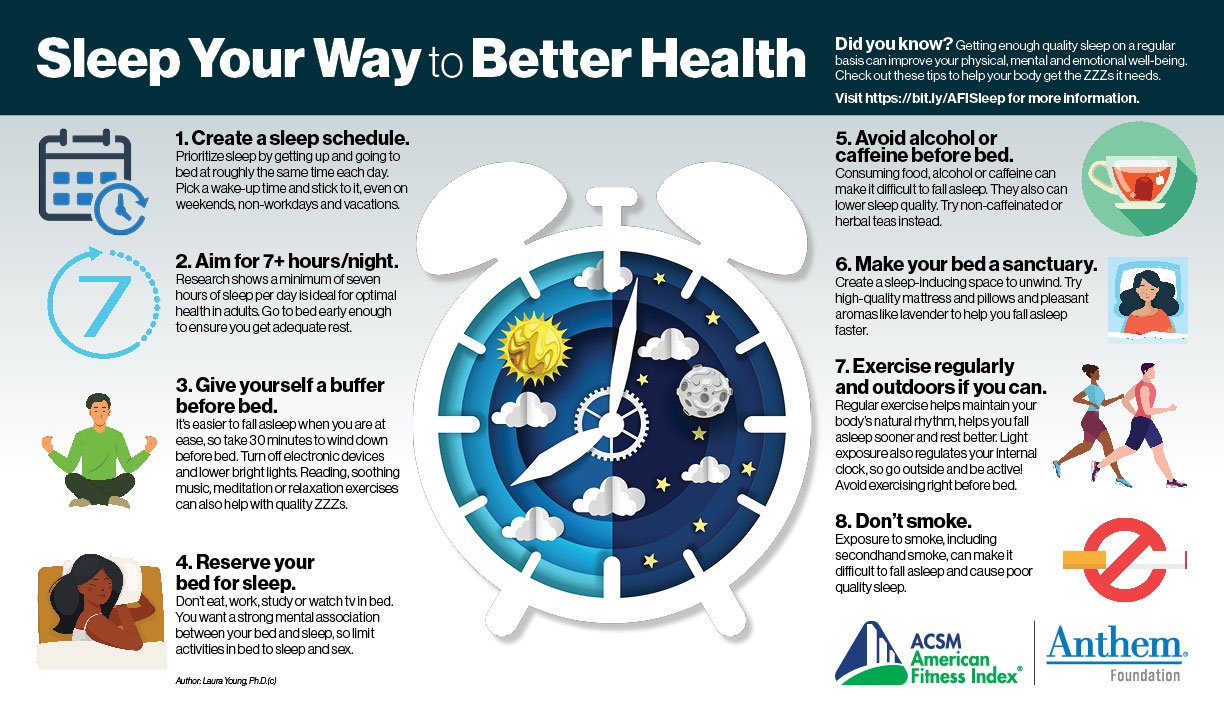
As well as the number of hours, the quality of sleep is also important. Signs of poor sleep quality include waking in the middle of the night and not feeling rested after an adequate number of hours of sleep. Some things a person should and should not do to improve sleep quality include the following:

  • Sleep for at least seven hours every day
  • Have a short nap for an energy booster if you need it during the day as a short nap of 10 to 20 minutes can help recharge energy levels and boost daytime productivity.
  • Exercise regularly as physical activity can help sleep better.
  • Relax muscles and release the tension in the body to help sleep better with some simple muscle relaxation exercises.
  • Establish a realistic bedtime and stick to it every night, even on the weekends.
  • Follow a bedtime routine. Grab a book, take a warm bath, or listen to some soothing music. A consistent routine can signal to the body to sleep at the same time daily.
  • Maintain comfortable temperature settings and low light levels in the bedroom.
  • Turn on the phone’s blue light filter. The night mode function filters out blue light, which inhibits the brain from producing sleep-inducing hormones.
  • Exercise during the day; this can help one wind down in the evening and prepare for sleep.
  • Keep the sleep environment comfortable by dimming or switching off the lights in the room or using blackout curtains or eye masks to help block out external light.
  • Refrain from using tobacco at any time of day or night.
  • Avoid sleeping in when one has had enough sleep.
  • Avoid Starving or eating a heavy meal before bedtime. It’s hard to sleep when one’s stomach is rumbling or after a large meal which may cause discomfort. Eat a couple of hours before sleep, or have a glass of milk before heading to bed.
  • Avoid caffeine or alcohol at night. Coffee is a stimulant that promotes wakefulness while alcohol may cause drowsiness and impact the quality of sleep.
  • Avoid Using electronics 30 minutes before bedtime as using such devices before bedtime stimulates the mind, making it harder to fall asleep and stay asleep.

If one thinks sleep is just a period of inactivity, then think again. The nightly shut-eye allows the brains to consolidate our learning and memory so we can perform tasks better the next day. When one has enough sleep, they are less likely to overeat and crave junk, and make wiser food choices. Sleep deprivation makes one unable to concentrate, have slow responses, make decisions impulsively and even felt easily annoyed. So tonight, make sure you sleep at least seven hours (more if you are older or younger) because the quantity and quality of sleep determine whether you wake up feeling energised or like a walking zombie.

In My Hands Today…

What Would Frida Do?: A Guide to Living Boldly – Arianna Davis

A contemporary guide to life, love, and happiness inspired by the extraordinary artist Frida Kahlo.

Revered as much for her fierce spirit as she is for her art, Frida Kahlo stands today as a brazen symbol of daring creativity. She was a woman ahead of her time whose paintings have earned her generations of admirers around the globe. But perhaps her greatest work of art was her own life.

What Would Frida Do? explores the feminist icon’s signature style, outspoken politics, and boldness in love and art, even in the face of pain and heartbreak. The book celebrates her larger than life persona as a woman who loved passionately and lived ambitiously, refusing to remain in her husband’s shadow. Each chapter shares intimate stories from her life, revealing how she overcame obstacles by embracing her own ideals.

In this charming read, author Arianna Davis conjures Frida’s brave spirit, encouraging women to persevere, to create fearlessly, and to stand by their own truths.

Poem: Travel

I wrote this poem sometime in December of last year when travel had just seem possible. Then the Omicorn variant was detected and for a while, travel seemed to become that much harder and difficult.

Travel

Oh what a joy it is to travel
To broaden the horizons, to gather souvenirs
With that first thought, the eyes have a twinkle
To discover new worlds, to conquer new frontiers

At home when you wake up, but across the continent by brunch
Perhaps for a meeting or is that for leisure you fly?
Then in another country to have a late lunch
Where you can finally take a deep breath and say goodbye

And when you come back, the trip still lingers within you
And suddenly when you least expect it, it happens
A memory will pop up once in a blue
Taking you back to that trip, nostalgic beckons

Travel makes one better, inside and outside
Travel opens your mind and makes you wise
Travelling shrinks the world makes it concise
That’s why it is said that travelling is the ultimate prize