An idea that’s been around for a while, but has gained traction in the last few years, the four-day workweek is an arrangement where a workplace or place of education has its employees or students work or attend school, college, or university over four days per week rather than the more customary five. This arrangement can be a part of flexible working hours and is sometimes used to cut costs. Typically, employees work longer hours during those four days to compensate for the lost day.
The idea behind the four-day workweek is to provide employees with more time for personal pursuits, such as family, hobbies, or other interests, while still completing the same amount of work. It is believed that a shorter workweek can increase productivity, reduce stress, and improve work-life balance.
The five-day workweek is a cultural norm; the result of early 1900s union advocacy to reduce the six-day workweek, which led to the invention of the weekend. In the early 20th century, when the average work week in developed nations was reduced from around 60 to 40 hours, it was expected that further decreases would occur over time. In 1930, economist John Maynard Keynes estimated that technological change and productivity improvements would make a 15-hour work week possible within a couple of generations. Other In 1956, then US Vice President Richard Nixon promised Americans they would only have to work four days in the not-too-distant future.
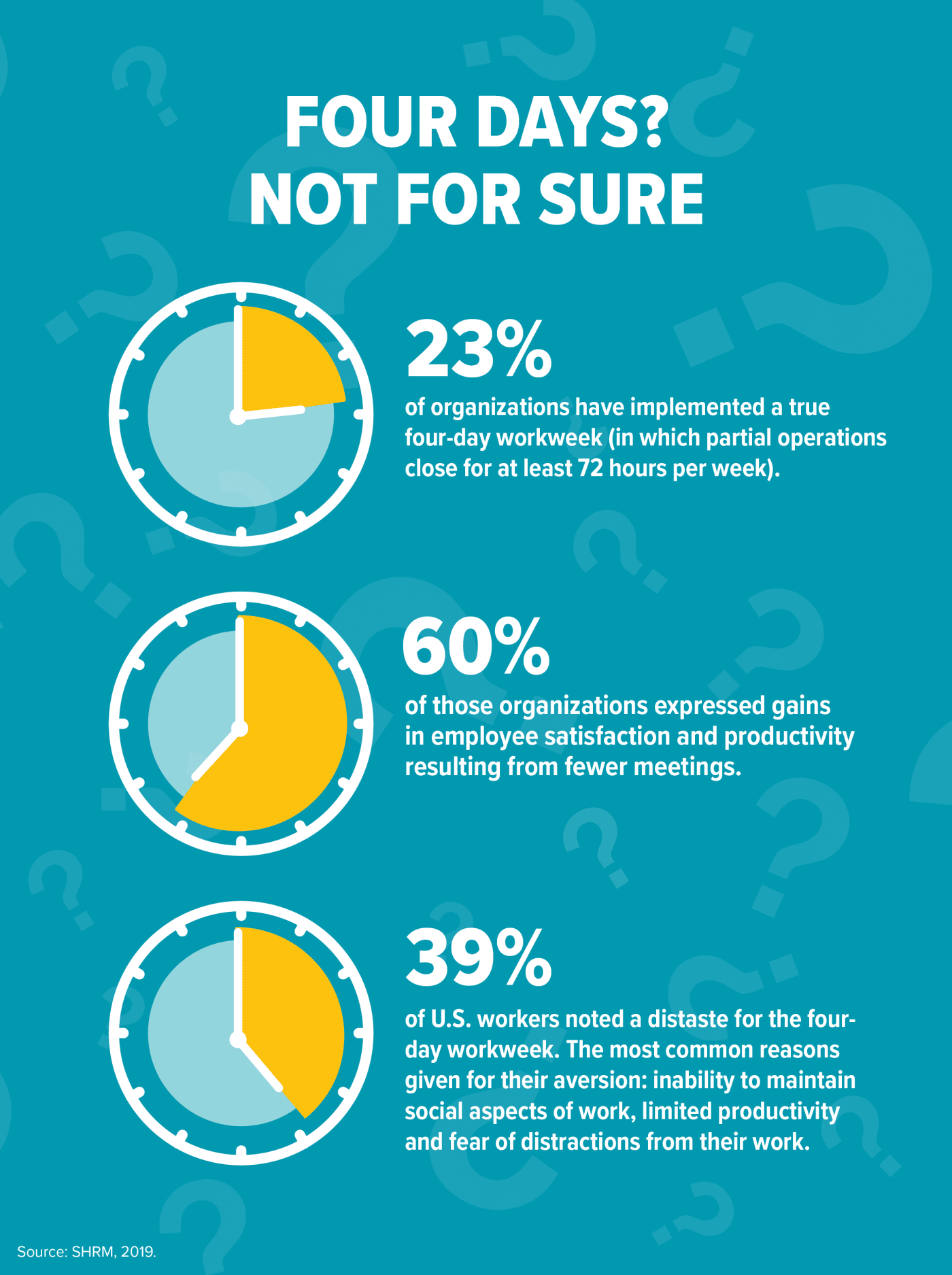
While the idea of a four-day workweek has been around for many years, it has gained more attention in recent years as some companies and governments have experimented with it as a way to increase employee well-being and productivity. Some companies have reported positive results, such as reduced absenteeism, improved employee morale, and even increased profits. However, it is important to note that the implementation and success of a four-day workweek can vary depending on the company, industry, and specific circumstances.
Most advocates for a four-day working week argue for a fixed work schedule, resulting in shorter weeks like four 8-hour workdays for a total of 32 hours. This follows the 100-80-100 model: 100% pay for 80% of the time, in exchange for a commitment to maintaining at least 100% productivity. However, some companies have introduced a four-day week based on a compressed work schedule: in the so-called 4/10 work week, the widely-used 40 weekly work hours are distributed across four days instead of five, resulting in 10-hour-long workdays, hence four-ten.
The resulting schedule may look different depending on the way the four-day week is implemented: in some variants Friday becomes the permanent non-working day, giving employees three consecutive days off over the weekend; some workplaces split the day off among the staff, with half taking Monday off and the other half taking Friday off; sometimes the day off is added in the middle of the week such as a Wednesday, allowing for a mid-week break; and, in some cases, the day off changes from week to week, depending on the company’s current goals and workload.
The push towards implementing the four-day week has remained loosely relevant within the contemporary workplace due to the various possible benefits it may yield. Although mostly untested, these benefits mainly lie within increased cost-cutting, productivity, and work-life balance. The theory behind this is, employees or students who work or attend school one less day a week will have additional time to pursue hobbies, spend time with family, get more sleep, and increase overall morale. Consequently, these employees or students will be more productive and refreshed for working or learning, which will make up for the lost day when they would otherwise be overworked and/or overtired. In addition, by having the workplace or school open one less day a week, the operating costs and environmental costs will decrease for businesses and society alike.
Where four-day weeks have been instituted so far, workers gain a better work-life balance that enables them to live happier and more fulfilled lives, and employers can recruit and retain high-quality and well-rested workers who deliver greater productivity and creativity. More broadly, a four-day week provides opportunities to rebalance employment, decreasing the number of overworked and unemployed or underemployed people and allows for greater gender equality through a more equal share of paid and unpaid work, too, including the caring roles that disproportionately fall on women, and better health and wellbeing for workers and their loved ones.
The four-day week movement has grown considerably in recent years, with increasing numbers of businesses and organisations around the world trialling and moving permanently to a four-day working week of around 32 hours, with no less pay for workers. Most of these businesses and organisations have found that a four-day week is a win-win for employees and employers, as trials have indicated that it leads to a better work-life balance, lower stress levels, and increased productivity. An overwhelming majority of studies report that a four-day week leads to increased productivity and decreased stress.
Other benefits include improved work-life balance as with an additional day off, employees can use the extra time to pursue personal interests, spend time with family and friends, or simply relax and recharge. This can help reduce stress and improve overall well-being. Research has shown that shorter workweeks can increase productivity, as employees may feel more motivated and focused during their work hours. Additionally, having longer weekends can provide employees with more time to rest and recharge, leading to better performance during the workweek. A four-day workweek can result in cost savings for both employees and employers. Employees may save money on transportation, meals, and other work-related expenses. For employers, there may be cost savings on utilities, rent, and other overhead expenses. A four-day workweek can help reduce absenteeism and turnover rates, as employees are often more satisfied with their work-life balance and feel more valued by their employer. Providing employees with a more flexible and balanced work schedule can lead to increased morale and engagement, as employees feel that their employer cares about their well-being and work-life balance. Evidence shows that cutting working hours isn’t only good for people: it’s good for the planet. It lowers energy use, meaning less pollution and an opportunity for us to live more sustainably and tackle the climate crisis. A four-day workweek can lead to a more satisfied, productive, and engaged workforce, which can ultimately benefit both employees and employers. An increase in remote work during the COVID-19 pandemic led to an increase in the desire for flexible work arrangements.
While a four-day workweek can have many benefits, there are also potential disadvantages to consider. Some of the possible drawbacks include longer workdays because to accommodate a four-day workweek, employees may have to work longer hours during those four days. This can lead to fatigue, burnout, and reduced productivity, especially if the work is physically or mentally demanding. Implementing a four-day workweek may reduce the number of days that employees are available to clients, customers, or colleagues. This can lead to delays in communication or project completion, which could be frustrating for stakeholders. With employees working different schedules, it can be more challenging to coordinate meetings, training sessions, or other group activities. This can lead to decreased collaboration and teamwork, which could impact productivity and morale. If employees are working fewer hours, they may receive reduced pay or benefits. This could be a disadvantage for employees who rely on a full-time salary to meet their financial needs. For some businesses, a four-day workweek may result in a loss of income, especially if they are not able to maintain the same level of productivity or customer service during the shorter workweek.
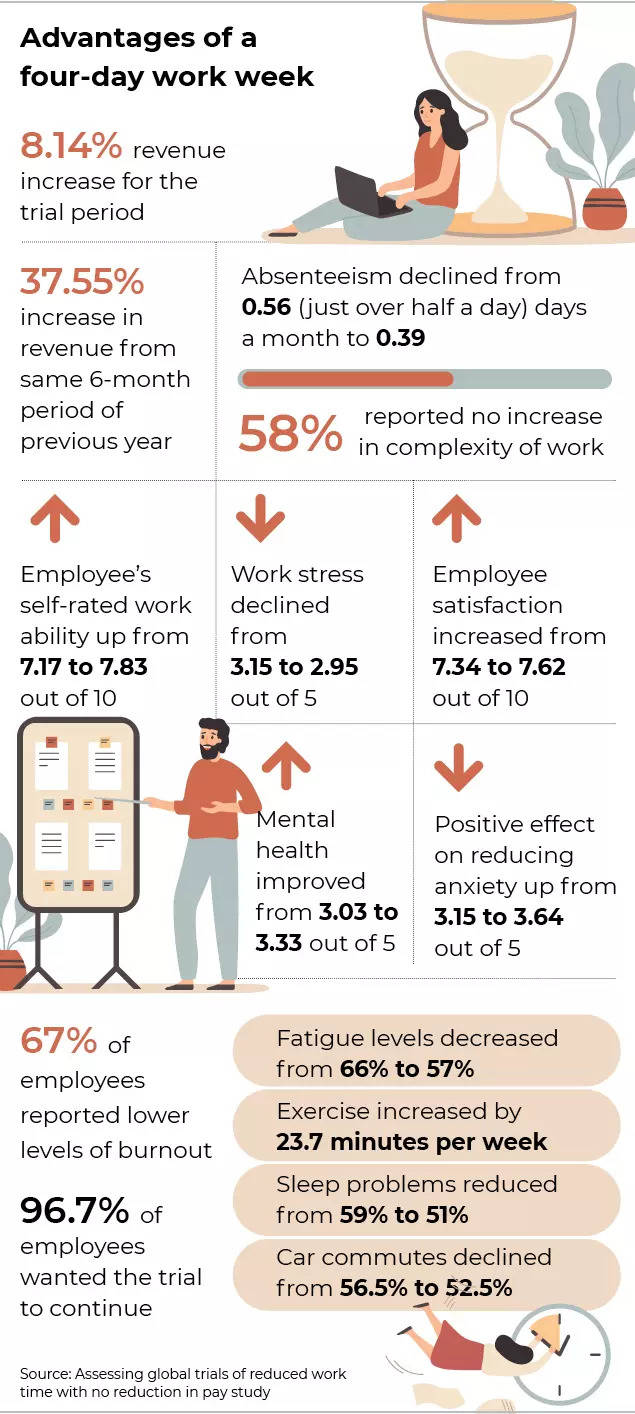
The first large-scale study of a four-day workweek ended recently and not one of the 33 participating companies is returning to a standard five-day schedule. Data released showed that the organisations involved registered gains in revenue and employee productivity, as well as drops in absenteeism and turnover. Workers on a four-day schedule were also more inclined to work from the office than home. The study is the first from a series of pilots coordinated by the New Zealand-based non-profit advocacy group 4 Day Week Global and involving dozens of companies in ongoing six-month pilots. A US and Canadian trial began in October, and a pilot of mostly European and South African organisations begins in February. With each iteration, researchers will adjust their data collection, including long-term tracking of how organisations fare with lighter schedules.
Dozens of indicators, ranging from productivity to well-being and fatigue, all improved as the companies transitioned. One weakness of the study is that all of the participating organisations opted in, meaning leadership was already biased toward four-day weeks. But employees, who did not necessarily opt-in, were won over. Ninety-seven per cent wanted to continue with four-day schedules, with workers reporting less work stress, burnout, anxiety, and fatigue, along with fewer sleep problems. Exercise also increased by 24 minutes a week, putting workers in line with World Health Organisation-recommended exercise targets. Employees also reported fewer conflicts between work and family, and fewer instances of coming home from work too tired to do necessary household tasks. Notably, the extra time off was not used for secondary employment, but for hobbies, housework, and self-care instead.
The four-day workweek is a big step today, especially when the majority of work can be done anywhere. What do you think, is this something you would be willing to do while working full-time? Please let me know in the comments.