Alopi Devi Mandir, Prayagraj, Uttar Pradesh
Located in the ancient city of Prayagraj, formerly Allahabad, the Alopi Devi Mandir is dedicated to Goddess Alopi Devi. While the exact date of the establishment of the Alopi Devi Temple is uncertain, the temple’s roots are deeply intertwined with Hindu mythology and the legend of Goddess Sati. The temple’s location in Prayagraj, near the sacred confluence or Sangam of the Ganges, Yamuna, and the mythical Saraswati rivers, adds to its spiritual importance. This proximity to the Sangam has made it a significant pilgrimage site, especially during the Kumbh Mela, the world’s largest religious gathering.
Historical evidence suggests that the area around the temple saw development during the Maratha period. The Maratha warrior Shreenath Mahadji Shinde is credited with developing the Sangam area during his stay in Prayagraj in 1771-1772. Later, in the 1800s, Maharani Baizabai Scindia undertook renovation on the Sangam ghats and temples in Prayagraj.
According to tradition, it is believed that the fingers of Goddess Sati fell here. The name Alopi is significant, meaning disappeared in Hindi. This name is derived from the belief that this is where the last part of Sati’s body fell and disappeared from the earthly realm. The goddess is worshipped as Lalita Devi while the bhairav in this location is known as Bhaveshwar.
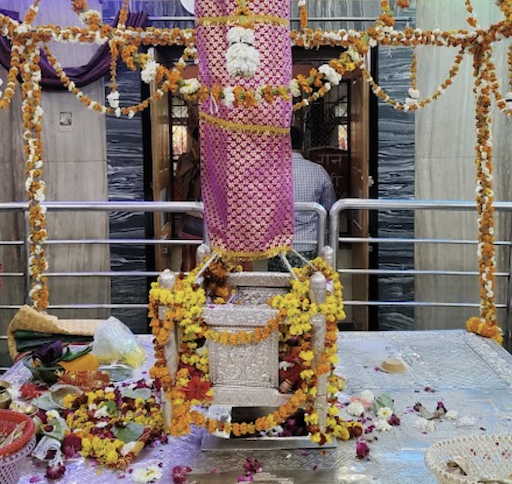
What makes the Alopi Devi Mandir truly unique is the absence of a traditional idol or statue. Instead, devotees worship an empty wooden palanquin or cradle or doli. This unconventional form of worship is believed to embody the divine, ever-present spirit of the goddess, offering blessings and protection to those who visit.
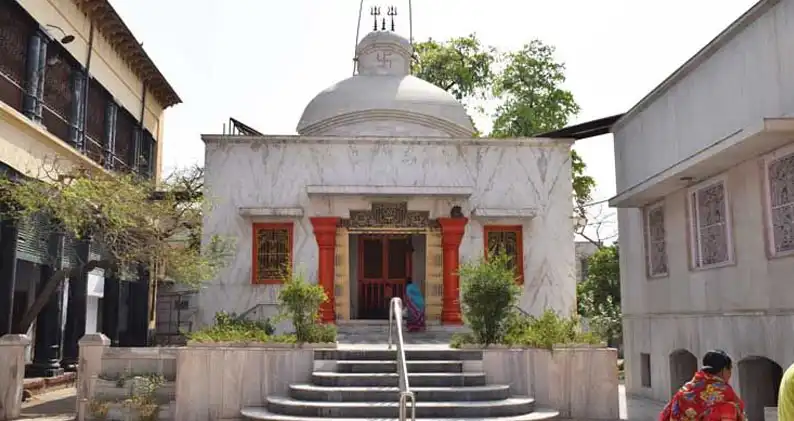
The temple showcases a harmonious blend of Hindu and Islamic architectural styles. It features a rectangular layout with a spacious courtyard surrounded by smaller shrines and pavilions. The temple is dominated by a tall shikhara or tower and a central dome adorned with intricate carvings and vibrant colours. The temple complex includes a sacred pond known as Kund, which holds immense religious significance and is used for various rituals. The temple walls feature intricate stone carvings depicting mythological scenes and divine beings. Its location near the holy confluence of the Ganges, Yamuna, and Saraswati rivers adds to its spiritual significance.
The temple remains open from 7 am to 8 pm. The festival of Navratri is celebrated with special prayers, and rituals. Bhajans or devotional songs are performed, creating an aura of reverence and devotion. During the Maha Kumbh Mela, held every 12 years, the temple sees a significant increase in visitors. The temple is famous among locals for mundan or hair tonsuring ceremonies. Devotees offer prayers and seek blessings, especially for family welfare, protection, and the resolution of personal hardships.
According to local lore, the last remnant of Sati’s body, the palanquin or doli, vanished at this spot – hence the name Alopi, meaning disappeared. Many locals consider Alopi Devi as their guardian deity, believing in her power to protect and bless. Some devotees believe that as the last part of Sati’s body fell here, it makes this temple the holiest among all Shakti Peethas.
The Alopi Devi Mandir, with its blend of myth, history, and living faith invites all who visit to partake in its timeless spiritual journey. The temple’s significance extends beyond its religious importance. It serves as a cultural cornerstone for Prayagraj’s residents, bridging centuries-old mythology with the present. Its unique form of worship, centered around an empty palanquin, offers a profound spiritual experience that sets it apart from other temples in India.
Vishalakshi Temple, Varanasi, Uttar Pradesh
Located in Varanasi, one of India’s most ancient and spiritually significant cities, the Vishalakshi Temple is dedicated to Goddess Vishalakshi, meaning the one with large eyes. Archaeological evidence and ancient texts suggest that this location has been a place of worship for over two millennia. The temple’s importance is mentioned in several ancient Hindu texts, highlighting its longstanding significance in Hindu cosmology.
According to legend, the temple’s origins are tied to a pious devotee named Kaushalya. Her unwavering devotion to Lord Shiva and Goddess Parvati was so intense that it moved the divine couple to grant her a vision. Impressed by her dedication, Goddess Parvati, in her form as Vishalakshi, instructed Kaushalya to build a temple in her name. This temple was to be a place where devotees could seek blessings for wisdom, knowledge, and spiritual insight. It is believed that the earrings or eyes of Goddess Sati fell at this sacred spot.
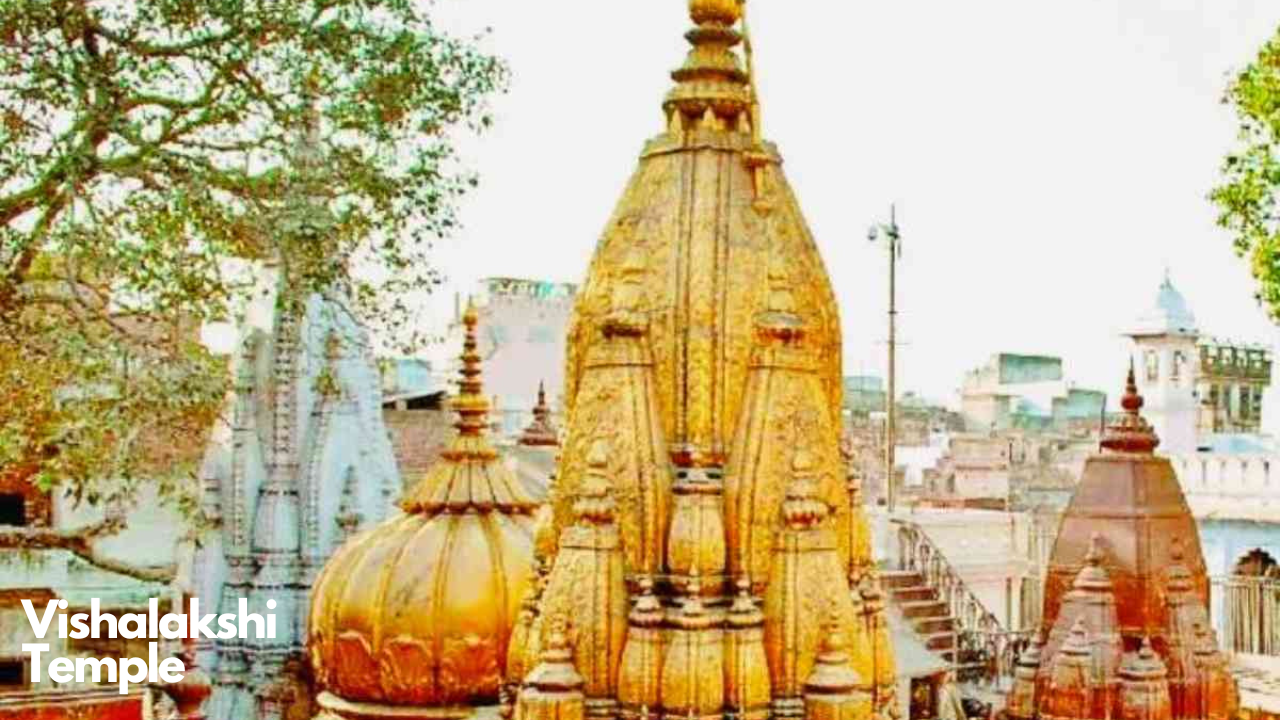
The temple showcases a unique blend of architectural styles. While the main structure follows the North Indian temple architecture, the entrance features a South Indian-style gopuram or ornate tower. This fusion of styles reflects the temple’s pan-Indian significance. The temple is part of a group of six points in Varanasi that symbolise Shastanga or six-fold yoga. The other five points include the Vishwanath Temple, the holy River Ganges, the Kala Bhairava Temple, the Dhudiraj Temple, dedicated to Lord Ganesha, and the Dandapani temple, dedicated to Lord Shiva.
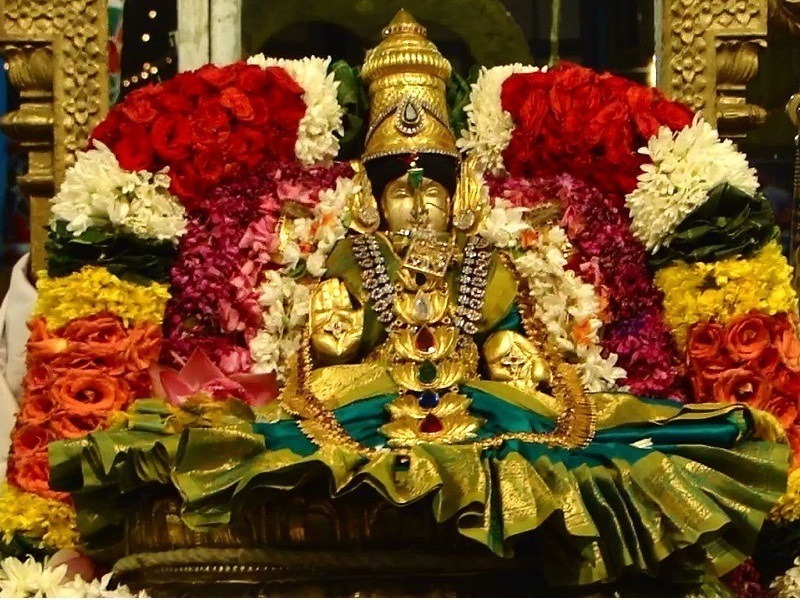
The main deity, Goddess Vishalakshi, is depicted with large, mesmerising eyes, symbolising her all-seeing nature and divine wisdom. The temple houses several sacred objects, including a sculpted horse and an alternative image of Goddess Vishalakshi, which are used during special processions. Inside the temple complex, there is a unique feature where nine statues representing the planetary deities from Vedic astrology are placed upon a platform. These sculptures are regularly worshipped, connecting the celestial with the earthly realm. The bhairav in this temple is worshipped as Kala Bhairaveshwar
The temple follows a strict schedule of daily worship rituals performed by specially trained priests. The morning begins with an aarti, where priests chant hymns and offer flowers, incense, and lamps to the goddess. Devotees traditionally take a bath in the holy waters of the Ganges before offering worship to Goddess Vishalakshi. Devotees bring various offerings to the goddess, including coconuts, sweets, and red saris, which are considered auspicious gifts. Unmarried girls often pray to find a suitable partner, childless couples seek blessings for progeny, and those facing misfortune pray for a change in their circumstances. Given its status as a Shakti Peetha, the temple is also associated with certain Tantric rituals, though these are typically performed by initiated practitioners.
Festivals celebrated at the Vishalakshi Temple include the nine-night Navaratri festival, celebrated twice a year, in spring and autumn which is one of the most important events at the temple. During this time, the temple is elaborately decorated, and special pujas are conducted for the nine forms of the goddess. The Kajali Tij festival, held on the third day of the Hindu month of Bhadrapada, usually in August, is particularly significant for women devotees while the harvest festival, Makar Sankranti that marks the sun’s transit into Capricorn, is celebrated with great fervour at the temple. Ganga Dussehra, celebrating the descent of the Ganges River to Earth, holds special significance due to the temple’s proximity to the river. While not specific to this temple, the celebration of Durga Puja sees increased activity and devotion at the Vishalakshi Temple, given its connection to the divine feminine.
Katyayani Temple, Vrindavan, Uttar Pradesh
Dedicated to Goddess Katyayani, the Katyayani Temple in the holy town of Vrindavan stands as a testament to the enduring power of faith and the rich tapestry of Hindu mythology. The spiritual significance of the temple predates its current structure, with references found in ancient Hindu texts. However, the present temple has a more recent history. It was constructed in 1923 by Yogiraj Swami Keshvanand Brahmachari, a devoted spiritual seeker. Swami Keshvanand spent nearly four decades traversing the Himalayas, meeting spiritual masters under the guidance of his guru, Shri Lahiri Mahasay. During his spiritual journey, he received a divine vision directing him to Vrindavan to fulfil an important spiritual mission – locating and establishing the Peethsthan or sacred site mentioned in the Puranas. The temple was consecrated on a full moon day of the Hindu month of Magh in 1923, which falls in February according to the Gregorian calendar. According to tradition, it is believed that the ringlets of the hair of Goddess Sati fell at this spot, making the temple a Shakti Peetha.
One of the most significant aspects of this temple is that it houses five separate deities representing five different sects or sampradayas of Hinduism. Each idol is worshipped according to its sampradaya’s specific methodology. The deities include Goddess Katyayani from the Shakta sampradaya, Lord Shiva from the Shaiva sampradaya, Lord Laxmi Narayan from the Vaishnava sampradaya, Lord Ganesha from the Ganapatya sampradaya, and Lord Surya from the Surya sampradaya. Additionally, Goddess Jagatdhatri Devi is also worshipped here.
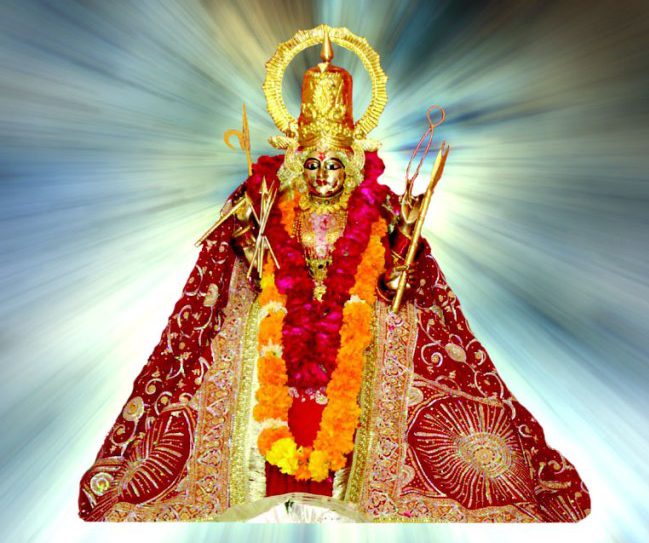
The main idol of Goddess Katyayani is made of Ashtadhatu, an alloy of eight metals. This idol was installed after performing Sanatan Dharm rites by religious scholars from various parts of India, including Varanasi and Bengal. Within the temple, devotees also worship Uchawal Chandrahaas, the sacred sword of the Goddess. This unique aspect adds to the temple’s spiritual significance. The shakti is worshipped as Uma Devi while the bhairav is Bhuteshwar.
The temple showcases a unique blend of architectural styles. The exterior is made of white marble, while large pillars of black stone support the structure. This contrast creates a visually striking appearance. At the entrance to the main courtyard, two golden-colored lion statues stand guard. These lions represent the vahana or vehicle of Goddess Durga.
The temple follows a strict schedule of daily worship rituals performed by specially trained priests. The timings for these pujas are from 7 am to 11 am and between 5:30 to 8 pm. Priests chant the Durga Saptashati, also known as Chandi Path daily, invoking the blessings of the Goddess. The Shodashopachara is one of the most important rituals at the temple, involving sixteen different offerings made to the Goddess. These offerings include flowers, incense, lamps, and food items. Devotees perform Abhishekam, a ritual, which involves bathing the idol of Goddess Katyayani with sacred water, milk, honey, and other auspicious substances. This is believed to purify the idol and invoke the Goddess’s blessings. The recitation of sacred hymns, mantras, and prayers dedicated to Goddess Katyayani is an integral part of the worship here.
The Katyayani Shakti Peeth comes alive with numerous festivals throughout the year, attracting thousands of devotees from across India and beyond. The nine-night Navaratri festival, celebrated twice a year in spring and autumn, is one of the most important events at the temple. During Navaratri, the Durga puja is performed with the chanting of Shatchandi Path. Katyayani Vrat is a special observance dedicated to Goddess Katyayani, where devotees fast and offer prayers to her. The festival of colours, Holi, is celebrated here for five days, continuing a tradition that dates back to the time of Lord Krishna. Basant Panchami, the spring festival is celebrated with great devotion and is dedicated to Shri Chaitanya Mahaprabhu, a famous saint who played a significant role in reviving the spiritual essence of Vrindavan. Krishna Janmashtami marks the birth of Lord Krishna and is celebrated with great fervour. Devotees observe fasts and participate in midnight celebrations. Diwali is another important celebration at the Shakti Peeth.
Several stories and legends are associated with the temple. According to legend, the Gopis of Vrindavan worshipped Goddess Katyayani on the banks of the Yamuna River to receive her blessings and have Lord Krishna as their consort. It is said that the Goddess blessed them, and they attained the supreme state of devotion, performing the Maharaas or Krishna consciousness. In Vrindavan, it is said that the Gopis used to make a statue of Goddess Katyayani out of the sand from the banks of the Yamuna River. They would worship this statue and ask for Lord Krishna to be their husband. This practice is known as Katyayani-vrata and is remembered by devotees even today. There is a popular belief that Goddess Katyayani blesses young unmarried girls who pray to her. It is said that girls who offer prayers at the temple will be blessed with a good husband. The Shrimad Bhagwat Puran mentions that Lord Vishnu directed Yogmaya, his Shakti, to appear in Brij as the daughter of Nandbaba and Yashoda before He himself was to be born there as Krishna avatar for the establishment of Dharma or righteousness in this world.
The Katyayani Shakti Peeth stands as a testament to the enduring power of faith and the rich tapestry of Hindu mythology. As a Shakti Peetha that celebrates the divine feminine in its multiple forms, it continues to captivate the hearts and minds of devotees and scholars alike. The temple’s unique position within Vrindavan, its distinctive rituals, and its historical significance make it a crucial piece in understanding the spiritual landscape of India.
In our modern world, where the role of women and the feminine principle is being reevaluated and celebrated, the Katyayani Shakti Peeth offers a timeless perspective on the power and wisdom of the divine feminine. It reminds us of the importance of balance between masculine and feminine energies, both in spiritual practice and in everyday life.










 Memories and Such